International Research Journal of Engineering and Technology (IRJET) e-ISSN:2395-0056

Volume: 10 Issue: 05 | May 2023 www.irjet.net
p-ISSN:2395-0072

International Research Journal of Engineering and Technology (IRJET) e-ISSN:2395-0056
Volume: 10 Issue: 05 | May 2023 www.irjet.net
p-ISSN:2395-0072
Abstract - In this research, a prototype for a Water Surface Mobile Garbage Collector Robot is presented with the aim of promoting awareness and monitoring the health of rivers through garbage collection using image processing. This device is designed to be utilized for clearing of small lakes, rivers, and sewages in India. Image processing is utilized for controlling the robot's navigation. The performance of the water garbage collector is evaluated based on its maneuvering control efficiency and garbage collection load capacity. The robot is capable of floating and moving around the water surface, and it should be constructed from durable, lightweight, and waterproof materials.
Key Words: Raspberry pi, BLDC motor, computer vision, yolo, Arduino UNO
Riversareimportanttopeopleaswellasotherorganismsforavarietyofreasons,includingservingastransithubs,providing habitatformarinefloraandfauna,supportinghumanexistencebysupplyingfreshwater,hydrationforplants, andregulating theearth'shumidity[2].
Theworld'spopulationisquicklygrowing,andvariousriverswereseverelyimpactedbyflooding.[3].Accordingtoasurvey, one ofthe primary causes ofsevere flooding in rivers is massive building upstream[3]. Heavy rains can transport sediments from inhabited regions, blocking drainage systems and causing flash floods in some locations, particularly cities.[4].Garbage canalsoclogdrainagesystems[5-6].Wefrequentlydiscoveralotofwastelyingonthewaterinpoornations,includingplastic leftovers,foamingagents,foliage,andmetalbottles.Drymaterialdriftingonthewater'ssurfacecanobstructwaterdrainagein city canals and cause flooding. Human negligence is to blame, for instance reckless dumping of packaging for food, drinking straws,orplasticcontainersinpublicplaces.[7].Plasticpollutioncannot beavoided.Itmayhappenanywhere. Aquaticlife is endangeredbecauseplasticgarbagemaychoke,smother,andkillit.Governmentsinvariousnationshavetakenpreventative measures.Whiletherehasbeenmodestimprovementinwaterquality,severalriversremainpolluted[2].Manyexperiments are being undertaken to find more efficient methods for collection of waste on the water's surface[6-8]. This will help the governmentofthecitiestoimprovethestateoftheiraquaticbodies.
Garbage collectors can be both fixed[13] as well as mobile[8]-[12], and [13]-[17]. Mr. Rubbish Wheel, a wheel that floats on water and is powered by solar energy, collects garbage at the entrance of a river and transports it to the main Baltimore Harbor.Itremoveswasteusingasolar-poweredhydraulicpump.Initsfirst22monthsofoperation,itgathered127dumpsters full ofrubbish anddebristotalling420tonnes[11].The soledisadvantage ofthistechniqueisthatpumpsmust besimpleto maintain and repair in order to function properly. Water surface cleaning robots that are simple to maintain could be accomplishedifa mechanical systemwherethere isno automationbasedon electronicsis employed[14].Although,moving thecleaningboatpedalsdemandsalargeamountofmanpower[14].Becauseofitsvastproportions,itiseffectiveincollecting bigvolumesofrubbish.
Another study's garbage collector concept used a conveyor system. It is an excellent design for decreasing labor since the rubbishisautomaticallytransferredtothecollectingtraybytheuseofmotorcontrol;nevertheless,considerableenergyusage isrequiredtocarryoutefficientoperationofthemotorastheamountoftrashbeingloadedon thetrayofthecollectorgrows [11]. A combination of smartphone capability with robotic capabilities that can be operated using a touch screen or other Android based technologies that allow for remote and easy operation.Some robots rely on Wifi networks and Bluetooth connectionstoreceivecommandsfromtheoperator,whocanuseajoystick,keyboard,orphonescreen.
Thisresearchproposesarobotthatcollectsmobilegarbageonwaterbodiesusing ahalf-submergedpropulsioncharacteristic thatcanbeoperatedremotelyusingbluetoothtechnology.Thecollector'sgoalwastogatherwastefoundonthesurfaceofthe water bodies without adding weight to the collector's body. The garbage collector's performance was assessed in terms of maneuveringcontrolefficiencyandrubbishcollectingloadcapacity.
Raschka [1] describes a framework for developing, training, and deploying machine learning technology using Python.Matthies[2]created aninteractivesystembasedongeometricsceneunderstanding thatisbuiltinsucha waythatit reactstothedynamicenvironment.AlightweightmachinelearningmodelwastrainedandconstructedbyNorrisandDonald [3].
ARaspberryPiwasusedtorunthemodel.EvenonacomputationallyconstraineddeviceliketheRaspberryPi,theapproach proved to be effective. Pranay and Agrawal [4] proposed a multi-robot lake cleaning method. MATLAB was used to model three robot systems. The robots are permitted totravel at random, and it was thoughtthat most portions would be covered overtime.Insimulation,theproposedstrategyprovedtobeeffective.ShreyaPhirkeandAbhayPatel[5]createdarobotidea thathasastrongmechanicalframework,sensorfusion,andcomputervisiontoenableautonomouscleaning.RPraveenandL Prabhu[6]conceivedandconstructeda 3D model ofa beachcleaner roboticvehiclethatiscontrolledusing radiofrequency couldbeutilizedtocleanthecoastalareas.
In [8], an automatic garbage segregation robot for waste classification was created. Image processing is used to categorize trash as degradable/biodegradable, after which the robot deposits the waste into the appropriate container.[9] presents a multi-robotaquaticsystemforlakecleaningthatmakesuseofnumeroussensorsandcommunicationtechnology.Therobotis self-contained and uses a recruitment navigation algorithm to walk the route and gather rubbish.[10] describes a pedalpoweredboatforcleaningsurfacetrashandgarbage.Thesystemcomprisesapedal-poweredboatwithpropellersattachedto the shaft and a conveyor belt for garbage collection. There is also an explanation of a prototype model with design requirements.
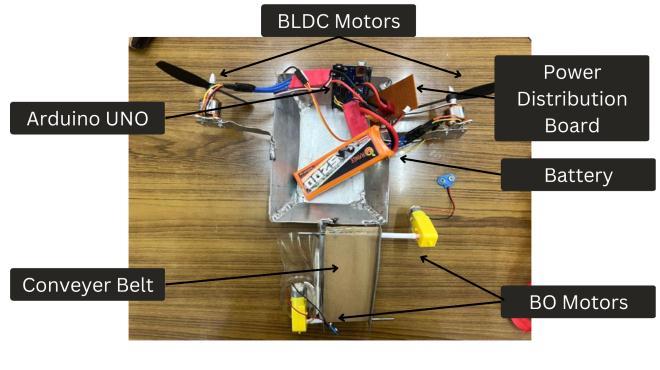
ThehardwareprototypewasbuiltbycuttinganAluminiumsheetof0.1thicknessintoasinglerectangularslabof15*10cm, fourtrapeziumshapedslabs,twoofwhichhadashorterlengthof10cm,alongerlengthof15cm,andsidesof6cmeach,and the trapeziums with larger areas had a shorter length of 15cm and a shorter length of 20cm. These five slabs were welded togethertoformacontainer.Thebldcmotorsarelinkedtoeachofthetwoarmsattachedtoeithersideofthecontainer.
Thebldcmotorsarelinkedtoeachofthetwoarmsattachedtoeithersideofthecontainer.Inthefrontofthemodel,thereis anarrangementportrayingaconveyorbeltwithtwoBOmotorsattachedtoeachrodfortheconveyorbelttofunction.
Components
• RaspberryPicamera5mpVersion1.3
• Propeller
• A22121000KVoltsBLDCmotors
• BOmotors100RPM
• Raspberrypi4B
• ESCmodule
• 5200mAh7.4VLiPoBattery
The project describedinvolvesthe design and implementationofa garbagecollecting boat. The first stepin the processwas assembling the necessary hardware components. The boat's mobility is powered by BLDC motors, which allow for efficient and effective movement inthe water. To control the boat'smovement, certain conditions were set in the code, whichallows for precise control over its direction. For instance, when the boat detects garbage in a particular direction, it turns towards thatdirection.Toachievethis,oneofthemotorsisturnedoffwhiletheothercontinuestorun,causingtheboattoturninthe directionofthemotorthatisstilloperational.
Inadditiontothemotors,a conveyorbeltwasalsoinstalledtocollectthegarbage.ThebeltispoweredbyBOmotors,which ensure thatit runs efficientlythroughoutthegarbagecollecting process.To ensure maximum efficiency,theconveyor belt is leftrunningevenwhentheboatisnotcollectinggarbage.
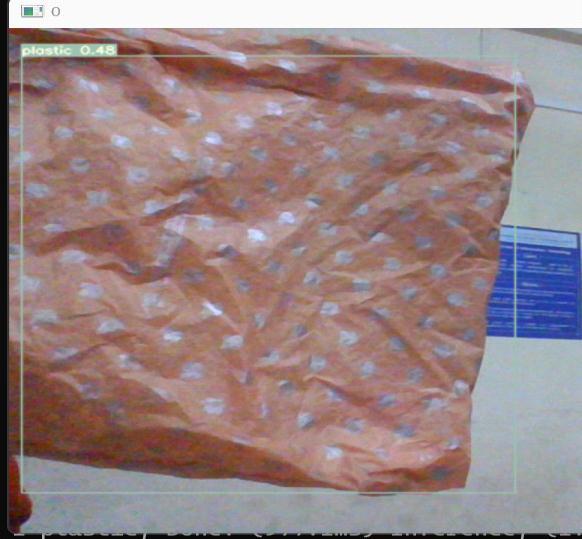
To detect the garbage, the team used a Picamera, which captures images of the surrounding area. The data collected by the camera is then processed using Python programming. The team trained the model using the collected data to enable it to identifyandlocategarbageinthewater.
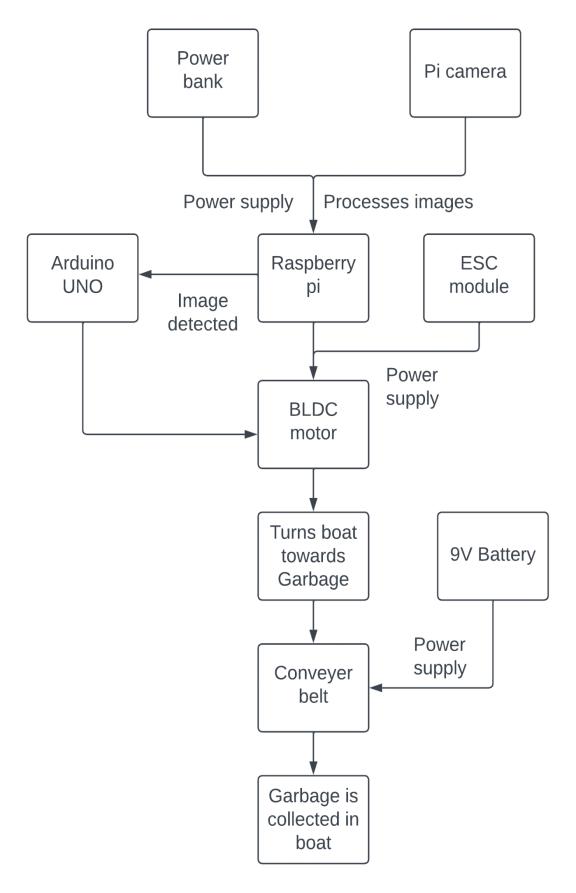
When the boat is collecting garbage, it remains stationary to allow for the efficient collection of waste. To achieve this, the motorsaretemporarilyturnedoff.Oncethecollectionprocessiscomplete,themotorsareturnedbackon,andthedetection andcollectionprocesscontinues.
Overall,thisprojectisanexcellentexampleofhowtechnologycanbeusedtoaddressenvironmentalchallenges.Bycombining various hardware components and programming techniques, the team was able to design a functional and efficient garbage collectingboatthatcanhelpkeepwaterbodiesclean.
1.InputImage:Thisistheinitialstepofthealgorithmwheretheinputimagecontainingobjectstobedetectedisgivenas an input.
2. Image Preprocessing: The input image is preprocessed to make it compatible with the YOLOv7 model. This step includes imageresizing,normalization,andcolorspaceconversion.
3.Backbone:Thebackbonenetwork,CSPDarknet53,isusedtoextractfeaturesfromthepreprocessedimage.
4. Neck: The features extracted from the backbone network are processed by the SPP-PAN neck network to create a feature mapwithhigher-levelfeatures.
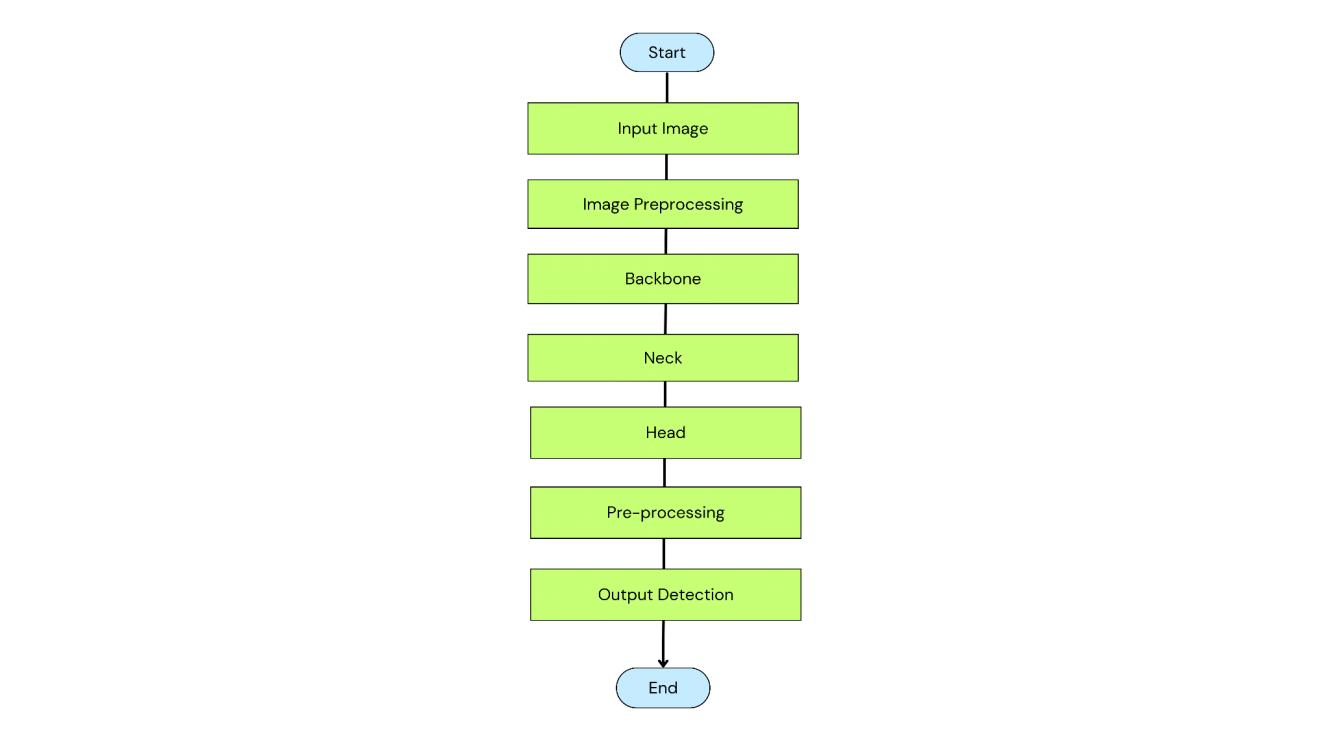
5.Head:Theheadnetworkgeneratesboundingboxesandclasspredictionsfortheobjectsintheimage.
6.Post-processing:Thepredictedboundingboxesarefilteredandrefinedusingnon-maximumsuppression(NMS)andother techniquestoremoveredundantdetections.
7. Output Detection: The final output of the algorithm is a list of detected objects with their corresponding class labels and boundingboxcoordinate
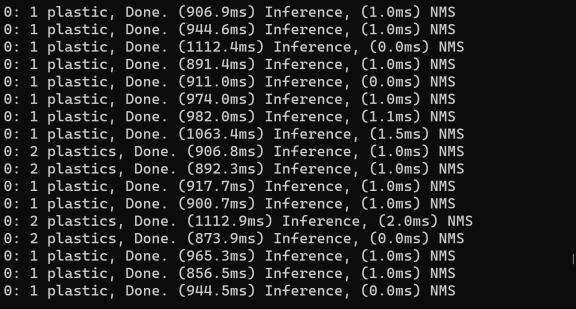
Withthehelpofadvancedimageprocessingtechnology,theboatwasabletodetectandidentifyrubbishinthewater.Assoon asgarbagewasspotted,themotorsweretriggered,andtheboatautomaticallymovedtowardsthewaste.Onceitreachedthe rubbish,theboatpaused,allowingtheconveyorbelttoscoopupthedebriswithprecisionandease.Thecollectedrubbishwas then deposited into a trash can on board, ensuring that it was removed from the water and properly disposed of. This innovativesolutionnotonlyhelpstokeepthewaterwaysclean,butalsohelpstoprotectaquaticlifeandtheenvironmentas a whole.
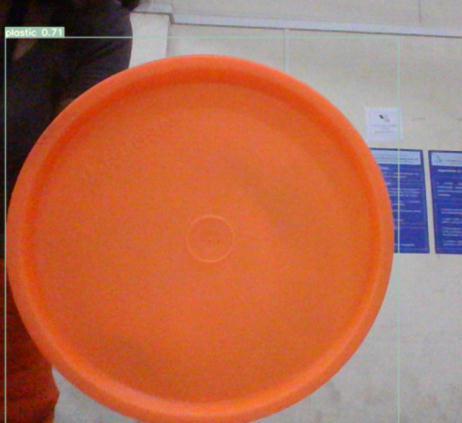
The ability of a water trash collector prototype to gather rubbish on the water, float, and partially submerge in the water's surfacewasdemonstratedinthisstudy.Imageprocessingwasusedtosuccessfullyregulatetheforward,reverse,leftandright turning of the water rubbish collector after numerous trial setups. It was able to gather up plastic bags and bottles successfully. The prototype may be enhanced further by employing high strength and waterproof materials for the collector bodytoeliminatethepossibilityofflooding.Aself-sustainingsolarpanelmayalsopowergreaterspeedandtorqueDCmotors.
WewouldliketothankProf.AnilKaduforhisguidanceandvaluableinputsgivenduringthemakingoftheproject.
We arealsothankful toVishwakarma Institute of Technologyfor providingus withthe necessary facilitiesto implementthe project.
[1] A. Christodoulou, P. Christidis, and B. Bisselink, “Forecasting the impacts of climate change on inland waterways,” Transportation Research Part D-transport and Environment,vol.82,p.102159,May2020,doi:10.1016/j.trd.2019.10.012.
[2]C.N.Weng,“SustainablemanagementofriversinMalaysia:Involvingallstakeholders,” International Journal of River Basin Management,vol.3,no.3,pp.147–162,Sep.2005,doi:10.1080/15715124.2005.9635254.
[3]M.E.Torimanetal.,“Integrationof1-dHydrodynamicModelandGISApproachinFloodManagementStudyinMalaysia,” Research Journal of Earth Sciences,vol.1,no.1,pp.22–27,Jan.2009.
[4]M.K.A.Kamarudin,M.E.Toriman,N.A.Wahab,H.Rosli,F.M.Ata,andM.H.M.Faudzi,“SedimentationStudyonUpstream Reach of Selected Rivers in Pahang River Basin, Malaysia,” International Journal on Advanced Science, Engineering and Information Technology,vol.7,no.1,p.35,Feb.2017,doi:10.18517/ijaseit.7.1.971.
[5] R. Adhiharto and F. A. Komara, “Perancangan Konstruksi Trash Bucket Conveyor (TBC) Sebagai Mekanisme Pembersih SampahDiSungai,” ResearchGate,Aug.2018.
[6] G. Khekare, U. Dhanre, G. T. Dhanre, and S. S. Yede, “Design of Optimized and Innovative Remotely Operated Machinefor WaterSurfaceGarbageAssortment,” International Journal of Computer Sciences and Engineering,vol.7,no.1,pp.113–117,Jan. 2019,doi:10.26438/ijcse/v7i1.113117.
[7] S. Huang et al., “Plastic Waste Management Strategies and Their Environmental Aspects: A Scientometric Analysis and Comprehensive Review,” International Journal of Environmental Research and Public Health, vol. 19, no. 8, p. 4556, Apr. 2022, doi:10.3390/ijerph19084556.
[8] H. Othman, M. I. Petra, L. C. De Silva, and F.-Y. Leu, “Automated trash collector design,” Journal of Physics, Jan. 2020, doi: 10.1088/1742-6596/1444/1/012040.
[9]A.H.A.Kader,M. K.M.Saleh,M.R.Jalal,O.O.Sulaiman,and W.N. W.Shamsuri, “DesignofRubbishCollectingSystemfor InlandWaterways,” Journal of Transport System Engineering,vol.2,no.2,pp.1–13,Sep.2015.
[10]C.Balasuthagar,D.Shanmugam,andK.Vigneshwaran,“Designandfabricationofbeachcleaningmachine,” IOP Conference Series,Aug.2020,doi:10.1088/1757-899x/912/2/022048.
[11] S. Kong, M. Tian, C. Qiu, Z. Wu, and J. Yu, “IWSCR: An Intelligent Water Surface Cleaner Robot for Collecting Floating Garbage,” IEEE Transactions on Systems, Man, and Cybernetics, vol. 51, no. 10, pp. 6358–6368, Oct. 2021, doi: 10.1109/tsmc.2019.2961687.
[12]LindquistandAdam,“Baltimore’sMr.TrashWheel,” The Journal of Ocean Technology,vol.11,no.2,pp.28–35,2016.
[13]C.Ranjan,S.Akhtar,D. Shaw,S.Nikhil,andB.R.S. Babu, Design and demonstration of manual operated pedalo water boat for garbage collection from lake.AmericanInstituteofPhysics,2019.doi:10.1063/1.5141267.
[14]M. Geraeds, T. VanEmmerik,R. De Vries,andM. S. A.Razak,“Riverine Plastic Litter MonitoringUsing Unmanned Aerial Vehicles(UAVs),” Remote Sensing,vol.11,no.17,p.2045,Aug.2019,doi:10.3390/rs11172045.
[15] Z. Sakawi, “MUNICIPAL SOLID WASTE MANAGEMENT IN MALAYSIA: SOLUTION FOR SUSTAINABLE WASTE MANAGEMENT,” Journal of Applied Sciences in Environmental Sanitation,vol.6,no.1,pp.29–38,Mar.2011.
[16]M.N.Mohammed,S.Al-Zubaidi,S.H.K.Bahrain,M.Zaenudin,andM.Abdullah, Design and Development of River Cleaning Robot Using IoT Technology.2020.doi:10.1109/cspa48992.2020.9068718.
[17]A.Sinha,P.Bhardwaj,B.Vaibhav,andN.Mohommad, Research and development of Ro-boat: an autonomous river cleaning robot.SPIE,2014.doi:10.1117/12.2037898.
[18]K.B,S.M.Raghavendran,S.Kalyani,P.Suja,andV.K.G.Kalaiselvi, Internet of Bins: Trash Management in India.2017.doi: 10.1109/iccct2.2017.7972277.
[19] N. Ruangpayoongsak, J. Sumroengrit, and M. Leanglum, A floating waste scooper robot on water surface. 2017. doi: 10.23919/iccas.2017.8204234.
[20]A.JaywantandA.Sapkal,“AquaSkimmerforTrashCollection,” International Journal of Applied Engineering Research,vol. 13,no.5,pp.5–8.