Understanding Inclusive Land Development and Analysing its existing problems and solution in the Indian Context
Deeksha Sharma1Student of Masters in Urban and Rural Planning, Department of Architecture and Planning, Indian Institute of Technology, Roorkee, Uttarakhand, India ***

Abstract - Inclusive land development is equity-based development. Development in any society will help overall development with the involvement of all (community, government, privatedevelopers,etc.).Urbanizationisthebasic cause of migration, which leads to problems such as land scarcity, lack of resources, high rent, low wages, and lack of affordable housing and so on. All these problems lead to informal settlements, which areincreasingthenumberofpoor in any society or community. Inclusive development should take place in such a way that it is helping poor to improve their socio-economic status and inclusiveland development is about providing basic amenities and infrastructure for the poor for their socio-economic development.
Key Words: Inclusive land development, Equity-based development.
1. INTRODUCTION
Development should help to grow each individual in a community. Still, there is a huge difference between the number of rich and poor in society (in India). Inclusive developmentiswhenthewholecommunitycometogether for the development of society. Adam Smith (Inclusive Development) in his essay Wealth of Nations says that a society,inwhichamajorpartofthepopulationispoorand miserable, will not grow and people will not be happy as theyaresupposedtobe.Inclusivedevelopmentisakeyto making society involved directly or indirectly in the developmentofthewhole.
The aim of the paper is to understand inclusive land development and go through some case studies to understand its importance in the Indian context. The objectiveistogetthefewoutcomesthatcanbesuggestedas interventions required in the policy of inclusive land development in India. What is the key to inclusive land developmentandthroughwhatwaysitcanbeachieved,this isbeendiscussedinthepaper.
Themethodologyfollowedwillincludefirstly,thestudyof thematerialexplaininginclusivelanddevelopmentandits parts.Secondly,lookingtowardsthedemandsideandsupply sideinterventionofthis.Thirdly,analysethecasestudiesto understandtheprocedurefollowedinthecurrentsituation in the Indian context. Fourthly, finalizing the key points throughtheanalysisandgivingthesuggestedintervention
2. INCLUSIVE DEVELOPMENT AND ITS TYPES
Inclusive development is ‘equity-based development, which is focused on the development of the poor in the community.About55.3%oftheworld’spopulationisliving in urban areas (Nation, 2018). In India 1 out of 5 people, living in urban areas lives in an informal settlement (Sanjaynagar Slum Redevelopment Project, 2022). The informalsettlementsarethecauseofmigration,economically weakergroupsandlackofaffordabilityoflandandservices (InclusiveDevelopment).Inclusivedevelopmentisproposed toreducethisgapbyprovidingatleastthebasicserviceand amenitiestothepoorofthecommunitysuchasahouse,basic services, infrastructure and opportunities for economic growth.TheplanningoftheIndusvalleycivilizationshows theformofinclusivedevelopmentsuchasprovidingroads, bathrooms and storage facilities for all (Inclusive Development),whichisfocusedontheinfrastructureforall.
Thereareafewtypesofinclusivedevelopment:i)Social inclusivedevelopment,ii)Economicalinclusivedevelopment, and iii) Political inclusive development. Social inclusive developmentincludestheabolitionofsocialinequalitiesin society. Economical inclusive development includes providingopportunitiesforincomegenerationtoall.Political developmentincludesthepolicy-makingprocesstoenhance the participatory development of society (Inclusive Development).
Inclusivelanddevelopmentisapartialpartofsocialand economic inclusive development. It is about providing infrastructure for one’s social and economic status and growth.Thesocialaspectis,intermsofprovidingthehouse and social status (supply-side intervention). Similarly, the economicaspectprovidesthemopportunities(demand-side intervention)
3. DEMAND AND SUPPLY SIDE IN INCLUSIVE LAND DEVELOPMENT
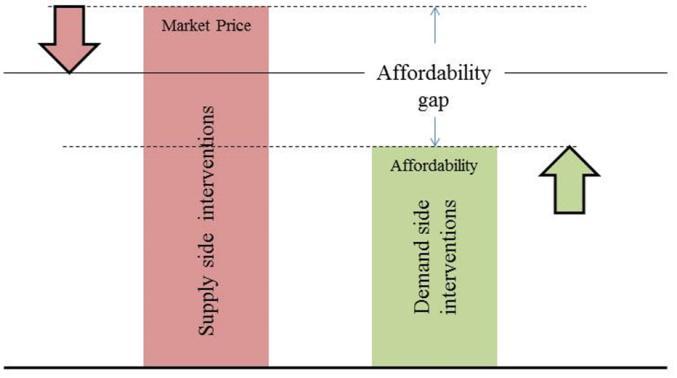
Increasingtheaffordabilityisademand-sideinterventionand increasing the availability of options is a supply-side intervention. However, there isa gap between supplyside anddemandside
Theabovefigureisexplainingthegapbetweenthedemand side(affordability)andthesupplyside(marketprice).The two arrows from the supply side downward and upward fromthedemandsideareindicatingthattominimizethegap the interventions should take place in such a way that the supplysideisreducingthemarketprizeandthedemandside isincreasingtheaffordability
3.1 Supply Side Interventions
Thesupplysideinterventionincludes(Roy,2017):
• Moreaffordableland
• legalreform
• Institutionalfinance
• Technologyreform
• Servicedeliveryreform
• MorehousingstockandRentalhousing
3.1 Demand Side Interventions
Thedemandsideinterventionincludes(Roy,2017):
Finance
Subsidy/Crosssubsidy
Economicopportunity
Thesedifferentpointscanhelptoreducetheaffordabilitygap by reducing the market price, providing land reform, increasing housing stock and etc. Similarly, by providing financeasaloantopurchasethehouse,providingsubsidyfor theconstructionofthehouseandbyincreasingtheincome earningopportunitiesthedemandsidegapcangouptomeet therequirement.TherearemanyexamplesinIndiaandin foreigncontextsthathaveusedinclusivelanddevelopment withalmostthesameapproaches.
4. Inclusive Land Development: Case Study
The case study discussed here includes two Indian case studies. These studies will give the represent context of inclusive land development and further the case study analysis will be used toidentifythegaps(ifavailable)and suggestimprovement(ifrequired).
4.1 Inclusive Land Development in India
Heretounderstandinclusivelanddevelopmentthetwocase studiesareadded:
• The first one is Maharashtra (Sanjay Nagar, Ahmednagar),wheretwopeopleoffivepeopleareliving in an informal settlement (Sanjaynagar Slum RedevelopmentProject,2022)tounderstandtheprocess inanareawithahighpercentageofpoorandinformal settlement.
• Secondoneis,Gujarat(Bhuj)becauseGujaratisastate where the ratio of urban population ratio is high in number to understand the process of working in high densityofurbanareas.
4.2 Inclusive Land Development in Maharashtra
The Sanjay Nagar, Ahmednagar was established and settled over the swampland (Sanjaynagar Slum Redevelopment Project, 2022). This is made over the land belongingtothemunicipality.
• Overview: Slum area with 298 families (Sanjaynagar SlumRedevelopmentProject,2022).
• Context: 22differentcommunitieslivetogetheroverthe landof2acres.
• Approach: Theparticipationofcommunitypeoplewas involvedinthedesignprocessandimplementation.The community representative was involved in the design process, the community brought the developer and duringtheimplementationthecommunityintakingcare (the inspection part) of the construction (Sanjaynagar SlumRedevelopmentProject,2022).
• Finance mechanism: There are different sources of funding (Sanjaynagar Slum Redevelopment Project, 2022):
o GovernmentofIndiathroughPMAY
o AhmednagarMunicipalCorporation
o Homeownersfortheconstruction
o Currystonefoundation
o PhilanthropicandCSRorganizations
• Impacts/Interventions: This project is about communitydevelopmentwiththeconsiderationofthe participation of the community, providing funds by institutionsandpromotingthefinancialinvolvementof private developers and NGOs (Sanjaynagar Slum RedevelopmentProject,2022).
4.3 Inclusive Land Development in Gujarat
TheBhujdistricthasaround33%ofthecity’spopulation livinginslumareasindifferentpatchesoflandinandonthe periphery of the city (Virmani). The land occupied by the slum areas is mostly government land but some lands are private also. Therefore, this case study will help to understandthescenarioofprocessingthelandbelongstothe privateowner(Virmani).
• Overview: 74slums in Bhujliving on 6% of thecity’s area,whichinclude11232families(Virmani).
• Context: 70%ofthepopulationoftheslumislivinghere for 2 decades and this area is provided with basic servicesmostly(Virmani).
• Approach: LandreadjustmentandLandresettlementis theprocessthathasbeentakenforthedevelopmentof thisparcelofland.Aparticipatoryapproachisthekeyto thisdevelopment.
• Finance mechanism (Virmani):
o RAY(RajivAwasYojna)forhouseconstruction
o Stategovernmentforinfrastructure
o Beneficiarycontribution
• Impacts/Intervention: Theprivateownershadissues with the compensations and giving up their land. In a report by The Times of India, the private owners are asking for compensation similar to the compensation giventhroughtheLARRactandtheyarealsosayingthat theywonthecasetwotimesinthehighcourtaboutnot givinguptheirlandbutthelocalauthorityisnotdoing anythingtoprovidethelandbacktotheownersorany negotiation between land owners, slum dwellers and developers(Anparthi,2019).
4.4 Comparative Analysis of the Case Studies
Both case studies are unique from each other in their characterbecauseofdifferentaspects.Hereaqualitativeand quantitativeanalysisisdonetounderstandthescenario
4.4.1 Quantitative Analysis
Table -1: Quantitativeanalysisofthecasestudies.
Aspects
Demand side
Finance
Supply side
Case study: Maharashtra Case study: Gujarat
Government and private parties included
Government and private parties included
More affordable land
Thelandistenureis given by the government at affordableprice
Local representatives areinincludedthe communication.
The land is tenure is given by the government at affordableprice Legalreform Local representatives are in included the communication.
Institutional finance
The government is providing funds throughPMAY
Government fund is provided throughRAY
Technology reform
Construction with modern technology withkeepinginmind the light and ventilation for each individualunit.
-
Service delivery reform
Considering the situationofcovid19 pandemic the livelihood of the community people affected so the government providedarelaxation in the instalment period,whichmeans thegovernmentgave a gap during the pandemic for the loanreturn.
4.4.2 Qualitative Analysis
Case study: Maharashtra
-
Positive aspects: Theinvolvementofthecommunityinthe designprocess,therelaxationintheloanduringapandemic andkeepinginmindthetechnology-basedconstructionare thekeypointsthatmakethisprojectsuccessful(Janardhan, 2020)
Negative aspects: The proposal was for a multi-storey communitybutthepeoplewerenotagreeingbecauseoftheir sentimentswiththelandsoforthefirstphasethisprojectis beingdevelopedasoneblockwith33housesandafterthe successfulimplementationthesecondphasewilltakeplace sothedeveloperwantstogetitdevelopedinthemulti-storey buildingbecauseofthefeatureoftheland(SanjaynagarSlum RedevelopmentProject,2022).
Case study: Gujarat
Positive aspects: The involvement of the community peopleisafactorthatmakestheprojectviableandinclusive. Thenthereadjustmentandredevelopmentofthelandparcel intheprocessofdevelopmentisprovidingmorestrengthto theprojectbecausepeoplehaveattachmentsentimentswith theland(Virmani).
Negative aspects: The private landowners struggled with compensation and getting their land back. The biggest problemtheyarefacingisthelocalauthorityisnothelping themeitherinnegotiationorwithcompensation(Anparthi, 2019).
4.5 Overall review
Overall, these two case studies give a brief idea about inclusive land development with community involvement overprivatelandandoverpublicorgovernmentland.The landownerswithprivatelandinsuchcaseswillsufferwhich is not an indication of inclusive development. Inclusive development is about promoting the poor but not demolishing the middle or high-class income group of the society.
Thecasestudymadethepointtheimprovementisrequired withthepolicybasedframeworkinthelandacquisitionpart ofthisparticularcase
3. CONCLUSIONS
Inclusivelanddevelopmentisinvolvingthecommunity in thedevelopmentandthecasesstudiesseenhereareaclear indicationoftheinvolvementofthecommunity,whichisa goodexampleofinclusivelanddevelopmentbutatthesame time, there is some adjustment that needs to do in the process.
Althoughthelegalprocessalreadyhasallthereformswhen itcomestoimplementationtheprocessbecomesveryslow andthatisthemainreasonfortheproblemthatoccurredin theGujaratmodel.Theprocessofnegotiationshouldhave taken place before the work started on the project (the designpartespecially)becauseasaresultnowtheprivate ownersandtheslumdwellers(whowereexpectingtoget the tenure) both are struggling. Therefore, the suggestion according to this model can be- the intervention requires
improvementsuchasmakingthenegotiationprocessalso privatize.
Ontheotherhand,theMaharashtramodelissuccessfuland thebasicdifferenceislandownership.Government-owned thislandsoitiseasytogivethetenuretopeople.Similarly, the provision of redefining the loan policy because of the covidsituationmakesthismodelmoresuccessful.Therefore, the suggestion through this model can be the situation assessmentandmakingdecisionsaccordingtothepresent scenarioisimportantforthedevelopment.
REFERENCES
[1] Sanjaynagar Slum Redevelopment Project. (2022). RetrievedNovember08,2022,fromCommunityDesign Agency:
https://communitydesignagency.com/projects/sanjayn agar/
[2] Anparthi,A.(2019,August22).231slumsonpvtlands set to be regularized. Retrieved November 08, 2022, from The Times of India: https://timesofindia.indiatimes.com/city/nagpur/231slums-on-pvt-lands-set-to-beregularized/articleshow/70777334.cms
[3] InclusiveDevelopment.(n.d.).RetrievedNovember06, 2022, from E-gyankosh: https://egyankosh.ac.in/bitstream/123456789/9065/1 /Unit-2.pdf
[4] Janardhan, S. N. (2020). Building Thousands of Communities,NotMillionsofHomes.CurryStoneDesign Collaborative,5,7.
[5] Nation,U.(2018).PopulationofUrbanandRuralAreas at Mid-Year (thousands) and Percentage Urban. DepartmentofEconomicandSocialAffairs.
[6] Planning, H. P. (Director). (2017). Affordability and HousingFinance[MotionPicture].
[7] Virmani, S. (n.d.). Slum Free City Bhuj. Retrieved November 08, 2022, from http://cdn.cseindia.org/userfiles/Slum_Free_Bhuj_Anan diben%201-Sandeep%20Virmani.pdf