Parkinson’s disease detection system using Support vector machine
2Professor, Dept. of Computer Science and Engineering Chandigarh University-Mohali,India
1,3,4,5,6B.TECH Scholars, Dept. of Computer Science and Engineering Chandigarh University-Mohali,India
***
Abstract -Parkinson’s is a neural disease that most of the people are unaware of and they don’t get to know of the thing that they are suffering from it in the initial stages. It is a kind of disorder that affects humans’ nervous system. It’s symptoms at starting are that slight that people are not being able to detect that they are suffering from Parkinson. In some cases, even doctors aren’t able to detect the disease at early stages. Its symptoms are like tremor in hand, shivering, change in facial expression or no facial expression at all, fever, stiffness etc. In our project, we are making a Parkinson disease detection that will detect the disease at initial stages. We have trained a big dataset that will detect the disease at its utmost efficiency
Key Words: Parkinson’s, SVM, Dataset, Disease, System etc
1. INTRODUCTION
Parkinson is a disease associated with human’s Nervous System.It’sakindofdisorderthatisdifficulttoidentifyin early stages. It is affecting life of a lot of people. It mostly affects the Nervous System. The first symptom is barely noticed in this disease, it starts with a tremor in hand. There are more symptoms that may later show on like beingslow,changinginvoiceandspeechetc.Thinkingtoo muchi.e.,depressioncanalsobeasymptom.Thecauseof Parkinson disease can be genetical and environment triggeringournervoussystem.
The main idea behind our research is to detect the Parkinson disease at early stages. So, we are creating a model which people can access easily and by which they candetectthestartingofdisease
2. LITERATURE REVIEW

A. Timeline of the reported problem
Parkinson's disease was firstly detected in 1817 by Dr. James Parkinson. It is a non-acute continuous braindegenerative disease with movement and non-movement features.Thereisaverystrikingmedicalimpactonpeople which are suffering from Parkinson’s Disease. Movement symptomsinPDhavebeenimputedbecauseofdecrement instriataldopaminergicneurons,howevertheexistenceof non-movementsymptomsalsoresultindecrementofnondopaminergicregions.
The parkinsonism word here depicts as a syndrome used to explain the movement characteristics of PD, including tremors in palm, bradykinesia, and muscle inflexibility. Generally, PD is the reason of Parkinson's disease, but therearealsomanyothercausesexistingthatcancopyPD andDrug-promptingcauses.
According to previous studies, the physiological changes associated with PD may begin before movement characteristics and can also comprise many nonmovement manifestations, such as nap disturbances, depression, and rational changes. Affirmations in premedicalstagehasfasten eagernessfornewresearches focusedondefensiveorpreventativetreatments.
Nowadays,PDhasbecomeoneofthemosttypical braindegenerative diseases. The report of PD Foundation says that around 1M Americans are presently suffering from thisdisease.
There are about 0.02% people suffering from PD every year, and the beginning age of this is nearly of 60 years. The generality of PD is around 0.01 people in 10000 peopleageof60andabove,increasingfrom0.01to0.03in people who are age of above 80. An foremost caution cognate with the numbers mentioned, however, is that theydonotshowunidentifiedcases.
The variable incidence of the Parkinson’s Disease all over the world suggests that ecological and hereditary factors, as well as racial differences, can also play a role in the development of the disease. Some previous biomedical researches in Parkinson's patients resumes and can also help in identifying other risk factors and upcoming direct avoidanceandtreatmentdecisions.
B.Existing Solutions
When recounting the history of Parkinson's disease treatment, there are several methods responsible for the invention of treatment based on data obtained from randomized observations of controlled clinical trials of specially designed drugs. But still there is no any particularandsuccessful method isfoundtill now tocure thisdisease,thesemethodshelpinrealizingthesymptoms ofdiseaseandtorelievepaintosomeextent.
BasicCategoriesofthesemethodsarementionedbelow:
● Therapies
● Medication
● Surgery
During the early stage of Parkinson’s Disease, Patient doesn’t require any treatment as the symptoms of their disease are too mild and they don’t consider it seriously and even don’t try to get a good treatment to overcome thisdisease.
C.Bibliometric analysis
The observation of James Parkinson’s unique description of disease resulted in the exploration of an alternate technique to assess the state-of-the-art research features of Parkinson's disease internationally, using relevant literature from the Knowledge Database on Internet technologies from the Medical Records Institute (ISI) for theperiod1991-2006.Thearticlesweredesignedtoassess thefrequencyofuseoftechnicaloutputcharacters,global collabs, and use of creator key phrases. Expanding regression was implemented to make the strong link betweentheincreasingnumberofarticlesand12months. Inrecentyears,articlesoninternationalcooperationhave been more extensive than in previous years, due to the sharing of ideas and workload, the increase in international cooperation can lead to more effective articles,whileChina,Italy,Spain,andAustriahavegreatly benefited from international cooperation. Finally, a benchmarkinganalysisoftheauthor'skeywordsprovides searchtrendsandcurrenthotspots
D.Review Summary
In the above literature review we discussed how existing detection model used by the users in recent years with different updated technologies. We are going to create a user interface which make interaction easy for users to detecttheirdisease.
E.Problem Definition
EventhoughmoduleoffeasibleParkinsondiseasemaybe determined in initial documents. In 1817, the first clear medical interpretation was written by using James Parkinson. During mid-1800s, Jean-Martin Charcot became mainly dominant in rarefying and increasing this initial illustration and in spreading records all over the worldaboutParkinson'sillness.HesegregatesParkinson's ailment from a couple of trembling and different issues distinguish through tremor, and he diagnosed instances that after some time might be labelled among the syndromes of Parkinsonism-plus. Initial remedies of PD had been depending totally on observed statement, and deliriants capsules had been used earlier because the
1900s. The detection of dopaminergic deficits in Parkinson's illness and the artificial trail of dopamine causedthe firsttrialsof levodopa onhumans.Inaddition, previously crucial anatomical, biochemical, and physiologicalstudiesdiagnosedextrapharmacologicaland neurosurgical objectives for Parkinson's disorder and permit current clinicians to offer an array of healing proceduresgearedtowardimprovingcharacteristicinthis neverthelessincurableailment
F.Goals/Objectives
Now a days, everyone got updated towards the new techniquesusedindifferentfields.Sameiswiththefieldof Healthcare, Doctors uses different new and advanced technologytopredictthediseaseandtoCurethedisease.
Our this model helps in detecting the Parkinson’s disease byusingtheSupportVectorMachine,weanalysethevocal data of the patient and on the basis of that vocal data we analysethestageoftheParkinson’sdisease
G.Objectives
➢Objective of our this model is to detect the accurate disease level so that patient can treat himself/herself verywell.
➢Wealsoattachthedatabaseinfuturesothatdoctor can easily get the previous data of the patient and also the timelineofthePatient’sdiseaselevel.
3.DESIGN AND METHODOLOGIES:
COMPONENT1:
Collectionofdata
COMPONENT2:
Splittingdataintotestandtrain.
COMPONENT3:
ApplySVM
COMPONENT4:
Predictionofdata.
4..IMPLEMENTATION:
ER-DIAGRAM
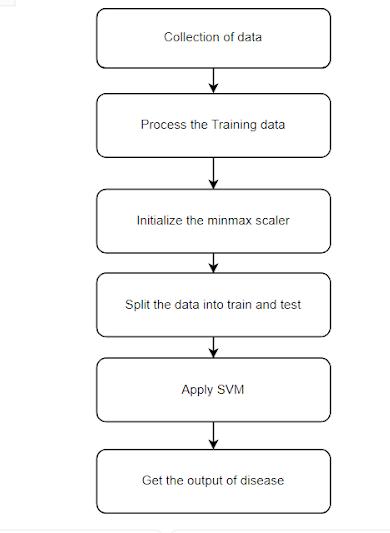
ARCHITECTUREDIAGRAM
DATA-FLOWDIAGRAM
SEQUENCEDIAGRAM
ARCHITECTURE DIAGRAM:
SEQUENCE DIAGRAM:
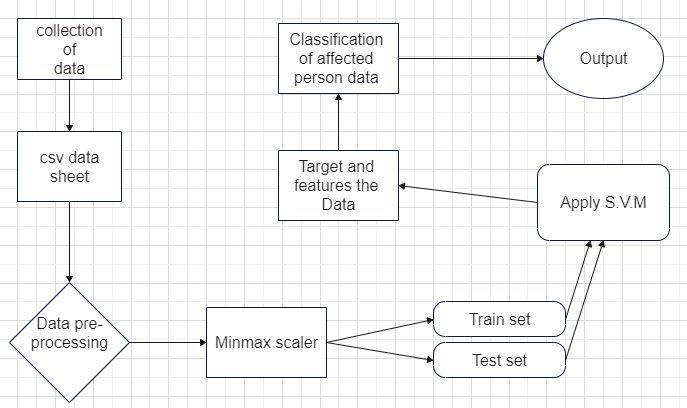
DATA- FLOW DIAGRAM:
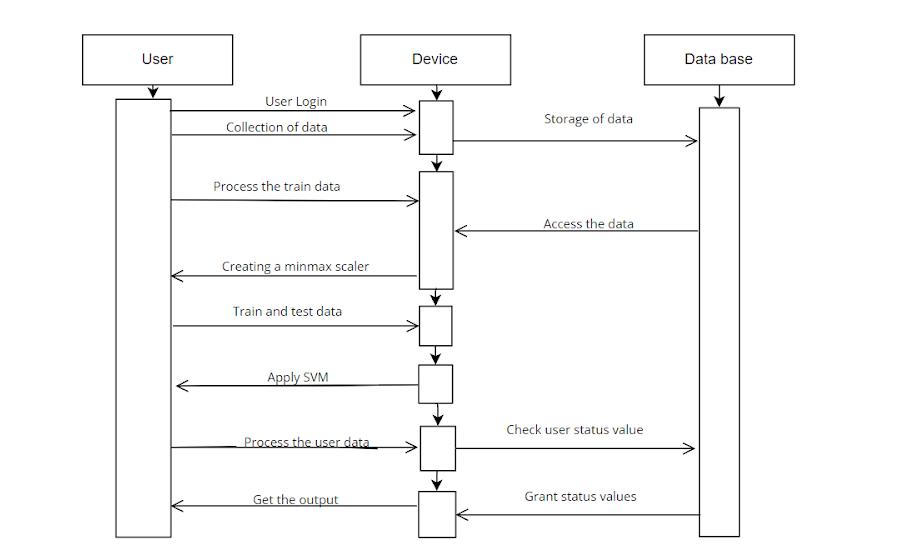
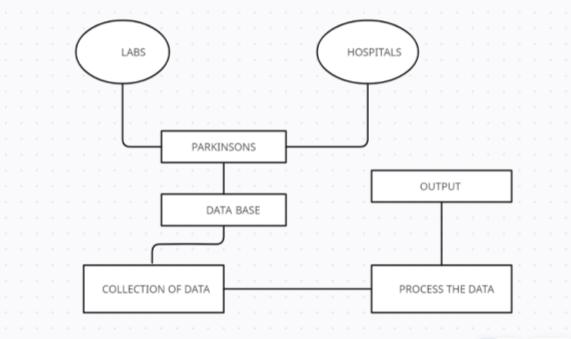
In this we are going to explain how the interaction takes place between modules and components to get the functioning of the system in the model. This system design is developed for achieving the requirement of the user with our algorithm and statistical data. The design will also capture the key functions in the building necessary to understand the system's construction process.
Adding new data: A user can either add new data to our model or he can edit the previous data of the user whose dataisalreadysavedinthedatabase.
Analyze the frequency from vocal data: Auserprovides his voice as an input in our model and by using some algorithm our model accepts the frequency from vocal data.
Detection of parkinson disease: Using the frequency rate of vocal data our model predicts whether a user is affectedbyparkinsondiseaseornot.
It is a machine learning algorithm used for classification and regression problem and mainly used for classification problem. for separation of n dimensional spaceintoclassessothatwecangroupournewdata,and the boundary is used for to classify the data is known as decisionboundaryandalsocalledhyperplane.
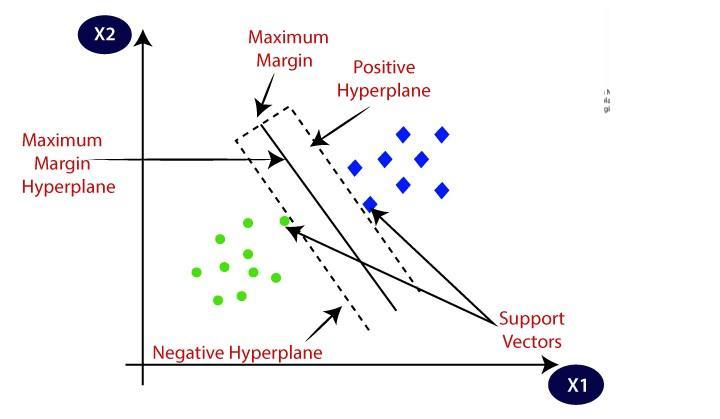
So here in our research we have used SVM model to classifythedataandtotrainthedataasperourmodeland wehavetrytogetbestaccuracyfromit.
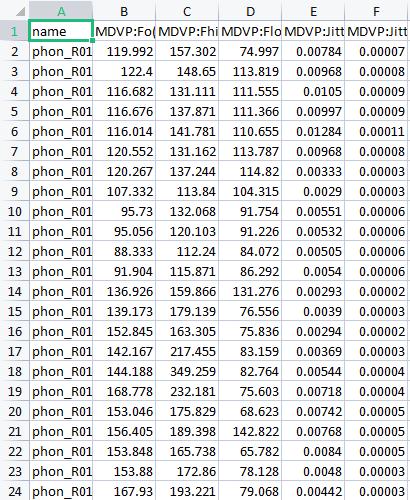
Here before going on model training we have to pre processourdata.
A. Data pre processing
Itisa techniqueinmachine learningusedforpreparation of our data before train it with our model .So that it get cleanedandinformattedwayandshouldnot containsany garbage value there are few steps in data pre processing wearediscussingitaccordingtoourresearch.
1.Separatingthefeaturesandtarget
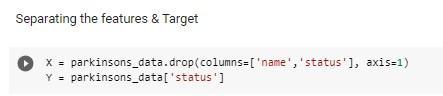
In this system we have separated the features and target value as per our model .So when we are talking about features and targets then the first question comes in our mind that what is feature and target in the language of datainmachinelearning. Feature isthatvalueinourdata whichistakenasinputforgettingaresultfromourmodel so it is very necessary condition for our model .And the output we have got after the feature that is called as Target
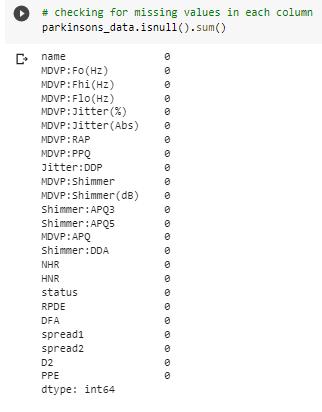
Here we are separating the whole data set into ratiofor trainingandtestingpurposeforourmodel
Here weareusingsomeevaluationfor togettheworking result of our model as you can also say that performance of the model is evaluated in this system. we have used accuracyfor evaluating it means the best accuracyhaving bestmodel.
In data standardization the data will changes to best and standard format to understand for the computer and model.
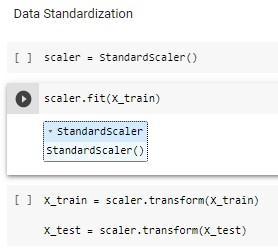
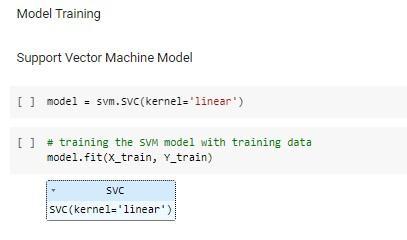
Modeltraininginmachinelearningistodevelopasystem that will predict and process with the data on some algorithmandgivesbestoutputaccordingtowhateverthe modellearnedfromthedata.

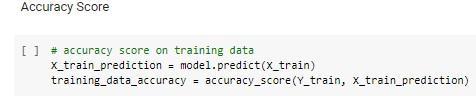
Wehavedeveloped apredictivesystemwherewegetour result from it .on what basiswe are getting our resultthe mainconditionaredevelopedhere.inourprojectwehave changed our input data to numpy array then reshaped numpy array accordingly . and again standardized the data
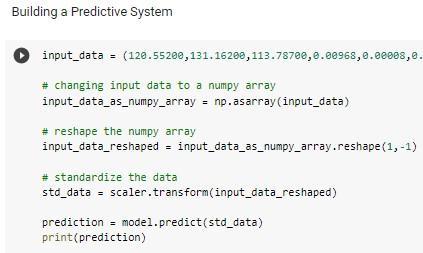

So here weare using support vector machine to train our model for getting best accuracy and also used linear kernel for reduction of our dimensionality of data for classification.
In this research we have developed and used a machine learningmodelandalgorithminwhichwehavepredicted a parkinson's disease through the best model of machine learning support vector machine .And will try to improve many things in future with connection of microphone in devicestopredictthesystemandget agoodinterfacefor interaction of user with the system and one more the affected patient or person can directly contact and search fordoctorfromgiven link
ACKNOWLEDGEMENT
we would like to thanks Mrs. Renuka rattan mam for guiding us in this project and in the research .we extremely thanking you to give us a better guidance and goodpathsothatwehavecompletedourtaskontime.We also appreciate each members of our group for making such collaboration to complete the research in a better way, They also help them in finding for a good solutions and for all the efforts made by them. At last I am very grateful to our university for providing such a platform andlibraryfordoingresearchandall.
REFERENCES
1. Pahuja, Gunjan, and T. N. Nagabhushan. "A comparative study of existing machine learning approaches for Parkinson's disease detection." IETE Journal of Research 67.1(2021):4-14
2. Moro-Velazquez, L., Gomez-Garcia, J. A., AriasLondoño, J. D., Dehak, N., & Godino-Llorente, J. I. (2021). Advances in Parkinson's disease detection and assessment using voice and speech: A review of the articulatory and phonatory aspects. Biomedical Signal Processing and Control, 66,102418
3. Moro-Velazquez, Laureano, et al. "Advances in Parkinson's disease detection and assessment using voice and speech: A review of the articulatory and phonatory aspects." Biomedical Signal Processing and Control 66(2021):102418
4. Moro-Velazquez, L., Gomez-Garcia, J.A., AriasLondoño, J.D., Dehak, N. and Godino-Llorente, J.I., 2021. Advances in Parkinson's disease detection and assessment using voice and speech: A review of the articulatoryandphonatoryaspects. Biomedical Signal Processing and Control, 66,p.102418
5. Naranjo, Lizbeth, Carlos J. Perez, Yolanda CamposRoca,andJacintoMartin."Addressingvoicerecording replicationsforParkinson’sdiseasedetection." Expert Systems with Applications 46(2016):286-292
6. Lahmiri, S., & Shmuel, A. (2019). Detection of Parkinson’s disease based on voice patterns ranking and optimized support vector machine. Biomedical Signal Processing and Control, 49,427-433
7. Naranjo, L., Perez, C. J., Campos-Roca, Y., & Martin, J. (2016). Addressing voice recording replications for Parkinson’s disease detection. Expert Systems with Applications, 46, 286-292http://www.ctan.org/texarchive/macros/latex/contrib/supported/IEEEtran/.
8. Pahuja, G., & Nagabhushan, T. N. (2021). A comparative study of existing machine learning
approaches for Parkinson's disease detection. IETE Journal of Research, 67(1),4-14
BIOGRAPHIES
1.Mr.VaibhavChandreshPandey (20BCS5923)Student, B.E. Computer Science and Engineering, Chandigarh university, Mohali, Punjab,India.

Areaofmachinelearning,Datascience, javaandSoftwaredevelopment
2.Er.RenukaRatten Assistant professor,Computer Science andEngineering, Chandigarh university, Mohali, Punjab,India
AreaofDigitalimageprocessing,
3.Ms.Gunjansaini (20BCS7202)Student, B.E. Computer Science and Engineering, Chandigarh university, Mohali, Punjab,India.
Area of machine learning and development






4.Ms.Sarahsharma (20BCS5823)Student, B.E Computer Science and Engineering, Chandigarh university, Mohali, Punjab,India
Areaofdevelopmentandtesting
5.Ms.Aditytarway (20BCS5933)Student, B.E Computer Science and Engineering, Chandigarh university, Mohali, Punjab,India



Area of machine learning and data science
6.MsSayanidebnath (20BCS7023)Student, B.E Computer Science and Engineering, Chandigarh university, Mohali, Punjab,India
Areaof Dataanalysis