IR-Based Snake Robot for Pipeline Inspection Using IoT
Umadevi B E1 , Roopabai M2 , Unnathi M T3, Nisarga G K4 , Anjali K5Abstract - The purpose of this project is to build a snakelike robot that can climb over obstacles up to a certain height and move like a real biological snake. It can also find an alternate path if the obstruction's height exceeds the limit. A snake-like robot is a biomorphic, extremely redundant robot that resembles a snake. Since the main objective of this project is to create a snake-like robot with the ability to avoid obstacles, the snake-like robot is made of moderate size with 4-5 segments, allowing it to move with flexibility in its surroundings. The snake-like robot's size and shape are determined by the application; various applications may call for various sizes and shapes. The snake-like robot may be built with multiple joints that allow it to have multiple degrees of freedom, giving it the ability to flex, reach, and approach a huge volume in its workspace with an infinite number of configurations to move and function like a real biological snake. The robot may be able to move around in more challenging areas because of its mobility. Therefore, the use of this snake-like robot could be very beneficial in dangerous or difficult-to-reach areas. This snake-like robot moves in a particular gait that is a periodic sine wave motion, similar to a lateral undulation motion. Last but not least, the unique traits including climbing abilities and snake-like movement
Key Words: IR Sensor, Pipeline detection, Obstacle detector, Mobility, Movement

1.INTRODUCTION
Snakes can monitor and capture such locations where humans can't go because they can go places that humans can't. The robot can map out its surroundings, navigate, and display its surroundings location on Google Maps. Numeroususesforthesnakerobotexist,includingpipeline inspection. Manual inspection of such pipes is risky becauseofthewidevarietyofsubstancesthatthepipelines inbusinessestransport,includingoil,water,chemicals,and occasionally even poisonous gases. To inspect such pipelines,thisrobotwasdesigned.Thesnakerobotisbuilt with numerous joints to give it the ability to bend to various degrees and the flexibility to reach or approach varied terrains, enabling it to work or function like a true
biological snake. The snake robot can move over in challenging areas thanks to its trait. Robots that resemble snakesincludestructuraltraitsincludingseveraldegreesof freedom, numerous joints, and a modular design that enable them to move in a variety of ways and have good adaptability.Thesnakerobotoffersexceptionalstabilityas comparedtomobilesystemswithwheelsandlegs.
It can move through nearly all terrain types. Therefore, it canbeusedinavarietyofsituationswhereitmightbetoo narrow or dangerous for personnel to operate, such as rescueoperations,firefighting,andmaintenance.
Self-reconfigurable modular robots are autonomous kinematicmachineswithchangingmorphology,sometimes knownasmodularself-reconfiguringroboticsystems.Selfreconfiguring robots have the sensing and control generally seen in fixed-morphology robots, but they may also purposefully alter their shape by rearranging the connectivity of their parts to respond to new situations, carry out new duties, or repair damage. A robotic system calledaninfrared(IR)-basedsnakerobot ismadetomove and carry out activities in dimlylit or dark situations. The robot is often designed with many segments that may move independently to traverse through limitedlocations. Thismimicsthemobilityandflexibilityofasnake.
The robot may use a variety of propulsion systems, such as wheels or tracks, to move across a variety of terrain types. When there is an opportunity for their traits to providethemanedgeovertheirsurroundings,thatisthe aim of our endeavor. These settings frequently resemble long,narrowpipesorareextremelycrowded,likerubble.
Mechanical engineering, electronics, and software design arefrequentlycombinedtobuildanIR-basedsnakerobot that can move and interact with its surroundings. In addition to the IR sensors, the robot may also be fitted with other sensors, such as cameras or microphones, to collect more data about its surroundings. The robot may use a variety of propulsion systems, such as wheels or tracks,tomoveacrossavarietyofterraintypes.
2. LITERATURE REVIEW
An examination of current research projects, papers, and publications about the creation and use of snake robots that make use of infrared sensors constitutes a literature survey on IR-based snake robots. A deeper grasp of the state of the art in this sector, the current trends and advances,andfuturestudyareasareall goalsofthistype of survey. A review of publications on the design and development of IR-based snake robots for a variety of purposes, such as search and rescue, inspection, and exploration, may be included in the literature survey. Studiesontheperformanceandcapacitiesoftheserobots in various situations, as well as assessments of the efficiency of various IR sensor types and sensing modalities,mayalsobeincluded.
locatesurvivors.Thethermalimagingcameraenablesthe robot to detect heat signatures that may not be visible to the naked eye and can provide valuable information to rescuersaboutthelocationandconditionofsurvivors.
4. "Design and analysis of a snake robot with thermal imaging for underground mining applications" by S. S. Kim et al. (2015).
This paper describes the design and analysis of a snake robot with IR sensors for underground miningapplications.Therobotcannavigatethrough narrow tunnels and detect temperature anomalies using its IR sensors. The authors developed an algorithm that allows the robot to avoid obstacles and navigate through the tunnels. The IR sensors enable the robot to detect temperature variations that may indicate the presence of ore or other minerals and can provide valuable information to miners about the location and quality of the minerals.
This paper presents the design and development of a snake robot with IR sensors for search and rescue operations. The robot can navigate through rubble and other obstacles to locate survivors using its IR sensors and other sensing modalities. The authors developed an algorithm that allows the robot to avoid obstacles and navigate through tight spaces. The IR sensors enable the robot to detect the heat signatures of survivors, even in low-light or dark environments. The authors also tested the robot in a simulated disaster scenario and demonstrateditsabilitytolocateahiddenheatsource.
2. "Design and implementation of a multi-modal snake robot for pipe inspection" by A. Bicchi and V. Kumar (2003).
This paper presents the design and implementation of a snakerobotwithIRsensorsforpipeinspection.Therobot can navigate through pipes and detect defects using a combination of IR sensors and other sensing modalities. The authors used a modular design that allows the robot to be reconfigured for different pipe diameters and lengths. The IR sensors enable the robot to detect temperaturevariationsthat mayindicate defectsorleaks in the pipe. The authors also tested the robot in a laboratory setting and demonstrated its ability to detect andlocatesimulateddefects.
3. “Snake robot for disaster response with thermal imaging" by Y. Kim et al. (2014).
This paper describes the development of a snake robot with IR sensors for disaster response. The robot is equippedwithathermalimagingcamerathatallowsitto detectheatsignaturesofsurvivorsandidentifyhazardous areas. The authors also developed an algorithm that allowstherobottonavigatethroughrubbleanddebristo
5. "A modular snake robot with IR sensors for inspection and surveillance applications" by H. Ayaz et al. (2019).
This paper presents the design and implementationofamodularsnakerobotwithIR sensors for inspection and surveillance applications. The robot can be reconfigured into different shapes and sizes to suit different environments and tasks and is equipped with IR sensorsforenhancedsensingcapabilities.
An analysis of the difficulties and constraints facedbyIR-basedsnake robots,suchastheneed for precise sensor calibration and alignment, the influence of environmental variables like temperature and humidity, and the computational requirements for processing and analyzing sensor data, may also be included in the survey. Overall, a review of the literature on IR-based snake robots can offer insightful informationaboutthestateoftheartinthisarea, pointoutareasthatrequireadditionalstudy,and assist researchers and developers in making defensible choices regarding the design and creationofthesecutting-edgeroboticdevices.
Paper Methodology Accuracy
"Development of a snake robot with IR sensors for search and rescue operations"byS. Moon et al. (2015)
"Snake robot for disaster response with thermal imaging" by Y. Kimetal.(2014)
"Design and analysis of a snakerobotwith thermal imaging for underground mining applications" by S. S. Kim et al. (2015)
"A modular snakerobotwith IR sensors for inspection and surveillance applications" by H. Ayaz et al. (2019)
ThesnakerobotusesIR sensors to detect the heat signatures of survivors and navigate through obstacles. The accuracy of the robot in detecting heat signatureswasreported tobearound85%.
The snake robot is equipped with a thermal imaging camera to detect the heat signatures of survivors and identify hazardousareas.
ThesnakerobotusesIR sensors to detect temperature anomalies and navigate through narrowtunnels.
3.2 Sensor calibration
The IR sensors must be calibrated after being integrated into the robot to make sure they are producing reliable readings.
Creatingabenchmarkforthesensorsperformanceusually entails exposing the sensors to sources of known temperature and seeing how they react. The specific specificationsforthesnakerobotcanbeestablishedbased on the objectives. The size and design of the robot, the quantityandkindofsensorsneeded,thekindofpropulsion systemnecessary,andotherdetailsmaybeincluded.
An essential component of an IR-based snake robot's operation is sensor calibration. The sensor values are calibrated to ensure accuracy and consistency across various settings and environments. To account for any differences in the sensor's performance, such as shifts in temperature, humidity, or other external conditions, the calibration procedure entails changing the sensor's parameters.
The modular snake robot is equipped with IRsensorsforenhanced sensing capabilities in inspection and surveillance applications.
3. METHODOLOGY
3.1 Define the problem and objectives
Designingandbuildingtherobotitselfistheinitialstepin producing an IR-based snake robot. This often entails developing a modular design that enables the robot to move in an adaptable and flexible manner, with the capacitytoslither,crawl,orevenswimasneeded.
Additionally, the robot needs to have IR sensors that can pickupinfraredradiationgivenoffbynearbyobjects.The problem that the snake robot is meant to solve and the goals it has to accomplish must be clearly defined in the firststep.
Settingupabaselinecalibrationforthesensorsisthefirst step.Thesensor'sreactiontoaknowntemperaturesource is measured to create a baseline measurement for subsequent calibration. Map the sensor's response over a variety of temperatures as the next step to determine its sensitivity and accuracy. Plotting the results includes testing the sensor's reaction to a variety of known temperaturesources.Thesensor'ssettingsaremodifiedto enhance performance based on temperature mapping. To increaseaccuracyandprecision,thismayentailmodifying thesensor's gain,offset,orothersettings. Thecalibration procedure is then verified by measuring the sensor's reaction to a known temperature source and contrasting theresultswiththeanticipatedresponse.
3.3 Navigation
To create an IR-based snake robot, a conceptual design must be created initially. This includes figuring out the robot'sdimensions,design,andfunctionalities.Therobot's intended environment, the kind of surfaces it will move over, and the tasks it will accomplish should all be taken into account throughout the design. The creation of the robot's mechanical design is the following step. Choosing thematerialsandparts neededtobuildtherobot,suchas themotors,gears,andbearings,isapartofthisprocess.
Therobot'ssize,shape,andtherangeofmotionnecessary for its actions should all be considered in the mechanical design. Numerous electrical and electronic parts are needed for the robot, including power supplies, sensors, andmicrocontrollers.
The information gathered from the IR sensors must be usedbythesnakerobot'scomputerprogrammingtotravel around its surroundings. This can entail employing algorithms to locate obstructions in the robot's route, temperature anomalies, or heat signatures, and then modifying the robot's movements accordingly. To offer more details about the environment, additional sensing modalitieslikemagnetic,auditory,andopticalsensorsmay alsobeused.
3.4 Data Processing and Interpretation
Togivevaluableinformationabouttheenvironmentofthe robot, the IR sensor data must be processed and interpreted. This can involve utilizing image processing techniques to detect particular items or features in the surroundingsorusingmachinelearningalgorithmstofind patterns in the data. The robot's IR sensors track changes intheambienttemperatureandprovidetheinformationto its microprocessor. The information is normally gathered regularly and saved for processing later. The accuracy of the interpretation may be impacted by noise or inaccuracies in the raw sensor data. Filtering and smoothing the data to remove errors and minimize noise arebothpartsofdatapre-processing.
The extraction of pertinent features from the data follows pre-processing of the data. This entails locating the temperature sources in the environment and learning aboutthem,includingtheirsize,location,andtemperature profile.
The properties of the temperature sources in the environment are ascertained through analysis of the retrieved features. This could entail analyzing the temperature profile to find changes in the environment over time or clustering the characteristics to identify objectsorimpedimentsintheenvironment
3.5 Control
The information gathered from the IR sensors and other sensing modalities must then be used to drive the snake robot.Todothis,therobotmayneedtochangeitsposition, direction,orspeedtoavoidobstacles orgotoaparticular target. Controlling an IR-based snake robot requires figuringouthowitwillmoveandreacttoitssurroundings. Therobotmustbeabletotraverseoverarangeofsurfaces, avoidhazards,andcarryoutdutieslikeobjectdetectionor environmental monitoring thanks to the control system's architecture. Typically, a combination of mechanical design, electrical and electronic engineering, and software programmingisusedtocontroltherobot.
ForanIR-basedsnakerobottofunctionasenvisionedina rangeofsettingsandscenarios,thecontrolsystemmustbe carefullyplannedandoptimized.Therobotmustbeableto respond to environmental changes and modify its behavior, thus the control system must be versatile and flexibleaswell.
4. IMPLEMENTATION
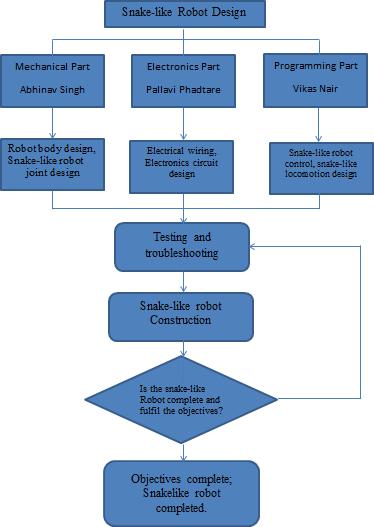
The development of an IR-based snake robot is a multistage, complex process that includes design, construction, programming, and testing. The implementation aims to build a snake-like robot that can move around its environment, avoid obstacles, and carry out tasks like object detection or environmental monitoring. Design is the initial step in the execution process. This entails developing the robot's mechanical parts, such as its body segments, actuators,and sensors. The bodyparts mustbe constructedsothattheycanmovetherobotinasnake-like fashionbycombininglateralandlongitudinal movements. The sensors must be able to detect the movement of the body parts, while the actuators must be strong and accurateenoughtocontrolit.
Design is the initial step in the execution process. This entailsdevelopingtherobot'smechanicalparts,suchasits body segments, actuators, and sensors. The body parts must be constructed so thatthey can move the robot in a snake-like fashion by combining lateral and longitudinal movements. The sensors must be able to recognize the robot's surroundings and react appropriately, while the actuators must be strong and accurate enough to control themovementofthebodysegments.
The robot is then built after the mechanical design is finished.Buildingaworkingrobot,entailsconstructingthe body segments, mounting the actuators and sensors, and joining the parts. The positioning and alignment of the sensors must be done with care for them to deliver accurate data and for the robot to successfully explore its surroundings.
The next step once the robot has been constructed is programming. Writing software is required to direct the robot's motions andenableittoreacttoits surroundings. The robot must be programmed with the ability to move likeasnake,combininglateralandlongitudinalmovements to navigate its surroundings. Additionally, the software mustbecapableofdeciphering
Testing and validation constitute the last step in the implementationprocess.Tomakesuretherobot operates as planned, many surroundings and scenarios must be tested. The robot must be proficient at navigating its environment, dodging hazards, and carrying out duties likeitemdetectionorenvironmentalmonitoring.
The effectiveness of the robot must be assessed using a range of measures, including speed, accuracy, and dependability. Finally, it should be noted that the development of an IR-based snake robot is a challenging process that calls for careful consideration of mechanical design, coding, and testing. The robot must be built to move like a snake, using both lateral and longitudinal movements to explore its surroundings. The software must be created to interpret the sensor data and react appropriately, and the robot's sensors must be precisely positioned and calibrated to deliver reliable readings. To
ensure that the robot functions as intended in a range of settings and scenarios, testing and validation must be done last. An IR-based snake robot can be successfully developed for several applications, from environmental monitoring to industrial automation, by paying close attentiontoeachofthesestages.
Fig-2: Modeloftheproposedsystem
HardwareImplementation:
A combination of mechanical, electronic, and software elementsareneededtodesignahardwareimplementation ofanIR-basedsnakerobotforpipelineinspection.WhileI can provide a rough summary of the essential hardware components involved, please note that the specifics of the implementation may vary based on the requirements, budget, and available technologies. Here are the main componentscommonlypresentinsuchasystem:
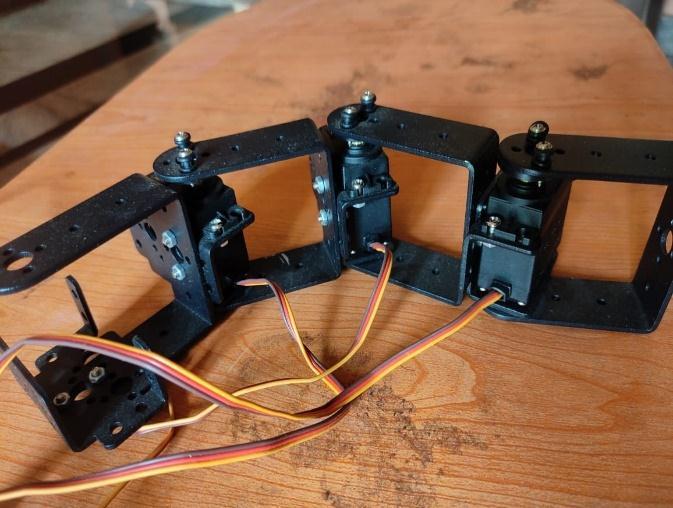
Mechanical Structure: Flexible snake-like bodyThe body of the robot is made up of numerous interconnected segments or modules that give it the ability to move over through confined spaces andaroundpipelinebends.
Sensors:
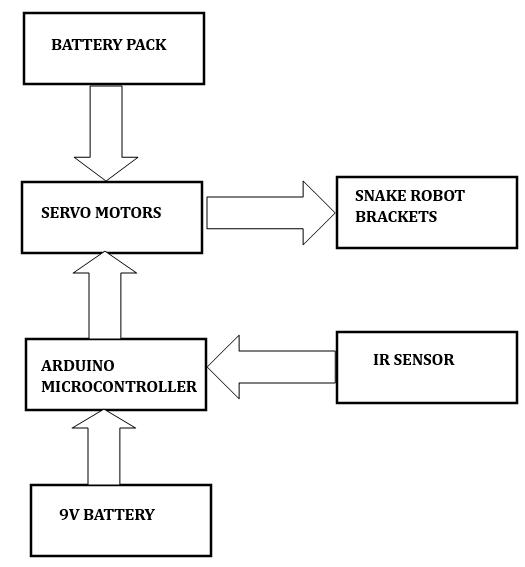
Infrared (IR) sensors: The robot can detect temperature variations in the pipeline by using these sensors to measure and detect the heat
signatures that objects emit. In the pipeline, IR sensorscanbeusedtofindleaks,obstructions,or anomalies.
ControlSystem:
Microcontroller/Embeddedsystem:Thisservesas the brain of the robot, receiving sensor data and executing control algorithms. It converts the information from the IR sensors into useful information for the operator after processing the sensorinput.
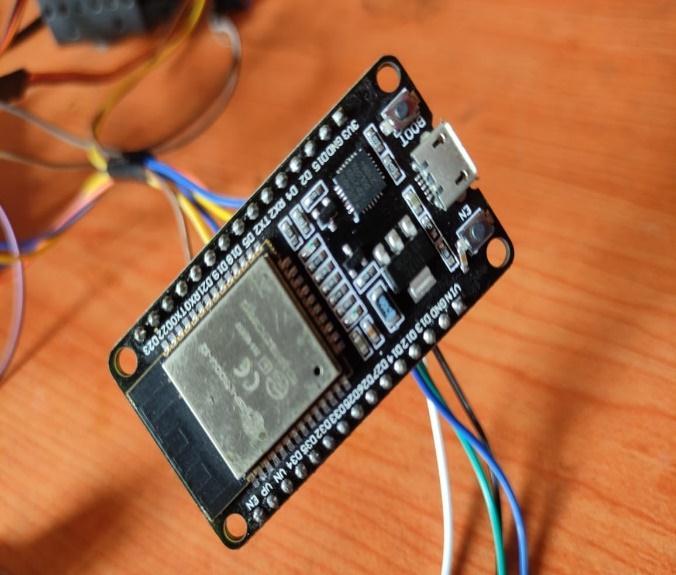
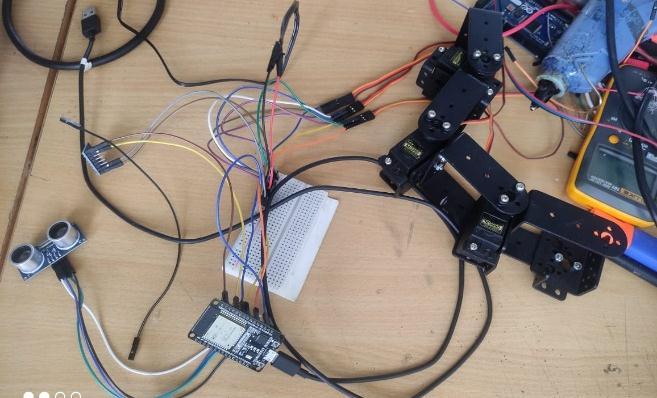
Motor drivers: These electrical components regulate the movement of the robot's actuators andjoints basedonthecommands receivedfrom thecontrolsystem.
Power supply: The components of the robot are powered by a suitable power source, such as batteriesoranexternalpowersupply.
Communication:
The robot can transmit data and receive commands over a wireless communication module.Operatorscannowcontroltherobotand getreal-timeinspectioninformation.
Data transmissionsystem:Inorderto conveythe inspection data back to the operator or storage system,therobotneeds a dependableandsecure method. Physical connections or wireless protocolsmaybeusedinthis.
MechanicalDesign:
Snake-like body with flexibility the body of the robot is made up of numerous interconnected pieces or modules that provide it the ability to moveoverthroughconfinedlocationsandaround pipeline bends. The robot can imitate snake motions including lateral undulation and sidewinding thanks to the joints and actuators thateachsegmenthas.
External casing: A protective casing is typically placed around the robot's outside to enhance mechanicalrobustnessandguardagainstpipeline damage.
Userinterface:
Control interface: This enables the operator to directthemovementoftherobot,viewinspection data,andcommunicatewiththesystem.Itcanbe acomputer,adedicatedcontrolpanel,oramobile device.
Data visualization is the process of presenting inspection data through software or display devices in a way that makes it easy for users to makesenseofthefindings.
Asnakerobot'shardwareismadeupofanumber of essential parts that cooperate to allow it to move, sense, and be controlled. The mechanical structure, which normally comprises of several segments joined by flexible joints, is one of the main components. These sections provide the robot its fluid and articulated mobility and resemble the snake's body structure. To achieve the specified range of motion and flexibility, the mechanical design of the segments and joints is essential.
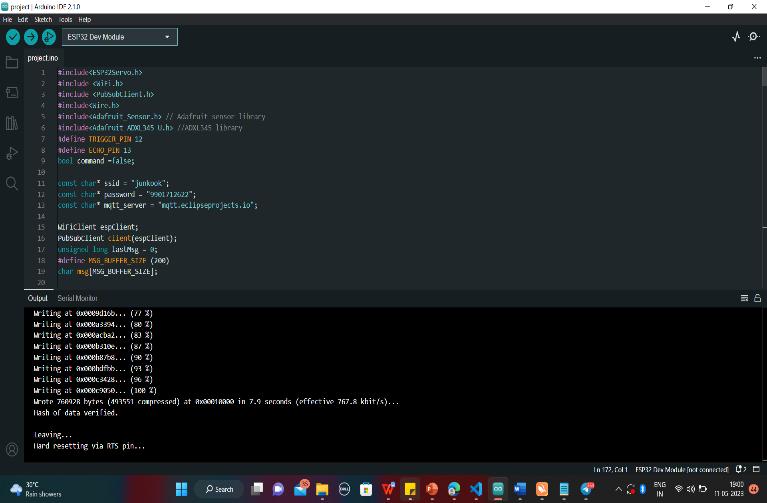
An IR-based snake robot for pipeline inspection uses a variety of software components to enable control, data processing,andvisualization.Thesoftwareis essential for ensuringtherobot'smovement,analyzingsensordata,and offering an easy-to-use user interface. An overview of the software used to construct an IR-based snake robot is givenbelow:
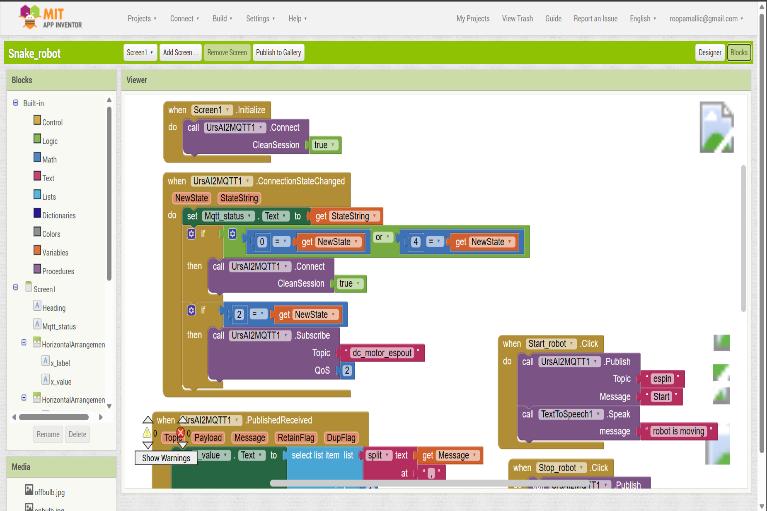
Algorithmsareincludedinthecontrolsoftwareto regulatethemovementsandconductofthesnake robot. It creates commands for the robot's actuators using information from the IR sensors andothersensors,includingcamerasorultrasonic sensors. The snake robot's locomotion patterns, pipeline navigation, obstacle avoidance, and reactiontodetectedanomaliesarealldetermined bythesealgorithms.
Processing of Sensor Data: Software modules analyses the information gathered by IR sensors. These modules examine temperature changes, locate abnormalities or hotspots, and extract
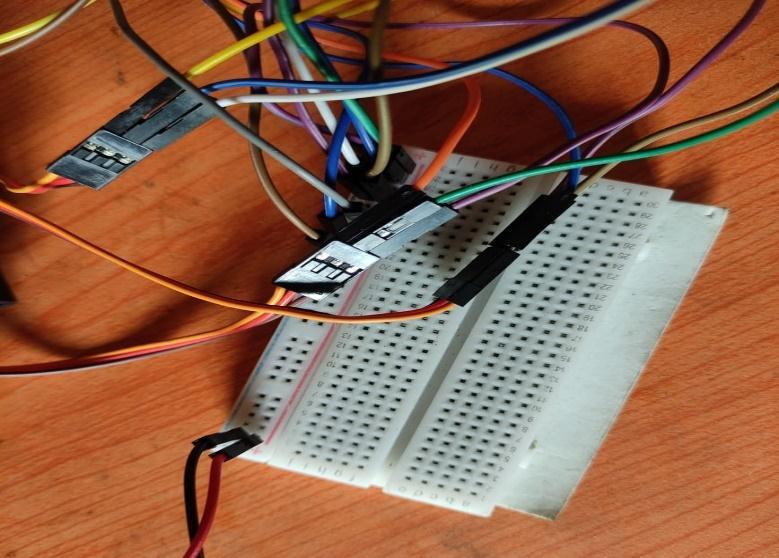
pertinent data for inspection needs. To provide a more complete understanding of the pipeline conditions,sensorfusiontechniques maybeused tomergedatafromdifferentsensors.
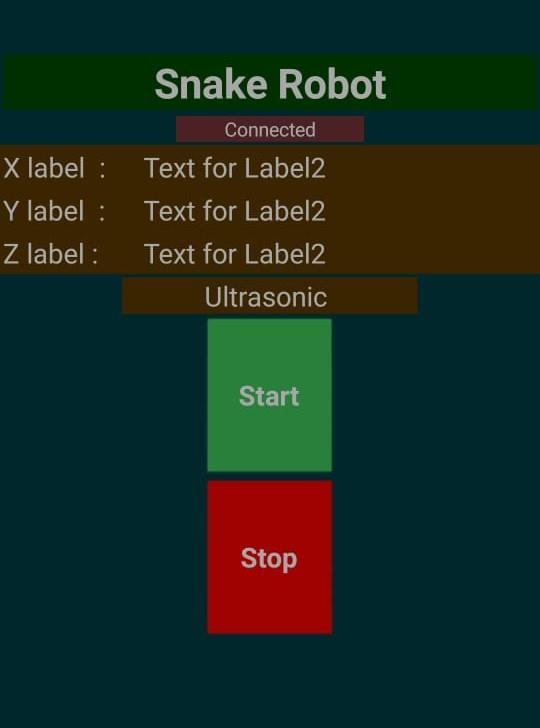
User interface and Visualization: The software offers a control panel that enables operators to monitorandmanagethesnakerobot.Theinterface displays data that is current, including thelocation of the robot, sensor readings, and inspection findings. To portray the inspection data in a meaningful and intelligible fashion, data visualization techniques are used. Temperature mapping, anomaly identification, and graphical displaysofthepipeline'sstateareafewexamplesof this.
5. CONCLUSIONS
In conclusion, IR-based snake robots have gained popularityrecentlybecauseoftheirdistinctiveshapeand capacity to move around through challenging and constrained spaces. These robots can move around in confined spaces, squeeze through pipes, and even carry outsearchandrescueoperationsindisasterzonesthanks toinfraredsensorsthatsensetheirsurroundings.
An IR-based snake robot's design and construction must take into account several crucial factors. The robot must beabletomoveasa genuinesnakewouldmove,andthe IR sensors must be calibrated and placed such that the robot can perceive its surroundings precisely. Additionally, careful planning must go into the control system to guarantee that the robot can move precisely andsmoothly.
AnIR-basedsnakerobotcanbemovedusingavarietyof different algorithms, depending on the task at hand and the capabilities of the robot's sensors and actuators. Whileobjectdetectionandobstacleavoidancealgorithms can be used to help the robot navigate its environment, PID control is frequently used to regulate the movement oftherobot'sbodysegments.Robotscanalsolearnfrom their environments over time by using reinforcement learningalgorithms.
In theindustrial sector, thisrobot will be a useful tool.It will aid in minimizing the time and effort spent by industry personnel doing pipeline inspections while also improving the effectiveness and accuracy of the inspection. The use of the robot can be expanded for a variety of other applications with additional modifications and the addition of other components. Robots that resemble snakes are now used far more frequently for surveillance and rescue operations. Even though different methodologies and procedures have beenoutlinedforalready-in-userobots,mostofthemare exclusively designated for a single operation. In other
words, robots that resemble snakes are made as application-oriented systems. Such a system's hybrid model will show to be a valuable addition to robotics applications.
The types of procedures that will be applied in the suggested system have been determined through analysis. The choice was decided in light of studies that were completed over earlier studies. The investigation thatfollowedrevealedthatmanystrategiesand methods of analysis had been used to create a snake-like robot. The majority of the analysis was performed with a specific application in mind. Here, an attempt is made to put into practice a hybrid model with adaptive locomotion.
Combiningdifferentapproachesandanalysismethodsinto asingleprototype,isused.Themostadvantageousmethod involved fusing the recently developed sensing systems with a real-time vision processing system. An effort was made to offer methods for processing streaming video to createanimage.
The adaptability of IR-based snake robots is one of their keybenefits.Theycanbebuilttodoavarietyofjobs,from assisting in surgery to exploring disaster zones. They can navigate through challenging settings with ease thanks to theirflexiblebodies,andsincetheycandetectIRradiation, they are well suited for jobs like object detection and obstacle avoidance. Nevertheless, creating IR-based snake robots is not without its difficulties. Designing a reliable controlsystemthatcanpreciselyregulatethemovementof the robot's body parts is one of the key challenges. To achieve precise and trustworthy observations of the environment,calibratingtheIRsensorsisafurtherissue.
Despite these difficulties, scientists have developed IRbased snake robots significantly over time. Robots are becoming more complex and powerful thanks to developments in control algorithms, sensor technology, and materials science. These robots are likely to develop even more versatility and usefulness as they continue to advance. Overall, IR-based snake robots are a fascinating anddynamicareaofstudy.Theserobotshavethepotential to revolutionize a variety of sectors and enhance the lives ofpeopleallaroundtheworldbyfusingthespecialtalents of snakes with the accuracy and adaptability of robotics. The mechanical, electrical, and software engineering disciplines must all be integrated into the design and development of the IR-based snake robot. Researchers have suggested a variety of design and prototyping techniques for the robot, including 3D printing, modular construction, and bio-inspired ideas. The methodology chosen will depend on the particular application requirements as well as the available resources. The IRbased snake robot's crucial components are data processing and interpretation. For the robot to be able to
makewisedecisions,alotofdatafromitssensorsmustbe processed in real-time. Numerous algorithms, such as genetic algorithms, fuzzy logic, and neural networks, have been proposed by researchers for the processing and interpretationofdata.
The IR-based snake robot, as a whole, is a promising technology that has the potential to revolutionize many applications, especially in hazardous or challenging-toaccesssituations.However,therearestillcertainproblems thatneedtobesolved,suchenhancingtherobot'ssensing abilities, increasing its speed and agility, and lowering its powerconsumption.TheIR-basedsnakerobotcanbecome a common tool for numerous applications with further research and development if these difficulties are overcome.
REFERENCES
[1] E.Y.Chou,Y.J.Liu,C.J.Wang,Y.S.Chen,andC.W. Chang, "Development of a snake-like robot for pipe inspection," IEEE Transactions on Industrial Electronics, vol. 61, no. 10, pp. 5625-5633, Oct. 2014.
[2] H. W. Kim, S. H. Ahn, and S. W. Park, "Design and controlofasnake-likerobotforurbansearchand rescue," International Journal of Precision Engineeringand Manufacturing,vol.16,no.5, pp. 881-888,May2015.
[3] H. Ren, J. Qian, and H. Chen, "A novel snake robot with IR sensors for disaster search and rescue," International Journal of Advanced Robotic Systems,vol.11,no.1,Jan.2014.
[4] K. Wang, Y. Ma, C. Chen, and Y. Li, "Design and experiment of a pipe inspection robot based on snake-like motion mechanism," Applied Mechanics and Materials, vol. 684, pp. 308-311, Dec.2014.
[5] T. Kamegawa, K. Tomita, and Y. Nakamura, "Development of snake-like robots for remote inspection," IEEE Robotics & Automation Magazine,vol.17,no.3,pp.43-51,Sept.2010.
[6] S. Li, Q. Li, S. Wang, and J. Zhang, "Design and experimental research of a snake-like robot for disaster exploration," International Journal of Advanced Robotic Systems, vol. 11, no. 4, Dec. 2014.
[7] Z. Zhou, J. Wang, and J. Zhao, "Development of a new pipe inspection robot with snake-like motion," Journal of Zhejiang University-SCIENCE A,vol.12,no.4,pp.297-305,Apr.2011.
[8] M. Shahbazi, H. D. Taghirad, and M. A. Jafari, "Design and control of a snake-like robot with soft-actuator-driven continuous locomotion," Robotics and Autonomous Systems, vol. 74, pp. 345-356,Aug.2015.
[9] Y.Chen,H. Huang,andS.Liu,"Design andcontrol of a snake-like robot with piezoelectric actuators forpipeinspection,"JournalofIntelligentMaterial Systems and Structures, vol. 23, no. 4, pp. 445456,Mar.2012.
BIOGRAPHIES
UMADEVI B E





AssistantProfessor,DeptofComputer ScienceandEngineering.
ROOPABAI M
B.EStudent,DepartmentofComputer ScienceandEngineering
UNNATHI M T
B.EStudent,DepartmentofComputer ScienceandEngineering
NISARGA G K

B.EStudent,DepartmentofComputer ScienceandEngineering
ANJALI K
B.EStudent,DepartmentofComputer ScienceandEngineering