Skin disease detection and classification using different segmentation and classification techniques
1,2,3,4Student, Final year B. Tech, Electronics Engineering, K.J. Somaiya College of Engineering, Mumbai, Maharashtra, India

5Professor, Electronics Department, Somaiya College of Engineering, Vidyavihar, Mumbai, Maharashtra, India ***
Abstract - Skin diseases are common and affect a large population all over the world. Skin disease management necessitates accurate diagnosis and treatment. The systems used image processing and machine learning techniques to automate the process of identifying skin diseases. With the advancement of machine learning algorithms, automated systems for skin disease detection and classification are now possible. This paper presents a study and exploration of various segmentation techniques used to detect the type of skin lesions, including Region-based segmentation, Otsu's Thresholding, Boundary, and spot detection, and Entropybased segmentation. Furthermore, support vector machines, DecisionTrees,Random Forestshavebeenusedtoclassifyskin diseases. Melanotic nevi, Melanoma Benign, Keratosis, Basal cell Carcinoma, Actinic Keratosis, Vascular Lesions, and Dermatofibroma are the seven types of skin cancer. The primary goal of this project is to improve diagnostic system accuracy by utilizing image segmentation and classification techniques.
Key Words: Skin Disease Classification, Convolution Neural Network, Deep Learning, Classification Algorithms, Image Processing.
1. INTRODUCTION
Theearlydiagnosisandtreatmentofskinillnessesdepend greatlyonthedetectionandclassificationofskindiseases, which is a critical responsibility in dermatology. Skin conditions are common around the world, and early diagnosisandclassificationcanpreventdeathandlessenthe financial load on the healthcare system. Recent advancements in machine learning and computer vision haveledtothedevelopmentofautomatedsystemsforskin disease detection and classification, which can assist dermatologists in providing accurate diagnoses and individualizedtreatments.
Theepidermis,dermis,andsubcutaneoustissuemakeupthe skin, which is the largest organ in the human body. The epidermisistheskin'soutermostlayerandabarrieragainst environmental hazards. Layers of keratinocytes, melanocytes, and Langerhans cells make up its structure. Keratin, which is synthesized by the skin's keratinocytes, givestheskinitsstrengthandabilitytorepelwater.Melanin
isapigmentmadebymelanocytesthatgiveskinitscolorand shielditfromthesun'sUVrays.
The dermis is the skin's intermediate layer and contains connective tissue, blood vessels, nerves, and other structures. It provides structural support to the skin and containscollagenandelastinfibers,whichimpartelasticity and strength to the skin. There are also hair follicles, perspirationglands,andsebaceousglands.
Fatandconnectivetissuemakeupthesubcutaneoustissue, the skin's deepest layer. It Insulates and regulates body temperature.
Although cancer can manifest itself in any of the skin's layers,basalcellcarcinoma(BCC),themostprevalentform ofskincancer,ismostoften foundintheepidermis' basal cells.Theepidermis'sbaseishometoaspecialtypeofcell called a basal cell. The epidermis' outermost layers are frequently the starting point for squamous cell carcinoma (SCC),anotherfrequentlyencounteredformofskincancer. Melanoma,amoreaggressiveformofskincancer,develops in the melanocytes, which are in the epidermis's deeper layers.Dependingontheirformandcause,skinlesionscan also affect various layers of skin. For instance, psoriasis lesions, which are characterized by thick, scaly regions of skin,affecttheepidermis,andcanextendintothedermis.In severe cases, the subcutaneous tissue may be affected by eczema lesions, which are caused by inflammation and irritationoftheskin.
The purpose of this work is to provide a comprehensive analysis of existing methods and algorithms for detecting andclassifyingskindiseases.TheHAM10000dataset,which contains photos of skin lesions, will be used to test the effectivenessofvariousmethodsandalgorithms.Wehope thattheworkpresentedherewillhelpmovethefieldofskin disease identification and categorization forward and ultimately improve the lives of many people around the world.
Inthiswork,weemploythepubliclyavailableHAM10000 dataset for machine learning. Ten thousand and fifteen dermatoscopy photographs of pigmented skin lesions are included,withseventhousandtwohundredandninety-five representing benign lesions and two thousand depicting
malignantmelanomas.Lesionssuchasseborrheickeratosis and angiomatosis make up the remaining 715 photos. In addition to the images themselves, the collection contains descriptiveinformationaboutthem,suchasthepatient'sage and gender, the anatomical location of the lesion, and the diagnosis.Init, youwill find examplesof both benignand malignantskinlesions.Belowarethesevenclassesofskin diseasespresentintheHAM10000dataset.
Molesormelanocyticnevi(nv),arebenignskingrowthsmade upofmelanocytes,whichareepidermalcellsresponsiblefor creatingpigment.
Melanoma (mel) isthemalignantskincancerwhichoccurs becauseofthe melanocytes thatisthepigment-producing cellsoftheepidermis.
Lesionsthatmimicseborrheickeratosisorsolarlentigines, whicharebenignskingrowths,areknownas keratosis-like lesions (bkl).
Cancer of the basal cells of the epidermis, also known as basalcellcarcinoma (bcc),manifestsasafirm,pink,orpearly whitenoduleontheskin.
Actinic keratoses (akiec) are thepremalignantskinlesions that,ifuntreated,candevelopintosquamouscellcarcinoma. Theyaretypicallybroughtonbyprolongedsunexposure.
Blood vessel abnormalities such as angiomas, angiokeratomas,andpyogenicgranulomasarereferredtoas Vascular lesions (vas).
A benign skin growth known as a dermatofibroma (df) typicallypresentsasatiny,hardbump.
Cancer of the epidermis or other melanocyte-containing tissues,knownasmelanoma,beginsinthesecells.Ablack, asymmetrical lesion on the skin is one possible manifestation.Differentlayersofskinareaffectedbyeachof theseblemish’skinds.
Epidermislesionssuchasmelanocyticneviandseborrheic keratosisaremorecommonthanthosecausedbybasalcell and squamous cell carcinomas, which can affect both the epidermisandthehigherdermallayers.Skin'sdermisand subcutaneoustissuearenotimmunetomelanoma'sreach. The affected skin layers might also be affected by the locationandseverityofthelesion.
2. LITERATURE SURVEY
[1]HeretheauthorshaveusedSVMasamachinelearning algorithmtofocusonMelanomaandCarcinoma.Theauthors ofthispaperaimedtocreateanautomatedsystemthatcan assistdermatologistsindeterminingwhetheraskinlesionis benignormalignant,whichisusefulintheearlydetectionof Melanoma. They trained and tested their SVM-based
classification system on 1,032 skin lesion images in their studyandextractedrelevantfeaturesfromtheimagesusing image processing techniques such as normalization, segmentation,andfeatureextraction.Theextractedfeatures werethenusedtotraintheSVMclassifier,whichachievedan accuracyrateof95.8%.
[2]Inthispapertheauthorshaveinvestigatedtheefficacyof different machine-learning algorithms for classifying skin diseases using color and texture features extracted from images. The authors gathered a collection of skin disease images from various sources and preprocessed them to extractcolorandtexturefeatures.Theimagedatasetconsists of Chronic Eczema, Lichen, and Plaque psoriasis images capturedwithadigitalcameraandprocessedtoextractRed, Green, and Blue (RGB) color features and Gray Level Cooccurrence Matrix (GLCM) texture features. To compare classifier performance, different combinations of features with four popular ML algorithms were considered. Linear Discriminant Analysis (LDA) and Support Vector Machine (SVM) had the highest classification accuracy of the four algorithmstested.Thepaperconcludesthatmachinelearning algorithmscanbeeffectivetoolsforclassifyingskindiseases andthatthealgorithmchosenshouldbebasedonthespecific featuresofthediseasebeingdiagnosed.Thestudy'sresults show that LDA performed better in binary and multi-class scenarios using color feature-based classification, SVM performed better for texture features in both binary and multi-class classifiers, and LDA and SVM classifiers performedbetterinbinaryandmulti-classclassificationfor thecombinedfeature.
[3] In this paper the authors did a literature review to compare how different image-processing techniques can detectandclassifypsoriasisdiseases.Thegoaloftheauthors wastolookatthecurrentresearchinthisareaandcompare howwelldifferentmethodsworkforfindingandclassifying psoriasisfromimagesofskin.Thereviewfoundthatdifferent imageprocessingmethods,suchastextureanalysis,feature extraction,andmachinelearningalgorithms,havebeenused tofindandclassifypsoriasis.Textureanalysishasbeenused tolookathowtheskinofpsoriasislesionsfeels,andfeature extractiontechniqueshavebeenusedtopulloutthingslike color,shape,andtexturefromimagesofskin.Psoriasishas beenputintogroupsusingmachinelearningalgorithmslike supportvectormachines(SVMs),artificialneuralnetworks (ANNs), and random forests (RFs). The machine learning algorithms have shown promise in correctly classifying psoriasislesions,withSVMsbeingthemostusedalgorithmin theliterature.
[4]Heretheyofferedanoverviewofthedifferenttechniques andmethodsusedtofindandcategorizeskindiseases.Using ImageProcessingandclassificationtechniques,themaingoal ofthisprojectwastomakediagnosticsystemsmoreaccurate. Inthesystemthatisbeingproposed,animagecapturedbya cameraisusedasinput.ByusingContrastEnhancementand
Grayscale Conversion, this image will be prepared for segmentation.TheGlobalThresholdingtechniqueisusedto divide the image that has already been processed into sections. This is how the real affected area is found. Using Grey Level Co-occurrence Matrix, texture features like Energy, Entropy, Contrast, and IDM (Inverse Difference Moment)aretakenfromasegmentedimage.ImageQuality Assessment features are taken out, such as Mean Square Error(MSE)andPeakSignaltoNoiseRatio(PSNR).Usingthe Decisiontreetechnique,theextractedtexturefeatureswillbe used to find skin diseases and classify them as melanoma, leprosy, or eczema if they are found. This system uses pictures of the skin taken by a camera to figure out if it is healthy or not. If it isn't healthy, it is categorized as Melanoma,Eczema,orLeprosy.
[5]Heretheauthorsgaveamethodfordecidingwhetherskin cancerintwodifferentmolesisbenignormalignant.Atfirst, thedatasethasimagesoftwodifferentkindsofmolesthat aremixed.Theseimageshavealreadybeenchangedsothat theycanbeusedforclassification.Whenthepre-processing ofthedatasetisdone,theseimagesaresenttoCNNmodels like VGG16, VGG19, and Inception V3 to pull out the characteristics. Lastly, these images are sent to different machine-learning classifiers to figure out if the moles are harmlessordangerous.TheresultsshowthattheInception V3 model with the neural network classifier has the best accuracyat83.2%.
[6] In this work they have used features such as entropy, variance,andmaximumhistogramvalueofHue-SaturationValue (HSV). These characteristics are used to construct a machine learning algorithm using Decision Tree (DT) and SupportVectorMachine(SVM).Accuracyisusedtoevaluate the proposed algorithm's performance. The first phase includesimageprocessingforskindiseasedetection,andthe secondphaseincludesamachine-learningalgorithm.Because ofchangesintheskin'scharacteristicfeaturessuchascolor and texture, it is difficult to diagnose skin disease in the primaryand other stages. SVM color features produce 8% betterresults.Asaresult,thedecisiontreeproducesbetter results.Thecolorofvariousskindiseasesisnearlyidentical. Itmakesclassificationdifficult.Asaresult,texturefeatures producebetterresults.
[7]Heretheyhavethoroughlyexaminedhowtexture-based feature extraction can be used to find skin diseases and suggest a system based on what they found. In this paper, they worked on texture-based features derived from the GLCMmatrixthatareusedtofindskindiseasesisdiscussed and consolidated. Most of the work is done to find skin cancer,butsomeoftheworksalsolookatotherdiseaseslike psoriasis, warts, moles, and eczema. Classifiers like neural networksandSVMdecidewhetheranimageshowsadisease ornot.Mostoftheresearchshowsanoverallaccuracyof90% or higher. Contrast, Correlation, Energy, Entropy, and Homogeneityarethetopfivefeaturesusedinallthiswork.
3. METHODOLOGY
In the proposed system we start with the basic image processingtechniqueswithasmallerdatasetandthenaswe move ahead, we work on multiple images and proceed towards the exploration of segmentation techniques. Thereafter we have worked on the complete HAM10000 dataset, using different ML techniques. Furthermore, to increase the efficiency of the model CNN was used and finalized.
3.1 Basic Thresholding
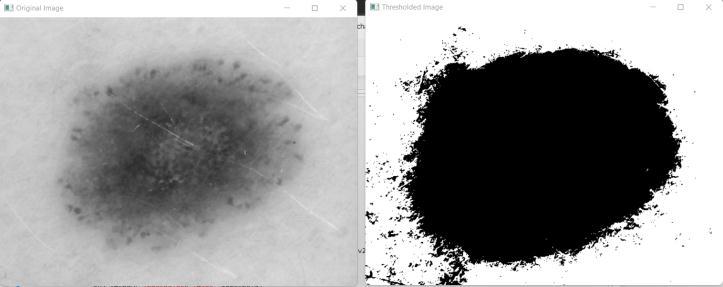
The first algorithm developed by us is basic thresholding. This type of thresholding technique is based on pixel intensities,ifthepixelintensityisgreaterthanthespecified thresholditwouldbeconsideredasoneorviceversa Thus, convertedintobinaryimage.Itisoneofthebasicalgorithms usedtodetectwhethertheskindiseaseispresentornot.For thisthresholdingalgorithm,weuploadedtheimagefromour datasetinthemodelandabasicclassificationoftheimage (disease detected or disease not detected) was done. Initially,theimageispassedthroughgaussianfiltersothat other insignificant parts would become blur and then the thresholding algorithm was applied on basis of term percentage.
3.2 Entropy based thresholding
In Entropy based thresholding algorithm, the optimum thresholdingvalueisacquiredusingthemaximumentropy plotted on the histogram and by choosing that respective pixelintensityandapplyingthethresholdingtechniqueonit andacquiringtheresults.
In Entropy based thresholding, a histogram is plotted to obtain the frequency of gray levels in an image and then cumulative sum of the histogram was obtained and is normalized.Afterthat,initializationofthresholdvalueand maximumentropyisdone,andthemodelismadetoiterate throughall thepossible valueswhere probabilitiesof two partswerebeencalculated.Then,themaximumentropyof twopartswascalculatedbyapplyingtheequations:
entropy1=-p1*np.log2(p1)ifp1>0else0 …3.2.1
entropy2=-p2*np.log2(p2)ifp2>0else0 3.2.2
Aftertakingintoconsideration,thetotalentropyobtainedby addingboththeresultsofaboveequations.
The parameters were updated i.e., threshold value and maximum entropy based on current entropy. While implementing it, If the current entropy is higher than the parametersmentioned,thentheentropywouldbeupdated orviceversa.Andfinally,thethresholdingwasperformedon theimageandthedesiredresultswereobtained.
3.3 Boundary and spot detection
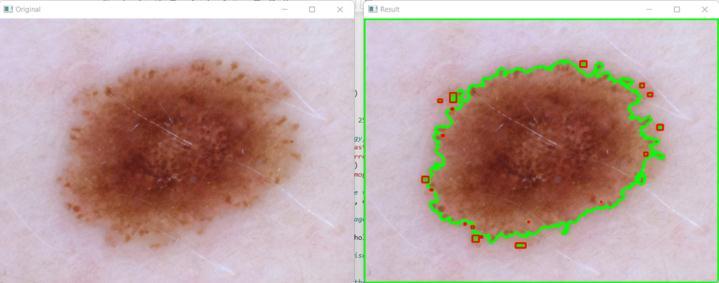
Inthismethod,wehavedefinedafunctioninwhichitwould checkifthespotisadiseaseornotbydefiningtheregionof interest.Ifthespotfallswithintheregionofinterestitwould return true or vice versa. Initially the same steps were followedasdoneintheabovealgorithmssuchasconverting the image to grayscale and applying gaussian filter on an imageandthentheOtsuthresholdingalgorithmwasapplied tosegmenttheimageandthenthecontoursweremadeto searchinthethresholderimageandthus,thecontourswere drawnontheoriginalimage.Thetrackoftruepositive,false positive,andfalsenegativespotswaskept.Thenafter loop overthecontoursweredevelopedinwhichiftheareawas lessthanacertainthreshold,itwasaspot.Foraccuracy,it was made to check if the spot was true positive or false positive.Thus,thedesiredresultswereachieved.
3.4 Otsu based Thresholding
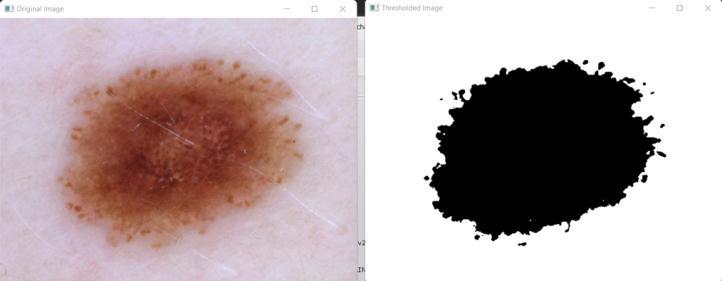
Initially, the image is uploaded from the dataset and the image is converted to grayscale and the gaussian filter is applied to reduce the noise and finally, the binary thresholdingandOtsuthresholdingisappliedontheimage and the ground tooth labels for the image were provided Thus,weobtainedthepredictedlabelsfromthethresholded imageandacquiredthedesiredresults.
3.5 Decision Tree
After importing the dataset, preprocessing is done using LabelEncodertoconvertintocategoricaldataforclassifythe imagesintomultipleclassesandthedecisiontreeclassifieris giventothemodel Byusingtrainandtestsplit,datasetwas trained and tested and finally, the results were displayed usingtheconfusionmatrix.
3.6 Support Vector Machine Algorithm
In support Vector Machine, the image is classified using three kernels namely linear, poly and rbf (Radial Basis Function).Thekernelstransformthenon-linearlyseparable dataset to a linearly separable dataset. In this method, hyperplane is used to classify the images into different classes.Themostaccurateresultsweregivenrbfkernelin comparedtolinearandpolykernelwithrandomstateas42. Thedatawasthentrainedandfittedtothemodel.Thusthe confusionmatrixwasplottedasaresult.
3.7 Random Forest
Afterimportingthedataset,therandomforestclassifier is given to the model comprising of 100 decision trees and random state as 42, so that it would take the same set of datasetseachtimeitisrun.Thus,usingtrain,testsplitthe modelistrainedandusingfit,thetraineddataisfittedtothe model.Thus,themodelistestedusingtestdatasetandthe desiredresultswereobtained.
3.8 Deep Neural Networks
AsHAM10000isahugedataset,withdifferentsupervised algorithmswerealizedthatitisessentialtoproceedtowards neuralnetworks.Neuralnetworkpossessesthecapabilityof processingcomplexcomputations,handlinghugedata,and end to end automation. We initially worked on preprocessingdatasetandthusthepreprocesseddatawas fed to deep neural network with 10,000 input images as neurons to an input layer, with two hidden layer and one output layer having tanh activation function. The output layer is used to flatten the matrix and convert it into 1D matrix. As, it was a huge image dataset, after deep study proceededtowardsconvolutionneuralnetwork.
3.9 Convolution Neural Network
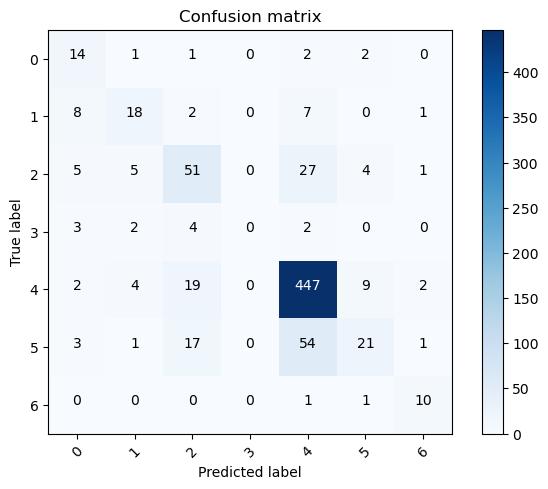
Initially,thedatasetisuploadedanddatacleaningisdoneby removingnullvalues,replacingitbymeanvalues,dropping insignificant columns, etc. Since, there are seven different classestobeclassified ofskindiseases,so it is multiclass classification. The data is fed to the input layer, then it is passed through three hidden layers where complex computationisperformed.Theactivationfunctionusedare Relu and then output is flattened i.e. converted to 1D and provided to the output. Since, the output is multi class classification, the activation function used is SoftMax activationfunctioninsteadofsigmoidactivationfunction.In hiddenlayers,twoconvolution2Dlayerwereprovidedwith kernel size (3,3) and max pooling filter of 16*2 size. The optimizer used for the model is Adam. Then, the model is compiled and the learning set annealer is set. The data is thensplitintofeaturesandtargets Trainingandtestingis performedonit.Afterdefiningthetraineddataandtested data,one hot encoding label is performed. There afterthe dataaugmentationisdonetopreventoverfitting.Thebatch size is 16. After the training, it is fitted to the model and variousepochswereperformedtoenhancetheaccuracyand finally,theconfusionmatrixwasplotted.
Theimagewasalsoconvertedtograyscaleandthegaussian filter was used to reduce the noise earlier and finally, the binarythresholdingandOtsuthresholdingwasappliedusing groundtoothlabelsfortheimage.Thus,thepredictedlabels fromthethresholdedimageswereacquired
4. RESULTS AND DISCUSSION
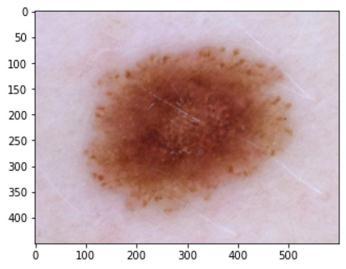
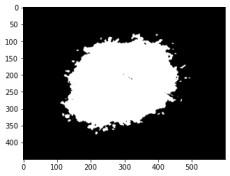
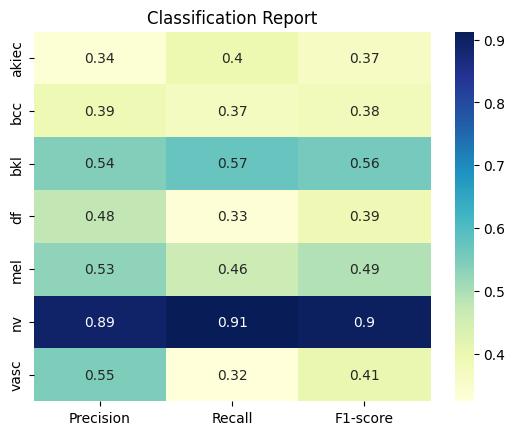
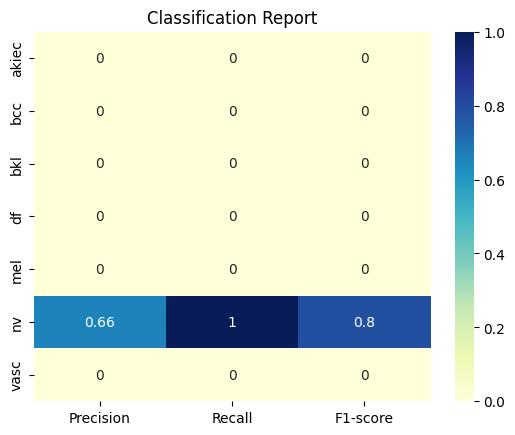
The results obtained below are through different image segmentationtechniques.Weprocessedeachimageofthe Datasetandwereabletogetsegmentedimagesandclassify the disease, but a major drawback of these segmentation techniques is the requirement of ground tooth masked images,obtainingthesegroundtoothmaskedimagescanbe averylengthyandtime-consumingprocessandthusitledus tomovetowardsdifferentmachinelearningalgorithms.
3. RandomForestClassifier
webegantheresearchwithfundamentalimageprocessing methods,weobtainedthehighestpossibleaccuracyof75%. However,whenwemovedontoclassificationalgorithms,we obtainedthehighestpossibleaccuracyof97%inboththe decision tree and the random forest. On the other hand, becauseoftheproblemsassociatedwithoverfittingandthe modelbecomingbiased,wedecidedtomoveontotheneural network.Convolutionneuralnetworkappearstobethemost effectivealgorithmfortheclassificationofimages,according to our findings. We found that it was accurate 82% of the time,anditenabledustoverifythatitworkedappropriately with random data as well. Additionally, it assisted us in attainingagreaterdegreeofprecision.
4. REFERENCES
In Supervised Machine learning algorithms, we classified using Decision trees, Support Vector Machine, Random Forestandgotmaximumaccuraciesof77.7%,67%,79.3% respectively.Butduetolowaccuracies,overfittinganddue tohighbiasnessofthemodelledustomovefurthertodeep learning.
b. Convolution Neural Network
[1].Kumar, N. V., Kumar, P. V., Pramodh, K., & Karuna, Y. (2019, March). Classification of Skin diseases using Image processing and SVM. In 2019 International Conference on Vision Towards Emerging Trends in Communication and Networking(ViTECoN)(pp.1-5).IEEE.
[2]. Hegde, P. R., Shenoy, M. M., & Shekar, B. H. (2018, September).Comparisonofmachinelearningalgorithmsfor skindiseaseclassificationusingcolorandtexturefeatures.In 2018InternationalConferenceonAdvancesinComputing, Communications,andInformatics(ICACCI)(pp.1825-1828). IEEE
[3]. Vincent,L.,&Jayasingh,J.R.(2022,April).Comparison of Psoriasis Disease Detection and Classification Through VariousImageProcessingTechniques-AReview.In20226th InternationalConferenceonDevices,CircuitsandSystems (ICDCS)(pp.122-124).IEEE.
[4].Pugazhenthi,V.,Naik,S.K.,Joshi,A.D.,Manerkar,S.S., Nagvekar,V.U.,Naik,K.P.,...&Sagar,K.(2019).Skindisease detection and classification. International Journal of AdvancedEngineeringResearchandScience(IJAERS),6(5), 396-400.
Asperthestudies,wefoundoutthattheConvolutionNeural Network was the best suitable technique for the classificationofdiseases.Duetohighcomputationcapacity andtheabilitytoclassifyahugedataset,thismodelproved to be better than the other classification techniques that were used above. It also overcame the drawback of overfitting, and can classify new and unseen data while maintainingahighaccuracyof82%.
3. CONCLUSIONS
Using the HAM 10000 dataset, a comparison of multiple algorithms has been carried out in order to detect skin conditionsandfortheclassificationofskinconditions.When
[5]. Gupta, S., Panwar, A., & Mishra, K. (2021, July). Skin disease classification using dermoscopy images through deep feature learning models and machine learning classifiers. In IEEE EUROCON 2021-19th International ConferenceonSmartTechnologies(pp.170-174).IEEE.
[6].Swamy,K.V.,&Divya,B.(2021,December).SkinDisease ClassificationusingMachineLearningAlgorithms.In2021 2ndInternationalConferenceonCommunication,Computing andIndustry4.0(C2I4)(pp.1-5).IEEE.
[7].Kolkur,S.,&Kalbande,D.R.(2016,November).Surveyof texture-basedfeatureextractionforskindiseasedetection. In 2016 International Conference on ICT in Business Industry&Government(ICTBIG)(pp.1-6).IEEE.