Delineation of Groundwater Recharge Potential Zones Using GeoSpatial Technique
Sweta Patil1 , Rajwardhan Patil2 Dhanraj Patil3 , Abhishek Rathi4, Pooja Kamble5 , Manisha Mare6Abstract - Water is one of the basic needs of any region for sustainable economic development and progress. There are various limitations regarding availability of surface and subsurface water, hence explorationof groundwaterbecomes inevitable. This study is aimed to trace the new water resources using Geo-spatial technique. The thematic layers consideredinthis study are geomorphology,soil,landuseland cover, slope, drainage density and rainfall usingsatellite data and ancillary data. The thematic layers were digitized from satellite imagery supported by ancillary data such as toposheets. Finally the thematic layers were integrated using ArcGIS software to generate a map showing groundwater recharge potential zones in the study area. Groundwater recharge potential zones were identified, namely ‘good’, ‘moderate’ and ‘poor’ using multi-criteria weighted overlay analysis by knowledge based assigned weightage and ranked influence factors. The results obtained based on geo-spatial technique are verified using field conditions of the study area. It is concluded that the geospatial technique is very efficient, time and cost effective and useful for identification of groundwater potential zones for exploration.
Key Words: groundwater, potential zones, Recharge, geospatial,multi-criteriaanalysis
1.INTRODUCTION
Groundwaterisoneofthemostvaluablenaturalresources, whichsupportshumanhealth,economicdevelopment,and ecological diversity. The prevention of contamination of groundwaterand managingitsusewill ensurethequality doesnotgetaffectedasitis anessential partofecological cyclesandhumanneeds.Thefrequencyofgroundwaterflow is influenced by two properties of the rock: porosity and permeability. Rainfall in India is erratic, uneven, and uncertain due to which groundwater recharge becomes unpredictableanduncontrolledGroundwateroccurrenceis in pockets/zones of hard rock terrains, and it is therefore necessarytolocatesuchzonesandincreasethequantumof groundwater recharge Need to identify the trend of distribution of groundwater recharge on watershed scale using advanced technology like Geospatial techniques
Remote Sensing and Geospatial techniques are innovative tools available to the researchers for scientific study of distribution of groundwater recharge on watershed scale.
Properplanningandefficientmanagementforgroundwater rechargeisofutmostimportance.

2. LITERATURE REVIEW
In recent times, many researchers such as Meijerink et al. (1996),Scanlonetal.(2002),Yehetal.(2009&2015),Patil et al. (2014 & 2019), Sharma (2016) and Tripathi (2017) have used the approach of remote sensing and GIS for identificationofgroundwaterprospectzonesanddelineating the potential recharge for the selected area. Vidhya and Vinay Kumar (2018) have used the GIS technique for identification of groundwater potential zones using nine parameters and then to delineate groundwater potential zones Devanathametal.(2020),Derdour(2022),Patiletal. (2014), Yeh et al. (2009) have used GIS to delineate groundwaterpotentialzones.Patiletal.(2019)haveapplied remotesensingandGISforprocessingandidentificationof groundwaterpotentialrechargezonesandidentificationof sitesforartificialrechargestructures.
IntegratedapproachofremotesensingandGIScanprovide theappropriateplatformforconvergentanalysisofdivergent datasets for decision making in not only mapping and planningofgroundwaterresourcesbutalsomanagementof groundwaterresourcesforitsefficientandcosteffectiveuse foraregionorstate.Thisstudyisaimedtodevelopandapply integratedmethodsforcombiningtheinformationobtained by analysing multi-source remotely sensed data in a GIS environment for better understanding the groundwater resourceforamicrowatershed,designatedbyGroundwater Surveys and development Agency (GSDA), Govt. of Maharashtra,inPunedistrict,Maharashtra,India
STUDY AREA
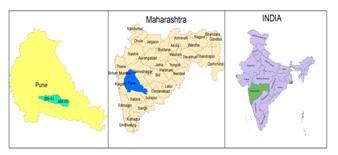
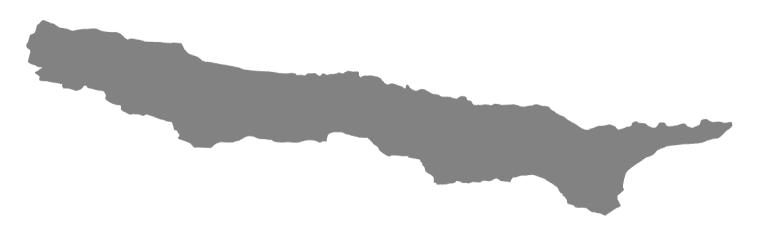
The study area is a watershed in the Pune district of Maharashtra, covering about 120 sq. km, which lies in between latitudes 18o 25’ 0’’ to 18o 27’ 30’’ N and longitudes74o15’0’’to 73o17’30’’E.Thelocationmapof the study area is shown in the Figure 1. The study area is surrounded by hills, plateau and valleys. Geologically majority of area is falls under the Deccan Trap Basalt. Temperatureinthestudyarearangesfrom10oC(minimum) to40oC(maximum).Averageannualrainfallinthestudyarea
is 500 to 700 mm. Humidity ranges from 30 % as low in summerto75%highinrainyseason.Windrangesfromlight tomoderateduringdryseason.
Methodology
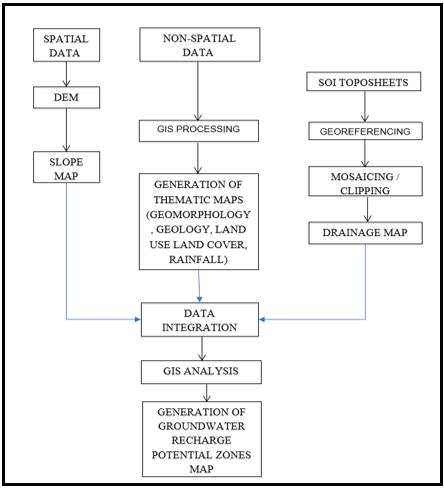
Methodology adopted in the present study is given in the Figure2. SurveyofIndia’stoposheetsarefirstgeocodedwith the help of known ground control points (GCPs) and mosaicedallthefourtoposheets.Theboundarymapofstudy area created using ArcGIS software based on watershed boundary.Mosaicedtoposheetswereclippedusingboundary map.TheIRS P6LISS-IIIsatellitedata wasregisteredwith SOI toposheets on 1:50000 scale using ArcGIS software throughmaptoimageregistrationtechnique.Thestandard False Colour Composite (FCC) was generated for better visualization and delineation of thematic layers. Linear, equalizationandrootenhancementtechniqueswereapplied toenhancethesatelliteimageryforbetterinterpretationof the geomorphological, soil, structural, land use land cover andotherinformation.
Data
1) SurveyofIndiatoposheets
2) LandSat9spatialdataacquired
3) ASTERGDEM30m(USGS/NASAASTERDEMdata availablefromthewebsiteasbelow: http://www.gdem.aster.ersdac.or.jp)
Thethematicmapsof(i)Geomorphology,(ii)Soil,(iii)Land Use Land Cover, (iv) Drainage Density, (v) Slope and (vi) Rainfallwerepreparedat1:50000scaleusingremotesensing andancillarydata.FromAsterDEM30m,thematicslopemap was generated. Survey of India toposheets and LandSat 9 satellite imagery were used to prepare various thematic mapsinArcGISenvironment.ArcGISsoftwarewasusedfor digitization, editing, and topology creation of various features/layers.Thegroundwaterrechargepotentialzones mapwasgeneratedusingMulti-CriteriaAnalysisi.e.overlay analysistoolprovidedintheArcGISsoftware.Spatialanalysis and knowledge based ranks and weightages to different features for delineating groundwater recharge potential zonesaredescribedbelow:
Spatial Analysis
This is a significant process using study of locations of geographicphenomenatogetherwiththeirdimensionsand attributes,classification,rankingandweightageassignment to individual and feature classes respectively. All thematic maps,suchasgeomorphology,soil,slopeandlanduseland cover map, drainage density and rainfall map have been preparedanddulyassignedrankingsforindividualclassand weightages to themes depending upon its influence on groundwateroccurrenceandmovement.Eachthemesuchas
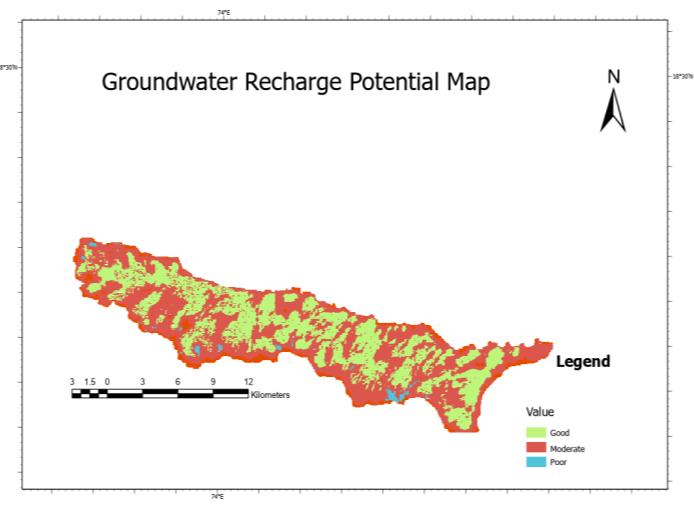
geomorphology, soil, land use-land cover, soil, rainfall and slope map provide certain clue regarding groundwater occurrenceandmovementinthestudyarea,whichisevident from the initial study. These thematic layers are used to generatethematicmapsforconductingmulti-criteriaanalysis by intersecting polygons. Using weighted overlay analysis, groundwater recharge potential zones map is generated whichisintegrationofvariousfeatureclassesfromdifferent thematicmaps.Weightedoverlayanalysisisatechniquetobe appliedforvariousdivergentinputthemestobringtheminto the unique convergent output. The groundwater recharge potential zones map (Figure10) was generated through overlayanalysisandbroadlycategorizedintothreetypesviz. good, moderate and poor, from groundwater prospecting pointofview.
Results and Discussion
1. Results
i. Geomorphology
Geomorphological mappinginvolves the identification and characterisationofvariouslandformsandstructuralfeatures. Many of these features are favourable for occurrence of groundwater and are classified in terms of groundwater potentiality.Geomorphicunitsaredelineatedbasedonthe imagecharacteristicssuchastone,texture,shape,colourand associations.
(Fig. 3) shows geomorphology map of the study area, as below.
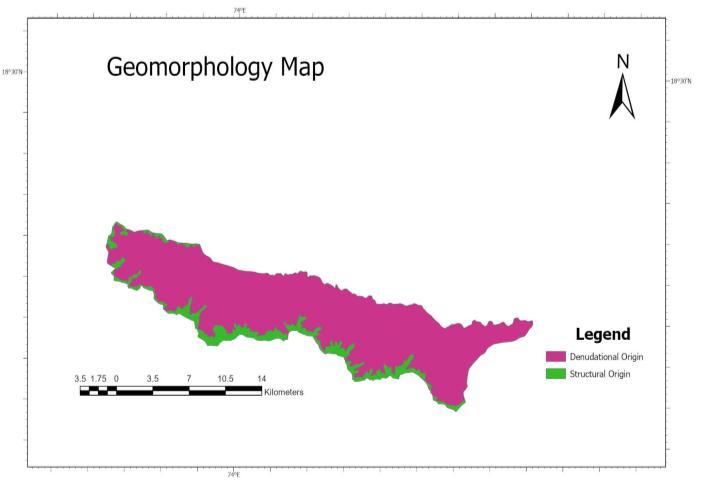
Table1:Rankingsforgeomorphologicunits
The rankings were assigned to the individual landform, according to their respective influence of groundwater holding,asshownin(Table1).
ii. Soil
The study area is prominently consisting in the basaltic regionofMaharashtraandfallspartlyinthehillsandpartly inregurandalluviumsoil. Byextractionofvariousclassesof soiltypes,athematicmapforsoilisgeneratedasshownin (Fig.4).
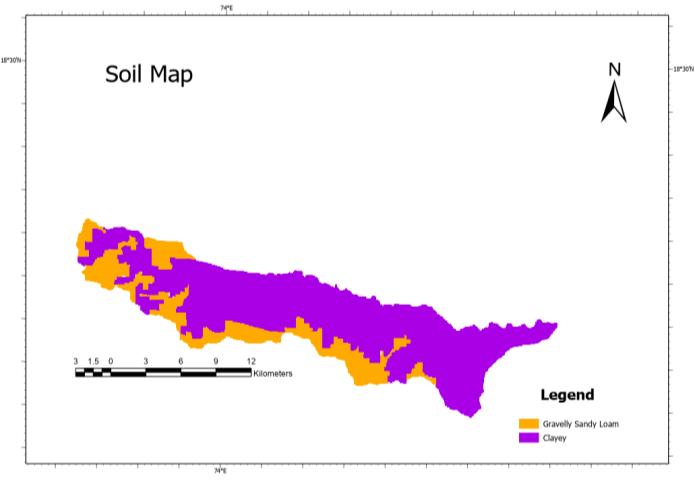
The rankings are assigned to the individual landform, according to their respective influence of groundwater holdingasshownin(Table2).
Table2:Rankingsforsoil
iii.Slope
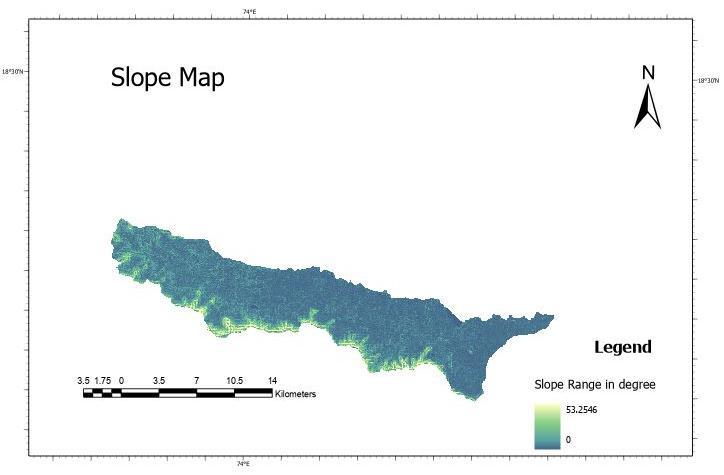
Slope of any terrain is one of the factors controlling the infiltrationofgroundwaterintosubsurfaceorinotherwords recharge.Inthegentleslopearea,thesurfacerunoffisslow allowingmoretimeforrainwatertopercolate,whereas,steep slopeareafacilitateshighrunoffallowinglessresidencetime for rainwater to percolate and hence comparatively less
infiltration.Theslopemapofthestudyareaisderivedfrom ASTERDEM30mandslopeofthestudyareaisclassifiedinto fiveclassesasshownin(Fig.5).
(Table3)showsrankingsassignedtotheindividualslope class,accordingtotheirrespectiveinfluenceofgroundwater holding.
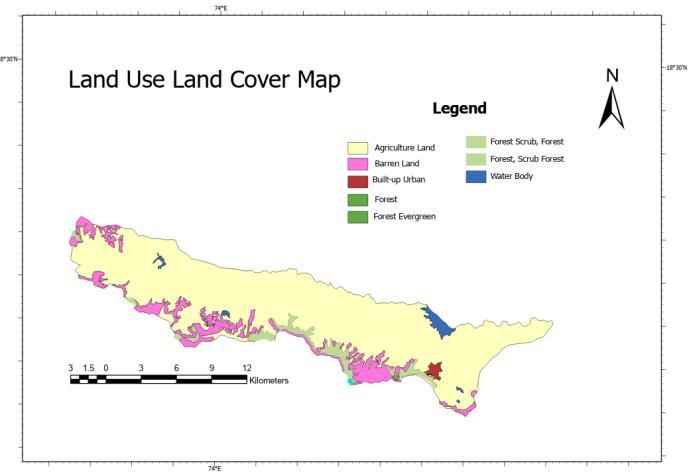
The rankings are assigned to the individual land use land cover type, according to their respective influence of groundwaterholding,asshownin(Table4).
Landuselandcoverfeaturescontroltheoccurrenceof groundwater with variety of classes among itself. Remote sensing data and techniques provide reliable, accurate baselineinformationforlanduselandcovermapping,which playsvitalroleindetermininglandusepatternandchanges thereinondifferenttimes.Theeffectoflanduselandcoveris manifestedeitherbyreducingrunoffandfacilitating,orby trappingwaterontheirleaf.Waterdropletstrappedinthis waygodowntorechargegroundwater.Landuselandcover playsimportantroleinthegroundwatermanagement.Land uselandcovermapisshownin(Fig.6).
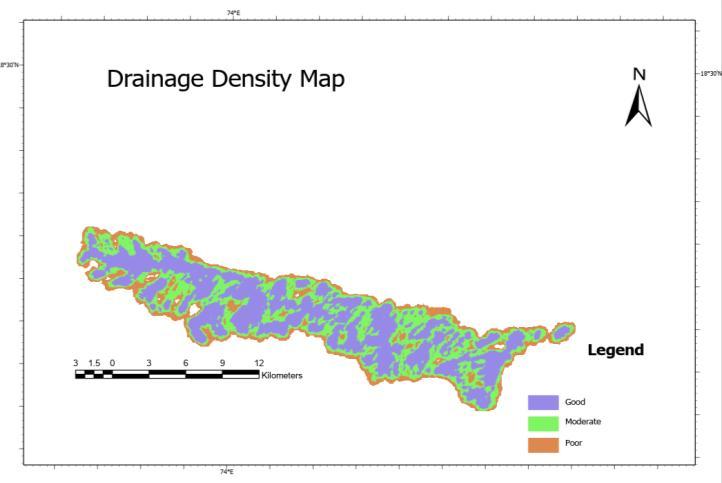
Drainagedensityactsasimportantparameterforanalysisof adrainagebasin.Drainagedensityalsohasabearingonthe permeabilityoftherocks.Usinggrids,drainagedensitymap forthestudyareawasprepared,whichisdividedintothree classes. The area of very high drainage density represents moreclosenessofdrainagelinesandvice-versa.Thehigher thedrainagedensity,thuslessinfiltrationandmoresurface runoff.
Byextractionofdrainagedensityfeatures,athematicmapis generated, classified into four zones according to their respectivedrainagedensity,asshownin(Fig.7).
The rankings are assigned to the drainage density class, according to their respective influence of groundwater holdingasshownin(Table5).
Therankingsareassignedtotherainfallclass,accordingto theirrespectiveinfluenceofgroundwaterholdingasshown in(Table6).
Multi-Criteria Analysis (Weighted Overlay)
Overlayanalysisismulti-criteriaanalysiswhereanalysisis carriedoutwithcomplexthingsforfindingoutcertaintheme withthehelpofassignmentofrankingtotheindividualclass of feature and then assigning weightage to the individual featureconsideringitsinfluenceovertheme.
Overlayanalysiswascarriedout,usingArcGISsoftware,to integrate various thematic maps viz. geomorphology map, soil map, slope map, land use land cover map, drainage density map and rainfall map, which are being very informative and plays important role in the study of occurrenceandmovementofgroundwaterfordelineationof groundwaterrechargepotentialzonesforthestudyarea.
Rainfall is the main source for groundwater recharge and have major impact over groundwater regime and plays importantroleinthegroundwaterdevelopment,exploration and management. The study area falls under rain-shadow region,havingaverageannualrainfallupto750mm;whichis below the average annual rainfall of 1100 mm for Pune district.Rainfallmapgeneratedisshownin(Fig.8).
Allthethematicmapshavebeenconvertedintorasterformat and assigned different weightages of numerical values as shown in (Table 7). Thematic raster maps have been integrated in the GIS environment and derived the groundwaterprospectzonesbasedondifferentrankingand weightages.Thegroundwaterprospectzonesmaphasbeen categorized into three major types viz. poor to good groundwaterpotentialzones(Figure9).
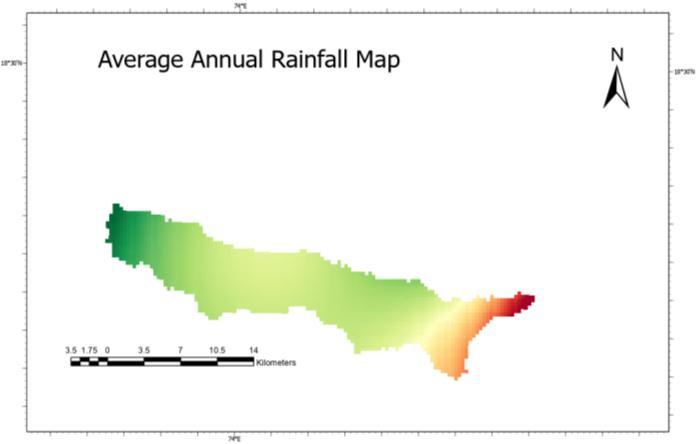
Table7:RankingsandWeightagesforInfluenceFactors
Usingaboveranksandweightagesforvariousgroundwater controllingfactorsandtheirclassesagroundwaterprospect zonesmapwasobtainedwiththehelpofArcGISsoftwareby Multi-CriteriaAnalysis(i.e.weightedoverlayanalysis)inGIS environment,whichisshownin(Fig.9).
resources and design a suitable exploration plan. The integratedgroundwaterprospectmapforthestudyareahas been categorized into ‘good’, ‘moderate’ and ‘poor’ prospecting zones, on the basis of the cumulative ranking andweightageassignedtodifferentfeaturesofthethematic maps.Thegeomorphologymapofthestudyareaindicatesit comprises mostly denudational origin and a small part of structuralorigin.Thedenudationaloriginofthestudyarea indicates good and moderate groundwater recharge potential.
Fromthisstudyitisobservedthatgeo-spatialtechniquecan be used effectively to delineate groundwater recharge potentialzonesmap,whichcanbeusedforvariouspurposes likeidentificationoflocationofwellsfordrinkingpurpose, tube wells for irrigation and efficient management of groundwater for the betterment of the society, economic development, etc. Further scope of study will focus on identifyingthelocationsforartificialrechargestructuresto improvethewaterresourcesinthestudyregion.
ACKNOWLEDGEMENT
Theauthorsacknowledgethehelpandsupportrenderedby Dr. Sivakumar V., Joint Director, ESEGGroup,C-DAC,Pune forthisstudywithgratitudeandthanks
REFERENCES
[1] Ahmed,Z.A.andPachkor,R.T. (2015).JalyuktaShiwarA combat to water stresses in Maharashtra. International Journal for Research in Applied Science andEngineeringTechnology,3(X),102-108.
[2] DevanthamAbhijith,SubbarayanSaravanan,Leelambar Singh,JesudasanJacinthJennifer,ThiyagarajanSaranya, K.S.S. Parthasarathy (2020). GIS-based multi-criteria analysis for identification of potential groundwater recharge zones- a case study from Ponnaniyaru watershed,TamilNadu,India
[3] Hsin-FuYeh, Youg-SinCheng,Hung-I.Lin, Cheng-Haw Lee. (2016) Mapping groundwater recharge potential zoneusingaGISapproachinHualianRiver,Taiwan
3. CONCLUSIONS
FromtheresultsobtainedfromtheGISanalysisconductedit isrevealedthattheoccurrenceofgroundwaterinthestudy areaiscontrolledbygeomorphology,landuselandcoverand slope. Geo-spatial techniques have been used to integrate variousthematicmapswhichareveryimportanttodelineate thegroundwateroccurrenceandmovementformappingand managementplanonascientificbasis.
Overall result demonstrates that the use of geospatial techniques provides powerful tool to study groundwater
[4] Abdessamed Derdour, Yacine Benkaddour, Brahim Bendahou. (2022)Applicationofremotesensingand GIS to assess groundwater potential in the transboundary watershed of the Chott-El-Gharbi (Algerian–Moroccanborder)
[5] A.M.J.MEIJERINK.(1996)Remotesensingapplications to hydrology: groundwater Hydrological Sciences Journal,41(4),549-561.
[6] Bridget R. Scanlon, Richard W. Healy, Peter G. Cook. (2002).Choosingappropriatetechniquesforquantifying groundwaterrecharge.
[7] Shivaji Govind Patil, Nitin Mahadeo Mohite. (2014). Identificationofgroundwaterrechargepotentialzones for a watershed using remote sensing and GIS. International Journal of Geomatics and Geosciences, 4(3),485–498.
[8] Dr. Reshma Saujani Sharma. (2016) Identification of Groundwater Recharge Potential Zones in Thiruverumbur block, Trichy district using GIS and RemoteSensing
[9] Shivaji Govind Patil, Ravindra Krishnarao Lad. (2019) GroundwaterPotentialZoneMappingusingGeo-spatial ToolsforWatershedsinUpperBhimaBasin,Pune,India. Springer - Journal of the Indian Society of Remote Sensing,50(7),1-22.
[10] 10.Dr.S.VidhyaLakshmi,Y.VinayKumarReddy.(2018) IdentificationofGroundwaterPotentialZonesUsingGIS AndRemoteSensing
[11] 11.Hsin-FuYeh,Cheng-HawLee,Kuo-ChinHsuPo-Hsun Chang. (2008) GIS for the assessment of the groundwaterrechargepotentialzone
BIOGRAPHIES
Sweta R.Patil isa AssistantProfessor, Dept. of Civil Engineering, Sinhgad InstituteofTechnology&Science,Pune.
Pooja S. Kambale is a student of SITS, Pune completing his B.E. (Civil)fromSPPU,Pune,India.



ManishaMareisastudentofSITS, Pune completing his B.E. (Civil) fromSPPU,PuneIndia.
RajwardhanS.Patilisastudentof SITS, Pune completing his B.E. (Civil) from SPPU,Pune,Indiaandhaspublishedone paperininternationaljournal.

DhanrajS.PatilisastudentofSITS, Pune completing his B.E. (Civil) fromSPPU,Pune,India.
Abhishek S. Rathi is a student of SITS, Pune completing his B.E. (Civil)fromSPPU,Pune,India.