Partial Object Detection in Inclined Weather Conditions
1
Margret Sharmila F,2
Amrithya Muralikrishnan, 3Sangavi S, 4Chandrupan R1Assistant Professor, 2,3,4 UG Student, Computer Science And Business Systems, Sri Krishna College Of Engineering And Technology Tamil Nadu, Coimbatore, India. ***
Abstract- This article provides a comprehensive analysis of the challenges associated with object detection. To conduct a systematic examination of the problem, we present a taxonomy based on the issues at hand. We delve into each issue in detail and present a unified view of the solutions proposed in this document. Moreover, we highlight significant gaps in the literature that have not been previously discussed, including existing imbalances and those that require further exploration.
Keywords: - Imbalance Problems, Object Detection, Number Plate reading
I. INTRODUCTION
Object detection is the simultaneous estimationofclass&thelocationforobjectinstancesin agivenimage.Itisafundamentalproblemincomputer vision with many important applications such as surveillance, autonomous driving, medical decisionmaking, and many problems in robotics. Since object detection is treated as a machine learning problem, first-generationmethodsbasedonmanualfeaturesand linear classifiers have maximum profit. The most successfulandrepresentativemethodofthisgeneration is the deformable part model (DPM) [13]. The current generation of OD methods is dependent on deep learning, and the handcrafted features and linear classifiers of the first generation methods are replaced by DL. The above replacement brings significant performance gains: on the widely used OD benchmark dataset (PASCAL VOC), DPM achieves a mean average precision (mAP) of 0.34, while current deep learningbased OD models achieve around 0.80 mAP. Over the past five years, although the main driver of OD advancements has been the incorporation of deep neural network imbalance problems at multiple levels in OD, it has also received a great deal of attention. A given image usually has a small number of positive samples, but millions of negative samples can be extracted. If left unaddressed, this imbalance can greatlyaffectdetectionaccuracy.
Here two User Personas are addressed, one is the person who uploads a picture for the Trained System to detect the Number Plate of the vehicle in Inclement weather conditions. The other User Persona
isthepersonwhorequiresthetextfilethatcontainsall theNumbersdetected.
II. LITERATURE-REVIEW

1. Vision-Assisted Robotic Handling: Object Positioning, Estimation, Detection, and Movement Planning
Inthisarticle,wewilltakeacloserlookatvisual inputforrobots.Wesummarizethe3mainjobsofvisionbased robot positioning: object localization, and perception estimation. Specifically, object localization tasks include classification-free object localization. Here the upper operation provides the target object's field in the input data. The object estimation pose task mostly refersto6Dobjectestimationposes.These3taskscanbe accomplished by different combinations of robotic grasping.
2. Modeling contextual scenarios with Boltzmann machines
Visual modeling is important for robots that need to see, think, and manipulate objects in their environment. In this article, we adapt and extend the Boltzmannmachinetosimulateavirtualscene.Thereare many examples on this topic, but ours is the first to combineobjects,relationships,andspaceintoapowerful general model. For this purpose, we introduce a hybrid versionofBM.Inthismodel,relationshipsandoffersare introduced into the model througha commonthree-way connection.
3. Object Research using a theoretical model
Wedelineate an object detection system based upon a composite model of multiple fault components. Our system can represent many variable classesofobjectsandachievestateresultsinchallenging PASCAL Object analysis. Although partial decomposition models has changed into very demanding ones. Our system is based on a novel approach to discriminative training using partly labeled data. We combine techniquesforextractingnegativedatawithamethodwe calllatentSVM.
International Research Journal of Engineering and Technology (IRJET) e-ISSN: 2395-0056
Volume: 10 Issue: 05 | May 2023 www.irjet.net p-ISSN: 2395-0072
4. Imagenet classification using deep neural networks
We educated a DNN to identify 1.3 million h-res images in the LSVRC-2010 Image Net sets into 1000 distinct classes. While testing, we attained a top-1 to 5 rate of 39.7% and 18.9\%, which are much finer than previousstate-of-the-artresults.
5. Benchmark for the 6d proportional object
We offer a model that can estimate a solid's 6D posture from a single RGB-D input picture. Examples of 3D object mappings or photographs of items, as well as well-known 6D postures, are included in the training data. Eight submissions in a single series addressing major global events, including two new anchor entries, areincludedintheprize.atvariousilluminationlevels,ii) aresearchtechniquewithanerrorbasedonblur,andiii) athoroughreview.Aconstantsubmissionoffreshresults is permitted through an open online assessment system, which has 15 distinct contemporary modes that reflect the status of the field. Evaluations reveal that 3D local feature-based techniques, learning-based methods, and point-pairfeature-basedmethodsarenowoutperformed by point-pair feature-based methods in terms of performance.
6. Finding content through cross-regional networks
In order to provide accurate and effective content search, we provide regional integration. Our regional analysis is remarkably unified, with practically all comparisons shared throughout the whole picture, in contrasttothepriorregionalanalysis(e.g.Fast/FasterRCNN [7, 19]), which employs hundreds of costly networks in the region. To do this, we offer unique features that address the issue of differential translation vs translation in picture classification. As a result, frameworks for classifying objects, including residual networks (ResNets) [10], may be explicitly classified using our technique. We use a 101-layer ResNet to provide competitive performance on the PASCAL VOC dataset(e.g.83.6%mAPonthe2007set).
Trainthesystemtodetectandreadthe“Number Plate” of the vehicle and return the Characters detected in a text file. For further use, the text file containing all thedetectedNumberplates’canbeusedbytherequestor whoisadifferentuserpersona.
III. PROBLEM STATEMENT
A survey is conducted all over the world to identify common imbalance problems in objects and thesolutionproposedforthecorrespondingproblemis
alsorecorded.Theproblem ismainlyduetoimbalance occurring in the object during improper weather conditions, and also due to common imbalance in the object.
Using GANs rather than duplicating the internet image is a more significant approach. Example for this is Task Aware Data Synthesis, the hard sample is generated using competing networks. Competing networks include synthesizer, a target network, a discriminator. Synthesizer is capable of Spoofing the differentiates, discriminators create high-resolution digital images to discover the connection. When an imageandgroundobjectiskept,thesynthesizerwants to generate the realistic samples by placing the object onto the image. To obtain the Realistic image from synthesizer,discriminatorishelped.
Considering the performance of the class during training, by switching the image of the instance betweentheexistingimages.
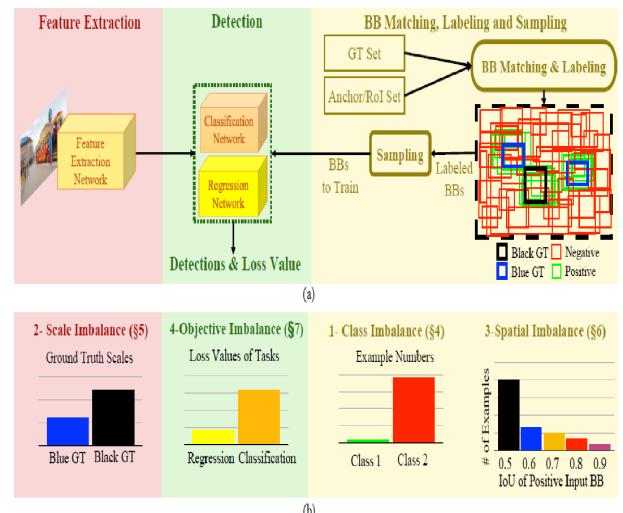
It is then tested and coded by matching a opaque conceptssetstoboxesoffacts.LabelattheendAnchor pointisfedtotheclassificationandRegressionnetwork fortraining.Atwo-stageapproach,Firstgenerateobject proposals (or regions of interest) Use anchors through aseparatenetwork
Tools:
Hardware
● System : Pentium IV 2.4 GHz.
● Hard Disk : 40 GB.
● Monitor : 15 inch VGA Color.
● Mouse : Logitech Mouse.
● Ram : 512 MB
● Keyboard : Standard Keyboard
International
Research Journal of Engineering and Technology (IRJET) e-ISSN: 2395-0056 Volume: 10 Issue: 05 | May 2023 www.irjet.net
Software
● Operating System : Windows XP.
● Platform :PYTHON TECHNOLOGY
● Tool : Python 3.6
● Front End : Python anaconda script
● Back End : Spyder
Theobjectdetectionliteraturehasmadeuseofa variety of human-designed metrics and measurements. Metrics that are learnt directly, however, will give superior resultswithintriguingfeatures.
We highlight and suggest numerous significant open issuesandimbalancesinobjectdetectioninadditiontoa thoroughdiscussionofresearchchallengesandsolutions. The imbalances that were studied warrant additional attentionamong the many unresolvedissues,identifying new imbalances that have never been addressed or discussedbefore.
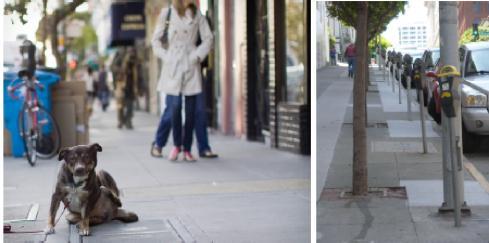
An excellent example of class inequality. (a) Model that resembles data (more human models than parking meters). (b) A case with a distribution that differsfromthedataset.TheMSCOCOdatasetisusedfor theimages.
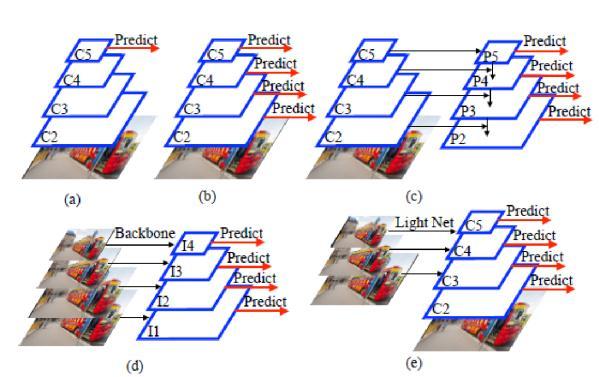
More specifically, if we analyze the traditional FPN The architecture in Figure 9, we note that although there are several layers of the C2 layer through the bottomup
Low-levelfeaturestotheP5layerofthefeaturepyramid, The C2 layer is directly integrated into the P2 layer, Suggests the influence of high-level and low-level Part numbersP2andP5aredifferent.
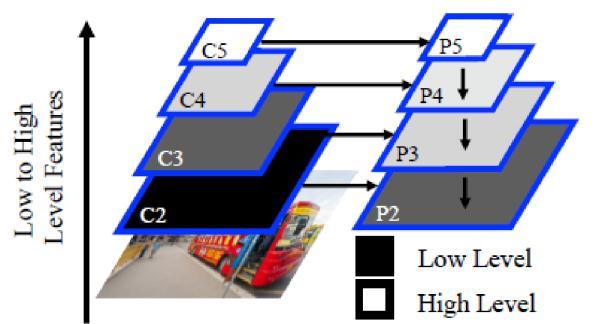
As emphasized earlier, Foreground-Background Class Imbalance and Foreground-Foreground Class Imbalance are the two primary subtypes of the class imbalance issue, as we stressed before. The issue that has to be resolvedis listed below. Paycloserattentiontotheview sinceitisunevensincefewerpeoplenoticeit.
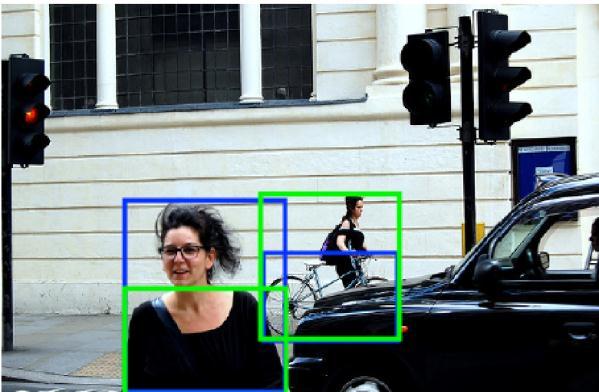
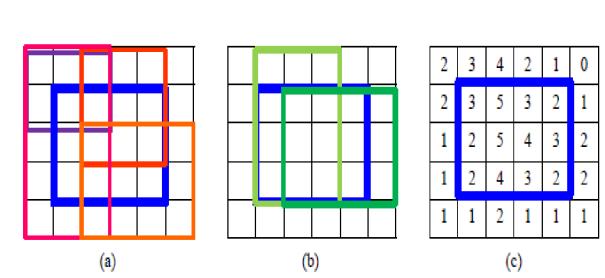
(a)Fourboxeswithnegativeseals.(b)Twotightlyclosed boxes. (c) Indicate how many overlaps there are inside each pixel of the bounding box. The total number of samples in the picture Because the pixel is changing, the frequencyofthepixelalsochanges. theoverlappedamount'sboundingbox.
International Research Journal of Engineering and Technology (IRJET) e-ISSN: 2395-0056
Volume: 10 Issue: 05 | May 2023 www.irjet.net p-ISSN: 2395-0072
[5]P.F.Jaeger, S.A.A.Kohl,S.Bickelhaupt,F.Isensee, T.A. Kuder, H. Schlemmer and K.H. Maier-Hein,"Retina u-net: a simple optical application of visual acuity for medical objectdetection"arXiv,Volume1.1811.08661,2018.
[6] S.-g. Lee, J. S. Bae, H. Kim, J. H. Kim, "Diagnosis of LiverLesionsfromUnderestimationofLargeCTVolumes Using a Single-Tap Multiplexer" Computer Science and MedicalTechnologyIntervention(MICCAI),A.F.Frangi,J. A. Schnabel, C. Davatzikos, C. Alberola-López, and G. Fichtinger,Eds.,2018.
Methodsforaddressingimbalanceissuesarecategorized based on difficulties. Please be aware that several inaccuracies may display in different places if the currencycorrectsthemall.VirgoR-CNN
V. CONCLUSION
In this study, we present a thorough analysis of the imbalance issue in object detection. We propose a taxonomy of issues and remedies to solve them in order to present a more comprehensive and cohesivepicture.
After classifying the issues, we go through each issue in depth independently and offer solutionsfromaunitedandcriticalviewpoint.Alongwith a thorough analysis of the examined issues and their resolutions, we also identify and suggest a number of unresolved issues and imbalances that are crucial for objectdetection.
We have found new imbalances that havenotbeenaddressedordiscussedbefore,inaddition tothenumerousopenpartsoftheresearchedimbalance thatneedadditionalconsideration.
VI. REFERENCES
[1]Q.Fan,L.Brown,andJ. Black,"AcloserlookatfastrCNNsforvehicledetection".In2016IEEESymposiumon IntelligentVehicles.
[2] Z. Fu, Y. Chen, H. Yong, R. Jiang, L. Zhang and X. Hua,"Backward Optimization and Forward Correlation Processing for Food Detection", IEEE Transactions on OpticalImageProcessing,2019.
[3] A. Geiger, P. Lenz and R. Urtasun, "Are we ready for autonomous driving? Kitti Vision Brand, In the IEEE Conference on Computer Vision and Pattern Recognition (CVPR),2012.
[4]X.Dai,“Hybridnet:Afastvehicledetectionsystemfor autonomous driving,” Signal Processing: Image Communication,vol.70,pp.79–88,2019.
[7] M. Rad and V. Lepetit, “Bb8: A robust, intuitive and accurate segmentation method for predicting the 3D representation of complex objects without using depth", in " IEEE International Conference on Computer Vision (ICCV),2017.
[8]W.Kehl,F.Manhardt,F.Tombari,S.Ilic,andN.Navab, “ssd6d: improved RGB-based 3d analysis and 6d pose estimation", In the IEEE International Conference on ComputerVision(ICCV),2017.
[9]B.Tekin,S.N.Sinha,andP.Fua, “Real-TimeSeamless Single Shot 6D Object Pose Prediction,” in The IEEE Conference on Computer Vision and Pattern Recognition (CVPR),2018.
[10] T. Hodan, F. Michel, E. Brachmann, W. Kehl, A. GlentBuch, D. Kraft, B. Drost, J. Vidal, S. Ihrke, X. Zabulis, C.Sahin,F.Manhardt,F.Tombari,T.-K.Kim,J.Matas,and C. Rother, “Bop: A description for comparing the positions of 6d" objects, At the European Conference on ComputerVision(ECCV),2018.
[11] G. Du, K. Wang, and S. Lian, “Vision-based robotic grasping from object localization, pose estimation, grasp detection to motion planning: A review,” arXiv, vol. 1905.06658,2019.
[12] I. Bozcan and S. Kalkan, “Cosmo: Contextualized scenemodeling withboltzmannmachines,”Roboticsand AutonomousSystems, vol.113,pp.132–148,2019.
[13]P. F.Felzenszwalb, R.B.Girshick,D.McAllester,and D. Ramanan, “Content analysis using machine learning models", IEEE Transactions on Simulation and Machine Learningsmart,vol.32,no.9,pp.1627–1645,2010.
[14] A. Krizhevsky, I. Sutskever, and G. E. Hinton, “Imagenetclassificationusing deep neural networks. In progressNeuralInformationSystems(NIPS), 2012.
[15] J. Redmon and A. Farhadi, “YOLO9000: Imagenet classificationusingdeepneuralnetworks.inprogress NeuralInformationSystems(CVPR),2017.
[16]R.Girshick,J.Donahue,T.Darrell,andJ.Malik,“Rich character Procedures for accurate object detection and semantic segmentation" ,In IEEE Conference on Computer Vision and Models To understand (CVPR), 2014.
[17] R. Girshick, “Fast R-CNN,” in The IEEE International ConferenceonComputerVision(ICCV),2015.
[18] J. Dai, Y. Li, K. He, and J. Sun, “R-FCN: Object detectionviaregion-basedfullyconvolutionalnetworks,” in Advances in Neural Information Processing Systems (NIPS),2016.
[19]W.Liu,D.Anguelov,D.Erhan,C.Szegedy,S.E.Reed, C. Fu, and A. C. Berg, “SSD: Explore Many One Box", in Europecomputervisionconference (ECCV),2016.
[20] J. Redmon, S. K. Divvala, R. B. Girshick, and A. Farhadi,"You Only See It Once: Integrated Real-Time Performance", in IEEE Congress of Computer Graphics andDesign(CVPR),2016.