Load Flow and PV Curve Analysis of a 220kV Substation
Mayur S. Sawant1 , Dr. Govind R. Kunkolienker2
1P.G. Student, Department of Electrical and Electronics Engineering, Goa College of Engineering, Goa, India

2Head of the Department of Electrical and Electronics Engineering, Goa College of Engineering, Goa, India ***
Abstract - Load flow analysis serves as a critical tool for analyzing and optimizing electrical power systems. In this paper, a comprehensive study on load flow analysis and voltage instability analysis is presented, focusing on a 220KV substation. The study encompasses various stages, including data collection, network model formulation, Y bus matrix development, Newton-Raphson analysis, and PV curve analysis. The primary aim of this investigation is to validate the design of new substations and upgrade existing ones, ensuring the safe and reliable operation of the electrical power system. The paper underscores the significance of load flow analysis in identifying potential issues and making informed decisions to enhance the overall performance and efficiency of the power system. This research adds to the existingknowledgeinthefieldofelectricalpowersystemsand provides valuable insights for engineers and researchers working in this domain.
Key Words: LoadFlow,Substation,MW,NewtonRaphson, CapacitorCompensation
1. INTRODUCTION
Loadflowanalysisisavitaltechniqueutilizedinelectrical powersystemstudiestoascertainthemagnitudeandphase angleofvoltageateachbus inthe network,aswell asthe realandreactivepowerflowingthroughthebranches,and theapparent powertransferbetweenbuses.Thisanalysis provides critical insights into the operational state of the power system, including factors such as voltage stability, powertransfercapacity,powerlosses,andidentificationof potential issues that may lead to power outages. Voltage stability, specifically, pertains to the ability of the power systemtomaintainastablevoltagelevelwithinacceptable limits despite fluctuations in load conditions or other disturbances.
Maintainingvoltagestabilityisacrucialconsiderationinthe operationandplanningofpowersystems,asfluctuationsin voltagelevelscansignificantlyimpacttheperformanceand reliabilityofelectricaldevicesandequipment.
Thispaperaimstoconductadetailedinvestigationintothe significance of load flow analysis in substations. It encompasses a thorough examination of various aspects, including the collection of load flow data from the substation,formulationofthenetworkmodel,analysisusing the Newton-Raphson method utilizing MATLAB, and PV curveanalysisutilizingPowerWorldsimulator.Theultimate
objective of this study is to foster a comprehensive understanding of load flow analysis in the context of substationsanditspracticalapplications.Thefindingsofthis research are expected to contribute towards the development of best practices in power system analysis, enhancingtheknowledgeandinsightsintothiscriticalarea ofstudy.
2. Theory
Loadflowanalysisholdsimmensesignificanceinmaintaining the stability, reliability and efficiency of power systems withinsubstations.Asapivotalcomponentthatbridgesthe transmission and distribution systems, substations play a vitalroleintheoverallfunctioningofthepowergrid.Load flowanalysiswithinsubstationsfacilitatesthedetermination ofcrucialparameterssuchasvoltageprofiles,powerflows, and loading conditions of vital components including transformers,switchesandotherequipment.
ThePVcurveservesasavaluabletoolinanalyzingvoltage stability,asitdepictsthecorrelationbetweenthemagnitude of the system's voltage (V) and power (P) at a specific moment in time. The PV curve delineates the loadability limitsofthepowersystem,offeringvaluableinsightsintothe stabilitymarginsofthesystem.
Capacitor compensation is a technique used in power systems to improve voltage stability and mitigate voltage fluctuations.TheeffectofcapacitorcompensationonthePV curveistypicallyseeninthelinearregionandthekneepoint. Whenshuntcapacitorsareaddedtothesystem,theycanshift the PV curve upwards, resulting in an increase in voltage magnitudeforagivenpowerlevelinthelinearregion.This means that the system can tolerate higher power demand levelswithoutexperiencingasignificantdropinvoltage,thus improvingvoltagestability.
3. Methodology
The study of load flow and PV curve analysis of a 220KV substationinvolvesseveralsteps,asoutlinedbelow:
i. Datacollection:Thefirststepistocollectpeakload readings and transformer ratings from the substation.
ii. Busnetwork:Thesubstationismodelledintoabus systemnetwork.
iii. Load flow analysis: The load flow analysis is performed using the Newton-Raphson method, whichinvolvesiterativecalculationsofthevoltage and phaseangles of each bus inthe network until convergenceisachieved.
iv. Voltageinstabilitystudy:APVcurveofaparticular bus is plotted and permissible real load is determined.
v. Reactive power compensation: Shunt capacitors helps in raising the voltage level and improve voltagestability.
vi. Interpretationofresults:Theresultsobtainedfrom theloadflowanalysisandvoltageinstabilitystudy areinterpretedtodeterminethevoltageandcurrent distributionwithinthesubstationnetwork,identify potentialproblems,andmakeinformeddecisionsto improvetheoverall performanceandefficiencyof thepowersystem
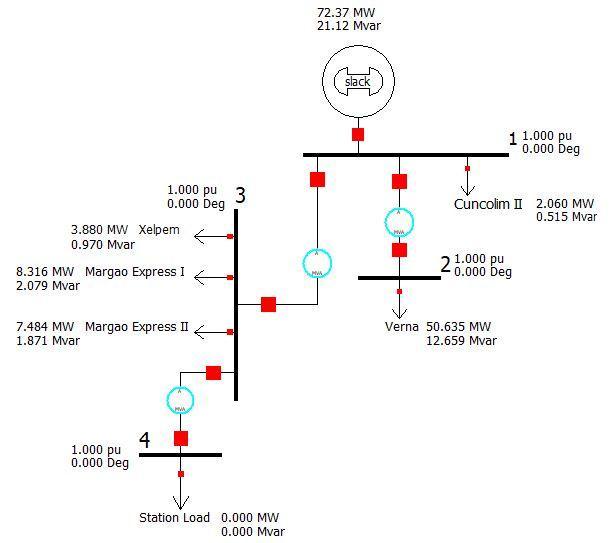
The circuit diagram shown in figure 1 was drawn using PowerWorldsimulatorandisapartofthe220kVsubstation Xeldem,Goa.The220kVbus1isfedusing220kVAP1line comingfrom220kVsubstationAmbewadi,Karnataka.Itis then step downed using 100 MVA 220KV/110KV transformer.Itisfurtherstepdownedto33kvusingtwo40 MVA110KV/33KVtransformers.10MVA33KV/11KVand 6.3MVA33KV/11KVtransformersareusedtostepdownthe voltageto11kV.Forstationloada200KVAtransformeris usedwhichstepsdownthe33kVto400V.
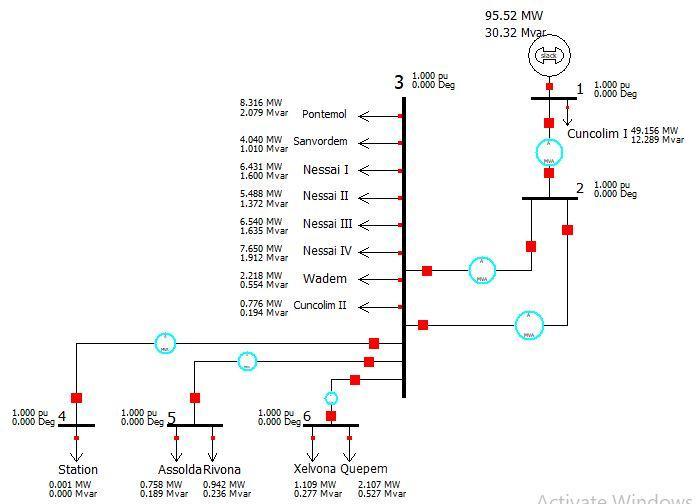
coming from 220kV substation Ponda, Goa. It is then step downedusing100MVA220KV/110KVtransformer.50MVA 220KV/33KVtransformersisusedtostepdownthe220kV voltageto33kV.Forstationloada200KVAtransformeris usedwhichstepsdownthe33kVto400V.
The circuit diagram shown in figure 2 was drawn using PowerWorld simulator and is a part of 220kV substation Xeldem,Goa.The220kVbus1isfedusing220kVPXRline
3. RESULTS
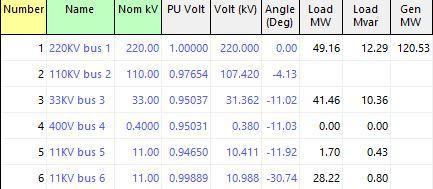
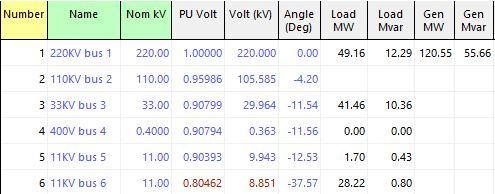
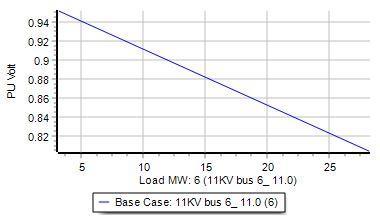
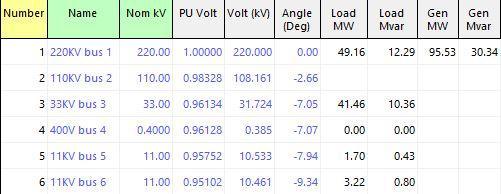
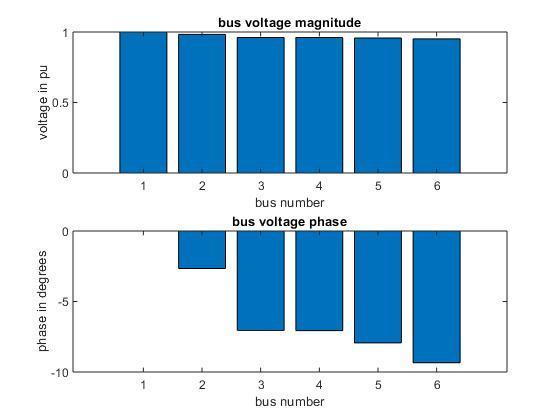
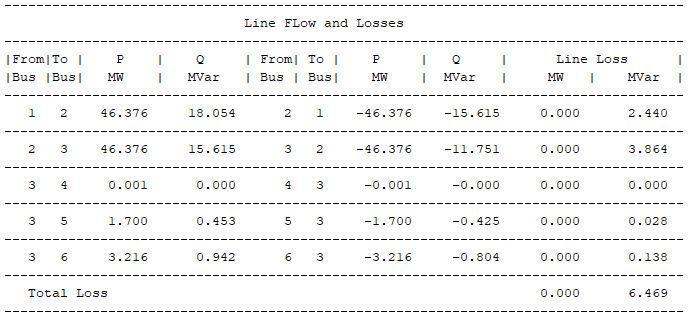
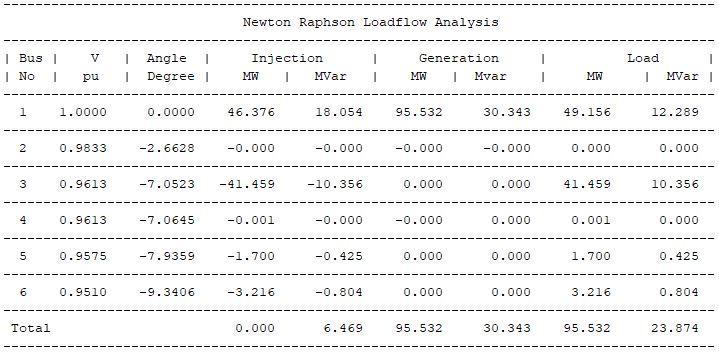
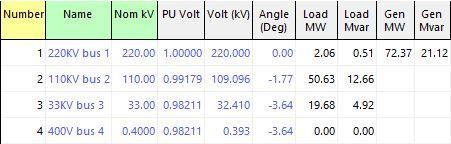
In this case the results of load flow analysis and voltage instabilitystudyofcircuit1asshowninfigure1isdiscussed. Figure3showstheresultsofNewtonRaphsonanalysisusing MATLAB of the six bus system given in figure 1. Figure 4 showslineflowsandlinelossesofcircuit1.Figure5shows themagnitudesandphaseanglesofthebusvoltagesusing MATLAB.Figure6givestheresultsofpowerflowanalysis usingPowerWorldsimulator.APVcurvewasplottedusing PowerWorldsimulatorfor11kvbus(busno.6)asshownin figure7.Theresultingchangesinthesystemcanbeseenin figure 8. The knee point of the curve is achieved at a pu voltage of 0.80462 and at a maximum load of 28.22MW. Capacitor compensation of 10Mvar is then provided by connectingcapacitorinshunttothe11kvbus(busno.6)and theimprovedresultscanbeseeninfigure9
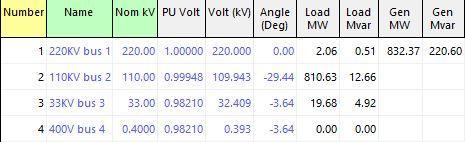
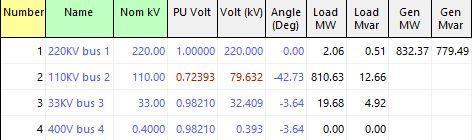
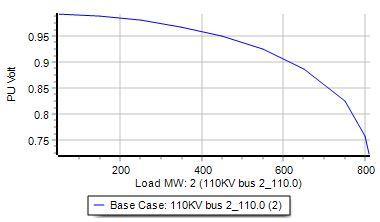
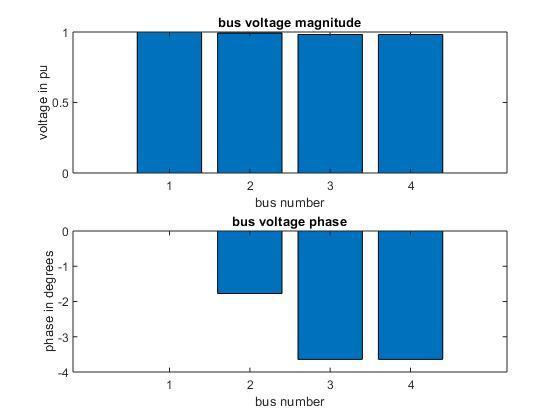
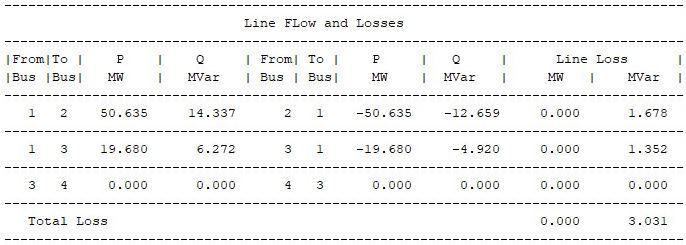
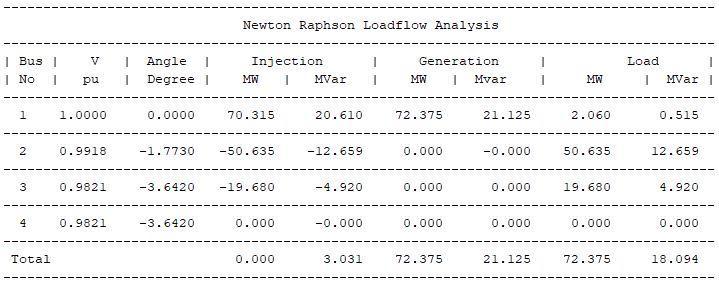
In this case the results of load flow analysis and voltage instabilitystudyofcircuit2showninfigure2isdiscussed. Figure 10 shows the results of Newton Raphson analysis using MATLAB of the four bus system given in figure 2. Figure11showslineflowsandlinelossesofcircuit2.Figure 12 shows the magnitudes and phase angles of the bus voltagesusingMATLAB.Figure13givestheresultsofpower flowanalysisusingPowerWorldsimulator.APVcurvewas plotted using PowerWorld simulator for 110kv bus (bus no.2) as shown in figure 14. The resulting changes in the systemcanbeseeninfigure15.Thekneepointofthecurve is achieved at a pu voltage of 0.72393 and at a maximum loadof810.63MW.Capacitorcompensationof224.8Mvaris thenprovidedbyconnectingcapacitorinshunttothe110kv bus(busno.2)andtheimprovedresultscanbeseeninfigure 16
4. CONCLUSIONS
In this paper Newton Raphson load flow analysis was performedusingMATLAB.Thevariouslineflowsandlosses were also noted. Also PV curve was plotted to study the voltageinstabilityofthepowersystemnetwork.Capacitor compensationisprovidedwiththehelpofshuntcapacitors, whichareconnectedinparalleltothepowersystem.Shunt capacitorsinjectreactivepowerintothesystem,whichhelps toraisethevoltagelevelandimprovevoltagestability.The findings highlight the importance of accurate load flow analysisfordeterminingsteady-stateoperatingpointsand the impact of voltage instability on power system performance.
REFERENCES
[1] D.P. Kothari, I.J. Nagrath, “Modern Power System Analysis”,4thed.,TataMcGraw-Hill,2011
[2] A.NagoorKani,“PowerSystemAnalysis”,1sted.,RBA Publications,1999.
[3] H.Saadat,“PowerSystemAnalysis,”McGraw-Hill,New York,1999.
BIOGRAPHIES
Mr. Mayur S. Sawant – Has receivedB.E.DegreeinElectrical& ElectronicsEngineeringfromGoa CollegeofEngineering,Farmagudi, Goa,India.Currentlyheispursuing M.E.inPowerandEnergySystem Engineering at Goa College of Engineering, Farmagudi, Goa, India.


Dr. Govind R. Kunkolienker - Has completed his graduation in Electrical Engineering from University of Bombay and PhD from India Institute of Science, Bangalore in High Voltage Engineering. Presently he is serving as Professor and Head of Electrical&ElectronicsEngg.Dept. at Goa College of Engineering, Farmagudi,Goa,India.