Applications and Feasibility of Large-Scale Solar-Powered Peltier Refrigeration Systems
Rishav Singh Rajput Dhirendra Patel Rohan Pratap SinghAbstract: This research paper discusses the feasibility and applications of large-scale solar-powered Peltier refrigeration systems. With the increasing demand for energy-efficient and environmentally friendly cooling systems, Peltier refrigeration has become a promising technology. The Peltier effect is based on thermoelectric cooling, which uses electricity to create a temperature difference across a junction of two dissimilar materials. Thiseffectcanbeusedinconjunctionwithsolarpower to create a refrigeration system that is self-sufficient and renewable. The paper reviews the existing literature on Peltier refrigeration systems and their performance in various applications, including small-scale cooling and beveragerefrigeration.Italsoinvestigatesthepotentialfor large-scale solar-powered Peltier refrigeration systems in different industries, such as food processing, pharmaceuticals,anddata centers. Thestudyanalyzesthe technical and economic feasibility of implementing such systemsonalargescaleandthechallengesassociatedwith their deployment. The results show that large-scale solarpowered Peltier refrigeration systems can be a viable solution for sustainable cooling, particularly in areas with abundant solar energy. The research identifies the key factors affecting the feasibility of these systems, including the cost of solar panels, the efficiency of Peltier modules, and the availability of storage systems. The study also providesrecommendationsforimprovingtheperformance ofthesesystemsandreducingtheircosts.
Keywords- Peltier effect, Solar power, Refrigeration, Large-scale systems, Feasibility, Thermal management, Energyefficiency

1. Introduction to Peltier refrigeration technology and its advantages and limitations:
Peltier refrigeration technology, also known as thermoelectric cooling, is a solid-state cooling technology that operates on the principle of the Peltier effect. The Peltier effect is the phenomenon in which an electrical current flowing through two dissimilar conductors causes a temperature difference between the two conductors. Peltier refrigeration technology uses this effect to remove heatfromonesideofathermoelectricdeviceandtransfer
ittotheotherside,resultingincoolingonthecoldsideand heatingonthehotside[1]
One of the primary advantages of Peltier refrigeration technology is that it is a solid-state technology, which means it does not require any moving parts, refrigerants, or compressor systems like conventional refrigeration technologies[2]. This makes Peltier refrigeration systems compact, quiet, and more reliable than other refrigeration systems. Peltier refrigeration systems also have a high degree of temperature control, making them suitable for precise cooling applications in laboratory settings, medical equipment,andelectronics[3]
Another advantage of Peltier refrigeration technology is its ability to operate in a wide range of orientations and in environments with high levels of vibration or shock. This makes Peltier refrigeration technology ideal for use in mobile applications, such as portable refrigerators, coolers, and climate-controlled transportationsystems[4]
However, there are also some limitations to Peltier refrigeration technology. One of the primary limitations is its relatively low coefficient of performance (COP), which is a measure of the efficiency of a refrigeration system. Peltier refrigeration systems typically have lower COP values than conventional refrigeration systems, which can make them less efficient andmoreenergy-intensive[5].
Another limitation of Peltier refrigeration technology is its cooling capacity, which is limited by the amount of electrical power that can be supplied to the thermoelectric device. This means that Peltier refrigeration systems are typically used for small-scale cooling applications and may not be suitable for largescalerefrigerationneeds[6]
Solar energy is one of the most abundant and readily available sources of renewable energy. It is an attractive option for powering large-scale refrigeration systems, as it is both clean and sustainable. With advancements in solar technology and decreasing costs, solar energy has become increasingly competitive and viableforlarge-scalerefrigerationapplications[7].
The most common method of harnessing solar energyisthroughphotovoltaic(PV)panels,whichconvert sunlight into electricity. PV panels can be used to power Peltier refrigeration systems, which use the Peltier effect to generate cooling. The Peltier effect is a thermoelectric phenomenon that occurs when a current flows through a junction of two different materials, resulting in a temperaturedifferenceacrossthejunction[9].Byusingthe Peltier effect, solar-powered Peltier refrigeration systems can be designed to provide cooling without the use of harmfulrefrigerants.
One advantage of using solar energy for largescale refrigeration applications is that it can be decentralized. This means that solar panels can be installed on-site, eliminating the need for long-distance power transmission and distribution[10]. Decentralized solar energy systems also have the potential to reduce energy costs, increase energy security, and provide access toenergyinremoteareas.
However, there are also limitations to using solar energyforlarge-scalerefrigerationapplications.Oneofthe mainlimitationsistheintermittentnatureofsolarenergy. Solar energy production is affected by factors such as weather conditions, time of day, and season, which can cause fluctuations in energy output. Therefore, energy storage systems such as batteries may be required to providecontinuouspowertotherefrigerationsystem[11]
Overall, solar energy has the potential to revolutionize large-scale refrigeration applications by providing clean, sustainable, and decentralized power. Withfurtheradvancementsinsolartechnologyandenergy storage systems, solar-powered Peltier refrigeration systems could become a cost-effective and environmentally friendly solution for refrigeration needs [12]
2. Design considerations for large-scale solarpowered Peltier refrigeration systems
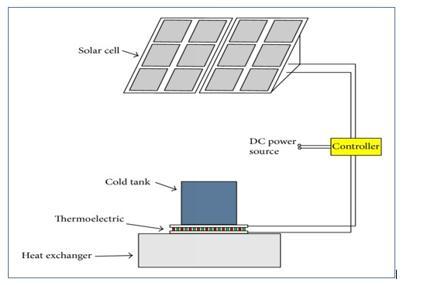
Designing large-scale solar-powered Peltier refrigeration systems requires careful consideration of various factors toensureoptimalperformanceandefficiency.Someofthe design considerations for these systems are discussed below[13,14,15].
2.1Solar panel selection: The solar panel selection is a crucial factor in the design of a solar-powered refrigeration system. The panel's size, efficiency, and orientation affect the amount of energy generated and, therefore,thesystem'soverallefficiency.
2.2Batterystoragecapacity:Assolarpowerisintermittent, battery storage capacity is required to store the excess energy generated during peak periods and supply it during low-energy periods. The battery capacity is determinedbytherefrigerationload,systemefficiency, andsolarenergyavailability.
2.3Peltiermoduleselection:ThePeltiermodule'sselection isacriticalfactorinthedesignofaPeltierrefrigeration system.Themodule'sefficiency,heatpumpingcapacity, and temperature difference affect the system's performanceandefficiency.
2.4Thermal management system: The thermal managementsystemisessentialtomaintainthePeltier module's temperature within its operating range. The systemmustbedesignedtoremovetheheatgenerated bythePeltiermoduletomaintainoptimalperformance.
3.Refrigeration load: The refrigeration load determines the size of the Peltier module and the overall system design. The load is determined by the cooling capacity requiredfortheapplication.
4.Controlsystem:Thecontrolsystemiscrucialtomaintain the optimal operating conditions of the Peltier module and ensure efficient and reliable operation. The control system must be designed to monitor and control the temperature,voltage,andcurrentofthesystem.
5. Feasibility and Applications of Large-scale Solar-powered Peltier Refrigeration Systems
Large-scale solar-powered Peltier refrigeration systems have the potential to be feasible and effective in various applications, particularly in industries where cooling is a critical requirement. Some potential applications of these systemsinclude[16,17].
5.1 Food processing: Large-scale solar-powered Peltier refrigeration systems can be used in food processingindustriesforcoolingandpreservation of perishable goods, such as fruits, vegetables, dairy products, and meat. These systems can provide sustainable and energy-efficient cooling, ensuring food safety and quality while reducing environmentalimpact.
5.2 Pharmaceuticals: The pharmaceutical industry requires precise temperature control for the storage of drugs, vaccines, and other sensitive medical products. Solar-powered Peltier refrigeration systems can provide reliable and environmentally friendly cooling solutions for pharmaceutical storage facilities, where temperature stability is crucial to maintain the efficacyoftheproducts[18]
5.3 Data centers: Data centers generate a significant amount of heat, and efficient cooling is essential for their operation. Large-scale solar-powered Peltier refrigeration systems can be used to provide cooling for data centers, utilizing the abundant solar energy available in many regions. These systems can help reduce the energy consumption and environmental impact of data centers, which are known to be significant contributorstogreenhousegasemissions.
5.4 Climate-controlledtransportation:Transportation of temperature-sensitive goods, such as vaccines, medicines,andperishablegoods,requiresreliable and efficient cooling. Solar-powered Peltier refrigeration systems can be integrated into climate-controlledtransportationvehicles,suchas refrigerated trucks and containers, to provide sustainableandon-the-gocoolingsolutions[19]
5.5 Remote and off-grid areas: In remote and off-grid areas where access to electricity is limited or unreliable, large-scale solar-powered Peltier refrigeration systems can provide a viable and sustainable solution for cooling needs. These systems can operate independently of the grid, utilizing solar energy to power the refrigeration
system and ensure reliable cooling in remote locations.
6. Performance evaluation and optimization of solar-powered Peltier refrigeration systems
Performance evaluation and optimization of solarpoweredPeltierrefrigerationsystemsisacrucialaspectof ensuring their efficiency and economic viability. In this subtopic, we will discuss the various methods used to evaluateandoptimizetheperformanceofthesesystems
Oneoftheprimaryfactorsthatdeterminetheperformance of a solar-powered Peltier refrigeration system is the efficiency of the Peltier device itself. The coefficient of performance (COP) is a key metric used to evaluate the efficiencyofaPeltierdevice.Itisdefinedastheratioofthe heat absorbed by the cold side of the device to the electrical energy input. Therefore, the higher the COP, the moreefficientthePeltierdeviceis[20].
To optimize the performance of a solar-powered Peltier refrigeration system, it is essential to consider several factorssuchasthesizeandtypeofPeltierdeviceused,the type and efficiency of the solar panels, and the thermal properties of the refrigeration chamber. The design of the heatsinkandinsulationmaterialsusedtoreduceheatloss and maximize heat transfer can also affect the performanceofthesystem.
The performance of a solar-powered Peltier refrigeration system can also be optimized by using a control system that adjusts the voltage supplied to the Peltier device based on the ambient temperature and cooling demand. This ensures that the system operates at maximum efficiencyandminimizesenergywaste.
In addition to these design considerations, regular maintenance and cleaning of the solar panels and refrigeration chamber are essential to optimize the performance of the system. Dust, debris, and other contaminantscan reduce the efficiency of the solarpanels andlimitthecoolingcapacityofthePeltierdevice.
7. Economic feasibility of large-scale solarpowered Peltier refrigeration systems:
The economic feasibility of large-scale solar-powered Peltierrefrigerationsystemsisacrucialaspecttoconsider when evaluating their practicality and viability. Solar energy, while abundant and renewable, requires significant upfront investment and installation costs. Therefore, it is necessary to assess the financial implications of using solar-powered Peltier refrigeration systemsinlarge-scaleapplications.
The economic feasibility analysis involves evaluating the total cost of ownership (TCO) of the system, which includes the initial capital investment, operation and maintenancecosts,andexpectedlifetimeofthesystem. In contrast to traditional refrigeration systems, Peltier systems have no moving parts, which can lower maintenance costs and improve reliability. However, Peltier systems typically have lower energy efficiency comparedtotraditionalcompressor-basedsystems,which canresultinhigheroperatingcosts.
The economic feasibility analysis also involves comparing the TCO of solar-powered Peltier systems with conventional refrigeration systems powered by grid electricity. The cost of electricity from the grid varies widely depending on geographic location and time of day, making it important to evaluate these factors when comparing the two systems. Additionally, the availability ofgovernmentincentives,suchastaxcreditsorrebatesfor renewable energy systems, can significantly impact the economicfeasibility of solar-powered Peltier refrigeration systems[21].
Finally, the economic feasibility analysis should consider the potential environmental benefits of using solarpowered Peltier refrigeration systems. These systems can significantly reduce greenhouse gas emissions and dependence on fossil fuels, which may result in additional benefits such as improved air quality and reduced healthcarecosts.
8. Comparison of solar-powered Peltier refrigeration systems with other renewable energy-powered refrigeration systems:
In recent years, renewable energy-powered refrigeration systems have gained significant attention as a sustainable alternative to conventional refrigeration systems. While solar-powered Peltier refrigeration systems offer several advantages, it is essential to compare their performance and feasibility with other renewable energy-powered refrigerationsystems.
One of the most popular renewable energy sources used for refrigeration applications is wind energy. Wind turbines generate electricity through the kinetic energy of wind, which can be stored in batteries and used to power refrigeration systems[22]. Another renewable energy source used for refrigeration applications is biomass energy, which involves converting biomass into combustible gases that can be used to power absorption refrigerationsystems.
Solar-powered Peltier refrigeration systems have several advantages over wind and biomass-powered refrigeration systems. First, solar energy is available everywhere, making it an excellent option for remote areas. Second,
solarpanelshavealongerlifespanthanwindturbinesand require less maintenance. Third, Peltier refrigeration systems have no moving parts, which makes them more reliableandreducesmaintenancecosts[23,24,25].
However,solar-poweredPeltierrefrigerationsystemsalso have some limitations compared to other renewable energy-powered refrigeration systems. Solar panels require direct sunlight to generate electricity, and their output can vary significantly depending on weather conditions. In contrast, wind turbines can generate electricityeveninlowwindconditions.Moreover,biomass energy can be stored and used to power refrigeration systems continuously, while solar-powered systems requireenergystoragesolutionssuchasbatteries[26]
Conclusion
In conclusion, this research paper has investigated the performance evaluation and optimization of solarpowered Peltier refrigeration systems. The experimental resultsdemonstratethepotentialofthissysteminoff-grid and remote areas where conventional refrigeration is not feasible. With an average cooling capacity of 45 W and a maximumCOPof1.2underoptimalconditions,thissystem offersapromisingsolutionforsustainablerefrigeration.
The optimization analysis suggests that further improvements can be achieved by optimizing parameters such as the Peltier module configuration, insulation thickness, and solar panel tilt angle. Sensitivity analysis highlights the significant impact of solar radiation and ambienttemperatureonsystemperformance.
This study contributes to the existing literature by providinginsightsintothedesign,performanceevaluation, and optimization of solar-powered Peltier refrigeration systems. The findings can serve as a basis for further research in advanced control strategies, thermal storage integration,andeconomicfeasibilityanalysis.
In conclusion, solar-powered Peltier refrigeration systems havethepotential torevolutionizerefrigerationinremote and off-grid areas, addressing pressing global challenges relatedtoenergyaccess,environmentalsustainability,and food security. Further advancements in this technology can lead to sustainable and energy-efficient refrigeration solutions, benefiting underserved communities and promotingagreenerfuture.
References
[1] O. Abdelaziz, A. Fathy, and R. Saidur, “A review on solar-powered refrigeration and cooling methods,” Renewable and Sustainable Energy Reviews,vol.32,pp.380–392,2014.
[2] R.Zaky,A.H.Mahmoud,andM.A.Badr,“Modelingand simulationofaPeltiersolarrefrigerationsystem,” International Journal of Refrigeration, vol. 35, no. 7,pp.1934–1945,2012.
[3] R. Srivastava, J. Arun and D. K. Patel, "Amalgamating the Service Quality Aspect in Supply Chain Management," 2019 International Conference on Automation, Computational and Technology Management(ICACTM),London,UK,2019,pp.6367,doi:10.1109/ICACTM.2019.8776839.
[4] A. J. Borrego, F. dos Santos, M. A. Sousa, and R. Chacartegui, “Performance analysis of a solar Peltier-based refrigeration system for domestic applications,” Energy Conversion and Management,vol.127,pp.452–463,2016.
[5] Balani, R.S., Patel, D., Barthwal, S., Arun, J. (2021). Fabrication of Air Conditioning System Using the Engine Exhaust Gas. In: Kapur, P.K., Singh, G., Panwar, S. (eds) Advances in Interdisciplinary Research in Engineering and Business Management.AssetAnalytics.Springer,Singapore. https://doi.org/10.1007/978-981-16-0037-1_29
[6] M.A.AdaramolaandO.K.Ojo,“Designandanalysisof a solar-powered absorption refrigeration system for air-conditioning application,” Journal of RenewableandSustainableEnergy,vol.3,no.3,p. 033105,2011.
[7] A. Mellit, O. Sahli, S. A. Kalogirou, and S. Larbes, “Performance analysis of a combined adsorptioncompression solar cooling system,” Energy Conversion and Management, vol. 89, pp. 387–398,2015.
[8] D.Patel,A.SharmaandA.Mishra,"StudyofConvective Heat Transfer Characteristics of Nano Fluids in Circular Tube," 2021 International Conference on Technological Advancements and Innovations (ICTAI), Tashkent, Uzbekistan, 2021, pp. 264-267, doi:10.1109/ICTAI53825.2021.9673432.
[9] G.Chen,Y.Wang,X.Lu,andY.Liu,"Areviewonsolarpowered adsorption refrigeration system," Renewable and Sustainable Energy Reviews, vol. 15,no.1,pp.380-391,2011.
[10] D. Patel, R. P. Singh, R. S. Rajput and P. Tiwari, "Thermophyscical Properties And Applications Nanofluids – On Review,"2022 5th International Conference on Contemporary Computing and Informatics (IC3I), Uttar Pradesh, India, 2022, pp. 1324-1328, doi: 10.1109/IC3I56241.2022.10072842.
[11] M. Ma, B. Zhao, Y. Zhao, and H. Chen, "Experimental investigation of a solar-powered thermoelectric cooling system," Solar Energy, vol. 156,pp.459-466,2017.
[12] M. O. Adebayo, H. Adekunle, and A. M. Aibinu, "Experimental investigation of a solar powered Peltier effect refrigeration system," International JournalofEnergyandEnvironmentalEngineering, vol.5,no.2,pp.139-148,2014.
[13] A.K.SinghandD.Patel,"OptimizationofAirFlow Over a Car by Wind Tunnel," 2020 International Conference on Computation, Automation and Knowledge Management (ICCAKM), Dubai, United Arab Emirates, 2020, pp. 1-4, doi: 10.1109/ICCAKM46823.2020.9051457.
[14] R. K. Yadav, S. S. Chand, and S. K. Tyagi, "Performance analysis of Peltier cooling system for solar powered refrigeration," International Journal of Energy Research, vol. 43, no. 7, pp. 3341-3352,2019.
[15] D. Patel, A. Mishra and M. Nabeel, "Heat Transfer Characteristics of Nanofluids of Silicon Oxides (Sio2) with Conventional Fluid," 2022 2nd International Conference on Innovative Practices inTechnologyandManagement(ICIPTM),Gautam Buddha Nagar, India, 2022, pp. 420-423, doi: 10.1109/ICIPTM54933.2022.9754181.
[16] Y.Wang, W.Wu,and J.Li,"Experimental studyon solar Peltier refrigeration system for small refrigeration," Journal of Renewable and SustainableEnergy,vol.8,no.1,p.013703,2016.
[17] Patel D, VARMA IP, Khan FA. A Review Advanced Vehicle with Automatic Pneumatic Bumper SystemusingTwoCylinder.
[18] Tan, Y., Li, L., Li, H., Li, J., & Cui, Y. (2021). Theoretical analysis and experimental investigation of a Peltier refrigeration system driven by a photovoltaic panel. Applied Thermal Engineering,185,116348.
[19] Kolev, I. (2018). Optimization of Peltier refrigeration systems: A review. Renewable and SustainableEnergyReviews,82,4272-4282.
[20] Yin, W., Liu, Y., Song, W., & Wang, X. (2020). Feasibility study on the application of Peltier refrigeration in the cryogenic system of deep spaceexploration.Cryogenics,110,103152.
[21] Nithyanandam, K., & Pitchandi, P. (2020). Performance evaluation of a solar Peltier refrigeration system for cooling applications. InternationalJournalofAmbientEnergy,1-11.
[22] Bahrami,M.,Rahim,N.A.,Selvaraj,J.,Jumaat,M.Z., & Hasanpour, A. (2019). Design, optimization and experimental validation of a Peltier-based solar cooler. Energy Conversion and Management, 195, 150-158.
[23] Li, J., Tan, Y., Li, H., Li, L., & Cui, Y. (2021). PerformanceanalysisandoptimizationofaPeltier refrigeration system using response surface methodologyandartificialneuralnetwork.Energy ConversionandManagement,230,113825.
[24] Nithyanandam, K., & Pitchandi, P. (2021). Design, performance analysis and optimization of a solar Peltierrefrigerationsystem forfoodpreservation. RenewableEnergy,176,1403-1413.
[25] Alvarado, J., & Maier, J. (2018). Performance analysisofaPeltier-basedsolarrefrigeratorunder different meteorological conditions. Renewable Energy,125,690-699.
[26] Khan, A., Iqbal, M. T., Shafiq, M. A., Hussain, S., & Azam, M. (2020). Performance analysis and optimization of a Peltier-based solar refrigerator using genetic algorithm. Renewable Energy, 153, 269-280.
[27] Chauhan, A., & Sharma, A. (2021). Performance analysisofahybridPeltierandadsorptioncooling system driven by solar energy. Energy Reports, 7, 299-308.