A Sustainable Decipher of Egyptian Hieroglyphs
Karthik Variath Divakaran Shiyas Ahamed S1 Tushar Renji Thoonkuzhy S.21B.Tech student, Department of Computer Science and Engineering, Rajagiri School of Engineering & Technology, Kerala, India
2Assistant Professor, Department of Computer Science and Engineering, Rajagiri School of Engineering & Technology, Kerala, India

Abstract - This paper presents various approaches for recognizing Egyptian hieroglyphs using machine learning techniques. Egyptian hieroglyphs represent a complex system of writing used in Ancient Egypt for over 3,000 years, which poses a substantial challenge for recognition due to the huge number of symbols and their variability in form and form. Documentation of the culture and language of different civilizations has been a critical component of human history, allowing us to preserve and communicate knowledge across time and space. Our system, which utilizes machine learning and image recognition to recognize and interpret ancient Egyptian hieroglyphs, is an important part of this ongoing movement to preserve and share knowledge for future generations. Our approach leverages the ability of neural networking to accurately recognize and classify hieroglyphs based on their visual features. Our system is able to recognize hieroglyphs from hand-drawn images/doodles of hieroglyphs and a live video feed. The proposed system is created entirely from scratch, with no usage of any pre-existing models or any pre-existing datasets. We trained and evaluated our model on a large dataset of manually created hieroglyphic images. We follow our own architecture of the neural networkfortraining purposes. Experiments show that our model achieves a covetable accuracyforhieroglyphrecognition. Ourapplication has the potential to revolutionize the field of Egyptian hieroglyphs decipherment and make them more accessible to scholars and the general public.
Key Words: Ancient Egyptian hieroglyphs, Image recognition and classification, Machine learning, ConvolutionalNeuralNetworks,JavaScript,p5.js,ml5.js.
1. INTRODUCTION
Egyptian hieroglyphs are a system of writing that was usedinancientEgyptfromabout3200BCEuntiltheendof the 4th century CE. The hieroglyphic script was used to compose a variety of texts, including administrative documents, religious texts, and literature [7]. Despite the scriptbeingancient,thereisstillmuchtobelearnedaboutit, and advances in machine learning have created new opportunities for understanding and interpreting these symbols.
Documentationhasplayedacrucialpartintheprogressof civilization, allowing us to learn from the past and build upontheachievementsofpreviousgenerations.Throughout history, documentation has taken several forms, ranging from stone tablets and papyrus scrolls to books and electronicmedia.Inrecentyears,theproliferationofdigital technologyhasbroughtaboutaneweraofdocumentation, withhugeamountsofdatabeingcreatedandstoreddigitally everyday[17].Aswecontinuetoproduceandconsumean ever-increasingamountofinformation,itismoreimportant thanevertodevelopefficientdocumentationsystemsthat can manage and maintain this knowledge for future generations. Our work is an important component of this effort,asitseekstoproducearobustandeffectivesystem forrecognizingandtranslatingancientEgyptianhieroglyphs. Byaccuratelydocumentingandtranslatinghieroglyphs,our workcanhelppreserveandsharetheknowledgeandculture of one of the oldest civilizations in human history. This is especially crucial given the fragile nature of many hieroglyphicartifactsandthelimitednumberofexpertswho areabletostudyandtranslatethem[17].Byleveragingthe recent advancement in machine learning and image recognition,ourpaperaimstomakehieroglyphictranslation moreaccessibleandaccuratethaneverbefore,contributing to the broader goal of preserving and sharing knowledge acrossgenerations.
Neuralnetworksareatypeofmachinelearningthathas become increasingly popular in recent years. They are designedtomimicthewaythatthehumanmindworks,and areespeciallyeffectiveatrecognizingpatternsindata[1][5]. This makes them ideal for image classification tasks, such as identifying hieroglyphs [6]. The use of neural networks for image classification has opened up new possibilitiesforunderstandingthehieroglyphicscriptandits significance. The study of hieroglyphs has a long and rich history. The hieroglyphic script is a complex system of writing that combines both phonetic and ideographic elements.Thescriptconsistsofover700individual signs, eachofwhichhaveitsownsignificanceandsignificance[7]. Thescriptwasfirstdecipheredintheearly19thcenturyby Jean-FrancoisChampollion,whousedtheRosettaStoneto unlockthesecretoftheancientscript.Sincethen,scholars havemadelargestridesinunderstandingthegrammarand vocabularyofhieroglyphs.However,thereisstillmuchthat
remainsobscureaboutthescript,especiallyinregardtothe waythatitwasusedindailylife[7].
Thispaperaimstoexploretheroleofneuralnetworksin the identification of Egyptian hieroglyphs. The paper will then describe the architecture of the system and the methodology used for training and testing the neural network.Thiswillincludeadiscussionofthedatasetused fortrainingthenetwork,aswellasthepre-processingsteps that were taken to develop the data. The paper will also describe the architectureof the neural network,including thenumberoflayers,andtheactivationfunctionused.The paper will then demonstrate the results of the neural network,includingitsaccuracyandperformance.Finally,the paper will conclude with a discussion of the possible applications of the developed system for the study of hieroglyphsandlinguistics
2. LITERATURE SURVEY
Fujita M., [8], et al. propose a system for detecting hieroglyphs in images using deep convolutional neural networks. Their scheme consists of two stages: first, candidate regions are extracted from the image using a regionproposalnetwork,andthenaCNNisusedtoclassify eachcandidateregionaseitherahieroglyphorbackground. Theauthorsgatheredadatasetof3,506imagescontaining hieroglyphs and non-hieroglyphic symbols, and used it to developandevaluatetheirsystem.Theauthorsexperimented withvariousCNNarchitectures,includingVGG-16,ResNet, andInception-v3,andfoundthatInception-v3achievedthe bestperformancewithanaccuracyof99.15%ontheirtest set.Oneinterestingaspectofthispaperistheauthor’suseof a visualization technique called Grad-CAM to generate heatmapsshowingtheregionsoftheimagethatweremost importantfortheCNN'sclassificationdecision.Theyfound thattheCNNwasabletofocusoncharacteristicfeaturesof hieroglyphs,suchascertainshapesandpatterns,tomakeits decisions.
Amin,M.A.,[9],etal. proposeahieroglyphrecognition systembasedondeeplearningtechniques.Theyuseadataset of736hieroglyphimages,whichwerepre-processedusing edgedetectionandbinarizationtechniques.Theauthorsthen developaCNNmodelonthisdatasetandachieveanaccuracy of95.65%ontheirtestset.Theyalsocomparetheirapproach totraditionalcomputervisiontechniquessuchastheScaleInvariant Feature Transform (SIFT) and the Speeded Up Robust Feature (SURF) algorithms, which achieve lower accuracy of 89.13% and 91.3%, respectively. The authors conclude that deep learning-based approaches are more efficient for hieroglyph identification than traditional computervision.
Kulkarni, A. R., [10], et al. the research discusses a hieroglyphrecognitionschemebasedonCNNs.Theyusea datasetof1536hieroglyphimages,whichweresplitinto12
classes based on their form and structure. They also performed data augmentation to increase the size of the dataset.Theauthorsusetransferlearningtofine-tunepretrained CNN models, including VGG-16, Inception-v3, and ResNet-50, on their hieroglyph dataset. They compare the performanceofthedifferentmodelsandfindthatResNet-50 achievedthehighestaccuracyof96.9%ontheirtestset.The authors also analyzed the confusion matrix to identify the most challenging hieroglyph classes for recognition. They foundthatsomeclasses,suchas"Eye"and"ReedLeaf,"were easier to distinguish than others, such as "Scepter" and "Spear". The authors note that their proposed scheme has severallimitations,includingthelimitedsizeofthedataset andthelack ofvariabilityintheimages.Theysuggestthat futureresearchshouldconcentrateoncollectingabiggerand more diverse dataset of hieroglyphs to improve the performanceofrecognitionsystems.
Elshamy,M.,[11],etal.discussesahybridapproachfor hieroglyphidentificationthatcombines2typesoffeatures: shape-basedfeaturesandtexture-basedfeatures.Theyuseda datasetof3200hieroglyphimages,whichweresplitinto32 classes based on their form and meaning. For the shapebasedfeatures,theauthorsusetheFourier-Mellintransform (FMT) to extract rotation, scale, and translation invariant featuresfromthehieroglyphimages.Forthetexture-based features, they use a local binary pattern (LBP) operatorto extract texture features from the hieroglyph images. The authorsuseak-nearestneighbor(k-NN)classifiertosortthe hieroglyph image based on their extracted features. They comparetheperformanceoftheirhybridapproachwiththat ofusingonlyshape-basedfeaturesortexture-basedfeatures. They find that their hybrid approach achieved the highest accuracy of 98.8% on their test set. The authors note that their proposed hybrid approach is robust to variation in rotation, scale, and translation and can handle the identificationofhieroglyphswithdifferenttextures.
Atallah, Y., [12], et al. bases their approach on a threestagepipeline,wheretheinputimageisfirstpreprocessedto removeinterferenceandenhancethecontrast.Then,feature extraction is performed on the preprocessed image using Histogram of Oriented Gradients (HOG) and Local Binary Pattern(LBP)techniques.Finally,theextractedfeaturesare classifiedusingaSupportVectorMachine(SVM)algorithm. Theauthorsevaluatedtheirapproachusingadatasetof28 hieroglyphsandachievedanaccuracyof89.29%.Tofurther assesstheperformanceoftheirapproach,theycompareitto other state-of-the-art techniques, such as Bag-of-Features (BoF) and Convolutional Neural Networks (CNNs). The resultsshowthattheirproposedapproachoutperformedthe other techniques, achieving high accuracy with low computationalcomplexity.Additionally,theusageofHOGand LBPforfeatureextractionallowsforthedetectionoftexture and pattern information, which are crucial for hieroglyph recognition.
3. PROPOSED SYSTEM
The system we have developed is an application that allowsuserstoinputhieroglyphiccharacters,eitherthrough text, doodles, or through a live video feed, and get the corresponding English character or its meaning. The application is designed for people who are interested in learningtheancientEgyptianlanguageorscholarswhoare studyingancientEgyptiantexts.Ourrecognitionsystemisan application that allows users to input hieroglyphic characters, either through text or doodles, and get the correspondingtranslationofthecharacter.Theapplication is designed for people who are interested in learning the ancient Egyptian language or scholars who are studying ancientEgyptiantexts.ThesystemconsistsofanEnglish-tohieroglyphconverter,ahieroglyphicdoodlerecognizer,and ahieroglyphicwordrecognizerthatrecognizeshieroglyphs fromavideofeed.
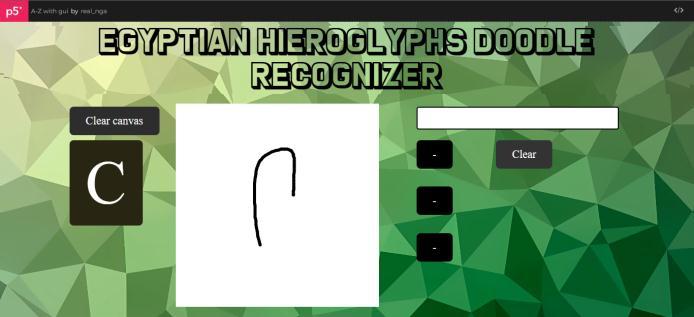
The Hieroglyphic doodle recognizer is one of the core features of the application. It is designed to recognize hieroglyphs from hand-drawn sketches. The doodle recognizeriscodedinp5.js,aJavaScriptlibraryforcreative coding[13],andthemodelfortherecognitionismadefrom ml5.js,amachinelearninglibrarythatoffersarangeofpretrained models for image and audio recognition [14]. The datasetusedfortrainingthemodelismanuallycreatedby generatingrandomimagesofasinglehieroglyphcharacter. Themodelistrainedusingaconvolutionalneuralnetwork (CNN) architecture, which is a deep learning architecture commonlyusedforimagerecognitiontasks[15].Thedoodle recognizerworksbytakinganinputimageofahand-drawn hieroglyph character and processing it through the CNN model. The model then predicts the corresponding hieroglyphic character from the input image. The hieroglyphicdoodlerecognizerisavaluablefeatureforusers who want to practice drawing hieroglyphic characters or whohaveencounteredanunfamiliarhieroglyphiccharacter andwanttoquicklyidentifyit.
The hieroglyphic word recognizer is a feature that recognizeshieroglyphicwordsfromavideofeed.Theword recognizer is also coded in p5.js, and the model for the recognition is made from ml5.js. The dataset used for trainingthemodelismanuallycreatedbyrecordingvideos ofeachhieroglyphwordandextractingframesofthevideo to provide as input for the training. The word recognizer worksbytakinganinputvideostreamandprocessingeach framethroughtheCNNmodel.Themodelthenpredictsthe correspondinghieroglyphicwordfromtheinputvideo.The Hieroglyphwordrecognizerisavaluablefeatureforusers whowanttotranslateancientEgyptiantextsthatareinthe formofhieroglyphicinscriptionsontemplewallsorpapyri.
3.1 System Architecture
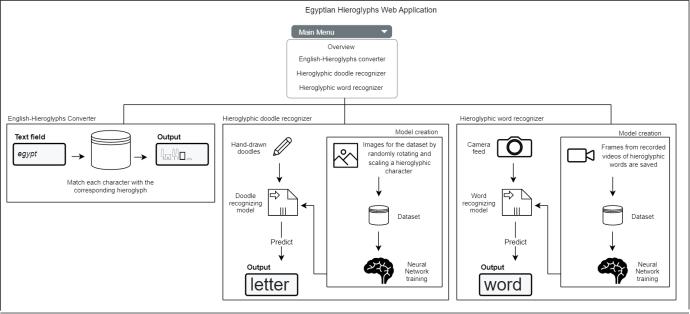
Thearchitectureofourhieroglyphicrecognitionsystem consistsofthreemaincomponents:anEnglish-to-hieroglyph converter, a hieroglyphic doodle recognizer, and a hieroglyphicwordrecognizer.Thearchitecturediagramis depictedinFig-1.
Fig -1: Architecturediagramoftheproposedsystem
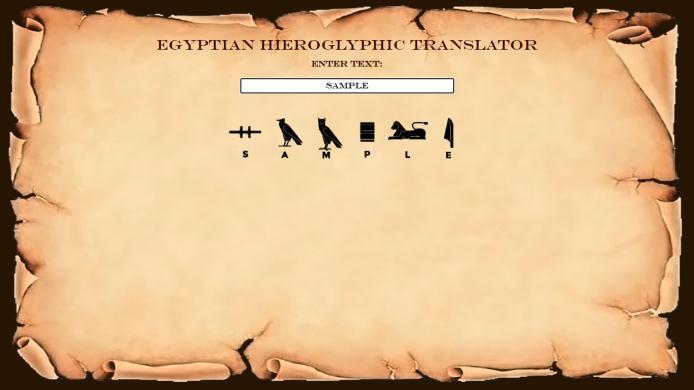
The English-to-hieroglyph converter is responsible for converting English words into Hieroglyphic symbols. This componentusesaninternallystoreddatabaseofcharacter mappings to generate a hieroglyphic symbol sequence for the corresponding English text. The hieroglyphic doodle recognizer is designed to recognize hieroglyphic symbols from freehand drawings or doodles made by users. This component uses machine learning techniques such as convolutional neural networks (CNNs) to recognize the shapeandpatternofthedoodlesandmatchthemtoknown hieroglyphicsymbolsinitsdatabase.Thehieroglyphicword recognizer is responsible for recognizing hieroglyphic symbolsthathaveawordmeaningfromavideofeed.This component uses similar machine learning techniques by using a model trained from recorded video frames to distinguishindividualhieroglyphicsymbolsfromthevideo feedandthenmatchthemtoknownwords.
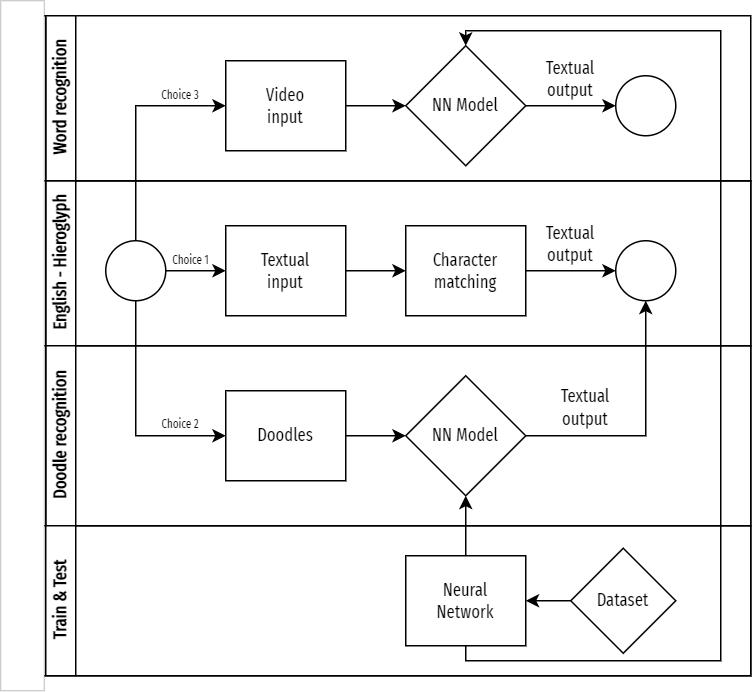
Figure -2 depicts the swimlane diagram of the same proposedsystem.Theswimlanediagramwouldbeginwitha sectionwheretheuserisabletochoosebetweeneachpart ofthesystem.FortheEnglish-to-hieroglyphconverter,the inputisintheformofEnglishtext.Theconverterwouldthen convert the English text into Hieroglyphic characters by phonetically matching each character. The Hieroglyphic doodle recognizer uses a trained CNN model for its recognitionpurpose,wheretheinputisintheformofhanddrawndoodles.Thethirdpartisthewordrecognizerwhere aCNNmodelisusedforclassificationpurposes.Thereisan extra lane for the neural network training process for developingthemodelforthedoodleandwordrecognizers.
Thearchitectureofthemodelforthedoodlerecognizer iscomposedofseverallayersandisshowninFigure-3.
correspondstothe4 colorchannels(red, green, blue,and alpha). The output of the network is a probability distributionover26classes,whichrepresentseachletterof theEnglishalphabet.
Thearchitectureofthewordrecognizercontainsextra layers for the network due to the requirement for classificationfromalivevideofeed.ItisdepictedinFigure-4.
Thefirstlayerisaconvolutionallayer,whichapplies8 filtersofsize5x5totheinputimage.Thestrideissetto1 andtheactivationfunctionisRectifiedLinearUnit(ReLU). This layer extracts features from the input image. The second layer is a max pooling layer, which reduces the spatialdimensionsofthefeaturemapsbyafactorof2.The poolingsizeissetto2x2andthestrideisalsosetto2.The thirdlayerisanotherconvolutionallayer,whichapplies16 filters of size 5x5 to the feature maps from the previous layer. The stride is set to 1 and the activation function is ReLU. This layer further extracts more complex features from the previous layer. The fourth layer is another max poolinglayer,whichreducesthespatialdimensionsofthe featuremapsbyafactorof2.Thepoolingsizeissetto2x2 andthestrideisalsosetto2.Thefifthlayerisaflattening layer,whichconvertsthefeaturemapsintoa1-Dvectorby stacking them. The last layer is a dense layer with the softmax activation function. This layer takes the flattened feature vector as input and produces a probability distribution over the 26 output classes. The input to the network is a 64x64x4 image, where the last dimension
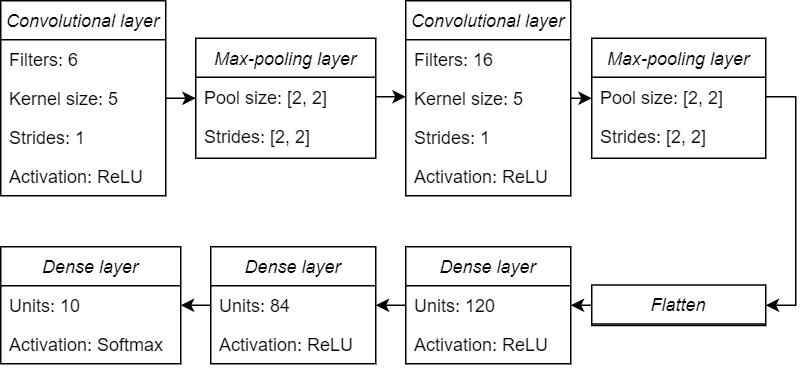
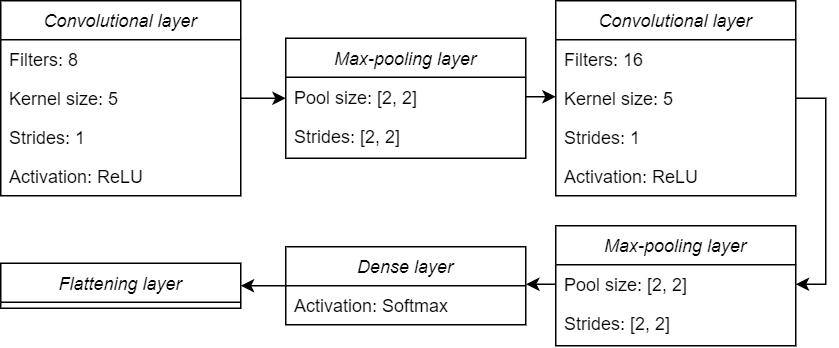
Fig -4: CNNarchitectureofthewordrecognizer
Thefirstlayerisaconvolutionallayerwith6filtersanda kernel size of 5x5 pixels. The layer applies the ReLU activationfunctiontotheoutput.Thesecondlayerisamax poolinglayerwithapoolsizeof2x2pixelsandastrideof2 inbothdimensions.Thethirdlayerisanotherconvolutional layerwith16filtersandakernelsizeof5x5pixels.TheReLU activationfunctionisappliedtotheoutput.Thefourthlayer isanothermaxpoolinglayerwiththesameparametersas the previous one. The fifth layer is a flattening layer that converts the output of the previous layer into a 1dimensionalarray.Thesixthlayerisadenselayerwith120 unitsandtheReLUactivationfunction.Theseventhlayeris anotherdenselayerwith84unitsandtheReLUactivation function.Theeighthandfinallayerisadenselayerwith10 unitsandthesoftmaxactivationfunction,whichproducesa probabilitydistributionoverthe10possibleoutputclasses. Theinputtothenetworkisa64x64x4image,wherethelast dimension represents the four color channels (red, green, blue,andalpha)oftheimage.Theoutputofthenetworkisa probabilitydistributionoverthe10possibleoutputclasses.
3.2 Experimental setup
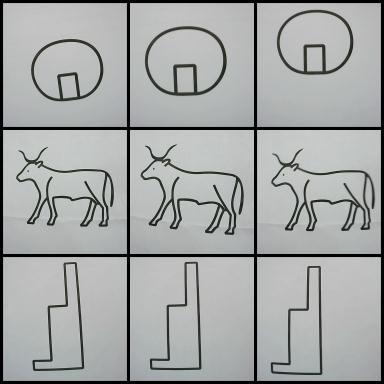
Oneofthekeychallengesindevelopingoursystemwas the limited availability of training data. As a result, we resortedtomanuallycreatingourowntrainingdataset.This isdonebygeneratingimagesviacodebythemanipulationof alreadyexistingimagesofASCIIcharactersofhieroglyphs andrandomizingthem.Thisisdoneasfollows:Initially,the canvasiscreatedwithawidthandheightof400pixels.The imagefileofthecharacterisloadedbeforeitismanipulated. Thebackgroundofthecanvasissettowhiteandarandomx andyposition isgenerated andthe imageisplacedat the coordinates,whileensuringthattheimagewillnotbeplaced tooclosetotheedgesofthecanvas.Theimageisalsothen
randomlyscaledandrotated.Aftersufficientmanipulations aredone,thecurrentframeissavedasaPNGfileinafolder afterdownscalingitdowntoadimensionof64x64pixels. TheresultoftheimagegenerationisshowninFigure-5
user interfaces [13]. ml5.js, on the other hand, is a library thatsimplifiestheprocessofintegratingmachinelearning intowebapplications.ItisbuiltontopofTensorFlow.js,a popular machine learning library for JavaScript, and providesasetofpre-trainedmodelsandtoolsfortraining and evaluating custom models. ml5.js can be used for a variety of machine learning tasks, such as image classification, object detection, text generation, and audio analysis[14].Therequirementsfordevelopmentinp5.jsand ml5.jsarerelativelystraightforward.Theyconsistofatext editor or integrated development environment (IDE) to writeyourcode,a webbrowser toview andtestthep5.js sketches and ml5.js models, and a server or cloud-based platformtohostthetrainedmodel[16].
4. PERFORMANCE EVALUATION
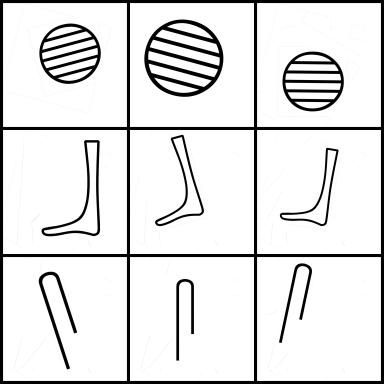
Wefollowasimilarmethodologyforgeneratingthedataset forthehieroglyphicwordrecognizer.Inthisparticularcase, we created our own dataset by recording videos of the words we wanted to recognize. A webcam was used to capturethesevideos.Fromthesevideos,wethenextracted frames to use as individual data points in their dataset. A frame is a still image that is captured from a video at a specificpointintime,andinthiscase,itwouldrepresenta single observation in the dataset. Once the frames are extracted, they are labeled or annotated with information aboutwhatisintheimage.Figure-6showstheresultofthe mentionedsteps.
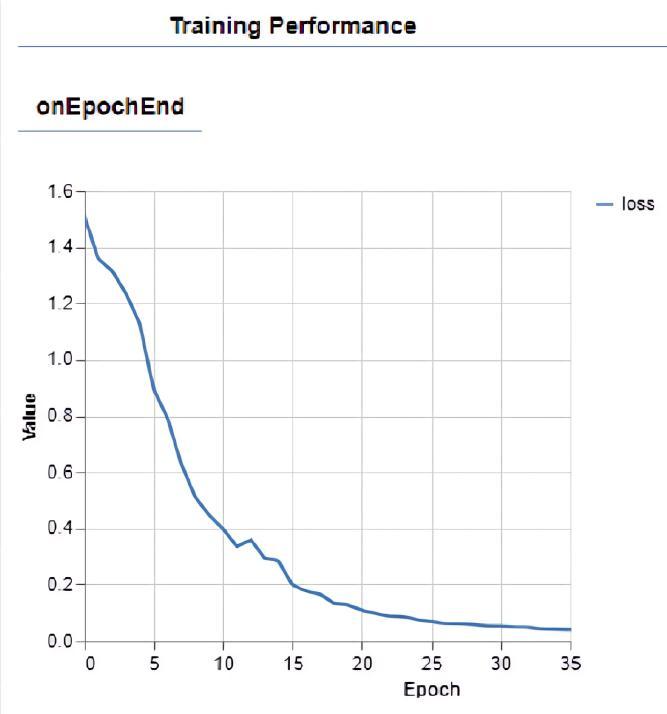
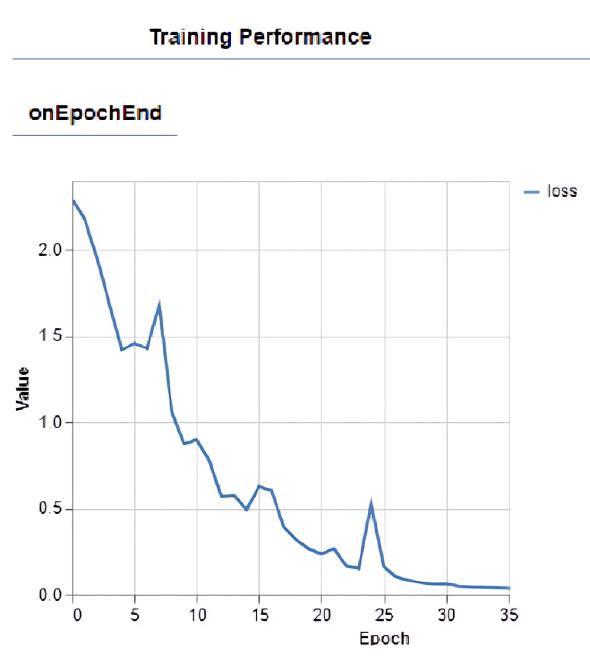
Bothcomponentsofoursystem,i.e.,thedoodlerecognizer andthewordrecognizerweretrainedfor35epochswitha dataset consisting of 4,030 images and 2,000 images respectively. We found that the model producing the best accuracywereofthearchitecturementionedintheprevious section.Thedoodlerecognizerandwordrecognizerproduce alossof0.09and0.10respectively.Thisisdepictedinfigure 6.1.Asseenfromfigures7and8,theendarchitecturefitsthe datawellasthevalidationlosshasmoreorlessconverged after the 30th epoch. Furthermore, fig 6.2 shows the accuracies achieved by doodle recognizer and word recognizer: 1. Final accuracy: 89.97% & 85.64. top-3 accuracy:86.71%&82.44%.
Oursystemisprimarilycodedinp5.jsandml5.js.p5.jsisa librarythatsimplifiestheprocessofcreatinginteractiveand creativegraphics,animations,andvisualizationsfortheweb. ItisbuiltontopoftheJavaScriptprogramminglanguageand providesasetoffunctionsandmethodsthatmakeiteasyto make shapes, manipulate images, play sounds, and make
5. RESULTS
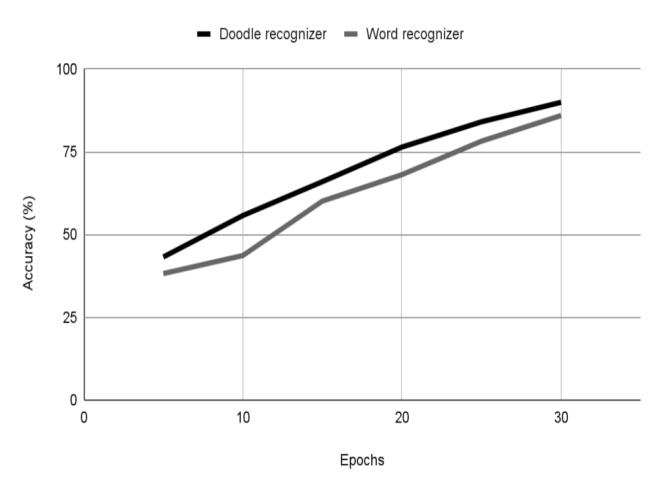
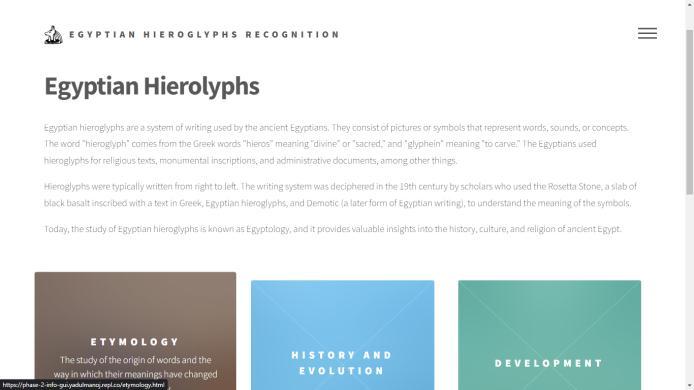
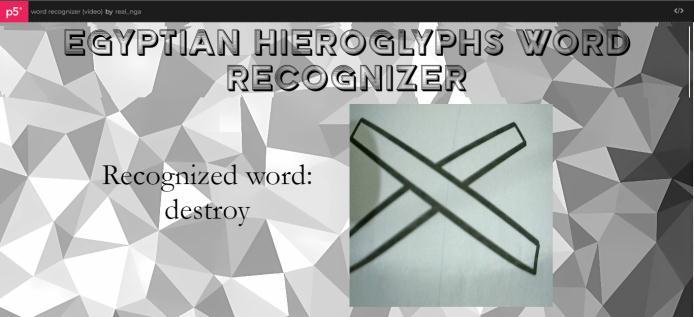
Figures 10, 11, 12, 13, 14 demonstrate the Egyptian hieroglyphs recognition system we have developed. The application can be run on any normal web browser with webcamfacilities.
6. CONCLUSIONS
Inthispaper,weproposedtodevelopasystemthatisableto recognizeEgyptianhieroglyphsthroughtwomainmethods, hand-drawn doodles and through a live video feed. Our system is developed purely from scratch without any assistance from pre-trained models or readily available datasets. Everything in our system is created manually, including the models used for classification purposes. Additionally, our application also includes an English-tohieroglyph converter, which can be used to quickly familiarizewiththehieroglyphiclanguagesystem.Another important aspect to highlight in the application is the performance. The system was able to generate a final accuracyof89.97%.Aspartofthepotentialareasforfuture researchanddevelopment, the existingcapabilitiesof our system could be expanded to recognize more complex hieroglyphicinscriptionsortotranslatehieroglyphictexts intootherlanguages.Thesystem'sperformancecouldalso beimproved,suchasthroughtheintegrationofadditional machine learning algorithms or the use of more sophisticatedcomputervisiontechniques.Furthermore,our systemcanbeexpandedtoavarietyoffieldslikehistorical andarchaeologicalstudies,andlanguagepreservationandis applicabletootherscriptsandlanguageswithasimilarlevel of complexity. This could fundamentally alter the field of study of Egyptian hieroglyphs and increase public and scholarly interest in them. Our work is a testament to the enduring importance of documentation and its use in preserving and sharing knowledge across generations. By contributingtothiseffort,ourworkseekstoensurethatthe richhistoryandcultureofancientEgyptarenotlosttotime and that succeeding generations have access to the knowledgeandwisdomofourpredecessors.
STUDY LIMITATIONS
Hieroglyphic inscriptions can be highly complex, with variousgrammaticalandsemanticstructures.Thismadeit challengingtodevelopasystemtoaccuratelyrecognizeand interpret the meaning of individual Hieroglyphs and their interactionswithinalargerinscription.Duetothisdifficulty, we decided to develop an application that recognizes rudimentaryhieroglyphiccharactersandwords.Finally,the
number of individuals who are proficient in reading and writingHieroglyphsisrelativelysmall,whichcanlimitthe resources available for maintaining and updating such a system.
REFERENCES
[1] I.Goodfellow,Y.Bengio,andA.Courville,DeepLearning. Cambridge, MA, USA: MIT Press, 2016. [Online]. http://www.deeplearningbook.org M. Young, The TechnicalWriter’sHandbook.MillValley,CA:University Science,1989.
[2] G.Carleo,I.Cirac,K.Cranmer,L.Daudet,M.Schuld,N. Tishby, L. Vogt-Maranto, and L. Zdeborová, ‘‘Machine learningandthephysicalsciences,’’Rev.Mod.Phys.,vol. 91, Dec. 2019, Art. no. 045002, doi:10.1103/RevModPhys.91.045002.
[3] M. Reichstein, G. Camps-Valls, B. Stevens, M. Jung, J. Denzler,N.Carvalhais,andM.Prabhat,‘‘Deeplearning andprocessunderstandingfordata-drivenEarthsystem science,’’Nature,vol.566,pp.195–204,Feb.2019.
[4] K.Yu,A.Beam,andI.Kohane,‘‘Artificialintelligencein healthcare,’’NatureBiomed.Eng.,vol.2,no.10,pp.719–731,2018.
[5] C.Scapicchio,M.Gabelloni,A.Barucci,D.Cioni,L.Saba, and E. Neri, ‘‘A deep look into radiomics,’’ La Radiol. Medica,vol.4,pp.1–16,Jul.2021.
[6] J.Duque-Domingo,P.Herrera,E.Valero,andC.Cerrada, ‘‘Deciphering Egyptian hieroglyphs: Towards a new strategy for navigation inmuseums,’’Sensors,vol.17, no. 3, p. 589, 2017. [Online]. Available: https://www.mdpi.com/1424-8220/17/3/589
[7] A. Gardiner, Egyptian Grammar. Oxford, U.K.: Griffith Institute,1957.
[8] Fujita,M.,Tamura,Y.,Takiguchi,T., &Aoki, Y.(2019). Hieroglyph detection based on deep convolutional neuralnetworks.InternationalJournalofHeritageinthe DigitalEra,8(1),129-138.
[9] Amin, M. A., Abdelsamea, M. M., & Mohamed, M. A. (2019).HieroglyphicRecognitionSystemBasedonDeep LearningTechniques.JournalofKingSaudUniversityComputerandInformationSciences,31(1),81-89.
[10] Kulkarni,A.R.,&Chandak,M.S.(2019).Recognitionof Egyptian Hieroglyphics using Convolutional Neural Network.InternationalJournalofScientificResearchin Computer Science, Engineering and Information Technology,5(2),404-408.
[11] Elshamy, M., Helala, M., & Elgharib, M. (2018). Hieroglyphrecognitionusingdeepconvolutionalneural networks. International Journal of Computer Applications,179(30),25-30.
[12] Atallah,Y.,AbdElMageed,N.2019.Ahybridapproach forancientEgyptianhieroglyphrecognition.Journalof Imaging,5(5),60.
[13] B. Mechtley and A. Johnson, "Teaching and Learning CreativeCodingwithp5.js:ACaseStudy",Proceedings of the 2017 ACM SIGCSE Technical Symposium on Computer Science Education, March 2017. DOI: 10.1145/3017680.3017724
[14] S.Yang,S.Goh,andG.Ressler,"ml5.js:MachineLearning fortheWebinJavaScript",Proceedingsofthe2018CHI Conference on Human Factors in Computing Systems, April2018.DOI:10.1145/3173574.3174218
[15] L.DengandD.Yu,"DeepConvolutionalNeuralNetworks for Image Classification: A Comprehensive Review", IEEE Transactions on Neural Networks and Learning Systems,DOI:10.1109/TNNLS.2014.2344017
[16] K. Santhosh and S. K. Venkatesan, "Visualizing ConvolutionalNeuralNetworkswithml5.jsandp5.js", Proceedings of the 2019 International Conference on ComputerVisionandImageProcessing,December2019. DOI:10.1109/ICCVIP46957.2019.8977402
[17] R.Parkinson,"TheRosettaStoneandtheDecipherment ofHieroglyphs,"Antiquity,vol.92,pp.1484-1497,2018.
BIOGRAPHIES
Karthik Variath Divakaran is a B.Tech Computer Science and Engineering student at Rajagiri School of Engineering & Technology,Kerala,India.
Shiyas Ahamed S is a B.Tech ComputerScienceandEngineering student at Rajagiri School of Engineering&Technology,Kerala, India.



Tushar Renji Thoonkuzhy is a B.Tech Computer Science and Engineering student at Rajagiri School of Engineering & Technology,Kerala,India.
YadulManoj isaB.TechComputer ScienceandEngineeringstudentat Rajagiri School of Engineering & Technology,Kerala,India.

Mr. Ajith S. is an Assistant ProfessorintheDepartmentofCSE ofRajagiriSchoolofEngineering& Technology. HecompletedhisB.E in CSE from SDMCET, Dharwad, and M.Tech in Computer Science fromSRMUniversity,Chennai.