Prediction of Heart Disease Using Machine Learning and Deep Learning Techniques.
Spurthi S R1, Shree Subeeksha G2 , Keerthi M S3 , Kavya P4, Dr. Gururaj Murtugudde51, 2, 3, 4Student, Dept. of Computer Science and Engineering, REVA University, Bangalore, India
5Professor, Dept. of Computer Science and Engineering, REVA University, Bangalore, India ***

Abstract - The primary cause of death has historically been heart related disease worldwide over past fewdecades,thusit is crucial and worrisome to anticipate any such disorders. Heart-related disease diagnosis and prognosis is a difficult task that calls for greater accuracy, correctness, and perfection since a small error can result in weariness or even death, which has a significant global impact. Due to a multitude of risk factors, such as smoking, diabetes, high cholesterol, and similar conditions, it can be challenging to diagnose heart disease. As a result of these circumstances, it is urgent to develop precise, practical, and trustworthymethods for making an early diagnosis, as doing so will benefit people everywhere by enabling them to receive thenecessarytherapy before the condition worsens. The data from the dataset is obtained using contemporary methods like data mining and machine learning techniques, and the fetched data is then utilised to forecast cardiac disease. With the help of deep learning techniques like CNN and MLP as well as machine learning methods likeADABOOSTandEXTRATREES,thiswork attempts to predict the likelihood of getting cardiac illnesses.
Key Words: Machine Learning, Adaboost, ExtraTree, Deep Learning, CNN, MLP, Heart disease Prediction.
1. INTRODUCTION
Themostimportantcrucialorgansinthehumanbody,the heart plays a crucial part in the blood's circulation throughout the body. Heart disease can be caused by a number of things, such as unhealthy lifestyle choices, drinking, smoking, and job-related stress. This syndrome mayresultinabnormalheartbloodflowandledtosevere conditionssuchasstrokes,coronaryheartdisease,andheart attacks.Iftheheartisfaultyinanymanner,cardiacdisorders suchcongenitalheartdisease,heartfailure,andarrhythmia mayalsomanifest.Heartdisease,ismajorcauseforillness andlossoflivesglobally,killing12millionpeopleeachyear according to the World Health Organisation. Predicting cardiovasculardiseaseissoessential,andmanyresearchers have investigated the most important risk factors to precisely determine overall risk. The prevention of heartrelated illnesses depends on heart illness being detected early.
Theenormousdatacreatedbymedicalindustryisusedby machine learning algorithms to make predictions and judgements.Onesuchapplicationistheanalysisofpatient
informationtoidentifypatientswithheartdisease,forecast futureheartillness,andidentifyitearly.Differenttypesof heartproblemscan bediagnosed,detected,andpredicted with the aid of machine learning methods like Adaboost, ExtraTreealgorithms,anddeeplearningtechniqueslikeCNN andMulti-layerPerceptron(MLP).Thebasicriskfactorsfor heart disease are universal across the range of heart illnesses,enablingpatientstogetappropriatecareandavert negativeoutcomes.Toidentifyhiddenpatternsandanalyse datatoidentifyheartsicknessatanearlystageandprevent consequences,machinelearningisessential.
2. LITERATURE REVIEW
Inthisstudy,KuldeepVayadandeetal.[1]usedthe303-row and 14-attribute UCI heart dataset and implemented ml algorithmssuchaslogisticregression,XGBoost,andrandom forest, which had good accuracy ratings of 88.52% in comparison to all other models. The accuracy of deep learningalgorithmslikeMLPandANNis86.89%and85.25 percent,respectively.
Inastudytopredictcardiovascularillness,ShafiqueRetal. usedavarietyofclassificationmethods,suchasExtraTree Classifier,LogisticRegression,SVM,andNBTheCleveland heartdataset,whichhastwoclassesand13attributes,was used.The researchdiscoveredthat, outofall the machine learningmethodsexamined,ExtraTreeClassifierachieved thehighestaccuracyrateof90%.
A. Lakshmanarao et al. predicted the risk of developing a coronaryheartdiseaseforaperiodoftenyearsinpatients usingFraminghamHeartStudydataset.Tosolvetheissueof anunbalanceddataset,threedistinctsamplingtechniques wereusedusingthedataset,whichhad15features.Using randomoversampling,thestudydiscoveredthatSVMwas the most accurate machine learning model, while using adaptive synthetic sampling and synthetic minority sampling,ExtraTreeandRandomForestweredeterminedto be the most accurate models. This study reveals how ml techniquesforecastaperson'sriskofgettingheartdisease, whichmayhelpwiththe earlydetectionandtreatment of thiscommoncondition.
Shadab Hussain et al. recommended a 1D convolutional neuralnetwork(CNN)architecturetodetectcardiacdisease. TheClevelanddatasetwasusedtotrainandtestthemodel,
whichhas13features.Trainingaccuracyforthemodelwas 97%,andtestaccuracywas96%.The1DCNNarchitecture surpassed all other classification algorithms when the performanceofeachwasexaminedinthestudy,including fewMLalgorithmsandANN.Thisstudyshowsthepotential of1DCNNsforcardiacdiseaseprediction,whichcouldhelp withearlydiagnosisandtreatmentofthiscondition.
SayaliAmbekarandRashmiPhalnikar[5]toextendthework of heart disease prediction, they have used CNN based on unimodel illness risk prediction algorithm on the heart datasetofUCIrepositorywith12attributes.TheCNN-UDRP algorithm have achieved an accuracy of more than 65%. Theyhaveconsidered500iterationandinputlayerwhich contains 10 input factors in CNN algorithm to obtain an accurateresult.TheyaimtoshowthatCNN-UDRPalgorithm performanceonstructureddatafordiseaseriskprediction.
3. MATERIALS AND METHODS
3.1 Description of Data
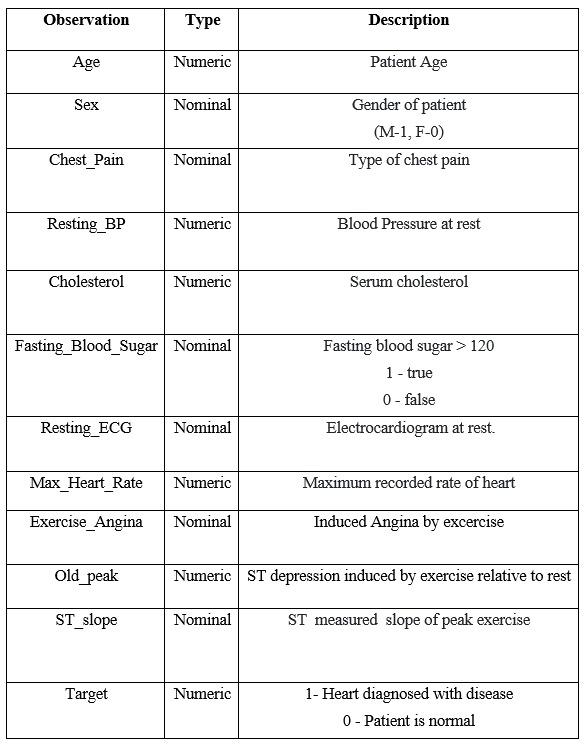
The Cleveland, Statalog, Hungarian, Swiss, and Long Beach VA heart datasets were pooled in this study to producealargerdatasetwithatotalof1190occurrences.11 commonfeaturesandatargetvariablewereincludedinthe merged dataset. Six nominal and five numerical variables wereincludedinthedataset,whichwasusedtoanalyseand forecast heart disease. The accuracy of machine learning modelsusedtoforecastcardiacdiseasemaybeenhancedby theuseoflargerdatasetswithdiversesamples.
3.2 Algorithms Used
Four machine learning algorithms were utilised in this studytopredictcardiacdisease.Deeplearningalgorithms,a branch of machine learning, are used in this situation. Adaboost Classifier and ExtraTrees Classifier are the two machine learning algorithms utilised, and Convolutional NeuralNetwork(CNN)andMultilevelPerceptronClassifier (MLP)arethetwodeeplearningmethodsemployed.
i. Adaboost:
A machine learning algorithm for categorization tasks is called the AB. To create a more reliable overall classifier and combines number of weak learners, or simple models. The firstweaklearnerinthemethodistrainedusingthe data before the error is calculated. Adaboost also offers a unique approach of machine learning: as ensemblelearningtool,itbuildsonthecorenotion thatmanyeffectivelearnerscanoutperformasingle effectivelearner.
ii. Extra-Trees Classifier:
Extremely Randomised Trees Classifier, also referred to as Extra-Trees Classifier, is a type of ensemblelearningmethodwhichcombines results of various de-correlated decision trees. Each of thesedecisiontreesseekstodifferentiatesamples from different classes in the target by removing impurities in some way. It simply differs conceptually from a Random Forest in terms of how forest'sDecisionTreesareconstructed.
iii. Convolutional Neural Network(CNN):
CNN is a artificial neural networks used in deeplearningtoanalysevisualdata.GiventhatCNN has an input layer, an output layer, numerous hidden layers, and millions of parameters, it can learncomplicatedobjectsandpatterns.CNNusesa stackingtechniqueforconvolutionallayers.
iv. Multi-layer Perceptron(MLP) :
Thereareaminimumofthreelayersinaneural network, an input layer, a hidden layer, and an output layer. Each input and each output have a singleneuron,alsocalledasanode.Thenumberof hiddenlevelsandnodesineachhiddenlayerisup toyou.Inthissystem,theinputlayerreceivesinput signalsfromtheoutside worldandsendsthemto everyneuroninthehiddenlayer.
4. PROPOSED WORK
Apersoncandiefromheartdiseasewithoutexhibitingany overtsymptoms,whichiswhyitissometimesreferredtoas a silent killer. The nature of the sickness is the cause of growing concern about the condition and its severe implications.Soeffortstopredictthefuturedevelopmentof thisterriblediseaseinthepaststillexisttoday.Asaresult, numeroustechniquesandtechnologiesareoftenevaluated tosuitthedemandsofcontemporaryhealth.
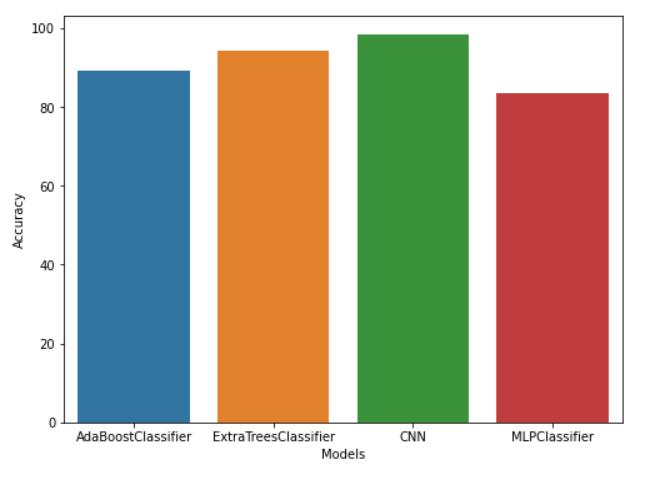
informationonatotalof1190instanceswith12attributes, was used in the implementation. Adaboost, a machine learning method, obtained an accuracy of 89.08%; ExtraTrees, an accuracy of 94.12%. This model's performance improved with the addition ofdeep learning techniques like MLP and CNN. Multi-layer Perceptron accuracy is 83.61%, and Convolutional Neural Network (CNN)accuracywith98.28%.CNNwaschosenasthemost effectivealgorithmforheartdiseasepredictionasaresult.
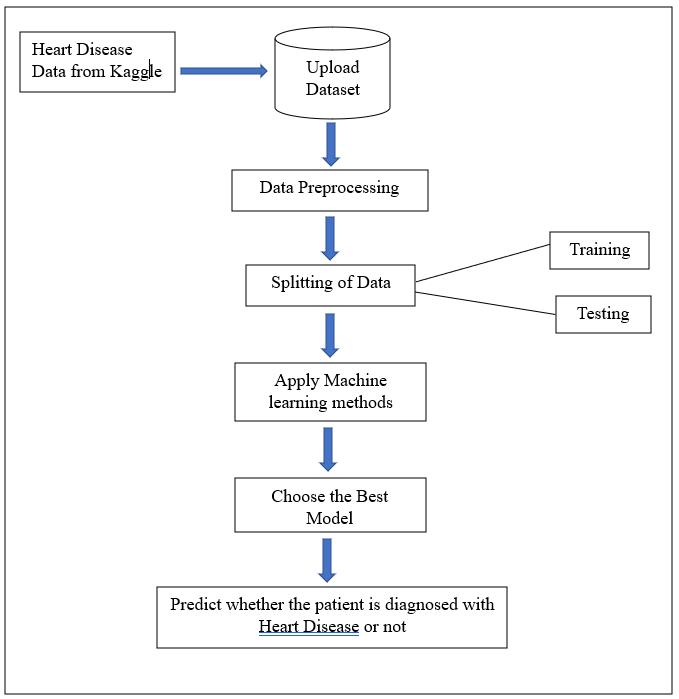
Fig 1.WorkflowDiagram
Inthisstudy,weusedaheartdatasetfromKagglethat contains 1190 instances with 1 target column and 11 common variables including age, sex, type, heart rate, cholesterol,etc.Lateroninthedatapreprocessingapproach, duplicateandmissingvaluesarechecked.Thedatasethad noduplicateormissingvalues.Thedatasetwasthendivided into 20% for testing and 80% for training. The dataset is exposed to different machine learning and deep learning algorithms applications, including Adaboost, Extra-Tree, CNN,andMLP,whereCNNachieves highestaccuracyofany technique. Multiple layers, including Sequential, Conv2D, MaxPool2D,Flatten,Dropout,andDense,isutilisedtotrain theCNNmodel.'Softmax'isusedasanactivationfunction with an output layer to stack a couple more layers. This model is used to forecast heart disease since it had an accuracyrateof98.28%.
5. RESULT AND DISCUSSION
Bothmachinelearninganddeeplearningalgorithmshave demonstrated impressive performance in this paper, accordingtoourstudy.Theheartdataset,whichcontained
6. CONCLUSION AND FUTURE WORK
Theriseinfatalheartdiseasecases,itisimperativeto develop a system that can accurately and successfully predictheartdiseases.Toenhancethepredictionofcardiac illness, this study applies a number of machine and deep learning techniques. The current study demonstrated classification using a sizable sample of participants. Our researchleadsustotheconclusionthattheCNNalgorithm performs the best for combined multiple cardiac datasets among all other methods. The suggested method is implementedasacomputersoftwaresystem,whichmakesit easiertocomprehendandgainabetterunderstandingofthe person'scardiachealthassoonasfeasible.Thefuturestudy shouldfocusonpredictingheartdiseaseusinglessernumber of clinical parameters, so that everyone may readily learn about their heart health and take immediate precautions. And still more deep learning algorithms to be explored to knowaboutthebetterperformanceofthemodels.Thestudy shouldinvolvetheusageofmoreheartdatasetasofnowthis study includes US, UK, and other European cities dataset whereitshouldbeconcentratedonAsianheartdatasettoo, sothatthesystemwouldhelpformaximumpopulation.
REFERENCES
[1] KuldeepVayadande,RohanGolawar,SarweshKhairmar, Arnav Dhiwar, Sarthak Wakchoure, Sumit Bhoite, Darpan Khadke, “Heart Disease Prediction using Machine Learning and Deep Learning Algorithms”, 1st
InternationalConferenceonComputationalIntelligence and Sustainable Engineering Solution (CISES 2022), doi:10.1109/CISES54857.2022.9844406
[2] Rahman Shafique, Arif Mehmood, Saleem ullah, Gyu Sang Choi, “Cardiovascular Disease Prediction System UsingExtraTreesClassifier”,2019, doi:https://doi.org/10.21203/rs.2.14454/v1
[3] A. Lakshmanarao, Y.Swathi, P.Sri Sai Sundareswar, “Machine Learning Techniques For Heart Disease Prediction”, International Journal of Scientific & TechnologyResearch,Volume8,Issue11,2019
[4] Shadab Hussain, Santosh Kumar Nanda, Susmith Barigidad, Shadab Akhtar, Md Suaib, Niranjan K.Ray, “NovelDeepLearningArchitectureforPredictingHeart Disease using CNN”, 2021 19th OITS International Conference on Information Technology, doi: 10.1109/OCIT53463.2021.00076
[5] Sayali Ambedkar, Rashmi Phalnikar, “Disease Risk Prediction by Using Convolutional Neural Network”, 2018 Fourth International Conference on Computing Communication Control and Automation (ICCUBEA), 978-1-5386-5257-2/18
[6] Chavana Sateesh, R. Balamanigandan, “ Heart Disease PredictionusingInnovativeDecisiontreeTechniquefor increasingtheAccuracycomparedwithConvolutional NeuralNetworks”,20222ndInternationalConferenceon Innovative Practices in Technology and Management(ICIPTM), doi:10.1109/ICIPTM54933.2022.9754196
[7] Muhammad Haseeb Aslam, Syed Fawad Hussain, “PredictionofHeartFailurebyusingMachineLearning andFeatureSelection”,2022InternationalConference on Emerging Technologies (ICET) 2022, doi:10.1109/ICET56601.2022.10004668
[8] Dr.C.N.Vanitha,Dr.K.Vanitha,C.Narmatha,S.A.Krishna, R.Dhivakar,“HeartDiseasePredictionusingEnhanced Deep learning”,2022 International Conference on AppliedArtificialIntelligenceandComputing(ICAAIC), doi:10.1109/ICAAIC53929.2022.9793175
[9] CH Raja Shaker, Anisetti Sidhartha, Anto Praveena, A. Chrsity, B.Bharati, “An Analysis of Heart Disease PredictionusingMachineLearningandDeepLearning Techniques”, 2022, Sixth International Conference on Trends in Electronics and Informatics(ICOEI), doi:10.1109/ICOEI53556.2022.9776745
[10] FadouaKhennou,CharifFahim,HabibaChaoui,and NourElHoudaChaoui,“AMachineLearningApproach: UsingPredictiveAnalyticstoIdentifyandAnalyzeHigh
RisksPatients withHeart Disease”,2019International JournalofMachineLearningandComputing,Vol.9,No.6, December2019,doi:10.18178/ijmlc.2019.9.6.870