A Noise Reduction Method Based on Modified Least Mean Square Algorithm of Real Time Speech Signals With The Help of Wiener Filter
1Dr S.China Venkateswarlu,2Srijan Verma, 3Kakasani Sai Teja, 4Chintha Sudheer1Professor, Institute of Aeronautical Engineering, Hyderabad, Telangana

234Students of Electronics and Communication Engineering, Institute of Aeronautical Engineering, Hyderabad, Telangana ***
Abstract - Real-time voice denoising employs an adaptive filtering technique with variable length filters that tracks the noise characteristics and selects the filter equations based on those features. The LMS algorithm's primary benefits are its low computational complexity and evidence of convergence in stationary environments. This research proposes a modified LMS technique for real-time speech signal denoise. The suggested approach increases the capabilities of adaptive filtering by fusing the general LMS algorithm with the diffusion least mean-square algorithm. The suggested algorithm is successful in reducing speech signal noise, according to the calculation of the performance parameter. For replications and additional research applications, a complete MATLAB programming method is given.
Key Words: Speech Enhancement, LMS, MATLAB, Modified LMS Algorithm, Segmental SNR, LLR, ISD, Cepstrum, Weiner Filter.
1.INTRODUCTION
Voice transmissions may experience interference from various noise components while being transported via transmissionlinesbeforetheyreachtheirdestinations.If these noise components are not eliminated, the voice signals may degrade to the point where their receiving ends suffer a partial or complete loss of the information content. The elimination of these undesirable components has been addressed by numerous researchersusingvariousadaptivefilteringtechniques.
Inordertominimisenoiseinspeechsignals,the authors showed how well the recursive least square (RLS) algorithm performed. They got three noise components machine gun, F16, and speech noises from theNOISE-92databaseinadditiontoacleanvoicesignal fromtheHindispeechdatabase.Thesamplingfrequency and resolution for both the noise and the clean signal componentsare16KHzand16bits,respectively.Twelve separate noisy speech signals were created by successively adding each of the three noises to a clean speechsignalatsignaltonoiseratios(SNR)of-5dB,0dB, 5dB, and 10dB levels. Six specially created filters were eachfedasetofnoisysignalsinordertosimulatethem.
Thenon-variableforgetting factorRLS(NVFFRLS),often known as the RLS algorithm, powers two of the filters, oneoforder5andtheotheroforder10,whiletheother two filters, both of order 2, are powered by variable forgettingfactorRLS(VFFRLS)algorithmisusedtodrive two of the orders, one of order 5, and two of order 10. WhenitcomestoRLS,theforgettingfactorhasavalueof =0.99whileithasa valueof min=0.95 whenitcomesto VFFRLS.
This is due to the fact that the VFFRLS algorithm can monitorchangesinthe noisysignal more preciselythan the RLS method. The performance of the RLS algorithm with a variable forgetting factor for non-stationary processes has improved, which is consistent with the researchers' findings. The researchers created a brandnew adaptive filtering method called the modified adaptive filtering with averaging (MAFA) algorithm, which is utilized to remove white Gaussian noise from voicesamples.
1.1 BLOCK DIAGRAM AND FLOWCHART
In this approach, the algorithm's parameters are improved by adding a weiner filter to the alreadyexisting algorithm. The parameters of the original method and the suggested approach are compared after the Weiner filter has been added. The NOIZEUS sound databaseisusedtosourcethenoisesignals.Signalswith differentstrengths,rangingfrom0dBto15dB,
ProposedNoiseAlgorithm
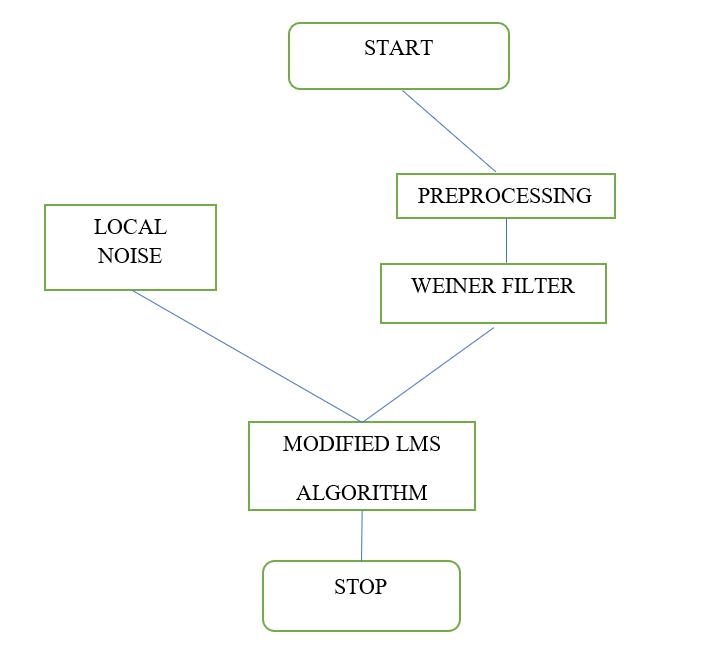
Arecompared.Speechisanalysedframe-by-frameunder the assumption that it is quasistationary. We assume that the clean speech signal xt(n) is deteriorated by additivenoisevc(n)ateachoccurrenceoftimen,andthe noisysignalisobtainedasyc(n).
Inamodelwithadditivenoise, yc(n)=xc(n)+vc(n)
1.2 IMPLEMENTATION
Speech is analysed frame-by-frame under the assumption that it is quasistationary. We assume that the clean speech signal xt(n) is deteriorated by additive noise vt(n) at each occurrence of time n, and the noisy signalisobtainedasyt(n).
�c(�)=�c(�)+�c(�)Increase in Segmental SNR: In any voice signal, energy change erratically and are not stationary in nature. As a result, each frame segment is computed independently and then added together to generate segmental SNR in order to obtain an accurate SNRvalue.
Thus, where N is the frame length, the equation for segmentedSNRisprovided.
Originalloudspeechisrepresentedbyx(n).Thesignalof theprocessedspeechisx(n).
Log Likelihood Ratio (LLR): LLR determines the amount of distortion added during processing by comparing the spectrum of clean audio with processed speech.Equation(4)displaystheformulaforcalculating LLRasDLLR
(ae,ac)=log10(aeRcaeT/acRcacT) (4)
whereacisthecleanspeechsignal'sLPCvector.
The LPC vector of the improved or processed speech signal is called ae. The clean voice signal's autocorrelationmatrixisdenotedbyRc.
Itakura-Saito Spectral Distance (ISD): Thistermrefers to the difference between enhanced and clean voice signals in terms of the associated spectral envelope. ISD'sstandardvalueisnevergreaterthan100.
Cepstrum: For linear separation, homomorphic signals incorporating convolution (such as a source and filter) are converted into the sums of their cepstra using the ceptrum representation. A common feature vector for characterising the human voice and musical sounds is the power cepstrum. The spectrum is typically initially convertedusingthemelscalefortheseapplications.
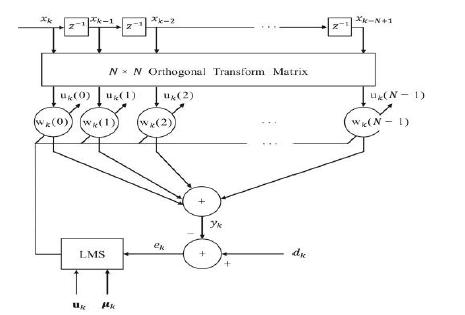
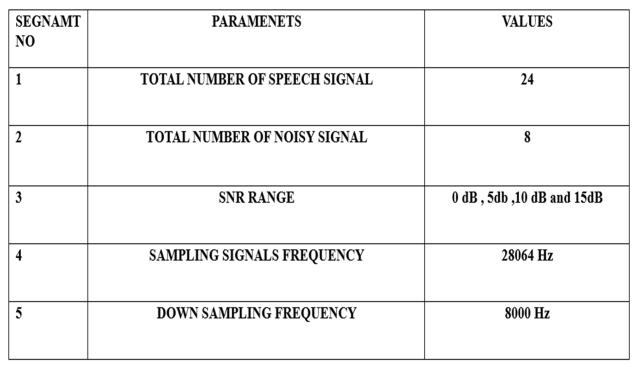
Database: The noise signals have been taken from NOIZEUS database. 24 Noise signals have been taken from the database (with the exception of train signals). Each sentence is distorted by eight different types of real-world noises (Restaurant, Station, Airport,babble, Car, Street). The extracted noises segments are artificially added to the filleted clean speech signal in ordertoreachthedesiredSNRlevels.
The noise signals from the NOIZEUS database are being passed through the matlab algorithm and the parameters have been verified. These parameters are comparedtotheexistingalgorithmandtheoutputsignal hasbeencomparedtothepreviousdatasets.
the magnitude and phase spectrum values from the noisyvoiceinputs.

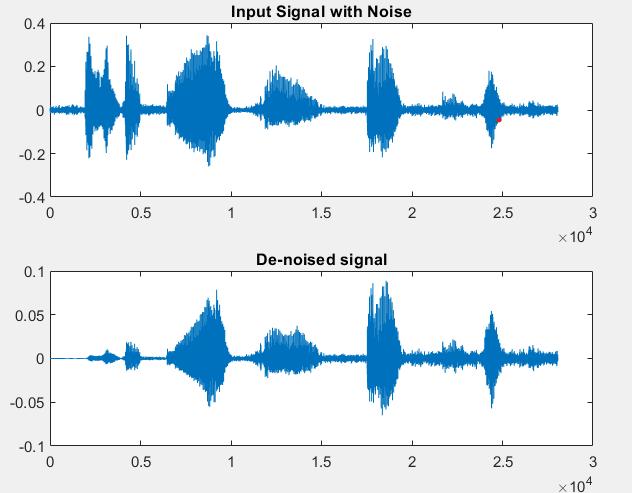
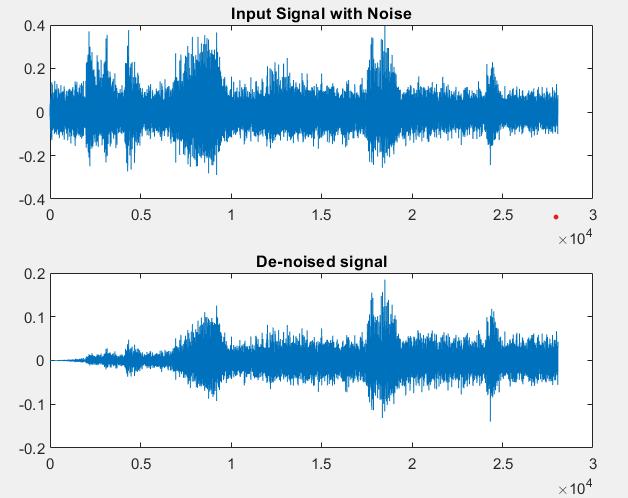
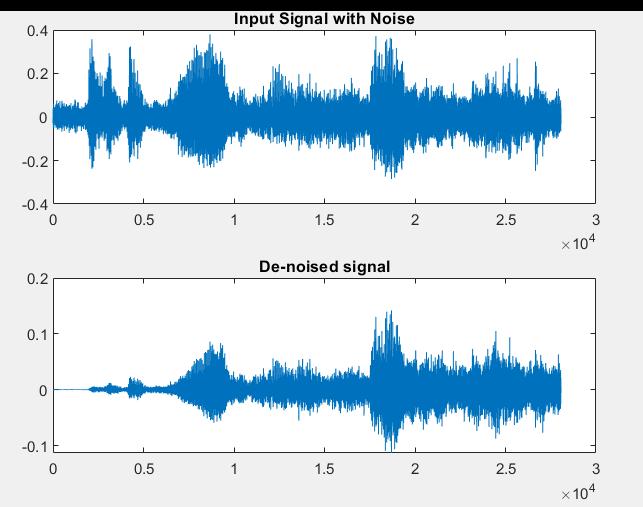
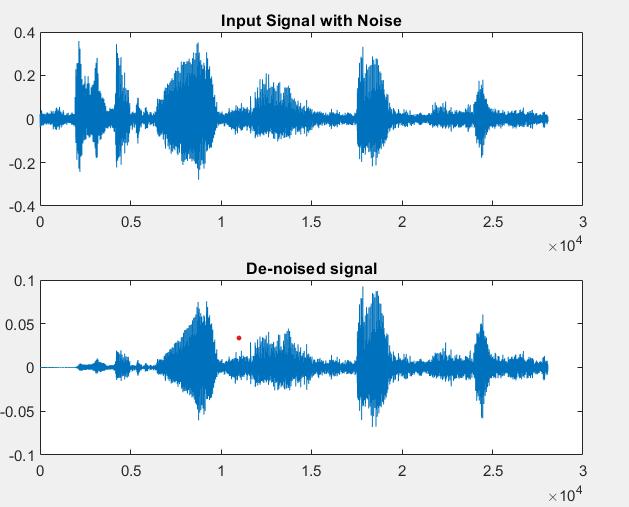
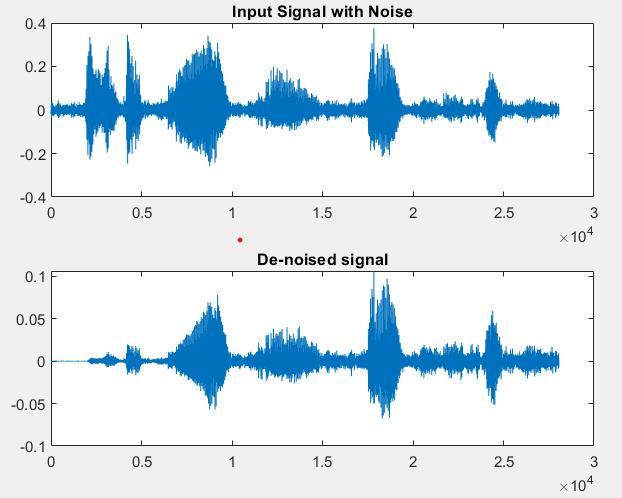
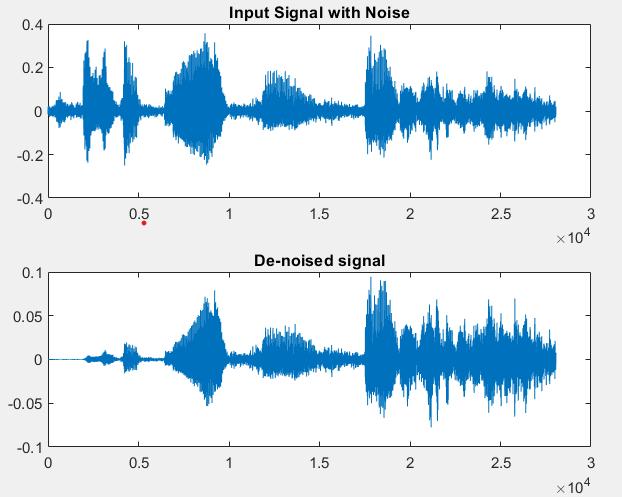
Finally, a two-stage method is used to reconstruct the speechsignalsinordertoobtainthetimedomainspeech signals. The original (clean) speech signal and the augmented speech signal are then calculated into four differentobjectivemeasuresforperformanceevaluation over each frame. The original (clean) and improved speech signals are shown in a time series plot over four differentSNRs.Thesignalfluctuationsoverthecourseof the 28064 samples are shown in this plot for various SNRs.
The experimental findings of the current investigation are presented in this section. To compare the denoise speech signal and evaluate the effectiveness of the proposed speech enhancement method, all tests were run using the NOIZEUS speech corpus database. The signalfluctuationsoverthecourseofthe28064samples are shown in this plot for various SNRs. The spectral power distribution for a spoken signal at 0 dB, 5 dB, 10 dB,and15dBwithairportnoise.
Table.1 DescriptionofSpeechDatabase
The results of the current experiment showed that the suggestedtechniqueoutperformedtheLMSAlgorithmin termsofincreasingthequalityofthespeechsignal.This was supported by the three objective measurements of segmental SNR, LLR, Cepstrum, and ISD. Different levels of noise (0, 5, 10, and 15 dB) are required for proper analysis.
2. RESULTS AND DISCUSSIONS
The experimental findings of the current investigation are presented in this section. To evaluate the effectiveness of the suggested speech enhancement method and compare the denoise speech signal, all experimentswererunusingtheNOIZEUSspeechcorpus database. Many researchers have used this database for applications involving voice improvement, and its gender-matched database has 30 IEEE sentences. For analysispurposes,oneofthevoicesampleswitha10dB SNR is left out of this work(Train).All of the voice samplesin thedatabasehavethis windowingapplied to them.Later,anadditivenoisewithvariousSNRsandthe sameoriginalspeechsignalwindowlengthisintroduced to the speech samples. The STFT is then used to derive
International Research Journal of Engineering and Technology (IRJET) e-ISSN:2395-0056
10 Issue: 05 | May 2023
2023, IRJET | Impact Factor value: 8.226 |
2395-0072
3. CONCLUSIONS
The modified LMS algorithm with the additional Weiner filter is suggested in this thesis. The proposed algorithm has produced satisfactory results when tested with different noise levels. This method can be utilised in a variety of settings, from the car to the airport, and is effective at reducing different types of noise levels. Through the objective measurements of Segmental SNR, LLR, ISD, and Cepstrum, this experiment demonstrated that the suggested method worked well in enhancing the quality of the speech signal over LMS Algorithm. Future work should concentrate on improving the current data andtestingthealgorithmwithdifferentotherparameters.
REFERENCES
Technology and Advanced Engineering, Vol. 4, Issue 10, October2014,pp.656-659.
[10]. G. K. Girisha, S. L. Pinjare, “Performance Analysis of Adaptive Filters for Noise Cancellation in Audio Signal for Hearing Aid Application,” International Journal of Science andResearch,Vol.5,Issue5,May2016,pp.364-368.
[11].P.Rakesh,T.K.Kumar,“ANovelRLSBasedAdaptive Filtering Method for Speech Enhancement,” International Journal of Electrical, Computer, Electronics and Communication Engineering, Vol. 9, No. 2, 2015, pp. 153158.
[
1] V. K. Gupta, M. Chandra, S. N. Sharan, “Noise Minimization from Speech ZJournal of Applied Sciences, Engineering and Technology Vol. 4, Issue 17, Sept. 2012, pp.3102-3107.
[2] Y. T. Ting, D. G. Childers, “Speech Analysis using the Weighted Recursive Least Squares Algorithm with Variable Forgetting Factor,” ICASSP, Albuquerque, NM, 1990, pp. 389-392. [3] S. H. Leung, C. F. So, “Gradientbased Variable Forgetting Factor RLS Algorithm in Timevarying Environment,” IEEE Transactions on Signal Processing,Vol.53,No.8,2005,pp.3141-3150.
[4] J. Wang, “A Variable Forgetting Factor RLS Adaptive Filtering Algorithm,” International Symposium on Microwave, Antenna, Propagation and EMC Technologies for Wireless Communications, Beijing, China, 2009, pp. 1127-1130.
[5] M. Z. A. Bhotto, A. Antoniou, “Robust Recursive Least Squares Adaptive Filtering Algorithm for Impulsive-noise Environments. IEEE Signal Processing Lett., Vol. 18, Issue 3,2011,pp.185-188.
[6]” A. K. Sahu, A. Hiradhar, “Noise Cancellation Using Adaptive Filters of Speech Signal by RLS Algorithm with Matlab.
[7] V. R. Vijaykumar, P. T. Vanathi, “Modified Adaptive Filtering Algorithm for Noise Cancellation in Speech Signals,”ElectronicsandElectricalEngineering,No.2(74), 2007,pp.17-20.
[8]G.Iliev,N.Kasabov,“AdaptiveFilteringwithAveraging in Noise Cancellation for Voice and Speech Recognition,” Department of Information Science, University of Otago, 2001.
[9] V.M. Kaine, S. Oad, “Noise Cancellation in Voice Using LMS Adaptive Filter,” International Journal of Emerging
[12]. M. T. Afolabi, C. B. Mbachu, “Windowed Adaptive Filtering for Reducing Noise in Audio Signals During Transmission to Remote Locations,” International Journal of Innovative Research and Development, Vol. 8, Issue 6, June2019,pp.265-271.
[13]. R. Martinek, J. Zidek, “Use of Adaptive Filtering for NoiseReductioninCommunication Systems,”Department of Measurement and Control, Technical University of Ostrava-Poruba. [14]. V. Thakkar, “Noise Cancellation Using Least Mean Square Algorithm,” IOSR Journal of ElectronicsandCommunicationEngineering,Vol.12,Issue 5,Ver.I,Sept.-Oct.2017,pp.64-75.
[15].E.A.Oni,I.D.Olatunde,K.O.Babatunde,D.O.Okpafi, “Improvement of Audio Signal Quality Using Adaptive Filtering and its Performance Advantage Over NonAdaptive (Linear) Filtering,” International Journal of Electrical and Electronic Science, 5(2), 2018, pp. 39-45. [16].J.Jebastine,B.S.Rani,“DesignandImplementationof Noise Free Audio Speech Signal Using Fast Block Least MeanSquareAlgorithm,”SignalandImageProcessing:An International Journal (SIPIJ), Vol. 3, No. 3, June 2012, pp. 39-53.
[17].Rajni,I.Kaur,“ElectrocardiogramSignalAnalysis-An Overview,” International Journal of Computer Applications,Vol.84,No.7,December2013,pp.22-25.
[18]. S. Y. Zaw, A. M. Aye, “Performance Comparison of Noise Detection and Elimination Methods for Audio Signals,” International Journal of Engineering and Technology, Vol. 03, Issue 14, June 2014, pp. 3069-3073. [19].B.A.Shenoi,Introductiontodigitalsignalprocessing and filtering design, USA, Canada: John Wiley and Sons, 2006.
[20].P. K. Dar,M.I. Khan, “Design andImplementation of, Non-Real Time and Real Time Digital Filters for Audio Signal Processing,” Journal of Emerging Trends in Computing and Information Sciences, Vol. 2, No. 3, 2011, pp.149-155.
[21]. G. Kadam, P. C. Bhaskar, “Reduction of Power Line Interference in ECG Signal Using FIR Filter,” International ofComputationalEngineeringResearch,Vol.2,IssueNo.2, Mar.-Apr.2012,pp.314-319.
[22].B.Chabane,B.Daoued,“EnhancingSpeechCorrupted by Coloured Noise,” WEAS Transactions on Signal Processing. [23]. G. Srika, R. Prasad, “An Enhanced Audio Noise Removal Based on Wavelet Transform and Filters,” Advances in Computational Sciences and Technology, Vol. 10,No.10,2017,pp.3111-3121.