
Smart Gas Regulator Using GSM
Dr. D. Sreelakshmi M.Vishnu Vardhan PVS. Nishok Reddy M. VikasAbstract - Gas leakage is a serious issue since it can result in accidents and other dangers in both industrial and residential settings. Gas leakage detection systems are frequently placed in vulnerable regions to stop such events. These systems use sensors to find LPG leaks and send SMS notifications through GSM to let people know about the problem. The gas sensor will activate and send a signal to the microcontroller to turn on the LED and buzzer, alerting the user, if the amount of LPG in the air exceeds a predetermined level. The amount of gas left in the cylinder is also monitored by a level sensor, and if a fire leak is discovered, the relay will immediately turn off the gas supply to prevent further danger.
Key Words: Arduino, GSM (Global Systems for Mobile Communications, LPG (Liquid Petroleum Gas), MQ-2 Gas Sensor, LED (Light Emitting Diode), LCD (Liquid Crystal Display),Servomotor.
1. INTRODUCTION
LPGplaysanessentialroleinourdailylives,particularlyin cooking.Itisacost-effectivefuelcomparedtootheroptions, making it a popular choice. One of the most significant advantages of using LPG is its ability to replace chlorofluorocarbons, which are known to harm the ozone layer.LPGcomprises55%butane,45%propane,andsmall amountsofisopentaneandolefins.Itisstoredinliquidform inacylinder,andtheodorlessbutaneandpropanearemade detectablebyaddingethylmercaptantothecylinder.LPGis lighterthanwaterandburnsinamixtureofLPG-airbetween 1.8%and9.5%.LPGcylindersareavailableinvarioussizes, ranging from 4kgs to 450kgs. Ascertaining the gas level insidethecylindercanbechallengingduringdailyuse.To address this issue, we suggest an effective method to monitor the LPG level in the cylinder. This method would eliminate the need for advance or delayed booking of cylinders.
2. LITERATURE REVIEW

S.Koushanfardescribetheprocessofintegratingthesensor nodes into a network and the challenges that must be overcometoensureaccuratemeasurements.Thisversatile platform uses infrared laser spectroscopy to detect and measuremanygasspeciesinconcentrationsfrompartsper million to billion (ppm-ppb). High-resolution gas sensing technologyhasbeenchallengingtoincorporateintosmall,
low-power,replicatedsensorssuitableforwirelesssensor networks(WSNs)duetothesignificantdifferencesinsize, cost,and powerconsumptioncomparedto traditional gas sensing devices that possess the same sensitivity and specificity[1].

LaserSPECKsTechnology.
Brush,A.J.havelongbeenfascinatedbytheideaofsmart houses,andhaveworkedhardtodevelophomeautomation systems. The main purposes of home automation systems were energy management and security, but there were severalobstaclesinthewayoftheirwidespreadacceptance, such as their high cost, complexity, and compatibility concerns.Theresultsofthestudysuggestseveralareasfor futureresearch,suchasdevelopingmethodstoinstallhome automation without requiring structural changes, creating straightforward security settings that users can easily configure,andfacilitatingtheintegrationofhomedevices[2].
N.S. G. B. D. Jolhe suggest that Gas Measurement Monitoring System is an intelligent solution designed to enhancetheconvenienceandsafetyofLPGgasconsumers. Additionally,thesystemoffersareal-timegasmeasurement monitoring feature that enables consumers to check the estimatedtimetillthenextrefill,consumptionhistory,and gaslevelthroughamobileapplicationorwebportal[3].
P.MeenakshiVidyaresearchonLPGgasforcookingand heating,anautonomousLPGleakagedetectionandhazard avoidancesystemaddsanextradegreeofsecurity.Itcanaid inavoidinganyrisksbroughtonbygasleaksandprovidethe home'sresidentspieceofmind.So,inthissystemLPGleak sensor detects and the information is sent to the user via shortmessageservice(SMS).Atthesametime,aGSMmodule warnsthecustomerandactivatesthealarmandexhaustfan. Themethodalsohastheaddedbenefitofusingaloadcellto continuouslycheckthelevelofLPGinthecylinderandaGSM moduletoautomaticallybookthecylinder[4].
Snehal Godse and Sneha Gurgulepresentsthesystem's designandimplementation,alongwithexperimentalresults toshowthattheproposedsystemisaccurateindetectinggas leakageandmonitoringthegaslevelinreal-time.Theauthors suggestthattheproposedsystemcanbeusedinhouseholds, industries,andgasdistributionagenciestoimprovesafety and convenience. LPG gas is the maximum generally used Domesticgasolineineachhousehold.Itcanexplodeifinhaled inlargeamountsandisdangerousifitsconcentrationrises. The MQ3 gas sensor is used to detect the gas, and the awareness is expressed in ppm. The consumer is notified when the awareness exceeds the desired amount and is encouragedtotakeappropriateaction[6].
S.SivajothiKavithausedawirelesssystemfordetecting gasleakageinhomesisequippedofthreemaincomponents: The receiver module, the GSM/GPRS MODEM, and the gas leakageandleveldetectionandtransmissionmodule.heLPG andnaturalgasconcentrationchangeisdetectedbythegas leakagedetectionandtransmissionmodule,andwhenitrises aboveathresholdpoint,anaudio-visualalertistriggered.In addition,ittransmitsanalertmessagetothemobiledevice. To determine the weight of the cylinder at the time of dispatch and throughout use, the level of the LPG is continuouslymonitored[5].
3.EXISTING METHOD
L.P.G leakage occurs when the faulty regulation, poor handling of the gas appliances and poor monitoring of the LPGcylinder.Thismayleadtothefactorsofoccurringthis type of disaster. This gas leakage when caught with air it becomes highly flammable and potentially explosive. This levelofdisastercanconvertanythingintoashesinaradiusof 50meters.
There are several existing models are there in the market whichcandetectthegasleakageandturnonthebuzzeror theLEDindicators.Mostofthemusesthesamegassensors fordetectionofanyleakages,andmostofthemusesLoadcell fordetectionofthelevelofthegaspresentinthecylinder.


IntheexistingversiontheArduinoUnoisthemicrocontroller that'stheprincipalunitofthecircuit.Asinkeepingwithour blockdiagramananalogtemperaturesensorisattachedto themicrocontroller.Andherethedrawbackistheyareusing Bluetoothforalertingtheclient.And,thereadingsmonitored bysensordirectlysenttotheclientfromthedevicesothe client should be there in the range of 50 meters from the device.EventhoughthereareBuzzerandRGBLEDalerting system,itisstillanuncompletedmodel,moreovermostof thesemodelsarecustombuiltthatis,theycanonlyuseby onewhobuiltordesigneditanditisnotpossibletouseby multiplepersons.
PowerSupply
noticethereareonlyindicatorswhichwarnsusaboutthe leakagebutnorelayswhichturnofthepassageofthegas.
Thusexplainstheexistingmodelhasseveraldrawbacks such as lacking of the shutting down mechanism. So, the futurework ofthismethodisbyusingPhotodiodesensor and Servo motor, these can eliminate the limitation of the existing model. And explains the advancements and improvementsintheindicatorsandbuzzers.Thesearethe featuresaddedtoourproposedsystem.
The proposed system with the Photo diodesensorand Servomotorcansignificantlyimprovethefunctionalityofthe existing model. The Photo diode sensor can detect the presence of light and can trigger the Servo motor to shut down the system when it detects a lack of light. This mechanism ensures that the system is automatically shut downwhenthelightsourceisnotavailable,preventingany damagetothesystem.
Signalamplifier Loadcell

Fig-6: BlockDiagramofexistingmodel. Themaincomponentsusedintheexistingmethodwas, PowerSupply5v.

ARDUINO-UNOmicrocontroller.

LoadCell.
MQ6Sensor.
LCD.
4.PROBLEM IDENTIFICATION AND SOLUTION
Inmostoftheexistedmodelsingasleakagearea,isthat most of them lack of shutting down mechanism. None of themconsistsofanelementwhichisusedforcuttingdown the passage of the gas into the gas pipe in case of any leakages. Moreover, none of us can in person go and shut downthegasvalveifthereexistsanyfireleakage.Adetail descriptionoftheexistingmodelisshowninblockdiagram,
5. PROPOSED SYSTEM
TheproposedSmartGasRegulatorisanimprovedversion ofagasindicatorthatoffersseveralbenefits.Itincorporatesa flamesensorthatcandetectanyfireorflameleakagesinthe vicinityofthegascylinder.Arelayorservomotorisusedto shut off the gas supply automatically if the flame sensor detectsanyfire.Thisfeatureprovidesenhancedsafetyand helpspreventpotentialaccidents.
Whentheflamesensordetectsanyfire,itsendsasignalto theArduinoMicrocontroller,whichthentriggerstheshut-off operation.TheArduinoMicrocontrollersendsasignaltothe inputoftheServomotor,whichthenturnsitsmotorwingby 90degrees.Thisactionshutsdownthepassageofgasflow, ensuringsafetyincaseofafire.
Theimportantcomponentsinproposedmethodare,
MQ-2Gassensor(GasLeakageDetection).
LoadCellsensor(Levelofthegas/Weightof thecylinder).

PhotoDiodesensor(FireleakageDetection).
5vPowersupply.
GSMModule.
LEDindicators.
Buzzer.
LCDDisplayforlevelandrealtimesensingdata.
This proposed system mainly the advancement of the existing model which can eliminate lot of gas related problems in both industrial and domestical. Earlier we notice that existing models are lacking of shutting down mechanism so here is a proposed model to remove that limitation.TheFlamesensor(Photodiodesensor)hereacts asasensingdeviceforfire/flameleakagedetectionnearthe gascylinder.Servomotorherewasintroducedtoshutdown thepassageofthegasinthegaspipe,onlyifitdetectsany fire by the Flame sensor. Another improvement can be observedintheindicatorsbothinLEDandBuzzer.
6. IMPLEMENTATION
A. Hardware Implementation
Thefirststepistosensethepresenceofgasusingagas sensor. This sensor detects the concentration of gas in the environmentandsendsthedatatothemicrocontroller.The microcontroller then sends an SMS to the user's phone numberalertingthemofthepresenceofgas.Thisisachieved usingaGSMmodulethatisconnectedtothemicrocontroller. In the event of a gas leakage, the microcontroller sends a signaltoanLEDandabuzzertoalerttheuser.TheLEDand buzzerprovideavisualandaudiblewarningtotheuser.The smartgasregulatormustalsobeabletosenseafire.Thiscan bedoneusingaphotodiodesensororaflamesensor.Inthe eventofafire,themicrocontrollersendsasignaltoanLED andabuzzertoalerttheuser.TheLEDandbuzzerprovidea visualandaudiblewarningtotheuser.Topreventthespread ofthefire,thesmartgasregulatormustbeabletoturnoffthe gas flow. This can be done using a servomotor that is connectedtothegasvalve.Themicrocontrollersendsasignal totheservomotortoshutoffthegasvalve,thuspreventing anyfurthergasleakage.Oncethefirehasbeenextinguished, thesmartgasregulatorcanberesetbytheuser.Thisisdone bypressingaresetbuttonontheregulator,whichallowsthe gasflowtoresume.
Alongwithalltheserealtimessensingnetworkanother sensoralsotakesthepartofArduinoworkingtimewhichis LoadCell.LoadCellisusedtocalculatetherealtimeweightof thegascylinder,italsosendsthedatatoArduinobyanalog signals,soadditionalADCisrequiredinourModule.Weight willgetdisplayedonthe16x2LCDdisplay.Andwheneverthe weightofthecylindergetsreducedbythecertainlimitsay 30%theitsendsanalerttotheregisteredmobilethroughan SMSusingGSMtechnology.
B Hardware Requirements
5vPowerSupply.
ArduinoController.
GSMmodule.
PhotodiodeSensor.
Buzzer.
LCDDisplay.
LEDindicator.
Servomotor.
Loadcell.
C. Software Implementation
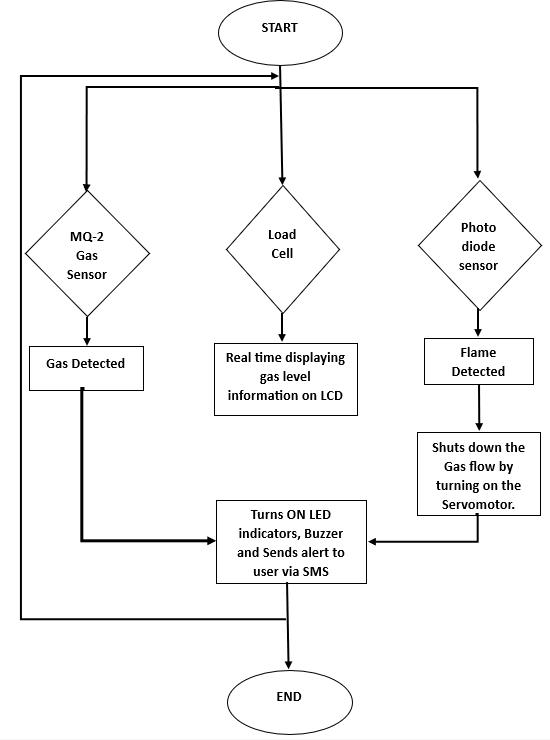
The Gas leakage detection using GSM Technology is a usefulapplicationthatcanbeimplementedusinganArduino Unomicrocontroller.Thisprojectinvolvestheintegrationof varioussensorssuchasLoadsensors,Gasdetectionsensors, andFlamesensor,along withan LCD,LED,and buzzersto detectandalertusersofanygasleakage.Themicrocontroller processes the input from the sensors and provides output throughtheLCDdisplayandsoundalertsystems.TheGSM technology allows the user to receive SMS alerts on their mobilephoneincaseofanygasleakdetectedbythesensors. Thissoftwareapplicationprovidesareliableandefficientway todetectgasleaksandpreventaccidents.
TheArduinoUnomicrocontrollermakesiteasytointegrate andcontrolvarioussensorsandcomponents,makingitan idealplatformforsuchprojects.TheGasleakagedetection usingGSMTechnology,Loadsensors,Gasdetectionsensors, Flamesensor,LCD,LEDbuzzersprojectcanbeimplemented usingArduinoUnosoftware.
ThesoftwarecanbedevelopedusingtheArduinoIntegrated Development Environment (IDE) which provides a userfriendlyinterfacetowrite,compileanduploadthecodeto theArduino board.Thesoftwarecan bedevelopedinC++ programminglanguageusinglibrariesandfunctionsspecific to the components used in the project. For example, the AdafruitIndustriesprovideslibrariesforgassensors,flame sensors,LCD,andLEDdisplays,andbuzzer.Theselibraries can be included in the code to control the sensors and display the output. The software code can be divided into differentfunctionssuchasinitializingthesensors,reading sensordata,displayingsensordataontheLCD,andsending SMSalertsusingGSMtechnology.Thecodecanalsoinclude conditionalstatementsandloopstoprovidedecision-making capabilities to the microcontroller. Once the code is developed, it can be uploaded to the Arduino Uno microcontrollerusingaUSBcable.Themicrocontrollercan be connected to the sensors and other components using wires and a breadboard. The GSM module can also be connected to the microcontroller using serial communication.Afterthehardwaresetupiscomplete,the softwarecanbeexecutedonthemicrocontrollertodetect andalertusersofanygasleak.

V1. RESULT
ThehardwareandsoftwaredevelopmentfortheSmart Gas Regulator is now complete. To achieve the desired outcome,wewillconnecttheadapteroftheArduinoUnoand then wait for a GSM request to register the user's mobile number.


Fig-15:
After introducing gas towards the MQ-2 sensor, the 'G' indicatorontheLCDdisplaywasilluminated,indicatingthe presenceofgas.Inthesecondfigurebelow,youcanseean SMSthatwassenttothemobilenumberregisteredwiththe GSMnetwork.Next,let’sintroduceflamenearthesetupand observedthebehaviorofthemodule.

Once the user's mobile number has been successfully registered with the GSM network, a message with the text 'reg'issenttotheuser'smobiledevice.ThistriggerstheLCD displaytoshowthepercentagelevelofgaspresent,aswellas anyindicationsoffireorgasleaks.TheLCDdisplayshownin Figure 11 illustrates how the display appears after it has transitionedfromitsinitialstate.Pleasenotethattheletters 'F'and'G'areusedtoindicatethepresenceoffireandgas leakages,respectively.


Whenthemodulesuccessfullydetectsthepresenceoffireor gas,boththebuzzerandLEDindicatorwillbeactivated.In the case of fire detection, an additional mechanism is activated which shuts down the gas flow through the servomotor.It'sworthnotingthattheuserwillbeinformed aboutthedetectionofflamesthroughanSMSsenttotheir registeredmobilenumberviatheGSMnetwork.
Please take note that the indicators labeled 'F' and 'G' are currentlynotilluminated,indicatingthattherearenosignsof fire or gas leaks. To demonstrate how the gas regulator respondstogasleaks,weintroducedgastowardstheMQ-2 sensortobetterobserveitsreaction.
Theloadcellisutilizedinthismethodtomeasurethecurrent weightofthegascylinderinreal-time.Ourmodelisdesigned tocreatethreeweightlimitsintermsofpercentage.Ifthegas levelfallsbelow25%,itisconsideredempty,andamessage is sent to the user with the tag 'Empty' to indicate the remaining gas level. Similarly, if the gas level rises above 35%,amessagewiththetag'Medium'issenttoindicatethe remaininggaslevel.Lastly,ifthegaslevelgoesbeyond90%, amessagewiththetag'Full'issenttoinformtheuserofthe remaininggaslevel.

TheSmartGasRegulatorUsingGSMisaversatiletechnology with applications across a wide range of industries. In domestickitchens,itcanensurethesafeandefficientuseof gasappliances,whileinhotelsandrestaurants,itcanhelp prevent accidents and improve operational efficiency. The technology can also be used in mining areas to detect gas leakages,enhancingsafetyforworkers,andreducingtherisk of explosions. In commercial buildings, the smart gas regulator can help optimize gas consumption and reduce costs.Theuseofthistechnologyisnotlimitedtoland-based operations, as it can also be used in transports such as airplanestoensurethesafeandefficientuseofgasasafuel source.Theoilandgasindustriescanalsobenefitfromthe smartgasregulator,whichcanhelpmonitorandcontrolgas usage across production facilities, reducing the risk of accidentsandimprovingefficiency.Ultimately,theSmartGas RegulatorUsingGSMisavaluabletoolforenhancingsafety, efficiency, and cost-effectiveness in a range of industrial settings.
CONCLUSION

Inconclusion,thisgasleakageandfiredetectionsystemis designedtoachievemultipleobjectives,includingreal-time monitoring of gas levels, and displaying them on an LCD display,sendingSMSalertsatdifferentgaslevels,detecting gasandfire leakages,andalerting usersthrougha buzzer and LED indicator. Moreover, the system also has an effectivemechanismtoshutdownthepassageofgasincase of a fire leakage to prevent further damage. Other advantages of the system include easy user registration, effectivegasleakagedamageprotection,easySMSalertson mobiledevicesabouttheremaininggaslevelinthecylinder, and a contactless shutting down mechanism to prevent injuries.Overall,thissystemprovidesareliableandefficient solutionforgassafetyandmonitoring,ensuringthesafetyof usersandtheirsurroundings.
FUTURE SCOPE
Gas leakage detection systems have a vast potential for continuous improvement and advancements in the future. Therearevariousareasofdevelopmentthatcanbeexplored, such as integrating with IoT devices, allowing users to monitor their homes or businesses from anywhere in the world and receive alerts when a gas leak occurs. By integrating AI algorithms, the system can automatically detect the source of the gas leak and take appropriate measurestomitigatetherisk.TheuseofWSNtechnologycan helpdetectgasleaksinremoteareasandcommunicatethis information to a central system or authorities for prompt action. Overall, with the help of new technologies, we can improvesafetystandardsandpreventpotentialaccidents.
REFERENCES
[1] S., Koushanfar, F., Kosterev, A., Tittel, F., “LaserSPECks:LaserSPECtroscopicTrace-GasSensor Networks - Sensor Integration and Applications”, Information Processing in Sensor Networks, 2007. IPSN 2007. 6th International Symposium on, April 2007,p.226-235,ISBN978-1-59593-638-7.
[2] Brush,A.J.,Lee,B.,Mahajan,R.,Agarwal,S.,Saroiu,S., & Dixon, C. (2011, May). Home automation in the wild:challengesandopportunities.InProceedingsof the SIGCHI Conference on Human Factors in Computing Systems (pp. 2115-2124). ACM. [5] F. Chraim, Y. Erol, and K. Pister, “Wireless gas leak detectionandlocalization,”IEEETrans.Ind.Inf.,pp. 1–13,2015.
[3] N.S.G.B.D.JolheandP.A.Potdukhe,“Automaticlpg booking, leakage detection and real time gas measurement monitoring system,” International Journal of Engineering Research & Technology (IJERT),vol.2,April-2013.
[4] P.M.Vidya,S.Abinaya,G.G.Rajeswari,andN.Guna, “Automatic lpg leakage detection and hazard preventionforhomesecurity,”inProceedingof5th National Conference on VLSI, Embedded and Communication&NetworksonApril,vol.7,2014.
[5] S.SivajothiKavithaandS.SenthilKumar,"AWireless Gas Leakage & Level Detection with Auto Renewal System",InternationalJournalofAdvancedResearch in Electrical, Electronics and Instrumentation Engineering, ISSN 2278- 8875, Vol. 4, Issue 4, pp. 2095-2100,April2015.
[6] M.S.Kasar,RupaliDhaygude,SnehalGodseandSneha Gurgule,”AutomaticLPGGasBookingandDetection System”,InternationalJournalofAdvancedResearch in Electrical, Electronics and Instrumentation Engineering, ISSN 2278-8875, Vol. 5, Issue 3, pp. 1250-1253,March2016.
[7] F. Chraim, Y. Erol, and K. Pister, “Wireless gas leak detectionandlocalization,”IEEETrans.Ind.Inf.,pp. 1
13,2015.