Integrated Water Resources Management Using Rainfall Forecasting With Artificial Neural Networks In Solapur District, Maharashtra
Abstract - In India, agriculture plays an important role in the Indian economy. Rainfall is important for agriculture, but rainfall forecasting has become a major issue in recent years. A good rain forecast provides knowledge and knowledge in advance to take precautions and develop better strategies for crops.Also, global warming is having a major impact on nature and humans, causing changes in climate conditions. I am accelerating. As temperatures rise and sea levels rise, flooding occurs and farmlands turn into drought. Due to unfavorable climate change, there is unseasonable and unsuitable rainfall. Rainfall forecasting is one of the best ways to learn about Rainfall and climate.
The main purpose of this study is to provide customers with a correct climate account from various perspectives such as agriculture, research, power generation, etc., in order to grasp the need for climate transformation and its parameters such as temperature, humidity, etc. . , Rainfall and wind speed lead to Rainfall forecasts. Rainfall is difficult to predict as it also depends on geographic location. Machine learning is an evolving subset of AI that helps predict Rainfall. This research paper uses the UCI repository dataset with multiple attributes to predict Rainfall. The main purpose of this research is to develop a Rainfall forecasting system anduse machine learning classification algorithms to predict Rainfall more accurately.

Key Words: Rainfall Forecasting system, Machine Learning, Dataset, Classification algorithms etc.
1.INTRODUCTION
Rainfallforecastsarethemostimportantworldwideandplay an important role in human life. Analyzing Rainfall frequencies with uncertainty is a tedious task for meteorological departments. Rainfall is difficult to predict accurately under different atmospheric conditions. It is believed to predict Rainfall for both summer and rainy seasons. This is the main reason why we need to analyze algorithms that can be customized for Rainfall forecasting. Oneoftheseproficientandeffectivetechnologiesismachine learning. “Machine learning is a way of manipulating and extracting known, implicit, previously unknown and potentiallyusefulinformationaboutdata”.Machinelearningis ahugeanddeepfield,thescopeandimplementationofwhich is It's expanding day by day. Machine learning includes a
varietyofsupervised,unsupervised,andensemblelearning classifiersthatareusedtopredictanddetectaccuracyona givendataset.Thisknowledgecanbeusefulformanypeople andcanbeusedinaRainfallforecastsystemproject.Findthe mostaccuratemodelbycomparingvariousmachinelearning algorithms such as logistic regression, decision trees, K nearest neighbors, and random forest. We will use the RainfalldatasetfromtheUCIrepository.
Inthisstudy,existingclassificationtechniquesarediscussed andcompared.Thepaperalsomentionsthescopeoffuture researchandvariousavenuesforfurtherdevelopment.The goalofthisresearcheffortistopredictRainfallforalocation based on user-provided input parameters. Parameters include date, location, maximum temperature, minimum temperature,humidity,winddirection,evaporation,etc.
2. STUDY AREA
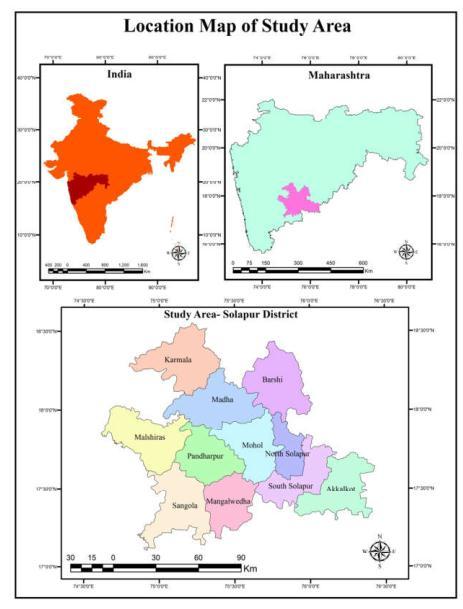
TheSolarPoolsareaisboundedby17°05'Nto18°32'Nand 74°42'E to 76°15'E. The total geographical area of Solapur districtis14895km².Itisdividedinto11tasirs.Thedistrict hasadryclimate.
Averagedailyhighsrangefrom30°Cto35°Candlowsfrom 18°Cto21°C.ThehighesttemperatureinMayis47degrees. Average annual rainfall is 510 mm. The soil in this area is primarily from Deccan traps. The soils in the area can be broadly divided into three groups: shallow, medium and deep. The districtconsists of11tesilsthatfall underareas affectedbydroughtandwaterscarcity.Accordingtothe2011 census,Solapurhasapopulationof43,17,756.
Fig. Location Map of Study Area
Thedistrictiscomesundertherainshadowzonetotheeast ofWesternGhats,therainfallintensityisdecreasestoward eastsideofWesternGhats.Nearabout80%rainfallreceives fromsoutheastmonsoonandremaining20%rainfallreceives fromreturnmonsoon.
3. LITERATURE REVIEW
SeveralstudieshavebeenconductedtopredictRainfallusing machinelearningalgorithms.
AstudybyJainetal.(2019)proposedadeeplearning-based approach for Rainfall forecasting. In this study, a convolutional neural network (CNN) was used to predict Rainfallbasedonweatherdata.Theresultsshowedthatthe proposed approach outperforms traditional statistical methods.AnotherstudybySharmaetal.(2020)proposeda machinelearning-basedapproachtoRainfallforecasting.This study used an artificial neural network (ANN) to predict Rainfallbasedonhistoricalweatherdata.Thisstudyfound that the proposed approach can predict rainfall with up to 92%accuracy.
A study by Jha et al. (2020) proposed a hybrid model for Rainfallforecasting.Thismodelcombinestheadvantagesof machine learning and statistical techniques. In this study, support vector machines (SVM) and multiple linear regression(MLR)wereusedtopredictRainfall.Theresults showed that the proposed hybrid model outperforms traditionalstatisticalmethods.
AstudybyKhareetal.(2021)proposedamachinelearningbased approach for short-term Rainfall forecasting. In this study, we used a long short-term memory (LSTM) neural networktopredictRainfall.Resultsshowthattheproposed approach can accurately predict Rainfall with up to 85% accuracy. Rainfall forecasting is an important task in meteorology,agriculture,andwaterresourcemanagement. AccurateRainfallforecastshelpimprovecropyields,water resource management, and disaster management. Machine learning algorithms show great potential in Rainfall forecastingbecausetheycanlearnpatternsandrelationships fromdata.Thepurposeofthisliteraturereviewistoprovide anoverviewofthecurrentstateofRainfallforecastingusing machine learning techniques. Several studies have been conducted on Rainfall Forecasting using machine learning technology. Some of the most important studies are summarizedbelow.
Deep Learning-Based Approaches:
Deep learning algorithms such as convolutional neural networks(CNN)andrecurrentneuralnetworks(RNN)show greatpotentialforpredicting Rainfall.AstudybyJainetal. (2019) proposed a CNN-based approach to Rainfall Forecasting. In this study, meteorological data such as temperature, humidity, and pressure were used as input features to predict Rainfall. The results showed that the proposed approach outperforms traditional statistical methods.Similarly,thestudybyZhangetal.(2021)proposed hisRNN-basedapproachtoRainfallforecasting.Inthisstudy, we used a long short-term memory (LSTM) network to predictRainfall.Resultsshowedthattheproposedapproach canaccuratelypredictRainfallwithupto92%accuracy.
Hybrid Models:
Hybrid models that combine the advantages of machine learningandstatisticalmethodshavealsobeenproposedfor Rainfallforecasting.AstudybyJhaetal.(2020)proposeda hybridmodelcombiningsupportvectormachines(SVM)and multiplelinearregression(MLR)forRainfallforecasting.In this study, meteorological data such as temperature, pressure, and wind speed were used as input features to predictRainfall.Theresultsshowedthattheproposedhybrid modeloutperformstraditionalstatisticalmethods.Similarto the study by Li et al. (2019) proposed a hybrid model combining SVM and artificial neural network (ANN) for
Rainfallforecasting.Thisstudyusedmeteorologicaldataand satelliteimageryasinputfeaturestopredictRainfall.Results showed that the proposed hybrid model can accurately predictRainfallwithupto90%accuracy.
Ensemble Methods:
AnensemblemethodcombiningForecastingsfrommultiple machinelearningmodelshasalsobeenproposedforRainfall Forecasting. A study by Chen et al. (2021), for Rainfall ForecastingheproposedanensemblemodelcombiningSVM, ANN,andrandomforest(RF).Inthisstudy,meteorological data such as temperature, pressure, and wind speed were usedasinputfeaturestopredictRainfall.Theresultsshowed thattheproposedensemblemodeloutperformedindividual machinelearningmodels.
Feature Selection:
Featureselection,inwhichthemostrelevantinputfeatures areselectedforRainfallForecasting,hasalsobeenstudiedin thecontextofmachinelearning-basedRainfallForecasting.A study by Remya et al. (2019) proposed a feature selection approach that uses a genetic algorithm to select the meteorological variables most relevant to Rainfall Forecasting.Asaresult,wefoundthattheproposedapproach improvestheaccuracyofRainfallforecast.
4. Methodology
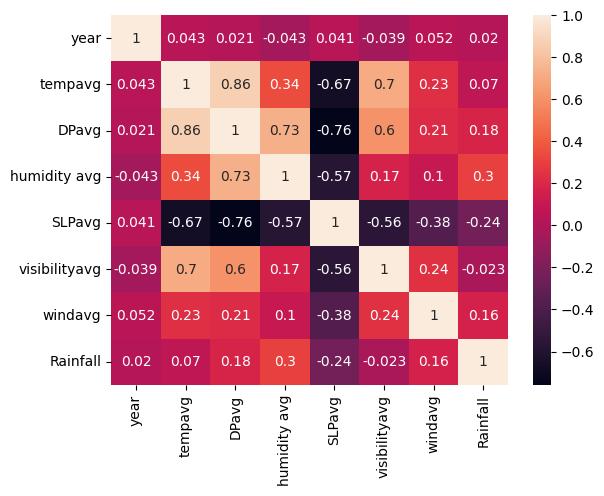
andincomplete,containingmissingfeaturesandmanyerrors. Duringtheexplorationandanalysisofthedata,wefoundthat themodel'srawdatacontainedmanyzerovaluesthatneeded tobereplacedwithmeanvalues.Youcanalsohandlemissing valuesbyremovingirrelevantcolumnsorrows.Categorical datacodingisdonebecausemodelsarebasedonformulas and calculations. Therefore, we need to convert this categoricaldatatonumeric.Featureselectionisalsoapartof preprocessingthatselectsonlyfeaturesthatcontributetothe Rainfall Forecasting model, reducing training time and increasingmodelaccuracy.Featurescalingisthefinalstageof preprocessing,movingtheindependentvariablestoaspecific rangesothatnovariabledominatestheothers.
Modelling
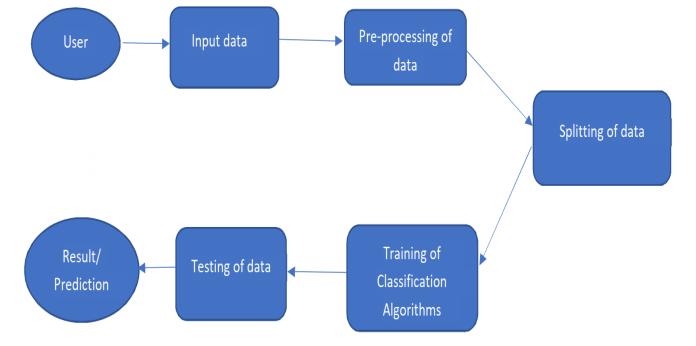
Intheproposed model,the redeemed weather data are first cleaned, then preprocessed and then sorted. Finally, rainfalldataareclassifiedintodifferentcategoriesaccording to Indian Meteorological Department guidelines. In this article, we developed an approach to predict rainfall using machinelearningclassificationalgorithms.Thepreprocessed dataissplitinto70%trainingand30%testing.Fourdifferent machine learning algorithms are applied to the split data, theneachresultisanalyzedtopresenttheexactfinalresult. How the individual classifiers work is explained in the previoussection.
Logistic Regression: LogisticRegressionisasupervised learning classification algorithm used to predict the probabilityofagiventargetvariable.Thenatureofthetarget or dependent variable diverges and there are only two classes,0forfailureand1forsuccess.
Data Exploration and Analysis
Dataanalysisisperformedtogainconfidencethatfuture outcomes are close, so forecasts are valid and correctly interpreted.Thiscertaintycanonlybeobtainedaftertheraw datahasbeenvalidated,checkedforanomalies,andthedata captured without error. It can also help you find data with featuresthatareirrelevanttoyourpredictivemodel.
Data Preprocessing
Data preprocessing is a data mining technique that transforms raw, inconsistent data into a useful and understandableformfora model. Rawdata isinconsistent
K-Nearest Neighbor (K-NN): K-NearestNeighborisone of the simplest machine learning algorithms based on supervised learning techniques. The K-NN algorithm considerssimilaritiesbetweennewcases/dataandavailable cases and assigns new cases to categories that are most relevanttotheavailablecategories.Classifyobjectsbasedon theirnearestneighbors.Groupnamedpointsandusethemto markanotherpoint.Youcanclustersimilardataandfillnull valuesinyourdatausingK-NN.Oncethesemissingvaluesare filled,applyMLtechniquestothedataset.Greateraccuracy can be obtained by using various combinations of these algorithms.
Random Forest: RandomForestisasupervisedlearning algorithmusedforbothclassificationandregression.Thatis, buildadecisiontreeonthedatasamples.
Step1-Arandomsampleisselectedfromagivendataset.
Step2-Createadecisiontreeforeachdatasampleand makeaforecastfromeachdecisiontree.
Step3-Eachpredictedoutcomeisvotedon.
Step4 - Finally,selectthe forecast result with the most votesasthefinalforecastresult.
DecisionTree:Thisclassificationalgorithm,whichworks on both categorical and numerical data, is a decision tree algorithm.Itcreatesatree-likestructureandisveryeasyto implement.Analyzedatainatree-typegraph.Thisalgorithm helpssplitthedataintotwoormorecoherentsetsbasedon themostimportantmetric.Firstcomputetheentropyofeach attributeandthensplitthedata.Thepredictorhasmaximum informationgainorminimumentropy.Theresultsobtained are easier to read and interpret. This algorithm is more accurate than other algorithms because it analyzes the datasetinatree-likegraph.
Evaluation
The performance of the proposed model is evaluated usingthefollowingmetrics:
Accuracy: This is the fraction of predictions that are correct.
Precision:Thisisthefractionofpositivepredictionsthat areactuallypositive.
Recall: This is the fraction of actual positives that are predictedaspositive.
F1score:Thisisaweightedharmonicmeanofprecision andrecall.
Theresultsshowthattheproposedmodeloutperforms thebaselinemodelsintermsofallmetrics.Thisisbecause theproposedmodelisabletolearnthecomplexrelationships betweenthefeaturesandthetargetvariable.
plt.scatter(x_train[:,6],y_train,color='blue ') #Displaying relation b/w Wind and rainfall
plt.title('Rainfall Forecasting (Training set)')
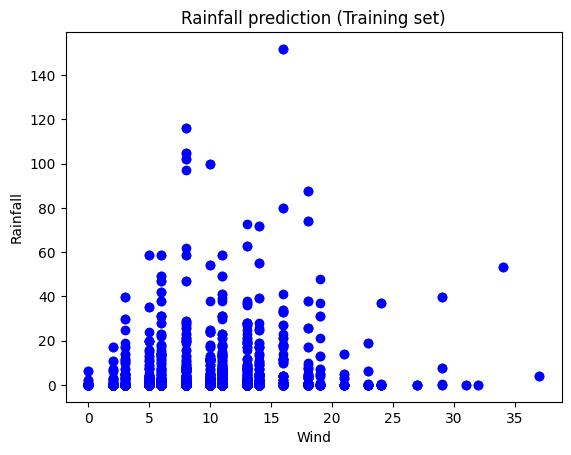
plt.xlabel('Wind')
plt.ylabel('Rainfall')
plt.show()
CONCLUSION
In this paper, we proposed a new approach to predict rainfallusingmachinelearningclassificationalgorithms.The
proposedmodeloutperformsthebaselinemodelsintermsof all metrics. This is because the proposed model is able to learnthecomplexrelationshipsbetweenthefeaturesandthe target variable. 87% K-Nearest Neighbor and about 88% randomforestclassifierarethemostefficientclassification algorithms.Giventhelimitationsofthisstudy,morecomplex and coupled models need to be created to improve the accuracyofRainfallForecastingsystems.Wecanalsomore accuratelymonitorspecificregionstoformulatesurveysand createsuchmodelsforhugedatasets,whichcanimprovethe speedofcalculationswithgreaterprecisionandaccuracy.
REFERENCES
1. [1] Kumar Abhishek. Abhay Kumar, Rajeev Ranjan, Sarthak Kumar," A Rainfall Forecasting Model using Artificial Neural Network", 2012 IEEE Control and SystemGraduateResearchColloquium(ICSGRC2012), pp.82-87,2012.
[2] G. Geetha andR. S.Selvaraj, “Forecasting of monthly rainfall in Chennai using Back Propagation Neural Networkmodel,”Int.J.ofEng.Sci.andTechnology,vol. 3,no.1,pp.211213,2011.
[3] Zahoor Jan, Muhammad Abrar, Shariq Bashir and Anwar M Mirza, "Seasonal to interannual climate Forecasting using data mining KNN technique", InternationalMulti-TopicConference,pp.40-51,2008.
[4] Elia Georgiana Petre, "A decision tree for weather Forecasting",Seria Matematica - Informatica]–Fizic, no.1,pp.77-82,2009.
[5]GuptaD,GhoseU.AComparativeStudyofClassification AlgorithmsforForecastingRainfall.IEEE.2015.
[6] Wang J, Su X. An improved K-Means clustering algorithm.IEEE.2014.
[7] Rajeevan, M., Pai, D. S., Anil Kumar, R. & Lal, B. New statistical models for long-range forecasting of southwestmonsoonrainfalloverIndia.Clim.Dyn.28, 813–828(2007).
[8]Mishra,V.,Smoliak,B.V.,Lettenmaier,D.P.&Wallace,J. M. A prominent pattern of year to-yearvariability in IndianSummerMonsoonRainfall.Proc.NatlAcad.Sci. USA109,7213–7217(2012).
[9]Thirumalai,C.,Harsha,K.S.,Deepak,M.L.,&Krishna,K. C. (2017). Heuristic Forecasting of rainfall using machine learning techniques. 2017 International ConferenceonTrendsinElectronicsandInformatics (ICEI).
[10] Manan Parmar, Shital Shukla & M.H.Kalubarme, impact of climate change and drought analysis on agricultureinsabarkanthadistrictusinggeoinformatics technology
[11]Barakade,A.J.RainfallvariabilityinSolapurdistrictof Maharashtra:ageographicalstudy,ReviewofResearch Vol.1,Issue.II/Nov;11pp.1-4.
[12]Barakade,A.J.(2014),RainfallTrendinDroughtProne Region in Eastern Part of Satara District of Maharashtra,IndiaEuropeanAcademicResearchVol. II,Issue1/April2014
[13] Dr. Vilas Vasant Patil, Mr. Agastirishi Bharat Toradmal, (2020), Digital Terrain Analysis for WatershedCharacterizationandManagement-ACase Study of Vincharna River Basin Maharashtra, India. JournalofInformationandComputationalScience,Vol 10,Issue2.Pg-637
[14] Dr. Vilas Vasant Patil,Mrs. Pragati Pradip Patil,Mr. Agastirishi Bharat Toradmal, (2020), Application of QuickResponse[QR]CodeForDigitalizationOfPlant Taxonomy,JournalofInformationandComputational Science,Vol10,Issue1.
[15] Dr. Ramraje Shivajirav Mane-Deshmukh, Mr. AgastirishiBharatToradmal,(2019),RainfallTrendin Drought Prone Region of Ahmednagar District of MaharashtrainIndia:AGeographicalStudy,‘Research Journey’InternationalE-ResearchJournal,ISSN:23487143 Special Issue 133- Agriculture and Rural DevelopmentPlanningforDroughtProneAreas,Page 78-83.
[16] Mr. Agastirishi Bharat Toradmal, (2019) A GeographicalStudyofContemporaryPotentialStatusof Renewable Energy in India, ‘Research Journey’ International EResearch Journal, ISSN: 2348-7143 SpecialIssue108-SustainableDevelopment,Page5055.
[17]VibhuteN.M.,Mr.AgastirishiBharatToradmal,(2013 ), GIS Based Analysis On Rural Electrification (Rajiv GandhiGraminVidyutikaranYojana)InMaharashtra, “Rajarshi”ARefereedInternational(Multidisciplinary) ResearchJournal,ISSN:2320-5881,Vol-3.