Autism Spectrum Disorder Using Machine Learning
Mrs. Suhasini, H.N.Chandan2, Manoj Kumar S3, Priyanka K41 Professor, Dept. of Computer Science and Engineering, Maharaja Institute of Technology, Thandavapura

2,3,4,5 Students, Dept, of Computer Science and Engineering, Maharaja Institute of Technology, Thandavapura ***
Abstract – Autism Spectrum Disorder(ASD) is a neurodevelopmental illness characterised by difficulties with speech, social interaction, and behaviour. It is a spectrum condition, which means that it affects people differently and that the symptoms vary from person to person. Machine learning is an artificial intelligence technology that enables computer systems to learn and improve their performance without being explicitly programmed. Machine learning may be used to analyse big datasets and uncover patterns that people do not see. Researchers have used machine learning to analyse data frombrainscans, behaviouralevaluations,andgeneticdata tobetterunderstandtheunderlyingcauses ofASD. Machine learning algorithms may also be used to create prediction models that can aid in the earlier and more accurate diagnosis of ASD, as well as to personalise treatment programmes for individuals with ASD. It is crucial to highlight, however, that machine learning is not a cure-all for ASD diagnosis and therapy. Rather, it is a potent tool that can assist researchers and clinicians in better understandingthecomplexitiesofASDanddevelopingmore effectiveinterventions.
Key Words: Autism Spectrum Disorder (ASD), Symptoms, Machine learning.
1.INTRODUCTION
Autism Spectrum illness (ASD) is a neurodevelopmental illness that impacts social communication and interaction, as well as behaviour and interests. It is often diagnosed in early childhood and is a lifelong disorder, however symptoms and severity can vary greatly across individuals. Individuals with ASD may struggle with social communication, including verbal and nonverbal communication issues, trouble recognising social cues, and difficulty building and sustaining relationships.Theymayalsodisplayrepetitivebehaviours, habits,andhobbies,inadditiontosensorysensitivity.
1.1 Overview
Machine learning (ML) is a potent technology for assisting in the diagnosis of Autism Spectrum Disorder (ASD). There is no one test for ASD, and the diagnosis is usually based on a thorough examination of a person's behaviour, developmental history, and clinical observations. To uncover patterns and traits related with
ASD,MLalgorithmsmaybetrainedonmassivedatasetsof clinical evaluations, behavioural observations, and other relevant data. ML algorithms, for example, may analyse facial expressions, language use, and other aspects of a person's behaviour to predict the possibility of an ASD diagnosis.
1.2 Problem Statement
Autism Spectrum illness (ASD) is a complicated illness that can be difficult to identify and manage successfully, according to the issue statement. The symptoms and severity of ASD can differ greatly between individuals, making it difficult for healthcare providers to offerreliablediagnosisanddesignpersonalisedtreatment regimens.Furthermore,thereisnosingletestforASD,and the diagnosis is usually based on a thorough examination of an individual's behaviour, developmental history, and clinical observations. This procedure can be timeconsuming and costly, and more efficient and reliable diagnostictoolsareneeded.
2. EXISTING SYSTEM
The current approach for diagnosing and managingAutismSpectrumDisorder(ASD)oftenentailsa full review of an individual's behaviour, developmental history, and clinical observations by healthcare experts. This evaluation may involve standardized exams, interviews with carers, and observations of the individual's behaviour. There are also a variety of standardized instruments and exams that are routinely used in the diagnosis of ASD. For example, the Autism DiagnosticObservationSchedule(ADOS)isastandardized evaluation that is extensively used to diagnose ASD. The ADOS is a semi-structured observation of the individual's behaviourthatcomprisesactivitiesandexercisesmeantto elicitbehaviourslinkedwithASD.
3. PROPOSED SYSTEM
The suggested approach for detecting and managing Autism Spectrum Disorder (ASD) combines machine learning (ML) algorithms with existing clinical evaluation methods. To uncover patterns and traits related with ASD, ML algorithms may be trained on massive datasets of clinical evaluations, behavioural observations, and other relevant data. The use of
computer vision algorithms to analyse facial expressions, eye gazing, and other visual clues that may be suggestive of ASD is one possible use of ML in the diagnosis of ASD. ML algorithms may also be used to predict the likelihood of an ASD diagnosis by analyzing language use and other aspectsofanindividual'sbehaviour.
Advantages:
•Increaseddiagnosticaccuracyandefficiency
• Treatment programmes that are tailored to the individual
•Earlyintervention
•Improvedaccesstohealthcareservicesandassistance
•Cost-effective
•Scalable
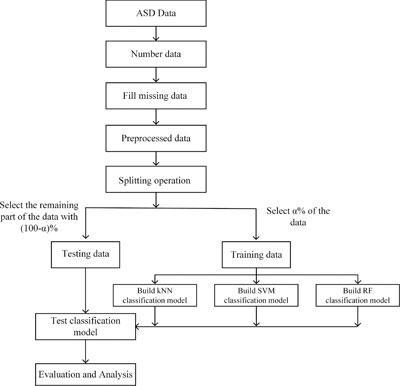
Collecting and preprocessing data, extracting relevant features,developingandtestingamachinelearningmodel, deploying the model in clinical settings, and monitoring andupdatingthemodelovertimeareallpartofthesystem design for the diagnosis and management of Autism Spectrum Disorder (ASD) using machine learning algorithms.
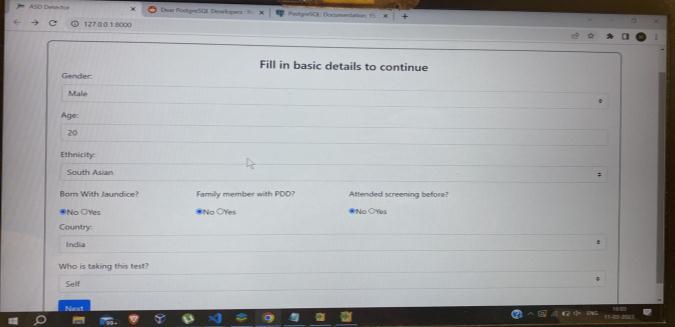
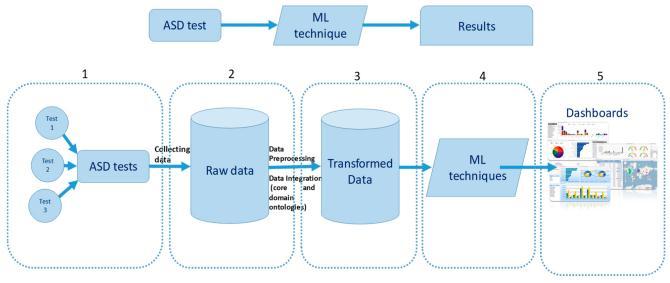
5. MODULE DESCRIPTION
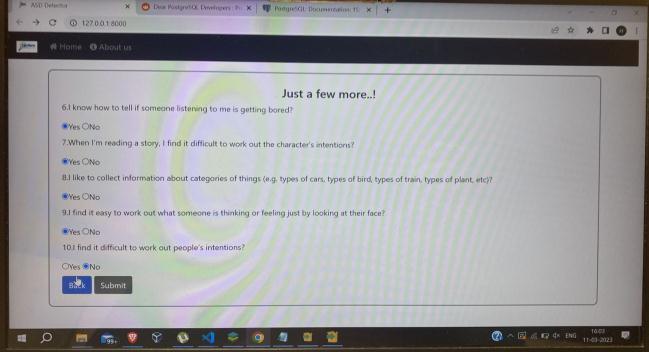
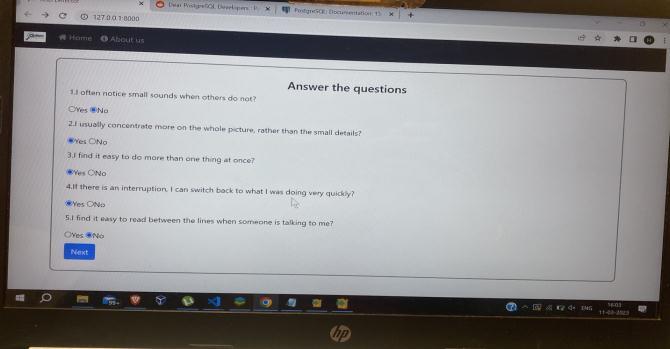
Havioral,imaging,andphysiologicaldata,withthe aim of accurately identifying and diagnosing ASD in individuals. The module may involve different steps, such as data preprocessing, feature extraction, feature selection, and classification, to analyze and learn patterns from the data and build a predictive model.The module may be used in various settings, such as clinical practice, research, and public health, to facilitate early detection and intervention oAn Autism Spectrum Disorder (ASD) using machine learning module is a system that utilizes algorithmsand statistical modelstoanalyzeand interpret various data related to ASD, such as bef ASD, improve diagnosticaccuracy,andbetterunderstandtheunderlying mechanisms of the disorder. However, it is important to note that the module should be used in conjunction with clinical assessment and diagnosis by a trained healthcare professionalandnotasastandalonediagnostictool.
8. CONCLUSIONS
Finally, the application of machine learning algorithms in the diagnosis and management of Autism Spectrum Disorder (ASD) has the potential to revolutionize how healthcare practitioners diagnose and treat persons with ASD. By combining machine learning algorithms with clinical evaluations and behavioural observations, the suggested approach might increase the accuracy and speed of ASD diagnosis, produce personalised treatment plans, and improve symptom monitoringandmanagement.Thesuggestedapproachhas the potential to improve access to healthcare treatments and assistance for people with ASD and their families, as wellaslowercostsandofferobjectiveassessments.
However, it is important to note that the system is still in itsearlystages,andmoreresearchisneededtovalidateits effectivenessandensureitssafety.
ACKNOWLEDGEMENT
We would like to extend our deepest gratitude to our Project Guide, Prof. Suhasini, who guided us and provided us with his valuable knowledge and suggestions onthisprojectandhelpedusimproveourprojectbeyond our limits. Secondly, we would like to thank our Project Coordinator, Dr. Ranjit K N and Dr HK Chethan, who helped us finalize this project within the limited time frameandbyconstantlysupportingus.Wewouldalsolike toexpressourheartfeltthankstoourHeadofDepartment, Dr. Ranjit KN, for providing us with a platform where we can try to work on developing projects and demonstrate the practical applicationsof our academiccurriculum. We would like to express our gratitude to our Principal, Dr. Y TKrishneGowda,whogaveusagoldenopportunitytodo this wonderful project on the topic of ‘Autism Spectrum Disorder using Machine Learning’, which has also helped us in doing a lot of research and learning their implementation.
REFERENCES
[1] World Health Organization. Dementia 2020. Available from:https: //www.who.int/newsroom/factsheets/detail/dementia.
[2]RashedurM. Rahman,M.Ruhul Amin,and MamunBin Ibne Reaz. "Autism Spectrum Disorder Detection using Machine Learning Techniques: A Review". Journal of MedicalSystems.2019
[3] Wang, S., Chen, K., Yang, S., Li, X., & Liu, X. (2019). Machine learning-based diagnosis of autism spectrum disorder using diffusion-weighted imaging and random forestclassifier.Frontiersinpsychiatry,10,315.
[4] Al-Fahdawi, S., Al-Jawad, N., & Ibrahim, Z. A. (2020). Autism spectrum disorder detection using machine learning algorithms. International Journal of Advanced ComputerScienceandApplications,11(2),139-144.
[5] Yang, Y., Yan, J., & Wei, J. (2021). A machine learning approach for autism spectrum disorder classification based on fMRI data. Neural Computing and Applications, 33(9),4153-4164.
[6] Sahin, B. A., Bilgiç, A., & Arslan, A. (2021). Early diagnosis of autism spectrum disorder using machine learning techniques: A systematic review. Journal of medicalsystems,45(2),1-15.
[7] Mohamed, M. S., & Mohammed, M. A. (2021). Machine learning and deep learning-based models for early detection of autism spectrum disorder: A systematic review.Journalofmedicalsystems,45(8),1-15.