A Review of Cyber Security Challenges, Attacks and Solutions for Internet Based Home Automation System
Sudheer
K. T11Lecturer in Computer Engineering, IPT & Government Polytechnic College, Shoranur, Kerala, India

***
Abstract - Platformsfor homeautomationmakeitsimple for users to automate many different physical components of their houses. Customers are starting to grasp the potential of smart home appliances to enhance the standard of domestic life, which is causing them to become more popular. The core of IoT is the ability to remotely manage and observe physical objects (things) over the Internet. The Internet of Things (IoT) idea has recently been used to automate, improve, and secure the home environment. The major significant obstacles to establishing a smart home application, however, have been highlighted as regulating privacy and security in smart home environments. In this paper, reviews some recent articles about the most prevalent cyber security problems and cyber-attacks that take advantage of the weak points of smart home environments. In addition, significant findings on security, threats, and vulnerabilities related to smart homes will be covered in this paper. This study concludes by making some suggestions and recommendations for practical security measures that could be used to reduce cyber-attacks on internet-basedsmarthomes.
Key Words: Cyber Security, Smart Home, Home Automation, IoT, Vulnerability, Threat, Privacy
1.INTRODUCTION
Since the late 1970s, the idea of home automation has been in existence. Yet, as technology and services have developed, so have people's expectations of what a home should be able to accomplish and how those services should be offered and accessed at home. This has also impacted how people see home automation systems. When comparing various home automation systems over time, we can see that each one has made an effort to give homeowners quick, easy, and secure access to their properties.Thefunctionofahomeautomationsystemhas not changed, despite changes in user expectations, technologicaladvancements,orthepassageoftime.
TheworkofJohnJ.Greichen[1]coveredsomeoftheinitial difficulties that home automation systems encountered. High manufacturing costs, high development costs, high installationcosts,extraserviceandsupportcosts,alackof home automation standards, consumer technology
illiteracy, and complicated user interfaces are a few of them. As time went on, technology and computing power advanced quickly, which significantly decreased the cost andsizeofdevices.Because ofall ofthese considerations, electronic devices are now quite popular, and people are no longer unsure or perplexed about how to use computers, smartphones, or tablets. In addition, other interface, communication, and home automation standards, including X10 [2], ZigBee [3], LonTalk [4], and CEBus [5], were developed throughout time. All of these elements helped early home automation systems address their problems and worries, which increased the appeal and acceptance of automated homes. The study done by A.J.Brush etal.[6]addressestheprimarychallengesfaced by contemporary home automation systems, including their high total cost, lack of flexibility caused by the integration of many devices, lack of trustworthy home devices, confusing user interfaces, and dependency on knowledgeableconsultants.Poormanageabilityandalack ofconvincingsecurityaretheresultsofallthesefactors.
Internetofthings(IoT)referstovariouselectronicdevices and objects that are able to connect, and transfer data through the seamlessly Internet [7]. In order to satisfy user needs and add value and convenience to our everyday activities, the adoption of IoT devices in the home environment has significantly expanded over the past few years. [8][9]. IoT technologies are utilized to make homes smarter in order to increase security, effectiveness, and comfort. Today's smart homes have a wide range of devices, including several cameras, microphones, sensors, actuators, device controllers, and home databases that can be accessed remotely for the user'sconvenience.Thesedevices and the home database contain a variety of personal data about the people who reside in a house, including health and financial information, videos, images, live feeds from the house, daily routines, favorite music, and even personal diaries. Various devices employed, bring distinct security vulnerabilitiestothesmarthome.Hence,iforwhenthese contemporary homes are penetrated, they pose a bigger threattotheprivacyandphysicalwellnessoftheresidents than ever before. Automation of the house [10] [11], its accessibility via the Internet [12] or mobile phones [13]
[14],energyconservation[15],technology-assistedsenior citizen living [16], and security [17] have all been the subjectofextensiveresearch.
Hence, the smart home domain is considered as the main factor of the Internet future [18] [19]. However, privacy and security in IoT environments have been identified as the key barriers of the smart home and they require attention. [20][21][22]. In addition, there is no wellestablished practice from governments to enforce IoTindustries to design IoT devices with high security and privacy standards [23]. Additionally, the difficulties of integrating IoT devices in homes could be exacerbated by thecomplexityandheterogeneityofmassivelynetworked servicesanddevices.[22][24][25].
Many hardware design constraints, such as processing unit, energy, and storage limitations, are present in the heterogeneous smart home devices, making it more difficult to apply conventional security solutions. [26]. Moreover,thehomeservicesandthesensitiveinformation should be protected against any malicious attacks that exploit the vulnerabilities of traditional security and monitoring system [27]. Thus, the smart home environment needs superior security methods and daily monitoring,backup,andsoftwareupdating[28][29].
Developing a lightweight IoT solution that satisfies the security requirement in terms of confidentiality and integrity becomes a hot topic in the recent research studies [19][30]. This is mostly because more countries are beginning to put stricter security rules on IoT companies.Therefore,securitycannolongerbelookedas an additional feature, instead, it must be considered as a corebuilt-insystem[31].Thispapermainlyfocusesonthe securityaspectofhomeautomation.
2. SMART HOMES ARCHITECTURE
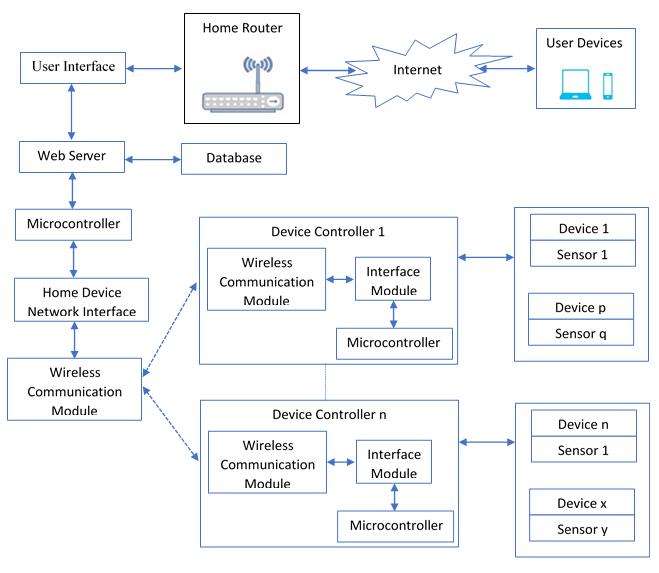
Internet based communication in home automation systems is a very popular choice. The Internet is a fairly common form of communication in the modern world becauseitiseasilyexpandable,versatileintermsofaccess and easy to use. So the hardware and the network required for access is readily available, offers high bandwidth,verylowcommunicationcost,anddevicescan connect to and disconnect from the network easily. The features like these make the Internet such an attractive choice.Deviceswithuserinterfacesincludinglaptops,cell phones, PCs, and tablets are widely available and are a part of many people's daily life. Hence, integrating home automation into these already-popular user devices appears to be a logical next step. Figure 1 shows the
components of a typical home automation system using theInternet.
The User Interface (UI): UIs are usually web pages or any Android/iOS/Windows applications developed. These applications or a web browser can be used by a user to connect to their house from a portable device over the Internet. A username and password are typically used by home automation systems to identify authorized users beforegivingaccesstothehouse.
Web Server, Database and the Microcontroller: A web server connects the user interface to the database. All of thehomedevice’sinformationandtheirpresentstatusare contained in the database. A user with remote access to their house can use the web server to query the database for the device's status information. A microcontroller manages all the operations and communications in the home network,asshown in Figure1. Asa PCcan actually performeachoftheseactivities,researchershavedecided to replace the web server, database, and microcontroller withaComputerforsimplicity.
Network Interface Module: It controls the communication betweenthecontrollersforhomedevicesandthePC.With this interface, the device controllers receive commands from users to modify the status of the equipment in their homes. Following the execution of these operations, the interfacetransmitsadevice'sstatustothedatabase.
Device Controller: A Device Controller has a microcontroller to manage its operations and interface,
wireless connectivity, and control modules. Many home sensors and devices are linked to a device controller. The devicecontrollerrelaysuserinstructionsandrequestsfor adevice'sstatus.
CommunicationModule:Whendecidingonthetechnology for the method of communication between the gadgets in the home, there are a few options. It is possible to use wired or wireless connections, depending on the resident's preferences. The most widely used communication protocol for wired communication is X10 because it can be deployed using existing wiring without requiring many significant changes. There are several options for wireless communication, including infrared, Bluetooth,Wi-Fi,andradiofrequency(RF).
Many benefits come with Wi-Fi communication technology, including inexpensive installation costs, simplicity in deployment and installation, respectable communication range, scalable technology, high bandwidth,andlittlepowerconsumption.AES encryption offers good security. Repeaters can also be employed to increase the transmission range. Without changing the current architecture, Wi-Fi is the best form of communication for automating an existing home. Also, since the transmission is wireless, the home'sappearance is enhanced. Wi-Fi is the best option for wireless communicationduetoallthesereasons.TheworkofA.El Shafee and K.A. Hamed [12] proposes an Internet-based system for home automation that makes use of Wi-Fi to allow communication between various gadgets and a server within the house. In their work, a PC with built-in Wi-Fi communication capabilities is used as a web server andacommunicationmodulethatenablescommunication betweenthehomedevices andtheserver(PC). Thehome devices are connected to the PC via Wi-Fi by a hardware interfacemodule.
Home Router: With a home's router, a home automation system is linked to the Internet. This allows the home’s inhabitants to access their home from anywhere with the rightcredentials..
Internet: If the home automation system is connected to the Internet, a resident can access and manage his or her house from any location in the globe. Although it offers benefits as we've already discussed connecting the hometotheInternetmakesitaccessibletoanyonewithan Internetconnection.
User Devices: People are now able to purchase and frequently use portable mobile devices for accessing the Internet because to improvements in electronics, processing power, and size and cost. In order to access
their houses over the Internet, people utilize cell phones, laptops, and tablets. As a result, homeowners now have a flexible and practical option to access their house wherever they are. Users utilize the same device to perform daily duties like browsing, playing games, downloading apps, and viewing movies on the Internet in additiontoaccessingotherapplications.Duetothis,there is a higher chance that the mobile device will have a securityrisk.
3. MAIN VULNERABILITIES AND THREATS IN SMART HOME
Thereisatrade-offbetweenconvenience,control,security and privacy in a smart home. The heterogeneous components of smart home that have different kinds of smart home applications such as securing homes, healthcare, energy, convenience as well as CPU and storage limitations make traditional security solutions for smart home not applicable. There are few security concepts need to be in mind in order to provide the best notionforthesmarthomeriskandmitigation[31].
Assets: physical and virtual things that are valuable for userssuchas personal information, activities,money,and properties.
Threats: any potential action that might cause damage, harmorloss.
Vulnerabilities: weaknesses or gaps inside the system thatpotentiallyareexploitedbyattackers
Risk: the potential loss or damage might impact the system by a threat advanced from the system vulnerabilities.
3.1 Main Vulnerabilities
The research study in [32] estimated that 80% of IoT devices arevulnerable to a widegroup ofthe hack.These weaknesses could be used by adversaries to affect environments in smart homes. IoT system has commonly three layers namely application layer, network layer, and perception Layer [33]. IoT devices are susceptible to attack and malicious behavior at every layer. Below is a description of some well-known vulnerabilities in smart homes.
A. Heterogeneous Architecture
To build a smart home system, we need a collection of a variety of smart home devices that work effectively using different systems. A dynamic heterogeneous architecture in a smart home needs to be built through the perception
layer,the network layer, andthe application layer. One of themostcommonchallengesinIoTnetwork istoidentify the nodes that may have access to users' privacy information related to the heterogeneous architecture of IoT [6]. Smart home system is a platform that consists of heterogeneous data, technologies, devices, and protocols. The heterogeneous architecture of smart devices and the dynamicenvironmentoftheInternetofthingsenforceIoT companies to figure out new security strategies to come up with the new challenges that should be considered [34]. Therefore, in order to get better IoT-devices homogeneous,theawarenessofusingIoTapplicationsand systemsisveryimportant.
B. Outdated Protocols
Since the Internet was established, there are some protocolsareoutdatedwithoutanyupgradewhichcanbe compromised by attackers [35]. In addition, the alarming development of IoT devices makes the current security protocols and techniques are not enough because the existingdeviceshavelimitationsintheirlevelsofintegrity, scalability, and interoperability [6]. Security features in IoT protocols are limited and the trust between these devices is poorly embedded [19]. Therefore, new techniques must be implemented to meet the privacy, security,andreliabilityrequirementsofIoT.
C. Weak Encryption
Encryption is the process of cipher information in such a way that only authorized people can access it in order to preventattackersfromeavesdroppingandtamperingwith data during transmission. If one piece of data is not encrypted or isolated, the data will be transparent and easy to be exploited by attackers [6]. Furthermore, some IoT device use a small encryption key which can make them vulnerable to hacked [36]. Most of IoT devices use different control platforms and protocols, so the cryptography solutions to protect all IoT systems differ based on the constraints of IoT devices. Smart home devices contain sensitive information about user’s daily life. Thus, encryption should be at the core of IoT industries as it is an easy and beneficial security method [36].
D. Limited Storage and CPU
Smart home devices collect a great amount of data that needs to be computed, analyzed, stored and processed. Mostly,datapre-processingisdoneateitherthesensoror some other proximate device [37]. The processing and storagecapacitiesofIoTdevicesare,however,constrained by the resources available, which are relatively
constrained due tothecomputational capability,available energy, and limited storage. Therefore, IoT-devices are vulnerabletoDenialofServiceattacks(DoS)[6].
E. Insecure Applications
There is a lack of systematic techniques for building privacy that has not been considered by IoT applications and middleware platforms [38]. Several IoT manufacturers create smart home products that can be managedusingsmartphoneapplicationsthataresimpleto hack.. A malicious code can be merged with applications software installed on the IoT system, which easily allow theattackerstoperformharmfulattacks[33].
F. Poor Authentication
Authenticationisthemethodofhavingthecredentialsthat validate your identity to a system or entity [19]. In network communication, the main risks come from poor confidential settings and poor authentication. Default credentials should change before using IoT devices becauseonceguessed,theycanbeexploitedtohackmany devices [29]. The smart home gateway's poor access control setup poses the greatest risk to the processing of information. This risk is primarily because of weaknesses of authentication procedure and inadequate separation of privilegesbetweenuseraccounts[28,38,39].
G. Firmware Failure
Many IoT devices in the smart home setting encounter a significant issue since they cannot update their firmware. As the majority of Internet of Things (IoT) devices are inexpensive, manufacturers frequently overlook methods for verifying firmware integrity during installation, execution, or upgrading [40]. Also, the firmware of many IoT devices is similar, which increases the chance of successfully exploiting the device and makes it a significant vulnerability for IoT devices [41]. Since the firmware on a device is fixed and never modified, attackers can exploit this problem to launch attacks with confidencethattheviruswillworkonsimilardevices[29].
3.2 Main Threats
In order to secure any system, it is necessary to analyze thetypeof threats thatwill be faced, and how thethreats will affect system security. The major threats that can affect each layer and have an effect on the smart home environmentaredescribedinthefollowingsubsections.
A. Denial of Service (DoS)
Denial of service (DoS) is a kind of cyber-attack in which the attacker attempts to make a system or network unavailable to the user for a temporary or permanent period[40].Inordertooverwhelmthetargetedsystemor network and prevent it from responding to legitimate requests, DoS often involves sending a large number of unnecessaryrequeststothesystemornetwork[34].
B. Eavesdropping
Owingtotheheterogeneous IoT architectureof thesmart home infrastructure, an attacker may employ a variety of tools and methods to record network data between the various IoT device components. These techniques are extremelybasedontheattacker’scapabilitiesandlocation [40]. The adversary will be able to intercept all traffic between the smart hub and the users if he uses the flaws in smart home technology to compromise the network's security.Theattackermightusewell-knowntoolssuchas tcpdump3,wireshark4,etc.,togainaccesstothedata[40]. Also, the adversary might use several types of hardware equipment like the Wi-FiPineapple5, whichcan spoof the accesspointsandintercepttheunderlyingcommunication [40].
C. Impersonation
In some circumstances, the adversary seeks to mimic a trustworthy user and act on that user's behalf to harm or spy on the victim. Obtaining the user credentials (user ID andpassword)canbeachievedthroughsocialengineering or by intercepting the network traffic in order to provide accesstotheIoTdevices[33].
D. Theft (Identity, credentials, information)
Users of smart homes are significantly impacted by the lossofvaluableassets.Theftisanactivitythroughwhicha person's property is taken or used without his/her permission [42]. The adversary seeks to steal important information from users of smart homes, such as login passwords or credit card information, for authentication and authorization. There are well-known types of equipment and hardware that might be used by the attackers to hack the smart home and obtain information abouttheuser[40].
E. Compromising
The attacker tries to hack several devices and systems regardless of the identity of these systems to achieve monetary gains from exploiting the information extracted [43]. Also, attacker can deploy his own node or even
compromise one of the existing nodes [44]. Once a network is compromised, the eavesdropper can be secretly merged into network traffic, making detection extremely hard. The attacker then begins covertly employing its cyber tools to identifysecurityholes within the critical network cables. A cyber-map of the network's topographywillbecreatedbythemalicioussoftwareafter ithasscannedthesmarthomeinfrastructureandprobing IoT devices to find any system vulnerabilities. This step can be easily done by using tools found on the Internet [43]. Real-time and autonomous interaction between devices make discovering and identifying the compromisednodesverydifficult[24].
F. Malicious Software
Malicioussoftwareisatermusedtodescribethesoftware code created by attackers to gain unauthorized access to private networks or systems, collect or erase sensitive data, disrupt business operations, or display unwelcome advertising. Examples of malicious software include worms, Trojan horses, rootkits, and spyware. Malicious software (malware) can be injected into IoT applications and then affects the IoT services and devices [33]. Since IoTdeviceshavea lightweightautonomous versionof the well-known operating system, the attackers can access to private information using over mentioned malicious software in order to look for vulnerabilities and exploit them[29].
4. RECOMMENDED SECURITY SOLUTIONS AND PRACTICES
IoT-based smart home environments have seen a lot of security practices and solutions presented since they can hold private, sensitive, and essential information. The following section discusses a number of security options for IoT-based smart homes that have been recommended inrecentyears.
4.1 Updating the Software
To ensure current security software, updating and upgrading device software, firmware, and firewall is crucial. A firewall acts as a filter between internet and interface and control the traffic between network and the Internet[46].Moreover,thefirewallprotectsthenetwork frommaliciouscodesandexternalthreats[8].Firewallcan detectandissuewarningtouserandinvokeitsmitigation strategy against particular security breaches [30]. Furthermore, it is essential to update the firmware and device software to the latest version to avoid unpatched vulnerabilities[47].Outofdatesoftwarestillhasthesame flawsandexploitablevulnerabilitiesinthecodethatallow
e-ISSN:2395-0056 Volume: 10 Issue: 04 | Apr 2023
cybercriminals and hackers to exploit them. The security issues in home automation can be mitigated by updating thefirewallanddevicesoftwaresystems[30].
4.2 Utilizing Effective Encryption
Wherever possible, the diverse components in an IoT device should successfully secure the data connection. Encrypted data communication would reduce the potential privacy risks and prevent unauthorized access getting benefits from the data transferred between components.Encrypteddatareducesanyprivacyviolation duetomaliciousattacksandunauthorizedaccess[38].
4.3 Using Private Network
One of the most common techniques for preventing unauthorizedaccesstoIoT devicesisthedeployment ofa secure communication channel. The secure communicationchannelcanutilizeasecurevirtualprivate network (VPN) and limit network traffic such that it is accessibleonlytoauthorizedusers[33].
4.4 Applying up-to-date Protocols
UsingthemostupdatedprotocolsinIoTdevicesiscrucial for network security. One of the most crucial elements of IoT is the protocol [35].It provides regulations for communications between devices to be established in a uniform way. Therefore, embedded computing services require a group of rules to control, communicate and exchangedata[19].
4.5 Changing Credentials Regularly
IoTmanufacturersshouldrequirecustomerstoupdatethe default identity (username and password) into strong ones the first time they use an IoT device, otherwise the IoT device should not function [47]. Moreover, the password must be changed at least once every three months. Besides that, users should not use the same password for all IoT devices, but rather should use a distinct password for each type of IoT device. Furthermore,itisstronglyadvisedagainstusingtheemail as a username because attackers frequently use this methodtoattempttophishemailaccountsandobtainthe password[48].
4.6 Backup Significant Information
Some smart home devices, such as healthcare devices, include important information that can only be accessed by authorized individuals. The ideal strategy is to regularly backup such information to prevent falsification
or theft. The research study in [33] gives guidelines of how-to backup sensitive information such as media information and store them off-site either digitally or physically
4.7 Monitoring the Network
Monitoring an IoT device's connection during message transferisoneofthegreatestwaystosecuresmarthomes. There are many tools help to monitor the network and analyse the device messages such as Microsoft Message Analyzer. Furthermore, the monitoring software can searchforvulnerabilitiesandthenupdateIoTprograms.
5. CONCLUSIONS
The internet based home environment has tremendously increased these years in order to enhance the quality of our lives at home by making it easier, more comfortable and convenient. However the main obstacles to the smart home have been identified as privacy and security in IoT environments. This paper reviewed some articles related to the architecture, threats, and security of smart homes environments. Some common existing architecture in smart home environment were presented in this paper. More significantly, the most common threats and vulnerabilities of smart homes were described and discussed. Finally, the best user practices and solutions suggestedforsmarthomeenvironmentswereprovidedin thispaper.
REFERENCES
[1]Greichen,J.J.,“Valuebasedhomeautomationortoday's market,” IEEE Transactions on Consumer Electronics, vol. 38,no.3,pp.34-38,Aug.1992.
[2]“TheX10Specification,” X-10(USA) Inc.,1990.
[3] “ZigBee Specifications,” ZigBee Alliance, version 1.0 r13,Dec.2006.
[4] “LonTalk Protocol Specification Version 3.0,” Echelon Co,1994.
[5]“EIA-600CEBusStandardSpecification,” EIA,1992.
[6] A.J. Bernheim Brush, B. Lee, R. Mahajan, S. Agarwal, S. Saroiu, C. Dixon, “Home automation in the Wild: Challenges and Opportunities,” in CHI ’11 Proceedings of the SIGCHI Conference on Human Factors in Computing Systems,pp.2115-2124,2011.
[7] Y. Lu and L. Da Xu, “Internet of things (IoT) cybersecurity research: A review of current research
topics,” IEEE Internet Things J., vol. 6, no. 2, pp. 2103–2115,2019.
[8]N.Apthorpe,D. Reisman,S.Sundaresan,A.Narayanan, and N. Feamster, “Spying on the Smart Home: Privacy AttacksandDefensesonEncryptedIoTTraffic,”2017.
[9] S. Zheng, N. Apthorpe, M. Chetty, and N. Feamster, “User Perceptionsof Smart HomeIoT Privacy,” Proc.ACM Human-Computer Interact., vol. 2, no. CSCW, pp. 1–20, 2018.
[10] K. Madhuri, B. L. Sai, B. S. Sirisha, “A Home Automation System Design Using Hardware Descriptive Tools,” International Journal of Engineering Research & Technology,vol.2,no.7,Jul.2013
[11] E.M.C Wong, “A Phone-Based Remote Controller for Home and Office Automation,” IEEE Transactions on Consumer Electronics,vol.40,no.1,pp.28-34,Feb.1994.
[12]A.ElShafee,K.A.Hamed,“DesignandImplementation ofaWiFiBasedhomeautomationSystem,” WorldAcademy ofScience,EngineeringandTechnology,vol.6,2012
[13] M. Danaher, D. Nguyen, “Mobile Home Security with GPRS,” in proceedings of the 8 th International Symposium forInformationScience, Oct.2002.
[14] A. Alheraish, “Design and Implementation of Home Automation System,” IEEE Transactions on Consumer Electronics,vol.50,no.4,pp.1087-1092,Nov.2004.
[15]V.Singhvi,A.Krause,C.Guestrin,JamesH.GarrettJr., H. Scott Matthews, “Intelligent Light Control using Sensor Networks,” in Proceedings of the 3rd international conference on Embedded networked sensor systems, SenSys '05,pp.218-229,2005.
[16] A. Gaddam, “Development of a Bed Sensor for an Integrated Digital Home Monitoring System,” IEEE International Workshop on Medical Measurements and Applications,pp.33-38,May2008.
[17] U. Saeed, S. Syed, S.Z. Qazi, N.Khan, A.Khan, M.Babar, “Multi-advantage and security based home automation system,” 2010 Fourth UKSim European Symposium on Computer Modeling and Simulation (EMS), pp.7-11, Nov. 2010.
[18] A. Jacobsson and P. Davidsson, “Towards a model of privacyandsecurityforsmarthomes,”IEEEWorldForum InternetThings,WF-IoT2015-Proc.,pp.727–732,2015.
[19] D. Bastos, M. Shackleton, and F. El-Moussa, “Internet of Things: A Survey of Technologies and Security Risks in
Smart Home and City Environments,” In IET Conference: LivingintheInternetofThings:CybersecurityoftheIoT
2018,pp.30(7pp.),2018.
[20] A. Jacobsson, M. Boldt, and B. Carlsson, “A risk analysis of a smart home automation system,” Futur. Gener.Comput.Syst.,vol.56,pp.719–733,2016.
[21]“Privacyiniotthreatsand challenges2014.pdf.”
[22] R. Heartfield et al., “A taxonomy of cyber-physical threats and impact in the smart home,” Comput. Secur., vol.78,pp.398–428,2018.
[23] D. Marikyan, S. Papagiannidis, and E. Alamanos, “A systematic review of the smart home literature: A user perspective,” Technol. Forecast. Soc. Change, vol. 138, no. September2018,pp.139–154,2019
[24] A. Dehghantanha, K. Franke, and S. Journal, “Internet of Things Security and Forensics: Challenges and Opportunities,” Future Generation Computer Systems, pp. 2–8,2018.
[25] A. R. Devidas, M. V. Ramesh, and V. P. Rangan, “High performance communication architecture for smart distribution power grid in developing nations,” Wirel. Networks,vol.24,no.5,pp.1621–1638,2018.
[26]K. Sha, W. Wei, T.Andrew Yang,Z. Wang, and W. Shi, “On security challenges and open issues in Internet of Things,” Futur.Gener. Comput.Syst.,vol.83,pp. 326–337, 2018.
[27] V. D. Vaidya and P. Vishwakarma, “A Comparative Analysis on Smart Home System to Control, Monitor and Secure Home, based on technologies like GSM, IOT, Bluetooth and PIC Microcontroller with ZigBee Modulation,” 2018 Int. Conf. Smart City Emerg. Technol. ICSCET2018,pp.1–4,2018.
[28] Cisco, “Cisco Annual Cybersecurity Report 2017,” Bioinforma. Biomed. Eng. 2008. ICBBE 2008. 2nd Int. Conf.,pp.7–58,2017.
[29] G. Corser et al., “IEEE Internet Technology Policy Community White Paper INTERNET OF THINGS ( IOT ) SECURITYBESTPRACTICES,”Ieee,no.February,2017.
[30] S. Ur Rehman and V. Gruhn, “An approach to secure smart homes in cyber-physical systems/Internet-ofThings,” 2018 5th Int. Conf. Softw. Defin. Syst. SDS 2018, pp.126–129,2018
[31] S. on Security, “New IoT Security Regulations.” [Online]. Available: https://www.schneier.com/blog/
archives/2018/11/new_iot_securit.html?fbclid=IwAR3LlV Y7hsuXOpFxNwlURp2MjOVifqqYssgJCbh7MLg_qFsIyNmec NiFKUo
[32]Rambus,“SmartHome:ThreatsandCountermeasures - Rambus.” [Online]. Available: https://www.rambus com/iot/smart-home/
[33] B. Ali and A. I. Awad, “Cyber and physical security vulnerability assessment for IoT-based smart homes,” Sensors(Switzerland),vol.18,no.3,pp.1–17,2018.
[34] D. E. Kouicem, A. Bouabdallah, H. Lakhlef, D. E. Kouicem, A. Bouabdallah, and H. Lakhlef, “Internet of things security : A top-down survey To cite this version : HALId:hal-01780365InternetofThingsSecurity:atopdownsurvey,”2018
[35]A.M.Lonzetta,P.Cope,J.Campbell,B.J.Mohd,andT. Hayajneh, “Security vulnerabilities in bluetooth technologyasusedinIoT,”J.Sens.ActuatorNetworks,vol. 7,no.3,pp.1–26,2018.
[36]iotforall,“HowEncryptionisPoweringtheFutureof IoT | IoT For All,” 2018. [Online]. Available: https://www.iotforall.com/future-iot-encryption/.
[37] P. Sethi and S. R. Sarangi, “Internet Of Things: Architecture,Issues and Applications,” Int. J. Eng. Res. Appl.,vol.07,no.06,pp.85–88,2017.
[38]C.Perera,C.McCormick,A.K.Bandara,B.A.Price,and B.Nuseibeh,“Privacy-by-DesignFramework forAssessing InternetofThingsApplicationsandPlatforms,”pp.83–92, 2016.
[38] A. Jacobsson, M. Boldt, and B. Carlsson, “A risk analysis of a smart home automation system,” Futur. Gener.Comput.Syst.,vol.56,pp.719–733,2016.
[39]Ahmed,A.A.andAhmed,W.A.AnEffectiveMultifactor Authentication Mechanism Based on Combiners of Hash Function over Internet of Things. Sensors, 19(17), 2019, p.3663.
[40] D. Geneiatakis, I. Kounelis,R. Neisse, I. Nai-Fovino, G. Steri, and G. Baldini, “Security and privacy issues for an IoTbasedsmarthome,”201740thInt.Conv.Inf.Commun. Technol. Electron. Microelectron. MIPRO 2017 - Proc., pp. 1292–1297,2017.
[41]W.Paper,“CyberSecurityintheEraofSmartHomes,” pp.1–114.
[42] J. M. Hatfield, “Social engineering in cybersecurity: The evolution of a concept,” Comput. Secur., vol. 73, pp. 102–113,2018.
[43]I.G.Seissa,J.Ibrahim,andN.Yahaya,“Cyberterrorism DefinitionPatternsandMitigationStrategies:ALiterature Review,”Int.J.Sci.Res.,vol.6,no.1,pp.180–186,2017.
[44] H. Rahmani, N. Sahli, and F. Kamoun, “Distributed denialof-service attack detection,” no.May2010,pp.839–859,2011.
[45] N. Nthala and I. Flechais, “Rethinking Home Network Security,”no.April,2018.
[46]F.Steps,S.Strategy,M.Risks,O.Security,andF.Steps, “HowtoDevelopanITSecurityStrategy,”pp.1–5,2018.
[47]T.M.Secur,“PARADIGM.”
[48] NetFormation, “8 Best Practices for Security Within the Internet of Things.” [Online]. Available: https://www.netformation.com/featured/8-bestpractices-for-security-within-the-internet-of-things/.