
R.A.W - THE GAME
Sanjay M1, Akshai Kanna SK2, Ms. Lakshmi Priya S31Department of computer science and Engineering, Sathyabama Institute of Science and Technology, Tamil Nadu, Chennai
2Department of computer science and Engineering, Sathyabama Institute of Science and Technology, Tamil Nadu, Chennai
3Assistant Professor, Department of computer science and Engineering, Sathyabama Institute of Science and Technology, Tamil Nadu, Chennai ***

Abstract - R.A.W - The Game is an open world action adventure game based in a steampunk setting. Its gameplay combines traditional RPG elements with FPS elements, such as cover-based shooting and crafting systems, while including stealth action sequences and exploration of a large over-world. It utilizes Unreal Engine 5 as its primary engine. Unreal Engine is a suite of Python libraries, comprising of C++ class library and UE4 plugin library, for 2D and 3D graphics programming. It includes real-time visuals like dynamic lighting, bump mapping, shadow mappingetc.,as well asa deepphysics simulationto boot.It uses OpenGL in its renderer backend which allows you to make use of Unreal’s simulation features. Blender is a free and open-source 3D computer graphics software tool set used for creating 3D models, game elements, interactive 3D applications, virtual reality, and, game environment, video games. Blender offers a wide range of capabilities for 3D modeling, including UV mapping, texturing, digital sketching, raster graphics editing, rigging, skinning, fluid and smoke simulation, particle simulation, match movement, animation, sculpting, soft body simulation, compositing, rendering, motion graphics and video editing. This game utilizes advanced animation and graphics technology. Lumen is the global illumination and reflections system in Unreal Engine 5, a completely dynamic global illumination and reflections system created for next generation consoles. In huge, intricate settings, Lumen displays diffuse interreflection with infinite bounces and indirect specular reflections at scales ranging from kilometers to millimeters. All programming code is written in C++ code, where Lumen is used as rendering systems that achievefastreal-timegraphicsrendering.
Key Words: Unreal Engine 5, Open World, Lumen, Nanite, Real Time Rendering, Action-Adventure Game
1.INTRODUCTION
Gaming has become a cultural phenomenon with computerandvideogamesevolvingfromsimpletitleslike Pac-Man and Tetris to advanced and immersive experiences enjoyed by players of all backgrounds. Advanced rendering systems like Lumen have replaced
traditional systems like Eevee, providing high-quality graphics in real-time. Lumen is a fully managed, highperformance render engine that offers complete control overframebudgetandCPU,allowingforthebestresultsin alltypesofgames.Theenginewascreatedbythousandsof artists and developers worldwide and includes advanced TurbulentDirectImageSynthesistechnologyforflexibility in game engine design. Game engines are software frameworks primarily used for the development of video games, and include relevant libraries and support programs.Gameenginesareversatiletoolsthatenablethe creation of video games for various platforms, including videogameconsolesandcomputers.Theseenginesoffera rangeof essential features, suchasa renderingengine for generating 3D or 2D graphics, physics engine for simulating physical interactions, collision detection, multiplayer support, animation, AI, networking functionalities,memory.Together,thesefeaturesformthe core functionality of a game engine and allow game developers to focus on designing and implementing game mechanics and content, rather than having to build the underlyingtechnologyfromscratch.Ourgameenginewas built using Unreal Engine 5, which allows for classic PC games to be played on gaming consoles, making the experience more immersive. Unreal Engine is a 3D computergraphicsgame enginethatallowsdevelopers to createtheirowngames.Itssourcecodeisavailablefreely, but it also has proprietary extensions that allow for customization. The engine includes a visual editor that provides an intuitive interface for designing games in 2D and 3D using Unreal Script. The project was made using Blender,a3Dmodelingtoolusedbyprofessionalsforfilm and video game animation. With Blender, 3D models, virtual reality, game environments, and video games can all be created. It is a free and open-source development tool.Thissoftwareallowsyoutomodel3Dobjects,useUV mapping, texturing, rigging and skinning, simulate fluids and smoke, run particle simulations, simulate soft bodies, and sculpt objects. The Lumen global illumination and reflectionsystemonUnrealEngine5isdesignedfornextgen consoles. With Nanite, Unreal Engine 5 renders high object counts, pixel-level detail and high object counts with a new mesh format and rendering technology. It
intelligentlyworksononlythedetailthatcanbeperceived and is highly compressed without losing the texture qualityandvisualappeal.
2. LITERATURE REVIEW
A. Primanita, M. N. A. Khalid and H. Iida’s study [1] explorestheidea of"indicator" inthecontext ofsearch in the domain of games, using the scalar versions of the original conspiracy number search (CNS) framework. Researchers found that domain-independent indicators were useful in understanding and solving search-tree computations, which are strongly influenced by information uncertainty in game states. According to the research, conspiracy numbers are also reflected in a conceptknownasstability changeoftherootnode(SCN), which provides a sense of thrill and long-term engagement. PPNS and SCN, domain-independent indicators for game-related computing, may provide usefuldirections,especiallyforsavingtimeandpreserving valuable resources while addressing high-stake decision making and planning, according to the study. Future researchshouldexplorehowPPNSandSCNcanbeapplied to multiplayer games and non-game contexts as well as establishing search and entertainment in a multidisciplinary perspective. In summary, the author argues that Leibniz understood the idea of creating sophisticated games that mimic nature’s mechanism, and thatgamesthatfollowthisdesignprinciplewillbeplayed with great pleasure as the human experience becomes closertonature.Theauthorissuggestingthatgamedesign is not only an entertainment but also a way to simulate and understand the natural world, and that sophisticated games that replicate the laws of motion found in nature will provide a more realistic and engaging experience for the player. The author implies that this would lead to a greater level of enjoyment for the player, and that the overall game experience would be closer to the natural world.
H. Iida and M. N. A. Khalid, The authors also suggest [2] that future research efforts should focus on exploring the relationshipbetweengamesandnaturefurther.Thiscould include investigating the feasibility of using AI algorithms for global optimizations, such as evolutionary computation, in determining the optimal solution in long term planning and risk minimization in decision-making. Additionally, the author suggests that future research shouldalsoaimtoestablishsearchandentertainmentina multidisciplinary perspective, bridging information and computation with psychological study and affective sciences. This would allow for a better understanding of the relationship between gamesandnature andhow they canbeusedtosimulateandunderstandthenaturalworld. Additionally, future research could also explore the potential for using games as a tool for education and
training,specificallyinareassuchasriskmanagementand decision-making. Studies could also investigate the effectiveness of using games as a tool for learning and understanding complex systems and phenomena found in nature.Furthermore,theimpactofincorporatingelements of nature in game design, such as realistic environments and naturalistic AI, could also be studied in relation to player engagement and immersion. Another area of researchcouldbestudyingtheeffectsofgamingonhuman nature, specifically how video games impact cognitive development,decisionmaking,andsocialbehavior.
Tom Andersson and Hampus Stromsholm’s [7] thesis contributes to the research on immersion in video games bystudyingfeaturesthatcontributetooverallimmersion. The evaluation produced a range of comparable data based on an artifact that was created, tested, and evaluated.Therehasbeena combinationofconfirmations andmodificationsoftheoriesderivedfromrelatedwork.It suggests that fear can be used as a tool to enhance other immersiveexperiences,regardlessofwhether fearshould be considered a feature. Many players tended to ignore graphics because they were considered forgiving by the average player. The overall immersion of the artifact was found to be influenced by flow. In addition to purpose, objectives, rewards, and audio, researchers are considering other immersive features and intend to map all the connections between these features so that game developerscanunderstandwheretostart.
A. S. Bastos, R. F. Gomes, C. C. dos Santos and J. G. Rodrigues Maia [9], the authors investigate the specific features that confer the quality of immersion to an electronic game. They draw upon literature to gain a theoretical background, but also aim to provide practical guidelines for developers to help them create immersive experiences.Todothis,theauthorsanalyzedtitlesthatthe audience considered to be immersive. They then developed a prototype game based on the features they identified in their analysis. After evaluating their prototype game and the titles selected, the authors conducted a comparative analysis. A game's immersive experience was determined by six specific features. In light of the recent advances in consumer-level virtual reality hardware, the authors contend that modern electronic games are notably immersive media. Developersneedmorethanjusttheoreticalbackgroundto create immersive experiences; practical guidelines can also help them. Through identifying specific features of electronic games that contribute to immersion, the authors aim to provide these guidelines. In order to develop the prototype game, they analyze titles that the audiencefindsimmersiveanddevelopa versionbased on thesefindings.Insubsequentevaluationsoftheprototype game, they determine that six features provided an immersivegamingexperience.
3. METHODOLOGY
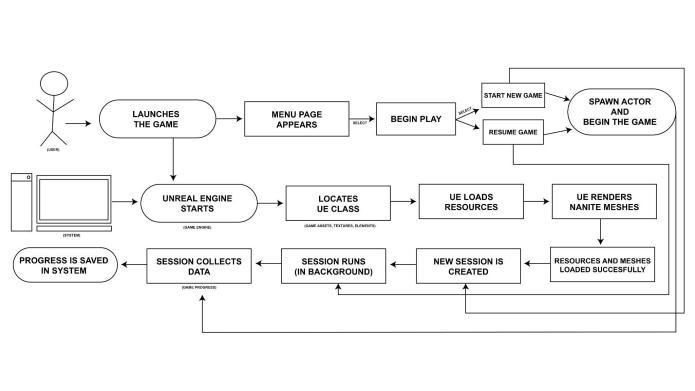
The different modules in the proposed system are discussedinFig-1.
4. RESULT AND DISCUSSION
Fig -1:SystemArchitecture
Traditional games use EEVEE as their render engine and use Unity or other gaming engines for development. We use Unreal Engine 5, which is superior to other gaming engines in every way. When it comes to rendering, unlike other engines, Unreal engine uses Lumen as their render engine and with the use of nanite meshes, the quality of thegamewouldbeincreasedsignificantlywithlesspower consumption. Lumen as its default system for global illumination and reflections. Lumen is an advanced and dynamic system that is optimized for next-gen consoles and is capable of handling vast and intricate environments.Itoffersdiffuseinter-reflectionwithinfinite bouncesandspecularreflectionsonawiderangeofscales, frommillimeterstokilometers.
Additionally, Unreal Engine 5 incorporates Nanite, a geometry system that is virtualized and utilizes a proprietary mesh format and rendering technology to achieve high object counts and pixel-level detail. There is an emphasis on only working on the details that can be seen,notonanythingelse. WithNanite'sdata format,you can automate streaming and get fine-grained detail while also reducing the amount of data. Additionally, Unreal Engine 5 supports ray tracing, allowing for more realistic lighting and reflections in games. It also includes a new animation system, which allows for more realistic and fluidmovementofcharactersandobjectsinthegame.The useofUnrealEngine5alsoprovidesdeveloperswithmore flexibility and control, since it allows easy integration of other tools and technologies, such as AI and machine learning. Overall, the use of Unreal Engine 5 in game development allows for a more immersive and realistic gaming experience for players, as well as more efficient andeffectivedevelopmentforgamedevelopers.
Nanite is a revolutionary virtualized geometry system that is integrated into the latest version of Unreal Engine, UE5. This system utilizes a new mesh format which is internal and rendering technology to produce high levels of details and a large number of objects in a scene. The goal of Nanite is to make the process of rendering 3D models in a game engine as efficient as possible. It does this by working intelligently, only rendering the details that the player can see and compressing the data to conservememory.AStaticMeshisatypicalformatfor3D models in gaming engines, and it includes Nanite meshes. EnablingNaniteforaStaticMeshisassimpleasflippinga flag. The process of creating content for Nanite is similar to creating content for traditional meshes, with the exception that Nanite can handle orders of magnitude more instances and triangles. This allows for the construction of more complex and realistic environments, andwhenthecameraisbroughtupclosetoaNanitemesh, the imported triangles from the original source will be generated.
Nanite mesh alsosupport multipleVertexcolors and UVs, which allows for more intricate and detailed textures. Different parts of the mesh can be assigned specific materials,eachofwhichcanuseadifferentshadingmodel and dynamic effect. This is done in the shaders, and just like with any other static mesh, the material assignment can be changed dynamically. Nanite eliminates the need for an additional baking procedure to decompose materials. Another feature of Unreal Engine 5 is Virtual Textures, which allows for the effective streaming of massive amounts of texture data. Virtual Textures are intended to accomplish similar objectives for texture data as Nanite does for mesh data. Although they are not necessary to use Nanite with Virtual Textures, they are strongly recommended to achieve the best results. By utilizing both Nanite and Virtual Textures together, game developers can create highly detailed and realistic environments that are optimized for performance and memory usage. It is a powerful tool for game developers thatallowsforthecreationofhighlydetailedandrealistic environments.Itiseasytouseandhighlyefficient,making it a valuable addition to the Unreal Engine. When combined with Virtual Textures, the results can be truly breathtaking, By pushing the boundaries of graphics and gameplay,gamedeveloperscancreateinnovativegames.
5. CONCLUSIONS
In conclusion, Nanite is a revolutionary virtualized geometrysystemthatisintegratedintoUnrealEngine5.It enables game developers to create highly detailed and complexgameenvironmentsbyusinganewinternalmesh format and rendering technology. The system is designed
to be highly efficient, only rendering the details that the player can see and compressing the data to save on memory. Nanite meshes, which are a type of Static Mesh, allow for greater levels of detail and complexity with minimal additional effort from the developer. They support multiple UVs and vertex colors, enabling the creation of intricate and realistic textures. Additionally, Nanite eliminates the need for an additional baking process for materials, making the development process morestreamlined.
Whilenotstrictlynecessary,itishighlyrecommendedthat developers utilize Virtual Textures in conjunction with Nanite to achieve the best results. Overall, Nanite is a powerful toolthatallowsgamedeveloperstocreatemore immersive and realistic game worlds, pushing the boundariesofwhatispossibleinthegamingindustry.
Inaddition,LumenandNaniteinUnrealEngine5allowfor improved performance and power efficiency. The Lumen global illumination which is a dynamic and reflection system optimized for next-gen gaming consoles and capable of rendering large, detailed environments with minimal power consumption. Nanite's virtualized geometry system, on the other hand, is designed to be highly efficient, only rendering the details that the player can see. The use of Nanite meshes also reduces the need for an additional baking process for materials, further streamlining the development process. Game developers can create highly immersive and realistic game worlds using Unreal Engine 5 and its advanced rendering capabilities. The use of Lumen and Nanite in particular allows for improved performance and power efficiency, making it possible to create more detailed and complex environments than ever before. The advanced technology integrated into Unreal Engine 5 pushes the boundaries of whatispossibleinthegamingindustryandallowsforthe creationoftrulynext-generationgamingexperiences.
REFERENCES
[1] A. Primanita, M. N. A. Khalid and H. Iida, "Computing Games: Bridging the Gap Between Search and Entertainment," in IEEE Access, vol. 9, pp. 7208772102,2021.
[2] H.IidaandM.N.A.Khalid,"UsingGamestoStudyLaw of Motions in Mind," in IEEE Access, vol. 8, pp. 138701-138709,2020.
[3] F.Kharvariand W.Höhl,"TheRoleof SeriousGaming usingVirtualRealityApplicationsfor3DArchitectural Visualization,"201911thInternationalConferenceon Virtual Worlds and Games for Serious Applications (VSGames),Vienna,Austria,2019,pp.1-2.
[4] H. Zhang, L. Jiang, S. Huang, J. Wang and Y. Zhang, "Attack-DefenseDifferential GameModel forNetwork DefenseStrategySelection," inIEEEAccess,vol.7,pp. 50618-50629,2019.
[5] W. Höhl, "Game-Based Learning -Developing a Business Game for Interactive Architectural Visualization,"201911thInternationalConferenceon Virtual Worlds and Games for Serious Applications (VS-Games),Vienna,Austria,2019,pp.1-4.
[6] D. Perez-Liebana, J. Liu, A. Khalifa, R. D. Gaina, J. Togelius and S. M. Lucas, "General Video Game AI: A Multitrack Framework for Evaluating Agents, Games, and Content Generation Algorithms," in IEEE Transactions on Games, vol. 11, no. 3, pp. 195-214, Sept.2019.
[7] T. Andersson and H. Strömsholm, ‘Immersion, Make and Break the Game - a Study on the Impact of Immersion’, Dissertation, Malmö universitet/Teknik ochsamhälle,2018.
[8] B. Kutun and W. Schmidt, "Rallye Game: Learning by Playing with Racing Cars," 2018 10th International Conference on Virtual Worlds and Games for Serious Applications (VS-Games), Würzburg, Germany, 2018, pp.1-2.
[9] A. S. Bastos, R. F. Gomes, C. C. dos Santos and J. G. Rodrigues Maia, "Assessing the Experience of Immersion in Electronic Games," 2017 19th Symposium on Virtual and Augmented Reality (SVR), Curitiba,Brazil,2017,pp.146-154.
[10] J. Jacob, R. Nóbrega, A. Coelho and R. Rodrigues, "Adaptivityandsafetyinlocation-basedgames,"2017 9th International Conference on Virtual Worlds and Games for Serious Applications (VS-Games), Athens, Greece,2017.