IOT BASED RIVER WATER QUALITY MONITORING SYSTEM USINGNODE MCU
1Assistant Professor, Department of Electronics and Communication Engineering,Vivekanandha College of Technology for Women, Tamil Nadu, India.
2,3,4,5 Students, Department of Electronics and Communication Engineering,Vivekanandha College of Technology for Women, Tamil Nadu, India.
ABSTRACT
The Internet of Things(IoT) is a network of physical objects, including furniture, cars, appliances, and other goods,thatareconnectedtooneanotherandsharedata. These objects are embedded with electronics, software, sensors, actuators, and connections. In India, water contamination is a serious environmental issue. Untreated sewage is the main cause of water contamination in India. Most Indian rivers, lakes, and surface waters are polluted by uncontrolled small-scale industries. In conventional systems, the monitoring procedure include manually gathering sample water fromvariousplaces,followedbytestingandanalysisina lab. This method is inefficient because it is laborious, takes a longtime, and doesn't yield results right away. Instead,weshoulddesignedcreatealow-costsystemfor real-time water monitoring. The quality of water continuously using IoT devices like Node MCU. Node MCU has a connected built-in Wi-Fi module that enables internet access and sends sensor data measurements to the Cloud. To evaluate the quality of water from aquatic bodies, a number of sensors are employed to monitor a variety of factors. To determine if the water is appropriate or not, the results are saved in the cloud. A warning message is sent to the PWD department if dirty waterisfound.

KEY WORDS: Water quality monitoring sensor, cloud and Web UI, IOT Node MCU ESP8266, Temperature sensor, PH sensor, turbidity sensor, Arduino, Fast SMS, Buzzer
1.INTRODUCTION
FreshWaterManagementiscrucialinBangladeshdueto thecountry'srapidlygrowingpopulation, whichcallsfor an increase in agricultural, industrial, and other requirements. Fresh water's "chemical, physical, and biological"makeupdefinesitsquality.Keepinganeyeon the water's quality aids in pollution detection pollution, harmful chemicals, and water. The classic approach, which is still popular today, comprises gathering water
samples, evaluating them in a lab, and providing advise on any water treatment measures. There are three basic processes in the current system for monitoring water pollution. Water sampling Sample testing Research analysis. These three methods are all very expensive, challenging, time-consuming, require professionalcounsel, and are not particularly effective. Hence, rather than relying on a human procedure, automation maynow be added to water quality monitoring in order totake the right action. Hence, some technical innovationhas crept into the automation of water qualitymonitoring, helping to monitor water quality rather ofdepending on human processes. Due to the indiscriminate discharge of untreated effluents into the local low-lying lands and proximity to the textile,bleaching, and dyeing factories, the shallow aquifers there and around are extremely polluted. We created amodel to assess water sources, and we then uploadedandanalyzedthe dataonline.The foundation of this is a wireless communication system. Such communication systems have a huge economic value, and as wireless sensor networks continue to expand and more nations demonstrate tremendous interest in curiosity. When water quality parameters deviate from the predefinedset of standard values, the system will additionally alerttheremoteuser.
2. RELATED WORKS
We'll discuss some of the current systems that are popular with regard to water quality before getting into the specifics of our Intelligent IoT-based Water Quality Monitoring system. The conventional water quality monitoringtechniqueusesavarietyoftoolstocheckthe water's quality, including "Secchi discs (measure probes, nets, gauges, metres, etc.) and water purity. It is simply notpossibletoassesswaterqualityanddetectanymajor changes using the conventional method. The 21st centuryhadmanyinventions,butitalsosawasignificant increase in water pollution, particularly in coastal areas. The methods for monitoring water quality, sensors, and data transmission, as well as the roles played by communities, the government, and organization administrators in ensuring accurate data dissemination.
It also looks into the sensor cloudy region. While directly enhancing water quality is currently not feasible, efficient use of innovation and sound financial principles can contribute to both increased water quality andincreased mindfulness among people. This researchargues that in order to ensure a reliable supply of drinking water, the quality must be continuouslymonitored. As a result, a novel technique based on IOT- based water quality testing has been suggested. In thisessay, we outline the design of an IOT-based water quality monitoring system that gradually screens the water's characteristics. This system has a few sensorsthat gauge several aspects of water quality, including pH,turbidity, and temperature". This research presents the burst location and confinement plot for water distribution networks that combines light pressure and inconsistency finding with diagram topology analysis. We demonstrate that the volumeofcommunicationsiscompletely reduced by our methods. Between the back-end servers and the sensor devices. When compared to circumstances involving regular periodic reporting, our findings can reduce communications by up to 90%. "QOI-Aneffectiveenergy managementparadigmisexaminedinthis paper in order to deliver a satisfying QOI experience in IOT sensory environments. Unlike in the past efforts aside, it is transparent and acceptable to employ fewerprotocols while maintaining energy efficiency over thelongterm withoutloweringachievedQOIlevels.
3. PROPOSED METHODOLOGY
Environmental telemonitoring has significantly advanced thanks to recent breakthroughs in technology, detecting improvements, and Internet of Things (IoT). Static stations or floats with computerized estimation, data logging, and wireless transmission capabilities have been widely used in the field of aquatic monitoring. Organized according to research institutes . This paper focuses on a number of parameters. similar to pH, turbidity, temperature, oxygen in solution, and salinity. Because, mostly depends on those characteristics, we measure this one. First, we interact with Arduino by connecting sensors (pH, turbidity, temperature, dissolved oxygen, and electrical conductivity. Arduino is used to process this data. Next, using serial communication between Arduino and Node MCU, all processed data is sent to Node MCU. Character by charactertransmissionishowweconveydata.Afterthat, divide the entire string of data into individual data. then processeddataparameterssubmittothePWDRealtime.
In this section we discuss about several components workingprocedure
TemperatureSensor
TurbiditySensor
pHSensor
NodeMCU ESP8266
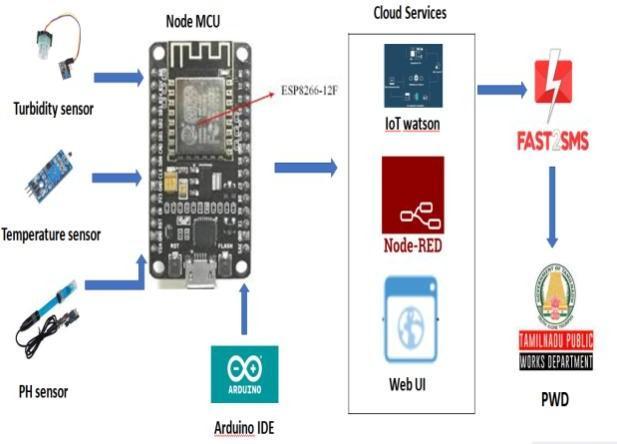
ArduinoIDE

cloudandWebUI
FastSMS
3.1 ARDUINO IDE
Single board micro-controller kits are created and manufactured by Arduino, an open-source hardware and software project, user community, and company. Its goods are covered by the GNU General Public License (GPL) or the GNU Lesser General Public License (LGPL). Severaltypesofmicroprocessorsandcontrollersareused in Arduino board designs. Several extension boards ('shields'), breadboards (for prototyping), and other circuits may be interfaced to the boards' sets of digital andanalogueinput/output(I/O)pins.
Serial communications interfaces are available on the
boards, including on some versions, the Universal Serial Bus (USB) is also utilized to load software from personal computers. C and C++ are two programming languages that can be used to programme micro-controllers. The Arduino project offers an integrated development environment (IDE) based on the Processing language project in addition to using conventional compiler tool chains.
3.2 NODE MCU
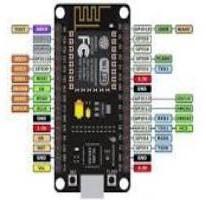
A cheap open source IoT platform is Node MCU. Hardware based on the ESP-12 module and firmware runningonEs-pressifSystems'ESP8266Wi-FiSoCwere initially included. Support for the 32-bit ESP32 Microcontroller was later added. There are open source prototypingboarddesignsfortheNodeMCUopensource firmware. "Node MCU" is a combination of the words "node" and "MCU" (micro-controller unit). In a strict sense, "Node MCU" only refers to the firmware and not the related development kits. The designs for the prototyping boards and firmware are also open source. The Lua programming language is employed by the firmware. The firmware was created using the Espressif Non-OS SDK for ESP8266 and is based on the eLua project.
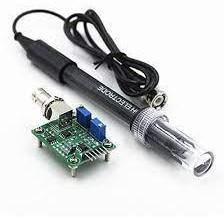
The measuring electrode is typically delicate glass. In recent times, glass has been substituted with solid-state devices that are more robust. A instrument for signal conditioning is the pre amplifier. It converts the pH electrode's high-impedance signal into a low-impedance signal that the analyzer or transmitter can handle. Additionally, the processor improves and stabilizes the signal, reducing its sensitivity to electrical noise. The acidity of liquid solutions is measured using both pH and ORP sensors. On a scale of 0 to 14, with 0 being the most acidic and 14 being the most basic, a pH issue gauges acidity. Similar to this, the pH of a substance is directly related tothevoltagethatanoxidation-reductionpotential (ORP) probe returns. This voltage is proportional to the propensityofthesolutiontoacquireorloseelectronsfrom the substances. An analogue sensor, pH meters transmit analogue datatoArduino.Wetransformitintoactualfacts. ApHmetergivesavoltagereadingbetween0and5,with0 denoting extremely acidic water. As the acidity level is reduced and the base level is raised, voltage rises. The maximum voltage for a very simple approach is 5. Therefore, we increase the voltage by 2.8 to obtain the desiredpHrange.
3.4. TEMPERATURE SENSOR
3.3 PH SENSOR
The pH sensor Module is made up of a pH sensor, also known as a pH probe, and a signal conditioning board that produces an output immediately interfaceable with anymicro-controllerandprovidesa readingproportional to the pH value. A combination pH electrode is a common instrument that combines the pH sensor components.
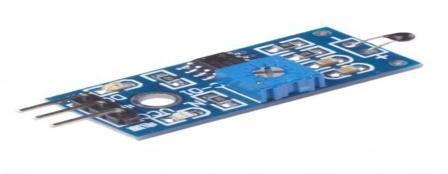
Temperature Sensor is a 1-wire configurable Temperature sensor. In harsh environments like chemical solutions, mines, or soil, it is frequently used to detect temperature. The sensor's enclosure is strong and has the choice to be waterproof, which makes mounting simple. With a respectable accuracy of 5°C, it canmeasure a broad range of temperatures, from-55° to+125°. Since each sensor has a distinct address and only uses one MCU pin to transfer data, it is a great option fortaking numerous temperature measurements withoutusingupmanyofyour micro-controller's digital pins. We can use your DS18b20 (datasheet) and comparable One- Wire temperature monitorsthankstothe component
:Temperaturesensor
Then, build the sensors using this hub. An external pull up resistor of approximately 4.7K should be present on the 1-Wire bus to which the sensors are attached. To do this, connect a resistor between the data pin and 3.3V that is approximately 4.7K (values around that, like 1, will typically work perfectly if we don't have extremely lengthywires).
METHODTOMEASURETHESUITABILITYOFWATER
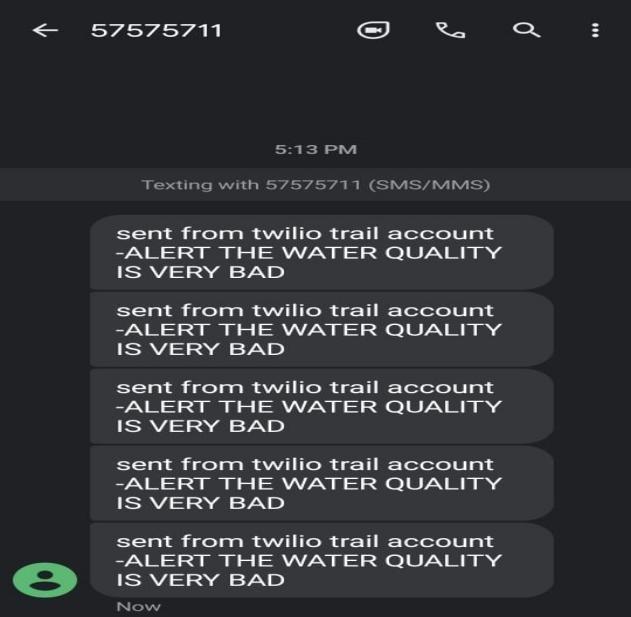
The ideal number for water purifiers is almost always close to 7. Since it is the same as the pH of mammalian mucous membranes and eyes. Lemon water with a low pH level is bad for human health because it can irritate the skin and hurt the eyes if it gets in them. Other disinfectants won't be as effective as they were for higherpHvaluesasaconsequenceofthislowpHvalue.
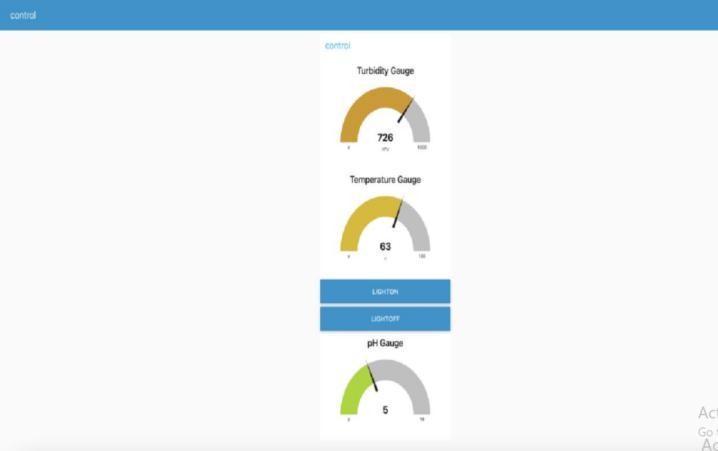
While basic water has a pH number greater than 7.5. Extremely Basic water that contains calcium hydroxides is unsafe for human consumption. We also receive the turbidity parameter's value, which demonstrates to us thatturbidityisa significantcomponentforbothaquatic and terrestrial organisms. It's safe to consume anything with a value under 5 NTU. We noticed that the water comingfromthefilterisalwaysbetween2and3NTU.As a result, it is safe to consume. The temperature of the water is also a significant element for the human body, as well as for agriculture and aquatic organisms. However,waterwithagreatervalueofturbidity(5NTU)
isveryunsafeandmixedwithothercomponents.Aswe cansee, the usual weather ranges between 17 and 30 degreesCelsius.
5. CONCLUSION & FUTURE SCOPE
Monitoring water quality is now a requirement for
protecting the ecosystem. The capacity of water quality monitoring systems is being improved by automating monitoring and telemetry. We can use sensors to use a Wi-Fi module to verify the water quality. Since there is no human labour involved, the system is low-cost and savesbothtimeandelectricitybecauseitisautomatic.It has a broad range of uses and extension value. This platform is open and modular, allowing for the addition of additional (bio) electro chemical sensors in the future (such as cutting-edge pH sensors or particular sensors for trihalomethanes, a frequent toxic byproduct of chlorine disinfection). It is clear that the water distribution network would greatly profit from the miniaturization and distribution of high-resolution sensors. By combining sensors and adding more characteristics, it is possible to detect arsenic in water sources.
6. REFERENCES
1. NikhilKedia,Water Quality Monitoring for Rural Areas-A Sensor Cloud Based Economical Project, in 1st International Conference on Next Generation ComputingDehradun,India,4-5September2015.9781-4673-6809-4/15/$31.00©2015IEEE.
2. JaytiBhatt,JigneshPatoliya,IoT BasedWaterQuality MonitoringSystem,IRFIC,21feb,2016.
3. (SECON),978-1-4673-1905-8/12/$31.00©2012IEEE
4. Zhanwei Sun, Chi Harold Liu, ChatschikBisdikia_, Joel W. Branch and Bo Yang, 2012 9th AnnualIEEE Communications SocietyConference on Sensor, Mesh andAdHocCommunicationsandNetworks.
5. User Manual Arm7-LPC2148 Development kitPantechSolutions.
6. Chuanzhen, S. (2015, June).Applications ofWireless Sensor Network in the Field of Production and Distribution.In20158thInternationalConferenceon Intelligent Computation Technology andAutomation (ICICTA)(pp.225-227).IEEE.
7. Sung, W. T., Chen, J.H., Huang, D.C., & Ju, Y.H.(2014, October). Multisensory real-time data fusion Optimization for IOT systems. In 2014 IEEE International Conference on Systems, Man, and Cybernetics(SMC)(pp.2299-2304).IEEE.
8. Sneha S. Phadatare, Prof. Sagar Gawande. Review Paper on Development of Water Quality Index in International Journal of Engineering and Technical Research,May2016.
9. K.S.Adu-Manu, C.Tapparello, W.Heinzelman, F.A.Katsriku, J.-D.Abdulai, Water Quality Monitoring Using Wireless Sensor Networks:Current Trends and Future Research Directions, ACM Trans. Sens. Networks.2017
10. L.Mainetti, L. Patrono,A.Vilei,Evolution of wireless sensor networks towards theInternet of Things: A survey,(2011)
11. Alippi, C.; Camplani, R.; Galperti, C.; Roveri , M.ARobust, Adaptive, Solar-Powered WSN Framework for Aquatic Environmental Monitoring. IEEESens.J.2011,11,45–55.
12. Adu-manu, K.S.; Tapparello, C.; Heinzelman, W.; Katsriku,F.A.; Abdulai, J.D.Water Quality Monitoring Using WirelessSensor Networks:Current Trends and Future Research Directions. ACM Trans. Sens. Netw.2017,13,4.
13. Ramanathan, N.; Balzano, L.K.; Burt, M.; Estrin, D.; Harmon, T.; Harvey, C.; Jay, J.; Kohler, E.; Rothenberg,S.; Srivastava, M. Rapid Deployment with Confidence: Calibration and Fault Detection in Environmental Sensor; Center for Embedded Networked Sensing: Los Angeles,CA,USA,2006.
14. Lumb,A.;Sharma,T.C.;Bibeault,J.-F.AReviewof Genesis and Evolution of Water Quality
Index(WQI)and SomeFutureDirections.
WaterQual.Expo.Heal.2011, 3,11–2
15. Jaytti Bhatt, Jignesh Patoliya, “IoT Based Water Quality Monitoring System”, vol. 4, no.4, pp. 762766,2016.
16. Geetha S, Gouthami S, “Internet of Things Enabled Real Time water quality MonitoringSystem”, Smart Water International Journal for aqua – Smart ICT for Water,vol.2,no.1,pp.3-11,2017
17. KumarRK, Mohan MC, Venkatesh pandiyan s,Kumar MM,EswaranR,“SolarBasedAdvancedWaterQuality Monitoring System Using Wireless Sensor Network’, International Journal of Science Engineering and TechnologyResearch,vol.3,no.3,pp.385-389,2014.
18. GoibWiranto,GraceA,Mambu,Hiskia,I
Dewa Putu Hermida, SlametWidodo,“DesignofOnlineData Measurement and Automatic Sampling System for Continuous Water Quality Monitoring”, Proceedings of 2015 IEEE International Conference on MechatronicsandAutomation,pp.2331-2335,2015.