International Research Journal of Engineering and Technology (IRJET)

International Research Journal of Engineering and Technology (IRJET)
Pawan Mandal, Isha Rajput ***
Abstract
Withthedevelopmentofnewreagents,sophisticatedmaterials,andcutting-edgeprocessesduringthepasttenyears,thefield ofbloodfingerprintenhancementhasmadeconsiderableadvancements.Bloodfingerprintenhancementisanimportantpart of forensic science, even though it is not as visually appealing as latent fingerprint development. It provides important evidence for identity verification, forensic investigation, and crime scene reconstruction. For improving blood fingerprints, conventional chemical reagents that target heme, protein, and amino acids are frequently utilised. These reagents have been modifiedandoptimizedtoimprovesensitivity,selectivity,andcontrast.However,falsepositivesremainasignificantconcern, and partial blood fingerprint enhancement is still challenging. Emerging enhancement techniques based on advanced materials,newequipment,ormethodshavealsoshowngreatpotential.Forinstance,magneticnanoparticles,fluorescentdyes, andmicro-structuredsurfaceshavebeenusedtoenhancebloodfingerprintswithhighsensitivityandspecificity.However,the compatibility of blood enhancement techniques with DNA analysis remains a crucial issue.Other critical issues in forensic science related to blood fingerprint enhancement include fingerprint age determination, the development of standard operatingprocedures,andthevalidationofenhancementtechniques.Additionally,theuseofbloodenhancementtechniquesin different environmental conditions and substrates requires further investigation. To address these issues, researchers in the field must collaborate to establish a standardized protocol for blood fingerprint enhancement, develop techniques with low false-positiveratesandhighsensitivityandspecificity,andinvestigatethecompatibilityofenhancementtechniqueswithDNA analysis.Inconclusion,bloodfingerprintenhancementisavitalareaofforensicscience,andrecentadvancesinconventional chemical reagents and emerging techniques have provided promising avenues for further research. However, there are still many critical issues that need to be addressed before blood fingerprint enhancement can reach its full potential in forensic science.
Keywords: Fingerprintenhancement;reconstruction;nanoparticles;Aminoacids;validation;emergingtechniques
Fingerprints have maintained their unparalleled importance in forensic science since Henry Faulds first discovered their evidential valueovera century ago [1]. Withtheunique ridgedetails,lifetime invariability, and detectabilityat crimescenes, fingerprintsremainthegoldstandardfor identification[2].Despitetheadventofmoderntechnologies,suchasDNAanalysis, theindividualityoffingerprintsand theirabilitytolink asuspecttoacrimescenehasneverbeen shaken[3].Intherealmof forensicinvestigation,therearetwoprimaryformsoffingerprints:latentand patent[4].Whilepatentfingerprintsarevisible tothenakedeye,mostprintsfoundatcrimescenesarelatentorinvisible.Thishasledtoagreaterfocusonthedevelopmentof latentfingerprintsbyforensicinvestigatorsandresearchersinchemistry,materialsscience,andoptical science[5].Inrecent decades,therehasbeenasurgeofinterestinthecombinationofnanotechnologyandfluorescenceimagingforthedetectionof latent fingerprints [6]. This innovative approach has resulted in higher sensitivity, higher contrast, and higher selectivity in latent fingerprint detection. As a result, forensic scientists can now extract more information from latent prints than ever before, aiding in the identification and prosecution of criminals [7] Contrary to popular belief, blood fingerprints can sometimesbepatentmarks,meaningthatspecifictreatmentisnotrequiredtovisualize them[8].However,thisdoesn’tmean that development methods for blood fingerprints are given less attention. In fact, despite their potential visibility, it is still necessary to use specific methods to enhance their visibility in cases where the bloodstain is blurry due to low amounts or longeragingtimes,orwhenthebackgroundcolorissimilartothatofthebloodstain.
Itisawell-knownfactthatbloodcanoftencontaminatefingerprintsfoundatcrimescenes,especiallyincasesofviolentcrimes [9] However, with the help of advancements in technology and materials, there have been significant developments in
International Research Journal of Engineering and Technology (IRJET) e-ISSN:2395-0056
enhancing blood fingerprints over the past decade [10]. This review highlights the evolution of traditional chemical development techniques such as heme-catalytic reagents (HCR), protein-dyed reagents (PDR), and amino-reacted reagents (ARR)forbloodfingerprint development,whichhaveshownpromisingresultsinrecentstudies.
Therearevariouscompoundssuchasbenzidine,aniline,lumino,leucocrystalviolet(LCV),andotheralternativereagentshave been used to develop blood fingerprints. However, despite the effectiveness of some HCR-based methods, they are still considered presumptive tests rather than confirmatory ones [11]. Recent research in HCR has focused on improving the accuracy of blood fingerprint development by reducing false positive and negative reactions, as well as exploring new fixing agents that are non-toxic [12]. Innovative approaches to fixing blood fingerprints while using HCRs include using alginate to prevent vertical diffusion of blood fingerprints prior to luminol treatment and utilizing 5-sulfosalicylic acid (SSA) as a stabilizerfortheproteininbloodfingerprintsbeforeLCV enhancement[13].Additionally,researchersarecurrentlyexploring new compounds and techniques to improve the accuracy and reliability of blood fingerprint development, which could have importantimplicationsforforensicinvestigations[14].
In 1904, Oskar Adler and Rudolf Adler made a breakthrough discovery regarding benzidine compounds, when they noticed thatthesecompoundsreactedwithbloodtoproducebluesubstances[15]
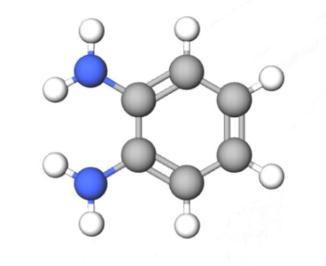
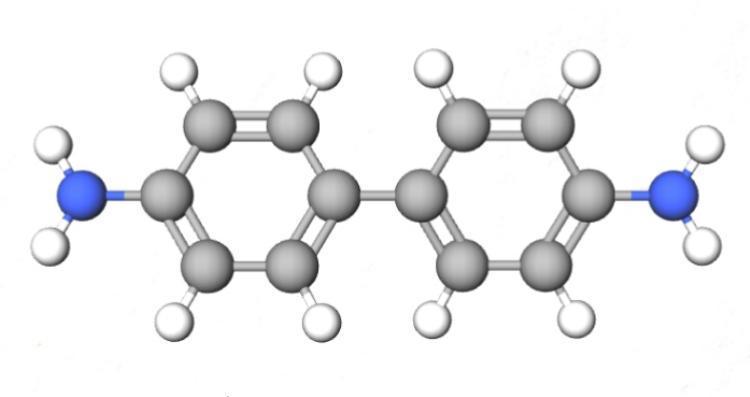
Thedevelopmentofbloodstainsincreasinglyusedbenzidine.Nonetheless,saferoptionsweresoughtoutduetoitssignificant riskofcarcinogenicity[16]. Hollandproposedtetramethylbenzidine(TMB)asalessdangeroussubstitutein1974[17]. Other body fluids are unaffected by conventional HCRs, which only react with blood [18]; nevertheless, they may interact with vegetable peroxidases and trigger cross-reactions. Hussain and Pounds offered diaminobenzidine (DAB) as a highly specific replacement in 1989 [19, 20] to overcome this problem. DAB doesn't react incorrectly with iron or rust and has a pH high enoughtopreventcross-reactionswithvegetableperoxidase.
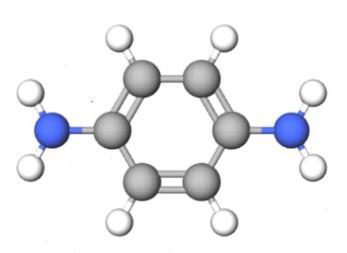
Aniline compounds, such as o-phenylenediamine (OPD) and p-phenylenediamine (PPD), have proven to be dependable and lessharmfulalternativesto3,30-diaminobenzidine(DAB)forbloodfingerprintenhancement.
OPD has been shown by Caldwell and Kim to significantly improve blood fingerprints on paper surfaces at pH 5.4 and glass surfaces at pH 7.4 [21]. Although OPD was developed in 2002, there has been little progress in the sector until Oliver found thatOPDsolutionsatpH5.4,6.4,and7.4demonstratedequalefficacyinimprovingbloodfingerprints,withpH5.4onceramic substrates producing somewhat better resultsin2018. They alsofound that OPD couldenhance both recent blood markings andlatentmarksthatwereupto90daysold[22].
The use of luminol hasbeen a popularmethodfor decadesin detecting hidden bloodstainsdue to its high sensitivity, simple preparation, and low cost [23] While Albrecht is generally credited as the pioneer who reported the chemiluminescent reaction of luminol in 1928, the chemical’s interference immunity has been a longstanding concern [24]. Luminol’s chemiluminescencecanbeaffectedorblockedbyawiderangeofsubstances,includingsomeantioxidantsoriron-containing reagents,horseradish,andhouseholdbleach[25].Anotherlimitationisthatluminoldoesnotcontainafixingagent,whichcan causeridgedetailstobecomediffusewithrepeatedapplicationsonnon-poroussurfaces[26].Additionally,recentresearchby Akemannetal.in2018suggeststhatluminolmayproduceafalsenegativeresultwhendetectingbloodstainsonsomesurfaces exposedtoheat,fire,soot,orwater.Despiteitspopularity,thelimitationsof luminolcallforalternativemethodsorimproved technologiesinforensicinvestigations[27].
Foryears,leucocrystalviolet(LCV)hasbeenapopulardeveloperforlatentfingermarksinbloodduetoitsquickandrelatively simple process[28]. LCV is colorless,but when combined with hydrogen peroxide andblood,itisoxidizedand turnspurple, makingitidealforenhancingbloodfingermarksonlight-coloredsurfaces[29].However,theuseofLCVandotherperoxidase reagents is not currently recommended in the forensic community due to their carcinogenic properties [30].Despite these concerns, recent studies have shown that LCV has biocompatibility and can be improved with better fixatives and luminescenceproperties.Foxetal.(2014)reportedthatmessengerRNAprofilingmaybeaffectedbytheuseofLCVforblood treatment, which could impact subsequent genetic analysis for body fluid identification [31]. Therefore, it is crucial to investigatetheimpactof bloodstainageandlengthen thetime between enhancement andgeneticanalysisin real cases[32]. AlthoughLCVremainsausefultoolinforensicinvestigations,cautionmustbetakentoensureitssafeandeffectiveuse.
Moreover,studieshaveshownthatemployingdifferentchemicalsmightreducebubblingwhileprocessingbloodfingerprinting withLCV[33].McCarthy(2014)discoveredthat5-sulfosalicylicacid(SSA)can enhanceLCV'scapacitytoproduceanddetect luminescence[34]andserveasafixativeforproteinsinbloodstains.Amethodto decreaseLCVbubbling wasdevelopedina mannersimilartothisbySeoandYu(2019)byfirsttreatingbloodsampleswithanethanol-basedaminotriazole(AT)solution [35]. With these state-of-the-art methods, blood fingerprint particular and idiosyncrasies can be better retained during the forensicinvestigationprocess.
International Research Journal of Engineering and Technology (IRJET) e-ISSN:2395-0056
Volume: 10 Issue: 04 | Apr 2023 www.irjet.net p-ISSN:2395-0072
Thehemochromereaction(HCR)approachusesanumberofothertechniquesinadditiontothosealreadydescribed,including the use of leucomalachite green (LMG), fluorescein, and 2,2-azino-di-[3ethylbenzthiazolinesulfonate] diammonium salt (ABTS).Whensubjectedtoaredoxreaction,ABTSyieldsapalegreentintandisasafersubstituteforDAB.Forsomesurfaces, thebrilliantgreencolourof oxidisedABTScanbeadvantageous,althoughitsproductioncostscanbeexpensive. Duetotheir poorvisibilityorrestrictedapplicability,LMGandfluoresceinarelessfrequentlyusedinbloodfingerprintenhancement[36].
The interaction between the proteins in blood and the dye reagents is influenced by various factors such as pH, resulting in different charges that allow positive and negative bonding to occur [37]. In addition to electrostatic forces, physical interactions such as hydrogen bonding and Van der Waals forces may also play a role in the affinity of acid dyes to protein molecules [38]. Among the commonly used protein dye reagents are Amido black, Coomassie brilliant blue, Hungarian red, Acid Yellow 7, and other biological dyes. Interestingly, the names of these acidic dyes often reflect their distinct colors, with somedyeslikeHungarianredandAcidYellow7beingfluorescentlyexcitedwhileotherssuchasAmidoblackandCoomassie brilliantbluearefluorescence-free[39].
This unique protein dye has a fascinating history of aliases, including Buffalo black NBR, naphthol blue-black, pontacyl blueblack SX, and naphthalene black 10. Its usefulness in forensics was recognized by the British Police Scientific Development Branch, who recommended it for fingerprint enhancement in blood in 2010, with two different formulations based on methanol or water [40]. Over time, forensic investigators have carefully examined its compatibility with DNA analysis and soughttooptimizeitsformulationformaximum effectiveness[41].DespitesomeconcernsaboutitspotentialimpactonDNA recoveryandanalysis,recentstudieshaveshownthattheuseofaqueous ABcanactuallyenabletherecovery oftwo distinct DNAprofilesfromtouchDNAandbloodsamples,respectively,increasingitsvalueforidentifyingsuspectsandvictimsalike.As aresult,thisversatileandvaluableproteindyecontinuestobeavitaltoolforforensicscientistsandinvestigatorsaroundthe world.
Coomassie Brilliant Blue, also known as Acid Blue 83, is a well-known protein staining reagent that produces a bright blue color upon reacting with proteins [42]. However, its uses are not limited to protein staining, as it has also been found to be effective in enhancing the weak fingerprints of blood diluted up to 1 in 125 folds on porous and non-porous surfaces, as demonstratedbyMattsonandBilousin2014 [43].Despiteitsusefulnessinenhancingfingerprints,therehavebeenconcerns regarding its biotoxicity on touchDNA, aspointedoutby Tsai etal.in 2016. In theiranalysis, they found CoomassieBrilliant BluetobeunsuitableforsubsequentSTRtypingduetoobservablestochasticeffectsonDNAquantityandquality[44]
ThehistoryofHungarianredcanbetracedbacktothe1990swhentheDutchCHEMZISworkgroupdiscoveredaprotein-dyed reagentthatwasbeingusedbytheMiskolcpoliceinHungary.However,theworkgroupwasunawareoftheingredientsinthe solutionand laterfound out thatit wasacid fuchsin[45],which gavethe reagentits distinctiveredcolor.Hungarianred was initiallybelievedtobemosteffectiveonsmoothandnon-poroussurfacesratherthanporousorsemi-porousones[46].Despite this,Corcoran’sstudydemonstratedthatHungarianredwasequallyeffectiveinenhancingbloodfingerprintridgepatternson contaminated glass and metal substrates [47]. However, recent research conducted by Petretei in 2019 revealed that Hungarianredhasalowdetectingsensitivitywhenappliedtodilutedbloodstainsthathavebeendilutedwith water[48].Even atadilutionratioaslowas1:1,Hungarianredcanonlyvisualizeridgeoutlines,whileABexhibitsbetterdetectionsensitivity indilutedbloodstains[49].
International Research Journal of Engineering and Technology (IRJET) e-ISSN:2395-0056
Volume: 10 Issue: 04 | Apr 2023 www.irjet.net
p-ISSN:2395-0072
Withits exceptionalfluorescenceproperties,AY7standsoutasa highlysensitivenonfluorescentPDRincomparisontoother reagents[28].Inthefieldofforensicscience,AY7hasbeenproventobeaninvaluabletoolinthe detectionandvisualizationof blood fingerprints on a variety of fabrics, including black cotton, polyester, and nylon/lycra [7]. Researchers have conducted extensiveverificationexperimentsthatdemonstrateAY7’sabilitytoproduceclearfingerprintdetailsofLevel3onnon-porous surfaces under alternate light sources, making it the top choice among numerous blood reagents [50]. A study conducted by Mattsonand Bilous further confirmsthe exceptional developingsensitivity of AY7, asit wasable to effectively develop latent fingerprintsonbloodtilesdiluted1:125[43]
Benzoxanthene yellow and Crowle’s Double Stain are two common techniques used to identify blood fingerprints on nonporous surfaces, but they both have their drawbacks. Although benzoxanthene yellow is effective, its availability is currently limited. On the other hand, prolonged exposure to Crowle’s Double Stain can reduce STR amplification efficiency [51].Incontrast, a recent study byChingthongkham et al.(2020)discovereda new approachusing natural Lac dye (Laccifer lacca) that has promising results for detecting blood fingerprints on non-porous substrates. Lac dye could be a potential replacement for AB and other chemicals because it is less expensive and safer. The technique is effective in identifying and enhancing blood fingerprints on various types of non-porous surfaces, and it provides comparable color contrast and detail leveltoAB[52].However,theresultswererelativelypoorwhenitwasappliedtoporoussurfaces.Therefore,theuseofLacdye onnonporoussurfacesshowspotentialforthedetectionandenhancementofbloodfingerprints[53].
Hemoglobin, a vital protein in red blood cells responsible for oxygen transport, is composed of a complex arrangement of aminoacids[54]. Techniquesfor enhancing bloodstains inforensic investigations often involve the use ofreagentsthatreact with specificchemical groupson proteinsand peptides,including amino acids in plasma thathave dissociated from proteins [55]. These enhancement methods based on amino acid reactive reagents (ARR) differ significantly from those based on protein digestion reagents (PDR) in their mechanisms of action [56]. Among the most commonly used ARR for staining bloodstainsareninhydrinanditsanalogues.
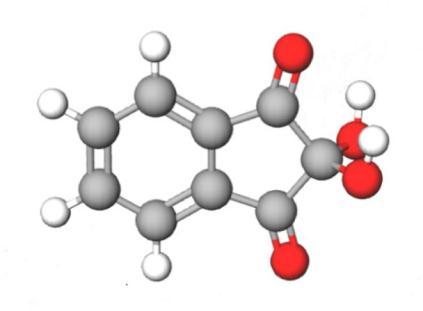
Ninhydrin has a long history in the field of forensic research, having been created for the first time in 1910 by Ruhemann, a professorofchemistryatCambridgeUniversity[57].
However, it was not until 1954 that ninhydrin was discovered to be a powerful reagent for fingerprint enhancement [58] Ninhydrin ability to develop sweat fingerprints on porous surfaces is well-known, but its effectiveness in developing blood
International Research Journal of Engineering and Technology (IRJET) e-ISSN:2395-0056
Volume: 10 Issue: 04 | Apr 2023 www.irjet.net
p-ISSN:2395-0072
fingerprints has also been noted [59]. Over the years, the developing sensitivity of ninhydrin has been constantly improved, makingitareliabletechniquefordetectingevensmallamountsofaminoacidsinfingerprints.
In2014,YangandLiantookNINdevelopmenttothenextlevelbycreatinganewseriesoffingerprintdevelopingmembranes (FDM) that utilize ninhydrin as a developer. This solid-medium NIN membrane was found to be even more effective than traditionalmethods,witha detectionlimitof0.1mg/Laminoacidforbothsweatandbloodfingerprintsdepositedonporous andnon-porousmaterials[60].Thisbreakthroughinfingerprintenhancementusingninhydrintechnologyhasrevolutionized thefieldofforensicscienceandhaspavedthewayforfurtherinnovationsinthefuture.
Thepotentialof1,2-Indanedione(IND)asasuperiorsubstitutefortheconventionalfingerprintdetectionapproachemploying ninhydrin (NIN) on porous surfaces has been established by cutting-edge research in the field of fingerprint detection [61]. Indanedione is a viable alternative for forensic investigators since its reaction product fluoresces strongly when excited by green light [62]. The amino acids in the fingerprint residues can be fully utilised by 1,2-Indanedione-ZnCl2 (IND-Zn) by lowering the electrostatic interactions or hydrogen bonds between the amino acids and the substrate, according to recent studyonthereactivityandprocessingsequenceofthiscompound.Anevaluationoftheimpactofbloodfingerprintdetection technologies on DNA typing after treatment with either indanedione or ninhydrin on porous surfaces found no appreciable effects [63]. However, further study has shown that blood concentration influences the ability of a polyvinylpyrrolidone and 1,2-indanedione (PVP-IND) mixture to recognise fingerprints. Although PVP-IND was found to perform better than the aqueoussolutionofABforfingerprintsindilutedblood,itwasfoundthattheABformulaperformedbetterforfingerprints in undilutedbloodduetothediffusionoffriction ridges,whichmaybeattributedtothereactionofPVPwithaminoacidsinthe blood[64].
Griggcreated1,8diazafluoren-9-one(DFO),ahighlyluminousninhydrinderivative,forthefirsttimein1990[65].Itisauseful tool in forensic investigations because it combines with amino acids to produce a distinctive magenta colour. In tests using blood fingerprints and shoe impressions, Pereira discovered that ninhydrin and DFO performed remarkably well on porous surfaces[66].DFOhasbeenproventohavenegligiblenegativeeffectsonDNArecoveryinadditiontoitsforensicapplications, asindicatedbyLaurin'ssystematictestingofnumerousreagents/productsand DNAanalysiscarriedoutin2015[67].Overall, DFOisausefultoolinforensicinvestigationsbecauseofitsdistinctivefluorescenceandcompatibilitywithDNArecovery.
The fingerprints remain a crucial tool in forensic science for identifying suspects and linking them to crime scenes. This systematic review provides a comprehensive overview of the effectiveness of HCR, PDR, and ARR in enhancing bloody fingerprint evidence. The review highlights the potential of these techniques in improving the visualization and detection of bloody fingerprints, which can aid in criminal investigations. The development of blood fingerprints through Heme-catalytic reagents (HCRs) has been a significant breakthrough in forensic science. Although several compounds, including benzidine, aniline, luminol, and leuco crystal violet (LCV), have been used as alternative reagents, HCR-based methods remain presumptive tests rather than confirmatory ones. To improve the accuracy and reliability of blood fingerprint development, recent research has focused on reducing false positive and negative reactions and exploring new fixing agents that are nontoxic. Protein-dyed reagent (PDR) interact with the proteins in blood through various physical and electrostatic forces, resultingindistinctcolorsthatcanaidinvisualizinglatentprints.Inthisreviewwehavediscussedaboutproteindyereagents Amido black,Coomassiebrilliantblue, Hungarian red,AcidYellow7have distinctpropertiesandvarying levels ofsensitivity. NaturallacdyeshownpromisingresultsandusedasapotentialsubstituteforABandotherchemicalsduetoitslowercostand safer properties. Despite the concerns about biotoxicity and potential impact on DNA recovery and analysis, protein-dyed reagentscontinuetobeanimportanttoolforforensicscientistsandinvestigatorsworldwide.Theaminoacidreactivereagents (ARR), such as ninhydrin, 1,2-Indanedione (IND), and 1,8 Diazafluoren-9-one (DFO), react with specific chemical groups on proteinsandpeptides,includingaminoacids,whicharethebuildingblocksofhemoglobin.Theeffectivenessofthesereagents
International Research Journal of Engineering and Technology (IRJET) e-ISSN:2395-0056
Volume: 10 Issue: 04 | Apr 2023 www.irjet.net
p-ISSN:2395-0072
indetectingevensmallamountsofaminoacidshasledtosignificant breakthroughsinfingerprintenhancement,makingthem a reliable tool for forensic investigators. The compatibility of these reagents with DNA recovery, further expanding their usefulnessinforensicinvestigations.
Overall, this review paper highlights the potential of HCR, PDR, and ARR-based approaches for enhancing bloody fingerprint evidence and improving the accuracy of forensic investigations. With continued research and development, these techniques havethepotentialtobecomevaluabletoolsforforensicinvestigatorsinsolvingcomplexcriminalcases.
6. Reference
1. Cole, S. (1999). What counts for identity? The historical origins of the methodology of latent fingerprint identification. ScienceinContext,12(1),139-172.
2. Rawtani,D.,&Hussain,C.M.(Eds.).(2020).TechnologyinForensicScience:Sampling,Analysis,DataandRegulations.John Wiley&Sons.
3. Ryan,M.J.(2020).EscapingtheFingerprintCrisis:ABlueprintforEssentialResearch.U.Ill.L.Rev.,763.
4. Kumar, N., & Sharma, A. (2021). Nano-Forensics: The New Perspective in Precision Forensic Science. Nanotechnology Applications in Health and Environmental Sciences,111-134.
5. Bhati,K.,Bajpai Tripathy,D., Kumaravel, V., Sudhani, H. P.,Ali,S.,Choudhary,R.,&Shukla,S.(2023).Sensitive Fingerprint DetectionUsingBiocompatibleMesoporousSilicaNanoparticleCoatingonNon-PorousSurfaces.Coatings,13(2),268.
6. Nadar,S.S.,Kelkar,R.K.,Pise,P.V.,Patil,N.P.,Patil,S.P.,Chaubal-Durve,N.S.,...&Patil,P.D.(2021).Theuntappedpotential ofmagneticnanoparticlesforforensicinvestigations:Acomprehensivereview. Talanta, 230,122297.
7. Ansari, A. A., Aldajani, K. M., AlHazaa, A. N., & Albrithen, H. A. (2022). Recent progress of fluorescent materials for fingermarksdetectioninforensicscienceandanti-counterfeiting.CoordinationChemistryReviews,462,214523.
8. Zhang, Z., & Peng, D. (2022). Recent Advances in Enhancement Techniques for Blood Fingerprints. Critical Reviews in AnalyticalChemistry,1-20.
9. Nickell,J.,&Fischer,J.F.(2014).Crimescience:methodsofforensicdetection.UniversityPressofKentucky.
10. Hazarika, P., & Russell, D. A. (2012). Advances in fingerprint analysis.Angewandte Chemie International Edition,51(15), 3524-3531.
11. Park, J. (2019). Human Capital Resource Development in Teams: Antecedents, Consequences, and Scale Development of HumanCapitalResources.
12. Zhou,X.(2020).RNAAnalysisofLiquidBiopsiesforCancerDiagnosis(Doctoraldissertation,UniversityofKansas).
13. Strongin, R. M., & Sibrian-Vazquez, M. (2009). Developing fluorogenic reagents for detecting and enhancing bloody fingerprints.NCJRS,Report,277841,1-67.
14. Cadd,S.,Islam,M.,Manson,P.,&Bleay,S.(2015).Fingerprintcompositionandaging:aliteraturereview.Science& Justice, 55(4),219-238.
15. Tilstone, W. J., Savage, K. A., & Clark, L. A. (2006).Forensic science: An encyclopedia of history, methods, and techniques. ABC-CLIO.
16. Deininger, L. (2017). Multi-Informative and Specific Detection of Blood in Fingermarks via MALDI-MS Based Strategies. SheffieldHallamUniversity(UnitedKingdom).
17. Holland,V.R.,Saunders,B.C.,Rose,F.L.,&Walpole,A.L.(1974).Asafersubstituteforbenzidineinthedetectionofblood. Tetrahedron,30(18),3299-3302.
18. Kasi, P., & Cheralathan, M. (2021, October). Review of cascade refrigeration systems for vaccine storage. InJournal of Physics:ConferenceSeries(Vol.2054,No.1,p.012041).IOPPublishing.
19. Hussain, J. I., & Pounds, C. A. (1989). The Enhancement of Marks Made in Blood with 3, 3’, 4, 4’-Tetraaminobiphenyl. ForensicScienceService:Birmingham.
20. Bleay, S. M. (2018). Enhancement processes for marks in blood. Fingerprint Development Techniques: Theory and Application,357.
21. Caldwell,J.P.,&Kim,N.D.(2002).Extensionofthecolorsuiteavailableforchemicalenhancementoffingerprintsinblood. Journalofforensicsciences,47(2),332-340.
22. Oliver, S., Smale, T., & Arthur, I. (2018). The use of ortho-Phenylenediamine and Zar-Pro™ strips for the development of bloodmarksonadark-coloured,non-poroussurface.Forensicscienceinternational,288,97-106.
23. Barni, F., Lewis, S. W., Berti, A., Miskelly, G. M., & Lago, G. (2007). Forensic application of the luminol reaction as a presumptivetestforlatentblooddetection.Talanta,72(3),896-913.
24. Albreacht, H. O. (1928). Concerning the chemo luminescence of aminophthalic acid hydrazides. Z Fur. Phys. Chem. Stochiomet.Verwandtschaftslehre,136,321-330.
25. Morozova,S.M., Sharsheeva,A.,Morozov,M.I., Vinogradov,A.V.,& Hey-Hawkins,E. (2021).Bioresponsivemetal–organic frameworks:Rationaldesignandfunction.CoordinationChemistryReviews,431,213682.
26. Bleay,S. M.,& dePuit,M. (2018).Sequential processing andimpacton other forensic evidence.Fingerprintdevelopment techniques:theoryandapplication.Hoboken,NJ:JohnWiley&Sons,443-67.
27. Akemann,E.,Bushong,L.C.,&Jones,W.M.(2018).UsingLuminoltoDetectBloodstainsExposedtoFire,Heat,andSooton MultipleSurfaces.JournalofForensicIdentification,68(3).
28. Farrugia,K.J.,Savage,K.A.,Bandey,H.,Ciuksza,T.,&Daeid,N.N.(2011).Chemicalenhancementoffootwearimpressions inbloodonfabric part2:peroxidasereagents.Science&Justice,51(3),110-121.
29. Strongin, R. M., & Sibrian-Vazquez, M. Document Title: Developing Fluorogenic Reagents for Detecting and Enhancing BloodyFingerprints.
30. Butler, J., Chaseling, J., & Wright, K. (2019). A comparison of four presumptive tests for the detection of blood on dark materials.Journalofforensicsciences,64(6),1838-1843.
31. Fox,A.,Gittos,M.,Harbison,S.A.,Fleming,R.,&Wivell,R.(2014).ExploringtherecoveryanddetectionofmessengerRNA andDNAfromenhancedfingermarksinblood.Science&Justice,54(3),192-198.
32. Fregeau, C. J., Germain, O., & Fourney, R. M. (2000). Fingerprint enhancement revisited and the effects of blood enhancement chemicals on subsequent Profiler Plus™ fluorescent short tandem repeat DNA analysis of fresh and aged bloodyfingerprints.JournalofForensicScience,45(2),354-380.
International Research Journal of Engineering and Technology (IRJET) e-ISSN:2395-0056
Volume: 10 Issue: 04 | Apr 2023 www.irjet.net p-ISSN:2395-0072
33. Yamashita,B.,French,M.,Bleay,S.,Cantu,A.,Inlow,V.,&Ramotowski,R.(2011).Latentprintdevelopment.Thefingerprint sourcebook,1,155-222.
34. McCarthy,D.(2014).SulfosalicylicAcidandRhodamine 6GasaFixingandDevelopmentSolutionfortheEnhancementof BloodImpressions.JournalofForensicIdentification,64(4).
35. Seo,Y.-H.;Yu,J.-S.ReducingtheBubblingofLCVbyInhibitionofCatalaseActivity.J.KoreaContentsAssoc.2019,19,249–256.DOI:10.5392/JKCA.2019.19.06.249.
36. Sears,V.G.,Butcher,C.P.,&Fitzgerald,L.A.(2005).Enhancementoffingerprintsinbloodpart3:reactivetechniques,Acid Yellow7,andprocesssequences.JournalofForensicIdentification,55(6),741.
37. Horobin,R.W.(2002).Biologicalstaining:mechanismsandtheory.Biotechnic&histochemistry,77(1),3-13.
38. Yu, W. H., Li, N., Tong, D. S., Zhou, C. H., Lin, C. X. C., & Xu, C. Y. (2013). Adsorption of proteins and nucleic acids on clay mineralsandtheirinteractions:Areview.AppliedClayScience,80,443-452.
39. Bossers,L.C.,Roux,C.,Bell,M.,&McDonagh,A.M.(2011).Methodsfortheenhancementoffingermarksinblood.Forensic scienceinternational,210(1-3),1-11.
40. Nettleton,G.S.,Johnson,L.R.,&Sehlinger,T.E.(1986).Thinlayerchromatographyofcommercialsamplesofamidoblack 10B.StainTechnology,61(6),329-336.
41. Becue,A.(2016).Emergingfieldsinfingermark(meta)detection–acriticalreview.AnalyticalMethods,8(45),7983-8003.
42. Neuhoff,V.,Stamm,R.,&Eibl,H.(1985).ClearbackgroundandhighlysensitiveproteinstainingwithCoomassieBluedyes inpolyacrylamidegels:asystematicanalysis.Electrophoresis,6(9),427-448.
43. Mattson, P., & Bilous, P. (2014). Coomassie brilliant blue: an excellent reagent for the enhancement of faint bloody fingerprints.CanadianSocietyofForensicScienceJournal,47(1),20-36.
44. Tsai, L.-C.; Lee, C.-C.; Chen, C.-C.; Lee, J. C.-I.; Wang, S.-M.; Huang, N.-E.; Linacre, A.; Hsieh, H.-M. The Influence of Selected FingerprintEnhancementTechniquesonForensicDNATypingofEpithelialCellsDepositedonPorousSurfaces.J.Forensic Sci.2016,61,S221–S225.DOI:10.1111/1556-4029.12893.
45. Theeuwen, A. V., Van Barneveld, S., Drok, J. W., Keereweer, I., Limborgh, J. C. M., Naber, W. M., & Velders, T. (1998). Enhancementoffootwearimpressionsinblood.ForensicScienceInternational,95(2),133-151.
46. Yi,R.(2018).Novelpowdermethodsforthevisualizationoflatentfingerprints:Thecasefortumericandotherspices.
47. Corcoran,E.(2017).Evaluationofcurrentmethodsforprocessingbloodyfingerprintsonnon-porous substratesexposed tovariouscontaminants(Doctoraldissertation,BostonUniversity).
48. Petretei,D.EnhancementofFingerprintsinDilutedBlood.Probl.ForensicSci.2019,120,267–277.DOI.
49. Becue, A., & Champod, C. (2016). Fingermarks and other body impressions–a review (July 2013–July 2016). In 18th Interpolforensicsciencesymposium,Lyon(France).
50. DeImpressoesDigitais,T.D.R.,&Revisao,U.(2021).FingerprintDevelopmentTechniques:AReview.
International Research Journal of Engineering and Technology (IRJET) e-ISSN:2395-0056
Volume: 10 Issue: 04 | Apr 2023 www.irjet.net p-ISSN:2395-0072
51. Sibrian-Vazquez, M., & Strongin, R. M. (2016). Principles of Fluorogenic Reagent Design for Forensics. Recent Progress Towards New Reagents to Develop Fingerprints in Blood and on Variable Surfaces. Reviews in Fluorescence 2015, 127145.
52. Chingthongkham, P.; Chomean, S.; Suppajariyawat, P.; Kaset, C. Enhancement of Bloody Fingerprints on Non-Porous SurfacesUsingLacDye(Lacciferlacca).ForensicSci.Int.2020,307,110119.DOI:10.1016/j.forsciint.2019.110119.
53. Kennedy,K.(2022).Refinementandvalidationofmulti-sourceblooddetectionforoperationaluse(Doctoraldissertation, SheffieldHallamUniversity).
54. Perutz,M.F.(1978).Hemoglobinstructureandrespiratorytransport.ScientificAmerican,239(6),92-125.
55. Landsteiner,K.(2013).Thespecificityofserologicalreactions.CourierCorporation.
56. Jelly,R.,Patton,E.L.,Lennard,C.,Lewis,S.W.,&Lim,K.F.(2009).Thedetectionoflatentfingermarksonporoussurfaces usingaminoacidsensitivereagents:Areview.Analyticachimicaacta,652(1-2),128-142.
57. Perrett, D. (2007). From ‘protein’to the beginnings of clinical proteomics.PROTEOMICS–Clinical Applications,1(8), 720738.
58. Hansen, D. B., & Joullie, M. M. (2005). The development of novel ninhydrin analogues. Chemical Society Reviews, 34(5), 408-417.
59. Prasad, V., Lukose, S., Agarwal, P., & Prasad, L. (2020). Role of nanomaterials for forensic investigation and latent fingerprinting areview.Journalofforensicsciences,65(1),26-36.
60. Joya, X., Pujadas, M., Falcon, M., Civit, E., Garcia-Algar, O., Vall, O., … & de la Torre, R. (2010). Gas chromatography–mass spectrometry assay for the simultaneous quantification of drugs of abuse in human placenta at 12th week of gestation. ForensicScienceInternational,196(1-3),38-42.
61. Lam,R.J.M.(2018).Novelfingermarkdetectionmethodsusingbiomolecularrecognition(Doctoraldissertation).
62. Chuena,L.W.,&Eea,K.B.(2010).Forensiclightsourcesfordetectionofbiologicalevidencesincrimesceneinvestigation: areview.Malays.J.ForensicSci,1,17-28.
63. Lin, S. W., Ip, S. C., Lam, T. T., Tan, T. F., Yeung, W. L., & Tam, W. M. (2017). Compatibility of DNA IQ™, QIAamp® DNA Investigator, and QIAsymphony® DNA Investigator® with various fingerprint treatments. International journal of legal medicine,131(2),293-301.
64. Kim, D., Ryu, H., Jeong, S., Joo, I., & Hong, S. (2021). Enhancement of fingerprint in blood deposited on the surface of thermal paper by using the mixture of polyvinylpyrrolidone and 1, 2-indanedione. Analytical Science and Technology, 34(3),122-127.
65. Pounds, A. C., Grigg, R., & Mongkolaussavaratana, T. (1990). The use of 1, 8-diazafluoren-9-one (DFO) for the fluorescent detectionoflatentfingerprintsonpaper.Apreliminaryevaluation.JournalofForensicScience,35(1),169-175.
66. Pereira, P. (2014). The Use of Various Chemical Blood Reagents to Develop Blood Fingerprint or Footwear Impressions. JournalofForensicIdentification,64(1),43.