ECG SIGNAL DE-NOISING USING DIGITAL FILTER TECHNIQUES
Abstract - The function of the heart is analysed by the Electrocardiogram(ECG) signal. But the ECG electrodes recorded ECG signal cannot be used directly for further processing.SeveralkindsofnoisesmaycorrupttheECGsignal in recording process. Usually the ECG signals are contaminated by the baseline wander noise (BLW), muscle noises (EMG) and moving electrode artifact (MA). Therefore, to enhance the ECG signal appropriate digital filtering techniquesareused.Inthisstudy,discretewavelettransforms (DWT)andlowpassfilter(LPF)methodsareusedtode-noise the ECG signal. Further moving mean method, linear regression method and savitzky-golay smoothing techniques are applied for ECG signal enhancement. Mean square error (MSE) and signal to noise ratio (SNR) parameters are evaluated to assess the noise removing capability of the methods. From the results it is observed that the LPF with movingmeansmoothingmethodshowsuperiorperformance in ECG De-noising.
Key Words: ECG signal, BLW noise, EMG noise, moving artefact, DWT, low pass filter, moving mean, linear regression,savitzky-golay.
1.INTRODUCTION

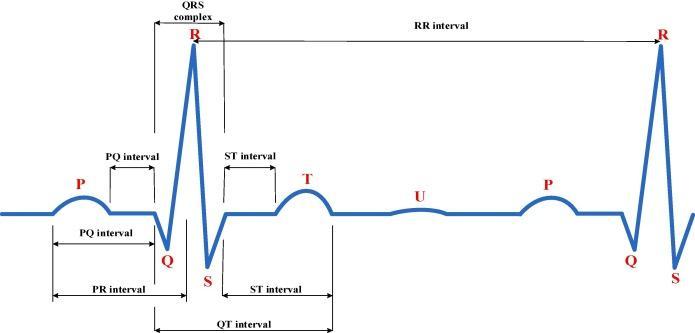
TheECGsignalisshowninthefigure1.Tounderstandthe functionofheartfirsthastoanalysesthePQRSTwave.TheP wave that indicates the polarization of the arteries, QRS complex that indicates the polarization of ventricles and depolarization of arteries, T wave that indicates the repolarizingoftheventricles.UsuallytheECGsignalissmall atrangefrom0.1mVto20mVandfrequencyrangeof0.05 Hzto100Hz.
Generally, the cardiac function is represented by the ECG signal.TorecordtheECGsignalmultipleECGelectrodesare placedontheskininanEinthovenstructure.Therecorded ECGsignaliscorruptedbythedifferenttypesofnoise,such as BLW noise, motion artifact, EMG noise, power line interferencenoise(PLI),electrodenoiseandhighfrequency noisecantainttherawECGsignal.AmongthesenoiseBLW noise, EMG noise and MA noise are more pervasive in process.PastresearchstatedthattheadvancementinECG signal de-noising, feature extraction, event detection and classification play crucial role in medical diagnosis and clinicalapplications.
TheECGsignalcannotbedirectlyalteredorprocessedusing conventional procedures when ithasbeentampered with differenttypesofnoise.Ingeneral,digitalfiltersarethebest choiceforreducingnoiseinECGsignals.P.C.Bhaskaraand M.D.UplanebsuggestedalowpassFIRfilterwithdifferent windowingtechniquesthatcancancelsthehigh-frequency noise effectively from the ECG signals [7]. Excellent noise reduction services were offered by Kaiser Window. ChaudharyM.andNarwariaR.P.comparedtheperformance ofdifferentdigitalfiltersIIR,Butterworth,ChebyshevType-I andType-IIintermsofthesignaltonoiseratioandaverage power. Concerned work results demonstrated that a low passButterworthfiltermightreducenoisemoreeffectively than the alternatives. Mahawar et al. developed a FIR low pass filter with strong attenuation using the windowing approach,KaiserandDolph-Chebyshev(DC),andDC.Based onsomeoftheperformancemetricsSharmaM.andDalalH. reportedthatFIRandIIRdigitalfilterscanremovethelowfrequencybaselinedriftfromtheECGsignal[4].Inorderto de-noisetheBaselineWanderinterferences,Rastogi,N.and Mehra, R. developed an integrated strategy that combines Daubechies wavelet decomposition with a variety of thresholding techniques and the IIR digital Chebyshev or Butterworthfilter[4].
BasedontheearliersurveyconcludedthatECGsignalpreprocessingandsmoothingtechniquesareessentialinECG signal enhancement. Since the first and foremost step commence here is the reduction of noise and next is smoothing the de-noised ECG signal [2] using different digitalfilteringtechniques.
2. METHODOLOGY
ThisworkoriginatedfornoisereductioninECGsignalsusing two digital filtering methods such as discrete wavelet transform(DWT)andLPF.Thesefilteringalgorithmstested forde-noisingoftheECGsignalinBLWnoise,MAnoiseand EMG noise. Also different smoothing techniques such as moving mean method, linear regression method and savitzky-golay smoothing techniques are applied for ECG signalprocessing.
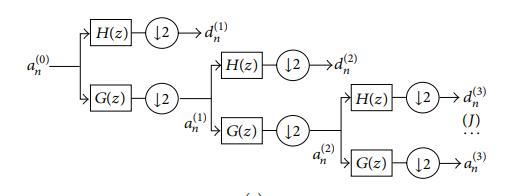
DWT: ADWTmethodseparatesagivensignalintoseveral sets,eachsetconsistingofatimeseriesofcoefficientsthat describe the signal's temporal history in the associated frequencyband
LPF: A low-pass filter is a filter that retains the signals in higher frequency than a predetermined cut-off frequency whileattenuatingsignalsthatareatlowerinfrequency.
Moving Mean: The de-noised ECG signal is typically smoothed using the moving mean method. These are smoothedbasedonshort-termovershoots.
TheECGsignalhadthethreedifferenttypesofnoiseadded toit.UsingtheDWTandLPFdigitalfilteringtechniques,the noise that was added to the signal is removed. These two approaches use various algorithms, such as the DWT algorithm,whichisfoundedondecompositionstages.Here, the ECG signal has been de-noised using 8 decomposition levels.Similarly,theLPFisauniqueapproachthatdepends entirely on the cut-off frequency. The cut-off frequency is assumedtobe360hertz.
The ECG signal's noise was subsequently removed in this manner.Followingthat,threedistinctalgorithms moving mean,linearregression,andsavitzky-golay smoothensthe filtered signal. The cut-off frequency used for these three approacheswas0.5hertz.
3. RESUTLS
Thede-noisingflowtoremovethenoisefromtheECGsignal is shown in the methodology. The MIT-BTH arrythmia database was used to download the ECG signal from the physio-bank ATM website. On the website, three different typesofECGsignalwereretrieved.Usingthephysio-bank ATMwebsite,threenoiseswereobtainedfromtheMIT-BTH noisedatabase.
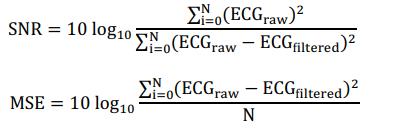
TheinputhealthyECGsignalandthefilteredandsmoothed signals performance measures were assessed. The two performanceindicatorsconsideredareMSEandSNR.The filteredsignalmeansquareerror(MSE)willbelowerthan theinputsignal.Similartothis,SNRwillrise,indicatingthat theECGsignalhaslessnoise.
Chart -1:ECG,NoisyandDe-noisedsignal(a)HealthyECG signal, (b) ECG signal corrupted with BLW noise, (c) Denoised by LPF, (d) Filtered signal smoothed by Movingmeanmethod
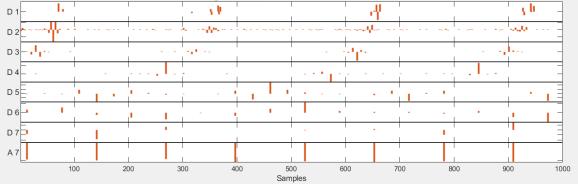
(a)De-noisedECGsignal,(b)DWTdecompositionsforthe de-noisedsignal

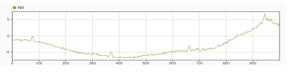
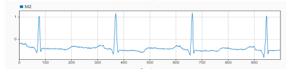
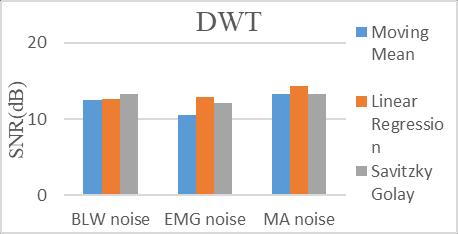
The above tables- 3.1, 3.2 and 3.3 represents the evaluationofperformancemetricsbytwodigitalde-noising methodsandthreesmoothingtechniquesinvariousnoise environments.
Chart-4: SNRresultbyDWT
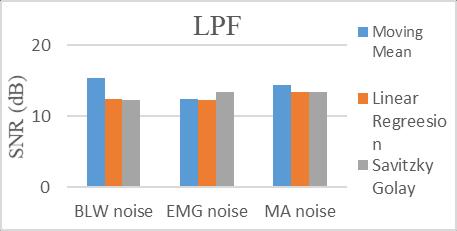
So, we may conclude that the LPF has produced superior resultsthantheDWTtechniquebasedonthecomparisonof MSE and SNR of the two digital filter techniques. Three different types of ECG signals were subjected to this methodology,whichinvolvedaddingthreedifferentnoises to each signal before de-noising it with two different proceduresandsmoothingitwiththreedifferentsmoothing techniques.ThethreesignalsMSEandSNRwereassessed. Oncomparingtheperformancemetricsbytwotechniques withthreesmoothingalgorithms,theLPFwithmovingmean methodperformsbetterthantheDWTtechnique.Thiskind of methodology can be used for any kind of bio-medical signalforeliminatingthenoisefromit.
5. REFERENCES
1. Velayudhan,A. andPeter,S. (2016)'NoiseAnalysis andDifferentDe-NoisingTechniquesofECGSignalA Survey', IOSR Journal of Electronics and Communication Engineering (IOSR-JECE), pp. eISSN:2278-2834,p-ISSN:2278-8735.
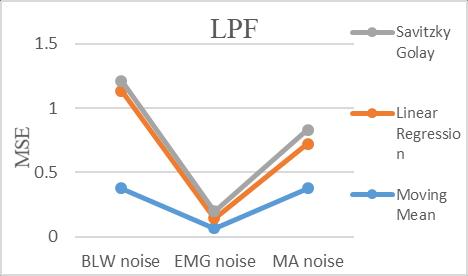
Chart-5: MSEresultbyDWT
2. Prasad, V. V. K. D. V. Prasad, P. Siddaiah & P. Rao. "De-noising of biological signals using different wavelet based methods and their comparison."Asian Journal of Information Technology7.4(2008):146-149.
3. M.T.Almalchy,V.CiobanuandN.Popescu,"Noise Removal from ECG Signal Based on Filtering Techniques,"201922ndInternationalConference onControlSystemsandComputerScience(CSCS), Bucharest, Romania, 2019, pp. 176-181, doi: 10.1109/CSCS.2019.00037.
4. Nayak,S.,Soni,M.K.andBansal,D.(2012)'filtering TechniquesforECGSignalProcessing',IJREAS,2(2), pp.ISSN:2249-3905.
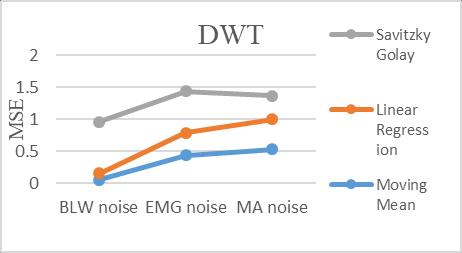
Chart-6: MSEresultbyLPF
The comparison of SNR values by three smoothing approachesisrepresentedintheabovefigures4.2and4.3. Similarly, the comparison of MSE by the three smoothing approachesisrepresentedintheabovefigures4.4and4.5.
TheinputSNRisconsideredas10dBforallthenoises.
TheendfindingsdemonstratethatboththeButterworthand Chebyshevalgorithmsperformednoisereductionwithabout equalefficacy.Theendfindingsdemonstratethatboththe Butterworth and Chebyshev algorithms performed noise reductionwithaboutequalefficacy.
4. CONCLUSION
In order to de-noise the ECG signal, we will apply digital filteringtechniques.Thetwomethodsthatwereutilisedto eliminate noise from the ECG data are discussed in this paper.
5. Patial,P.andSingh,K.(2014)'FilteringTechniques ofECGSignalusingFIRLowPassFilterwithVarious WindowTechniques',IJESRT,3(8).
6. Prasad, Dr VVKDV. "A new wavelet packet based method for de-noising of biological signals." InternationalJournalofResearchinComputerand Communication Technology 2.10 (2013): 10561062.
7. Singh T., Agarwal P. and V.K Pandey (2014) 'ECG BaselinenoiseremovaltechniquesusingwindowbasedFIRfilters',ICMI(MedCom).
8. AlMahamdyM.,H.BryanRiley(2014)'Performance Study of different De-Noising Methods for ECG ', ICTH,pp.325–332.
9. Nagasirisha.B & Prasad. V. V. K. D. V. A New ApproachforReductionofBaselineWanderNoise inEMGSignal. TurkishJournalofPhysiotherapyand Rehabilitation,vol 32: 2.
10. P. C. Bhaskara & M. D. Uplaneb (2016) 'High Frequency Electromyogram Noise Removal from ElectrocardiogramUsingFIRLowPassFilterBased OnFPGA',RAEREST,pp.497–504.
11. B. Nagasirisha, V.V.K.D.V. Prasad ‘Noise Removal fromEMGSignalUsingAdaptiveEnhancedSquirrel Search Algorithm’ 2020, Fluctuation and Noise Letters.Vol.19,No.04
12. ChoudharyM.,NarwariaR.P.(2012)'Suppression ofNoiseinECGSignalUsingLowpassIIRFilters', IJECSE,pp.2277-1956.
13. N. Mahawar, A. Datar & A. Potnis (2013) 'Performanceanalysisofadjustablewindow-based FIRfilterfornoisyECGSignalFiltering',IJACR,3(3), pp.(print):2249-7277,(online):2277-7970.
14. Sharma M., Dalal H. (2014) 'Noise Removal from ECG Signal and Performance Analysis using DifferentFilter2014',IJIREC,1(2),pp.2349-4042 (Print)&2349-4050(Online).
15. NagasirishaBhattiprolu,V.V.K.D.V.Prasad.‘EMG Signal de-noising using adaptive filters through hybrid optimization algorithms.’ Biomedical Engineering: Applications, Basis and Communications33.02(2021):2150009.