ANTENNA ARRAYS FOR MILLIMETER WAVE COMMUNICATION: A REVIEW
Arpit Yadav1, Mr. Nadeem Ahmad21M.Tech, Electronic and Communication Engineering, GITM, Lucknow, India

2Assistant Professor Electronic and Communication Engineering, GITM, Lucknow, India ***
Abstract - Antenna arrays are groups of antennas that are used to transmit or receive radio signals. These arrays are made up of multiple individual antennas, also known as elements, that are positioned in a specific pattern to enhance the performance of the overall system. The main advantage of antenna arrays is that they can provide a beam of radio energy in a specific direction, which can increase the strength of the signal in that direction and reduce interference from other sources. This makes antenna arrays particularly useful for applications such as wireless communication, radio astronomy, and radar systems. There are different types of antenna arrays, including linear, planar, and circular arrays, each with unique properties and applications. The specific design of an antenna array depends on the desired frequency, radiation pattern, gain, andother requirements for thesystem. Antenna arrays are a key component in many modern communication systems and play a crucialrole in maintaining reliable and efficient wireless connectivity.
Key Words: beamforming;beam-scanning;millimeter-wave (mm-wave);5G;line-of-sight(LOS);phasedarrays.
1. INTRODUCTION
Thehistoryofantennaarraysdatesbacktotheearlydaysof radio communication. As early as the late 19th century, engineersandscientistswereexperimentingwitharraysof simple dipole antennas to improve the performance of wireless communication systems. During World War II, antennaarraysbecameanimportanttoolformilitaryradar systems,whichusedthemtodetectenemyaircraft. These early arrays were often large and cumbersome, but they providedthenecessaryperformancefortheradarsystemsof the time. In the post-war period, the development of microwave technology and the increasing demand for wireless communication led to rapid advancements in antennaarraytechnology.Theintroductionofnewmaterials andmanufacturingtechniquesmadeitpossibletoproduce smaller,moreefficientarraysthatcouldbeusedinawider range of applications. In the 1960s and 1970s, the developmentofcomputer-aideddesignandsimulationtools revolutionized the design and analysis of antenna arrays. Thismadeitpossibletooptimizetheperformanceofarrays inwaysthatwerepreviouslynotpossible,leadingtoeven moreadvancedarraysforavarietyofapplications.
Today, antenna arrays continue to play a critical role in moderncommunicationsystems,fromcellphonenetworks to satellite communication systems. Advances in antenna arraytechnologyhavemadeitpossibletodeliverwireless connectivity to more and more people, in more and more places,aroundtheworld.
1.1. Phased Array
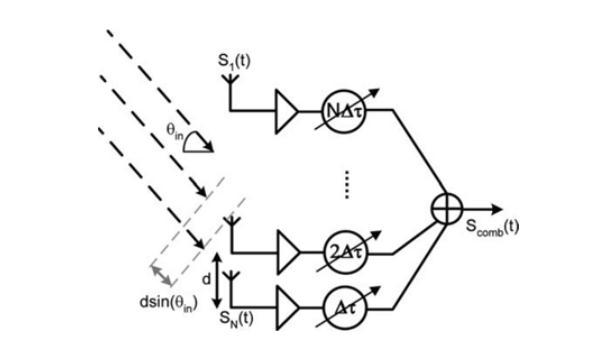
Aphasedarrayisaspecialsortofantennaarraythatuses electronicphaseshiftingtoguideandcontrolthepaththata beamofradiowavestravelsalong.Phasedarraysareoften usedincommunicationssystems.Eachantennainaphased array is connected to a computer-controlled electrical systemthataltersthephaseofthesignalsthatarebeingsent or received by each element in the array. This allows the phaseofthesignalstobepreciselyadjusted.Becauseofthis, the array may perform the duties of a single antenna. Becauseoftheprecisecontrolthatcanbeexercisedoverthe relativephasesofthesignals,thephasedarraycangenerate a highly directed beam that can be aimed in a variety of directions.Thisismadepossiblebythefactthattherelative phases of the signals can be precisely controlled. Phased arrays provide several major advantages over traditional antennaarrays,whicharethemostcommonkindofarray. Forinstance,sincethedirectionofthebeamcanbeadjusted electronically,aphasedarraymaybeconfiguredtofollowa movingobject,suchasanairplaneorasatellite,withoutthe need to physically move the antenna. This eliminates the requirementfortheantennatobephysicallymoved.Thisis madefeasiblebythefactthatthebeam'sdirectionmaybe electrically adjusted, making it possible to achieve the aforementionedgoal.Sincethisisthecase,phasedarraysare particularlyusefulforapplicationssuchasradar,navigation, and communication systems. Since of their adaptability, phased arrays are suitable for a diverse range of uses because they can be programmed to operate over a large rangeoffrequencyranges.Thismakesthemsuitablefora varietyofdifferentapplications.Theyareusefulinadiverse array of applications, including military radar systems, systems for regulating air traffic, and systems for communicating by satellite, amongst others. It is now possible,withdevelopmentsindigitalsignalprocessingand microwaveelectronics,toproducehigh-performancephased arraysthataremorecompact,efficient,andversatilethan they have ever been before. These phased arrays have a broadrangeofpotentialusesinmanydifferentcontexts.Asa
consequence of this, phased arrays are being used in an expandingvarietyofapplications,anditisanticipatedthat theywillplayanevenmoreprominentpartinthefutureof wirelesscommunicationaswellasotherindustriesthatare tiedtoit.
1.2. Millimeter-wave (mmWave) Technology
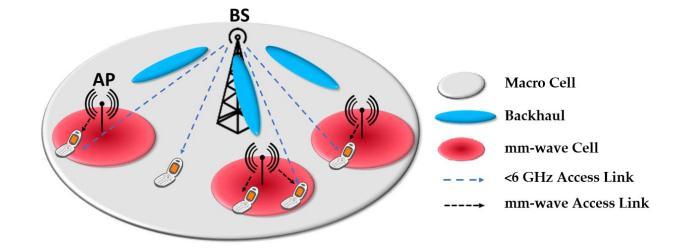
Millimeter-wave(mmWave)technologyisakeyenablerfor high-speed5Gwirelesscommunication.Itreferstotheuseof radiofrequenciesinthemillimeterrange,typicallybetween 30 GHz and 300 GHz, for wireless communication. This frequency range provides a large amount of bandwidth, which allows for very high data rates and low-latency communication. 5G wireless communication is the next generation of wireless communication technology that promises to deliver faster and more reliable wireless connectivity. It uses a combination of mmWave and traditionalsub-6GHzfrequenciestoprovidehigh-speeddata transmission and low-latency communication. The use of mmWave frequencies enables 5G to deliver multi-gigabitper-seconddatarates,whichisordersofmagnitudefaster thancurrent4Gnetworks.Theuseofmm-wavefrequencies for 5G wireless communication presents some unique challenges, such as high atmospheric absorption, high penetrationlossthroughwalls,andlimitedrange.However, advancesinmmWaveantennatechnology,suchasphased arraysandbeamforming,havemadeitpossibletoovercome thesechallengesanddeliverthehigh-speedandlow-latency communicationthatisthehallmarkof5G.Overall,mmWave technologyisanimportantpartofthe5Gecosystemandis playing a critical role in enabling the next generation of wireless communication. It is expected to be a key technology for many applications, including high-speed mobile broadband, enhanced mobile broadband, ultrareliablelow-latencycommunication,andmassivemachinetypecommunication.
1.3.
Arrays for5GMobile Terminals
Millimeter-wave (mmWave) antenna arrays are a crucial component of 5G mobile terminals, as they enable highspeed and reliable wireless communication at mmWave frequencies. The main challenge of designing mmWave antenna arrays for 5G mobile terminals is to achieve high gainanddirectionalperformanceinacompactandlow-cost package.
To achieve this, mmWave antenna arrays for 5G mobile terminalstypicallyuseacombinationofbeamformingand beam-steeringtechniques.Beamforminginvolvestheuseof multiple antennas to focus the radio energy in a specific direction, while beam-steering involves adjusting the directionofthebeamtotrackamovingtarget,suchasa5G base station. One of the most promising approaches to designingmmWaveantennaarraysfor5Gmobileterminals istheuseofphasedarrays.Phasedarraysconsistofmultiple antennas that are connected to a computer-controlled electronicsystemthatadjuststhephaseofthesignalsbeing transmittedorreceivedbyeachelementinthearray.This makesitpossibletosteerthebeamindifferentdirections and provide high gain and directional performance in a compactandlow-costpackage.Otherapproachesincludethe useofpassiveantennaarrays,suchasparasiticarraysand patch arrays, which are simpler and less expensive than activephasedarrays,buttypicallyhavelowergainandless flexibilityintermsofbeamsteering.
Inadditiontothedesignoftheantennaarraysthemselves, theintegrationofthearrayswithothercomponents,suchas theRFfront-endandthemodem,isalsoacriticalaspectof designingmmWaveantennaarraysfor5Gmobileterminals. Thegoalistoachieveacompactandefficientsolutionthat can meet the stringent requirements of 5G mobile communication while also being economically viable. Overall,thedevelopmentofmm-waveantennaarraysfor5G mobileterminalsisakeyareaofresearchanddevelopment, andsignificantprogressisbeingmadeinthisfield.Theuse
of mm-wave frequencies is an important part of the 5G ecosystemandisplayingacriticalroleinenablingthenext generationofwirelesscommunication.
2. LITERATURE SURVEY
Inthisreviewpaper,wehavestudiedthepreviousresearch work related to the Millimeter‐WaveAntenna Arrays,and conclusionoftheallresearchworksaregivenbelow:
Semkin et.al: Different radii of curvature were used in simulationsandmeasurementsofaseries-fedantennaarray operating at 58.5 GHz. As the antenna array's supporting structure's radius is shortened, the primary beamwidth expandsandtheantennaarray'srealizedoverallgaindrops, asprovenbymeasurements.Theobtainedgainvalueis17.2 dBandthehigh-powerbandwidthis208fortheplanarcase of the series-fed antenna array, whereas it is 11.4 dB and 828forthebentantennaonthecylinderwitharadiusof6 mm. The gain of the conformal antenna array that was curvedaroundacylinderwitharadiusofR=6mmis4dB more than what was required for 1.5 Gbit/s data transmission.Afterevaluatingthemateriallossesat60GHz, the antenna design may be refined. The results of these models and experiments demonstrate that the optimum beamwidth of the conformal antenna array for the given situation may be determined. Antenna coverage may be expanded by making use of the beamwidth-widening feature;forexample,bymountingseveralantennaarrayson acylinderstructure,a3608-square-kilometerregioncanbe covered. With enough effort, an omnidirectional radiation patternwithhighgainvaluesispossible.Beamsteeringmay be implemented by using conformal antenna arrays with theseparametersincombinationwithaswitchingnetwork.
Aqeel, Sungjoon: Wepresentedapracticalexampleofthe newlysuggestedphasedarraysfor5Gmobileterminalsand accessterminals.Thesecutting-edgephasedarraysfeature sufficient beam-scanning and coverage range for their inexpensivecostandsmallsize.Thesecutting-edgephased arrayswiththree-dimensionalcoverage,createdonsinglelayerandmultilayersubstrates,wereusedtodemonstrate theimpactofelectromagneticwavesonthehumanbodyand brain. Additionally, mobile terminal space limitations and multi-polarized antenna arrays were introduced and examined. To reduce the co-channel interference and compensate for the route loss, several beamforming approachesusingmodernmm-wavephasedarraydesigns weredeveloped.
Jiang et al: Aninnovativearraydesignforbeamformingand multibeammassiveMIMOsystemsbasedonametamaterialbasedthinplanarlensantennawasproposed.Thesuggested antennaisanarrayofantennasandanelectromagneticlens. Whenusedwithanantenna array,theEMlens boosts the throughput and data rate of massive MIMO (MIMO). PCB technologywasusedtocreateboththelensandtheantenna
parts.Youcanseetheproposedlensantennafromboththe topandthesideinFigure17a,b.Inthefocusareabehindthe EMlensisa28GHz,seven-elementstackingpatchantenna suppliedbyasurface-integratedwire.Foursquarepatches suppliedbyaSIWconstitutetheradiatingelementsofeach subarray.
Zhang et al: Different antenna array topologies and beamforming methods for use in outdoor mm-wave communication systems were compared and contrasted. Figure15depictstheresultsofananalysisoffourdistinct array architectures: an 8x8 rectangle element array, a 64 circularelementarray,a61hexagonalelementarray,anda 16 cross-shaped element array. Figure 15 shows the 2D radiation plots that were derived from the 3D radiation patterns.Theresearchofseveralarraylayoutsrevealsthat the array architecture with circular components provides superiorcoverageintermsofbothgainanddirectivity.
Ayman, Hesham: For upcoming 5G networks, a straightforward mm-wave MIMO slot antenna system consistingoftwometallicarraysofthreeelementshavebeen devised. The F/B ratio was increased and the backward radiation was reduced thanks to the EBG reflector. The performance analysis and design history of the proposed MIMO antenna system have been discussed. The experimentalresultsdemonstratethattheproposeddesign provides low envelope correlation values throughout the entirebandofoperation,withpeakgainsofover11.5and 10.9 dBi at the two frequencies of 28 and 38 GHz, respectively, and high isolation over wide impedance bandwidthofmorethan81.7%rangingfrom22.5tobeyond 50 GHz for 10 dB return loss. The suggested antenna is competitive for forthcoming 5G networks due to its small sizeandadequateperformance.
Tapan, Sanyog: Thesuggestedantennahasabandwidthof 22.509GHz,whichismorethanenoughtoaccommodatethe data rates needed for the next generation of wireless communications (5G) and beyond. The presented construction has a single layer, a flat contour, and a minimumofcomplicatedparts.Theantenna'sthicknessis just0.254mm,anditssizeis96.6798.518mm2,suggesting thatitmightbeseamlesslyintegratedwiththeRFICin5G mobiledevices.Themanufacturing pricemaybekeptlow becauseofthecompactshape.Sidelobelevelsarelessthan10dBatbeamanglesupto45degrees,demonstratingthe array's impressive potential for beam steering. The antenna'sgainremainsrelativelyconsistentoveritsusable frequency spectrum. The suggested antenna may be a suitable contender for future fifth-generation mm-Wave mobilephonesbecauseofitsbroadband,highgain,narrow fan beam, simplicity of integration, cheap cost, compact planar shape with a low profile, and potential to fit on constrainedspaceavailableinmobilephones.
Santos et.al: In this study, we introduce two millimeterwavearchitecturesthatmaybeusedinthefifthgeneration ofmobilephones.Thefirstisahigh-gainplanararraythat providesmainbeammodulationflexibility.Thesecondkind isareconfigurable3Darraythatcanspaneithera90-degree orfull360-degreearcwithasignificantamountofgain.The manufacturingofbothantennas,aswellastheassessmentof theirreflectioncoefficientandradiationpatterninthesemianechoicchamberatBrazil'sNationalTelecommunications Institute,aretasksforthenearfuture.
Jalal et.al: For 5G mm-wave communication systems, an antenna array with multiple inputs and multiple outputs (MIMO) is given. For this Multiple-Input Multiple-Output design,werecommendusingapairofantennaarrays.Each antennaarrayhasfourcomponentsthatareevenlyspaced apart,andthentwoarraysareputtogetherwitha90-degree rotation concerning one another. The 37 GHz spectrum, reservedfor5Gmm-wavecommunication,iscoveredbythe proposed MIMO antenna array. The suggested antenna element has a gain of 6.84 dB, which may be increased to 12.8dBusinganarrayoffoursuchcomponents.Metricsfor theperformanceoftheproposedMIMOantennaarray,such as the envelope correlation coefficient (ECC) and the diversity gain (DG), are measured and determined to be below the norm. Within the target operating frequency range,thesuggestedMIMOantennaarrayisshowntohavea radiationefficiencyofover85%.Inaddition,measurements areperformedonthesuggestedMIMOantennaarray,with thefindingsagreeingwellwiththesimulations.Withthisin mind,thesuggestedarchitecturemightbeconsideredasa possibleoptionfor5Gmm-wavecommunicationnetworks.
Aqeel et.al: Wepresentedapracticalexampleofthenewly suggestedphasedarraysfor5Gmobileterminalsandaccess terminals. These cutting-edge phased arrays feature sufficient beam-scanning and coverage range for their inexpensivecostandsmallsize.Thesecutting-edgephased arrayswiththree-dimensionalcoverage,createdonsinglelayerandmultilayersubstrates,wereusedtodemonstrate theimpactofelectromagneticwavesonthehumanbodyand brain. Additionally, mobile terminal space limitations and multi-polarized antenna arrays were introduced and examined. To reduce the co-channel interference and compensate for the route loss, several beamforming approachesusingmodernmm-wavephasedarraydesigns weredeveloped.
3. CONCLUSIONS
Thereissufficientbandwidth,radiationpatternsaresteady, the realized gain is appropriate across the intended band, and flexible material substrates are used. Because of this, novelantennaarchitecturesforthesubsequentgenerationof communications are offered. The suggested antennas' performanceiscomparedtothatofotherrecentlypublished works operating on the same frequency. The comparison
demonstratesthatthesuggestedantennasoutperformthe competitionthankstotheantennas'adaptability,bandwidth, steadyradiationpattern,andachievedgain.
REFERENCE
1.T.S.Rappaport,S.Sun,R.Mayzus,H.Zhao,Y.Azar,etal., ‘‘MillimeterWaveMobileCommunicationsfor5GCellular:It WillWork!’’IEEEAccess,1,May2013,pp.335-349.
2. E. Hossain and M. Hasan, ‘‘5G Cellular: Key Enabling Technologies and Research Challenges,’’ IEEE Instrumentation&MeasurementMagazine,18,3,June2015, pp.11-21.
3. T. S. Rappaport, R. W. Heath, Jr., R. C. Daniels, and J. N. Murdock,MillimeterWaveWirelessCommunications,Upper SaddleRiver,NJ,PearsonEducation,2015.
4. G. Orecchini, M. M. Tentzeris, L. Yang, and L. Roselli, ‘‘‘SmartShoe’’’:AnAutonomousInkjet-PrintedRFIDSystem ScavengingWalkingEnergy,’’IEEEInternationalSymposium onAntennasandPropagation(APSURSI),Spokane,WA,USA, July3–8,2011,pp.1417-1420.
5.M.Ur-Rehman,N.A.Malik,X.Yang,Q.H.Abbasi,Z.Zhang, et al., ‘‘A Low Profile Antenna for MillimeterWave BodyCentricApplications,’’IEEETransactionsonAntennasand Propagation,65,12,December2017,pp.6329-6337.
6. S. Das and D. Mitra, ‘‘A Compact Wideband Flexible ImplantableSlotAntennaDesignWithEnhancedGain,’’IEEE Transactions on Antennas and Propagation, 66, 8, August 2018,pp.4309-4314.
7.M.Tighezza,S.Rahim,andM.Islam,‘‘FlexibleWideband Antenna for 5G Applications,’’ Microwave and Optical TechnologyLetters,60,1,January2018,2018,pp.38-44.
8.S.Hong,S.H.Kang,Y.Kim,andC.W.Jung,‘‘Transparent and Flexible Antenna for Wearable Glasses Applications,’’ IEEETransactionsonAntennasandPropagation,64,7,July 2016,pp.2797-2804.
9.A.Dierck,H.Rogier,andF.Declercq,‘‘AWearableActive AntennaforGlobalPositioningSystemandSatellitePhone,’’ IEEE Transactions on Antennas and Propagation, 61, 2, February2012,pp.532-538.
10.J.-S.Park,J.-B.Ko,H.-K.Kwon,B.-S.Kang,B.Park,etal.,‘‘A Tilted Combined Beam Antenna for 5G Communications Using a 28-GHz Band,’’ IEEE Antennas and Wireless PropagationLetters,15,January2016,pp.1685-1688.
11.Y.J.Cheng,H.Xu,D.Ma,J.Wu,L.Wang,etal.,‘‘MillimeterWaveShaped-BeamSubstrateIntegratedConformalArray Antenna,’’IEEETransactionsonAntennasandPropagation, 61,9,September2013,pp.4558-4566.
12. Q. Jia, H. Xu, M. Xiong, B. Zhang, and J. Duan, ‘‘OmnidirectionalSolidAngleBeam-SwitchingFlexibleArray Antenna in Millimeter Wave for 5G Micro Base Station Applications,’’ IEEE Access, 7, October 2019, pp. 157027157036.
13.H.Qiu,H.Liu,X.Jia,Z.-Y.Jiang,Y.-H.Liu,etal.,‘‘Compact, Flexible, and Transparent Antennas Based on Embedded Metallic Mesh for Wearable Devices in 5G Wireless Network,’’IEEETransactionsonAntennasandPropagation, 69,4,April2021,pp.1864
1873.
14.Y.J.Cheng,H.Xu,D.Ma,J.Wu,L.Wang,etal.,‘‘MillimeterWaveShaped-BeamSubstrateIntegratedConformalArray Antenna,’’IEEETransactionsonAntennasandPropagation, 61,9,September2013,pp.4558-4566.
15.H.-L.Kao,C.-L.Cho,X.Y.Zhang,L.-C.Chang,B.-H.Wei,et al., ‘‘Bending Effect of an Inkjet-Printed SeriesFed TwoDipoleAntennaonaLiquidCrystalPolymerSubstrate,’’IEEE AntennasandWirelessPropagationLetters,13,June2014, pp.1172-1175.
16. H.-L. Kao, C.-S. Yeh, X. Y. Zhang, C.-L. Cho, X. Dai, et al., ‘‘InkjetPrintedSeries-FedTwo-DipoleAntennaComprisinga Balun Filter on Liquid Crystal Polymer Substrate,’’ IEEE TransactionsonComponents,Packaging,andManufacturing Technology,4,7,July2014,pp.1228-1236.
17. N. G. Alexopoulos, ‘‘Integrated-Circuit Structures on Anisotropic Substrates,’’ IEEE Transactions on Microwave TheoryandTechniques,33,10,October1985,pp.847–881.
18.N.G.AlexopoulosandC.M.Krowne,‘‘Characteristicsof SingleandCoupledMicrostripsonAnisotropicSubstrates,’’ IEEE Transactions on Microwave Theory and Techniques, 26,6,June1978,pp.387–393.
19. N. G. Alexopoulos and S. A. Maas, ‘‘Performance of Microstrip Couplers on an Anisotropic Substrate With an Isotropic Superstrata,’’ IEEE Transactions on Microwave TheoryandTechniques,31,8,August1983,pp.671–674.
20.B.A.Nia,F.DeFlaviis,andS.Saadat,‘‘FlexibleQuasiYagiUda Antenna for 5G Communication,’’ 2021 IEEE InternationalSymposiumonAntennasandPropagationand USNC-URSIRadioScienceMeeting(APS/URSI),Singapore, December2021,pp.115–116.
21. A. Hosseini, F. De Flaviis, and F. Capolino, ‘‘A 60 GHz Simple-to-FabricateSingle-LayerPlanarFabry–Perot´Cavity Antenna,’’ IET Microwave Antennas & Propagation, 9, 4, March2015,pp.313–318.
22.N.G.AlexopoulosandN.K.Uzunoglu,‘‘ASimpleAnalysis of Thick Microstrip on Anisotropic Substrates (Technical Notes),’’ IEEE Transactions on Microwave Theory and Techniques,26,6,June1978,pp.455–456.
23.S.-H.Wi,Y.-S.Lee,andJ.-G.Yook,‘‘WidebandMicrostrip Patch Antenna WITH U-Shaped Parasitic Elements,’’ IEEE Transactions on Antennas and Propagation, 55, 4, April 2007,pp.1196–1199.
24.R.Kumar,R.K.Khokle,andR.R.Krishna,‘‘AHorizontally PolarizedRectangularSteppedSlotAntennaforUltraWide Bandwidth With Boresight Radiation Patterns,’’ IEEE TransactionsonAntennasandPropagation,62,7,July2014, pp.3501-3510.