Graduate Admission Predictor
1,2,3,4 Department of information Technology, Shree LR Tiwari College of Engineering, Maharashtra, India ***

Abstract - When applying to master's programs, prospective graduate students are sometimes faced with the challenge of selecting their preferred universities. While there are many predictors and consultancies that canhelp a student, they are not always accurate because decisions are basedona small number of previous admissions. Here, we describe a machine learning-based approach in which, given the student profile, we assess various regressiontechniques, such as Linear Regression, Decision Trees, and Random Forest. Then, we calculate error functions for each model and evaluate performance to determine which model performs the best. The outcomes then show whether the selected university is a risky or ambitious one.
Key Words: Graduate Admissions, Predictor, Statistical Model,ProbabilityEstimation,SupportVectorRegression.
1. INTRODUCTION
Thecomplicatedprocedureofapplyingtoagraduateschool intheUSAresultsinaveryhecticundergraduateschedule forIndianstudents.Theparallelapproachofkeepingahigh Cumulative Grade Point Average, with good GRE, TOEFL scoresandpublishingresearchpapers,gettinggoodLetters of Recommendation and making a good Statement of Purpose certainly makes every Indian student busy who wantstofurtherexcelinacademia.Weunderstandthatall the things cumulatively are very important for graduate schooladmissions.Butwhatarethemostimportantfactors?
SeveralMachinelearningalgorithmswillbeutilizedinour predictortopredicttherateofacceptanceasapercentage.
MachineLearningalgorithmslikeLogisticRegression,Linear Regression,DecisionTrees,andRandomForest.Regression models will be compared according to their coefficient of determination denoted by R2 whilst classification models willbecomparedaccordingtotheiraccuracy,precision,and recall.
Thispaperaimstoprovideacomprehensiveunderstanding oftheGraduateAdmissionPredictor
Theobjectiveistoofferinsightsintotheworkingprinciples of the system, its advantages, its applications, and its limitations,providingafoundationforfutureresearchand development.
2. PROPOSED SYSTEM
AGraduateAdmissionPredictorsystemcouldpotentiallybe developedusingmachinelearningalgorithms,basedondata aboutapplicantsandtheiroutcomes(i.e.,whethertheywere admitted or rejected). This historical data could include various factors that are typically considered in graduate admissions, such as undergraduate GPA, standardized test scores (e.g., GRE), letters of recommendation and other applicationmaterials.
Todevelopsuchasystem,thefirststepwouldbetogather and preprocess the historical data, which might involve cleaning the data, dealing with missing values. Then, a machine learning model would need to be trained on this datatopredictthelikelihoodofadmissionfornewapplicants.
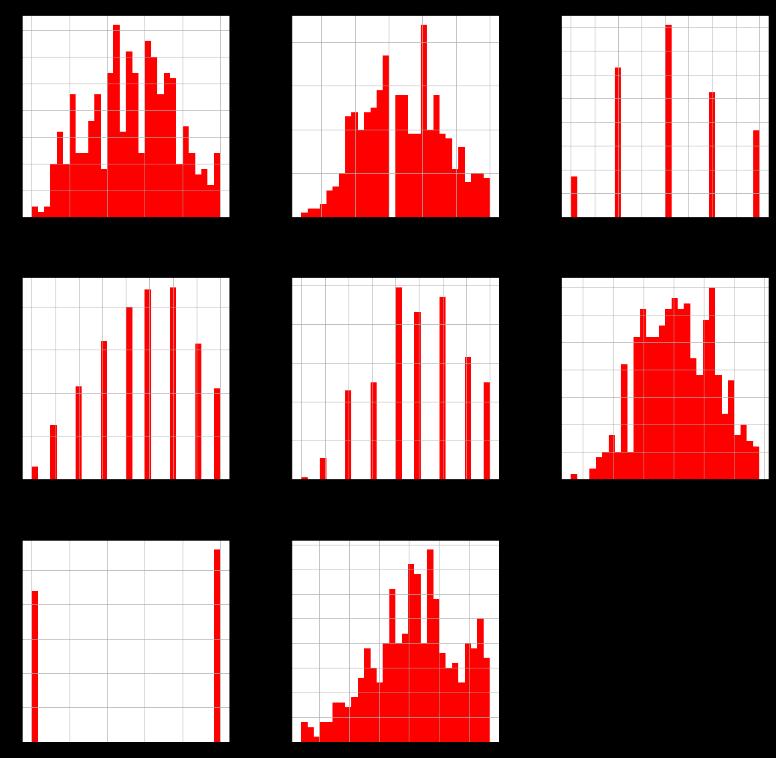
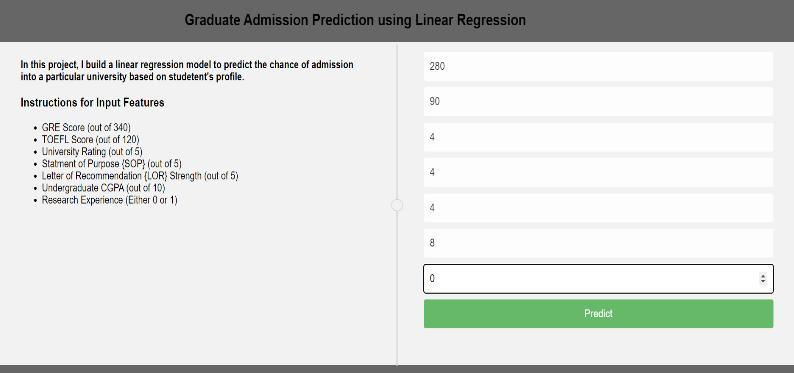
I. GRE Score (General Record Examinations); this score measuresgeneralknowledgeinundergradMathandEnglish. Thisscorerangesfromavalueof260to340
II. TOEFLScore(TestofEnglishasaForeignLanguage);this scoremeasuresstudent’sEnglishabilities.Thisscorehasa valuebetween0and120.
III. SOP (Statement of Purpose); a letter written by the applicantexplainingtheirpurposeoftheapplication.Thisis givenascorebetweenoneandfive.
IV. LOR(LetterofRecommendation);teststheweightofthe recommendationprovidedbytheapplicant.Thisisgivena scorebetweenoneandfive.
V. CGPA (Cumulative GPA); based on the academic performanceoftheapplicantinundergraduatestudies.This isscoredonarangefromonetoten.
VI. University Rating; based on the reputation of the applicant'spreviousuniversity.Thisisgivenascorebetween oneandfive.
VII. ResearchExperience;binaryvaluebasedonwhetherthe applicanthasanyresearchfamiliarity.Thisvalueiseitherone orzero.
VIII.ChanceofAdmission;therateofadmissionintograduate school.Thisattributeisthetargetedvalueinwhichwillbe predictedastheratefromzerotoone.
3. ALGORITHM
Below is a list of algorithms analyzed for the Graduate AdmissionProcess:
3.1 Regression Algorithms
A. Linear Regression
1.Insimplelinearregressiongoalistoobtainarelationship modelbetweenxandy.
2. We predict the value of one variable y based on the variablex.
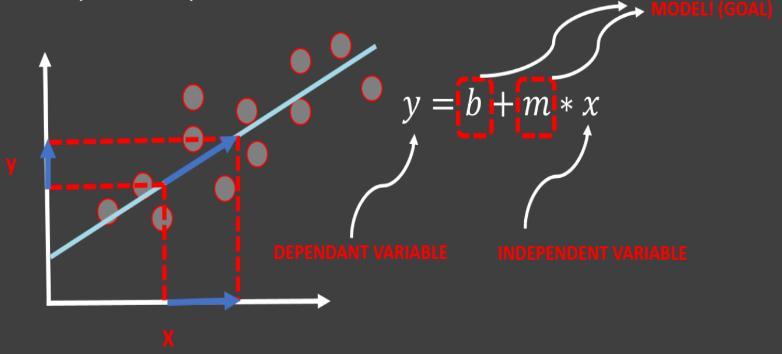
3. X is known as independent variable and y is called as dependentvariable.
4.Itissimplebecauseitexaminestherelationshipbetween twovariablesonly.
5. It is called as linear regression because when the independent variable increases (or decreases), the dependentvariablealsoincreases(ordecreases)inalinear fashion.
B. Multiple Linear Regression
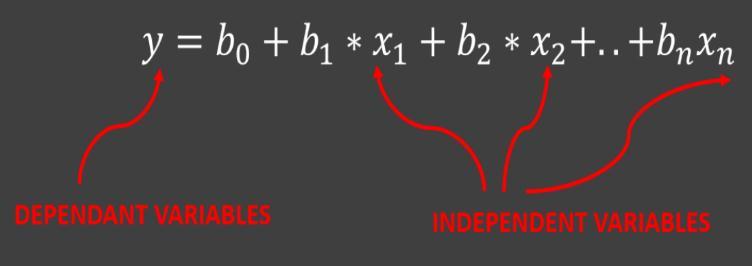
1.MultipleLinearRegressionexaminesrelationshipbetween morethantwovariables.
2. It is different from simple linear regression which is a statistical model that examines the linear relationship betweentwovariablesonly.
3. Each independent variable has its own corresponding coefficient.
3.2 Classification Algorithms
A. Artificial Neural Network
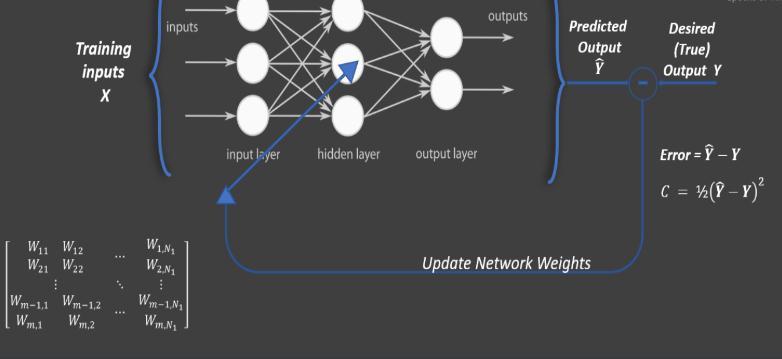
1.Multi-layerperceptronisaclassoffeedforwardartificial neuralnetworks.
2.Itusuallyconsistsofinputlayer,hiddenlayerandaoutput layer.
3. It uses a supervised learning technique called backpropagationfortraining.
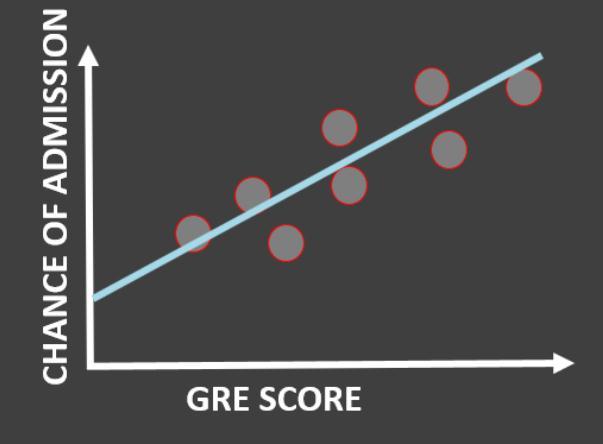
If R²=80, this means that 80% increase in the university admission is due to GRE scores (assuming a simple linear regressionmodel).
3.3.1 Regression Metrics: To assess model performance
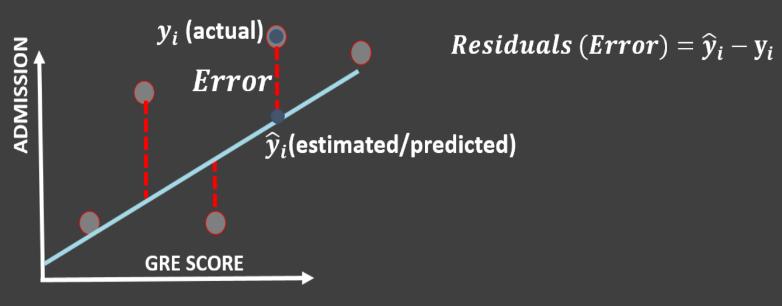
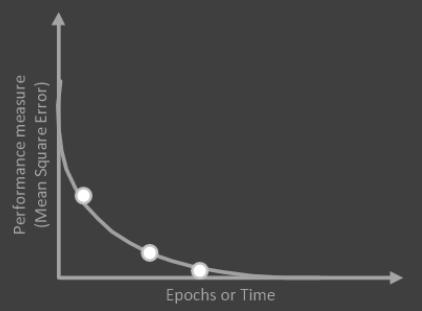
Aftermodelfitting,wewouldliketoassesstheperformance of the model by comparing model predictions to actual (True)data.
B. ADJUSTED R
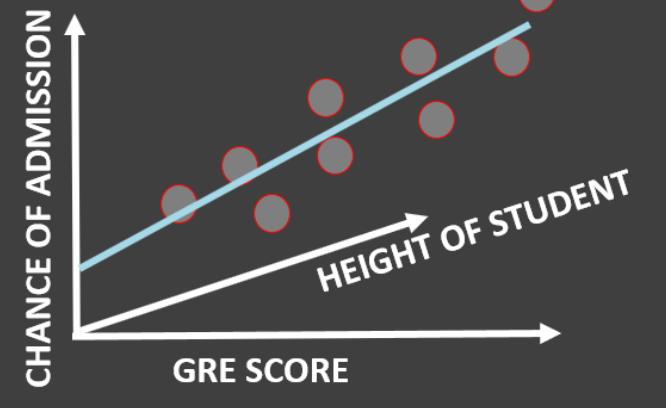
If R²=80, this means that 80% increase in the university admissionisduetoGREscores.
Let’saddanotheruselessindependentvariable,let’ssaythe heightsofthestudenttotheZ-axis.
NowR²increasesandbecomes:R²=85%
A. R
The percentage of the variation (of y) that has been explained by the independent variables in the model is shownbytheR-squareorcoefficientofdetermination.
Khan,M.A.,Dixit,M.,&Dixit,A[1]publishedtheirresearch work on Demystifying and Anticipating Graduate School AdmissionsusingMachineLearningAlgorithms.Theyhave offeredacutting-edgestrategyforestimatingthelikelihood ofadmissiontograduateschool.
Acharya,M.S.,Armaan,A., &Antony,A. S. [2] presenteda research paper which gives a comparison of Regression ModelsforPredictionofGraduateAdmissionsthatcompute errorfunctionsforthedifferentmodelsandcomparetheir performancetoselectthebestperformingmodel.
Bitar,Z.,&Al-Mousa,A[3]haveproposedacomprehensive and insightful overview on " Prediction of Graduate
Admission using Multiple Supervised Machine Learning Models"
Jeganathan, S., Parthasarathy, S., Lakshminarayanan, A. R., AshokKumar,P.M.,&Khan,M.K.A.[4].havedoneabrief study on Predicting the Post Graduate Admissions using Classification Techniques. The authors have applied the classificationtechniquessuchasLogistic Regression,KNN Classification, Support Vector Classification, Naive Bayes Classification, Decision Tree Classification and Random Forest Classification on the given academic admission dataset.
apare,N.S.,&Beelagi,S. M. [5]havepresenteda research paper which gives a " Comparison study of Regression Models for the prediction of post-Graduation admissions usingMachineLearningTechniques"
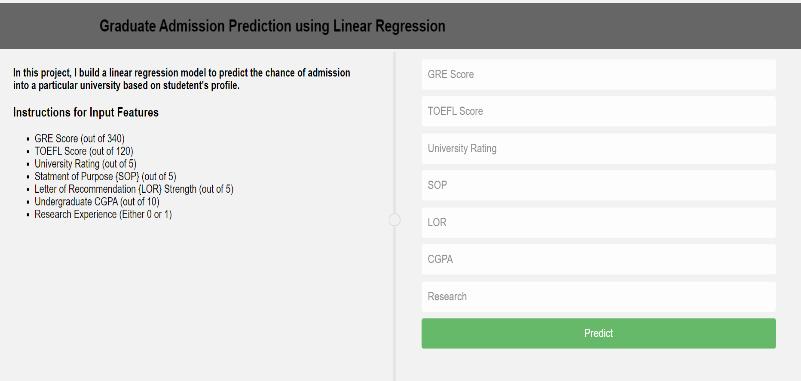
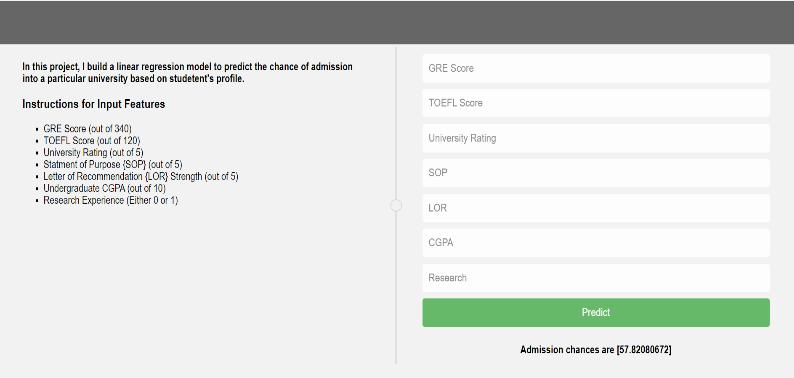
5. RESULTS & ANALYSIS
6. CONCLUSIONS
Intermsofaccuracy,ArtificialNeuralNetworkonceagain outperformsallofourothercategorizationtechniques.
WithalowMSEandhighR2score,itisevidentthatLinear Regression outperforms Random Forest on our dataset. RandomForestcomesinsecondplace.Thisisexplainedby thelineardependenciesofthedataset'sfeatures.Highertest scores, GPAs, and other metrics typically increase the likelihoodofacceptance.Theinclusionofafewoutliershas impactedtheLinearmodeltosomeextent.
7. FUTURE SCOPE
Weaimtoexpandourdatasetandincreasethenumberof profiles with some variations. The number of outliers (profilesthatdonotseemimpressivebuthadahighchance ofadmission)wouldbesignificantlyincreasedtoreducethe lineardependencyoffeatures.WewillalsouseDeepNeural Networks as another plausible model to understand the subjectivenatureofadmission.Thepredictorpresentedcan beimplementednotonlyinuniversityadmissionfaculties but also at recruiting agencies or human resources departments. By putting this predictor into practice, applicantCVanalysiswouldtakelesstime.Inthefuture,we plan to carry out our study by using different volumes of data & with more attributes, mainly considering neural networks.
8. REFERENCES
[1] Khan, M. A., Dixit, M., & Dixit, A. (2020). Demystifying and Anticipating Graduate School Admissions using Machine Learning Algorithms. 2020 IEEE 9th International Conference on Communication Systems and Network Technologies (CSNT). doi:10.1109/csnt48778.2020.9115788
[2] Acharya, M. S., Armaan, A., & Antony, A. S. (2019). A Comparison of Regression Models for Prediction of GraduateAdmissions.2019InternationalConferenceon Computational Intelligence in Data Science (ICCIDS). doi:10.1109/iccids.2019.8862140
[3] Bitar, Z., & Al-Mousa, A." Prediction of Graduate AdmissionusingMultipleSupervisedMachineLearning Models",2020
[4] Jeganathan,S.,Parthasarathy,S.,Lakshminarayanan,A. R., Ashok Kumar, P. M., & Khan, M. K. A. (2021). Predicting the Post Graduate Admissions using Classification Techniques. 2021 International Conference on Emerging Smart Computing and Informatics (ESCI). doi:10.1109/esci50559.2021.9396815
[5] apare, N. S., & Beelagi, S. M. " Comparison study of RegressionModelsforthepredictionofpost-Graduation admissionsusingMachineLearningTechniques",2021
[6] Gedam,MadhuriN.,andBanduB.Meshram.”Proposed SecureContentModelingofWebSoftwareModel.”IJETT 6.2(2019).