Impact of Land-use and Land-cover Change Dynamics on Flooding: A Case Study of Safilguda and RamakrishnaPuram Lake Watersheds of Hyderabad Metropolitan
Ravali Bharadwaj TR1, Harish Gupta2*1Research Scholar, Dept. of Environmental Sciences, Osmania University, Hyderabad

2UGC-Assistant Professor, Dept. of Civil Engineering, Osmania University, Hyderabad
Abstract - Rapid urbanization is a driving force in the transformation of the natural environment and the spatial layout of cities and towns. It has a negative impact on terrestrial ecosystem productivity and alters urbanecological security. Urbanization directlyimpacts the land-use landcover (LULC) change of an area, altering the ecological services and their functions. Natural water bodies like rivers, lakes, ponds, and wetlands are all part of the metropolitan landscape. And their importance grows as theycarryout their most important environmental and socio-economic roles, including providing drinking water, functioning as sponges by recharging groundwater, maintaining biodiversity, andgivinglivelihoods. Because of urbanization pressure, various types ofdepressions and low-lying regions close to or around cities that were acting as cushions and flood absorbers are gradually filled up and built over. Water bodies are being encroached upon at several places and converted to built up to meet the growing populations' demands. LULC changes often determine the spatial dimensions of all of these ecological variables. Remote Sensing and geographical information systems are the best tools for understanding the changes over a period of time. Latest advancements in remote sensing technology and satellite data availability have made spatial analysis easier. The current study examines changes in the LULC of the Ramakrishnapuram and Safilguda Lake watersheds between 1997 and 2016. High-resolution satellite imageryResourcesat LISS IV of 5.7m resolution was used to understand the change dynamics. The results demonstrate that the areas have seen significant conversions from vegetative areas to built-up areas. The change analysis shows how the rise in impervious surfaces has exacerbated flooding in certain places.
Key Words: LULC, Remote Sensing, GIS, Resourcesat, LISS IV
1. INTRODUCTION
Land-coverreferstothedominatingphysicalcharacteristics oftheearth'ssurfaceforagivenareaataspecificpointin time. It includes natural attributes such as type and distributionofvegetation,waterbodies,soilcoveretc,and man-madephysicalfeaturessuchassettlements,agriculture fields,andmodifiedvegetationcovers.Land-useofagiven areareferstohowthelandhasbeenused byhumansand theirhabitat,withanemphasisonthefunctionalroleofland
for economic activities (Singh et al., 2015). In this way, a region's land-use and land-cover (LULC) pattern are the outcome of results from natural and prevailing socioeconomicfactors,aswellasman'sutilizationofthemover timeandspace(Rawatetal.,2013).InformationonLULCis critical for selecting, planning, and implementing managementmethodstofulfillthegrowingdemandforbasic human requirements and the welfare of the world's population(Halmyetal.,2015).ProperinformationonLULC is required to implement multiple projects, planning, and land use plans to meet the ever-increasing demands for fundamental human necessities. Reliable and up-to-date information on LULC and their dynamics can assist in establishing a foundation for future decision-making in watershed management efforts (Rogan & Chen, 2004). Understandingland-useandland-coverchanges(LULCC)are oneofthefocalareasinthefieldsofglobalclimatechange andglobalenvironmentalchange.LULCCisthemostvisible representationofhumanactivity'sinfluenceonthenatural ecosystem of the earth's land surface and a link between humansocialandeconomicactivitiesandnaturalecological processes(Mooneyetal.,2013).ChangesinLUCCsarelinked to both human and environmental interactions (Liu et al., 2014).AnthropogenicactionsdriveLULCdynamics,which are extensive, rapid, and substantial processes that cause alterations that impact humans (Agarwal., 2002). For maintaining the sustainable development of natural resourcesandhuman habitats,itisstrategicallycrucial to conductlong-termnationwideLULCCmonitoringtodetect spatial patterns of land-use changes (LUCs) and aid in formulating effective infrastructure management plans (Herricketal.,2016).
Remote Sensing is useful in quickly evaluating and monitoring natural resources. Remote sensing and GIS integrationallowthemappingofland-coverandchangesin land-use,thusfacilitatingfutureplanning,development,and decision-making,whichiscriticalforfulfillingtheincreasing needsandwelfareofanever-growingpopulation.(Aithalet al.,2017;Anand&Oinam,2020;Erener&Düzgün,2009).It is a dependable data source from which we can extract, evaluateandupdateLULCchanges.Moreover,forsuccessful land-use and water resource planning and management, extensivemonitoringandmodelingofthedynamicsofurban sprawl and its implications on land-use patterns and
hydrologicalprocesseswithinthewatershedarenecessary. Asaresult,theLULCchangeisrecognizedasanimportant measure for evaluating the efficacy of watershed managementapproaches(Rajesh,2018).
Humanactivitieshavesignificantlyalteredthehydrological cyclethroughvariouswaterresourcemanagementmodes and flow path changes. LULC changes are an important indicationofsuchconsequencesandsignificantlyinfluence hydrological processes, economics, and the ecology of watersheds.LULCchangesandecosystemvulnerabilityare keycausesofglobalenvironmentalchange,withpotentially severeconsequencesforhumanwell-beingandlivelihoods (Umukizaetal.,2021).RapidchangesinLULChaveresulted in extensive deterioration of terrestrial and aquatic ecosystems,influencingbiologicalprocesses.Thedynamics of LULC, comprising surface runoff, subsurface runoff, groundwaterrecharge,andotherterrestrialfluxes,playan importantroleinthehydrologicalbalance.
Floodingincitiesisoftencausedbyacomplexsetoffactors primarilyduetoinsufficientorpoorlanduseplanning.The naturalforcesaffectingtheurbanenvironmentarethesame asthoseaffectingthenaturalenvironment,andthepresence ofurbansettlementsexacerbatesthesituation.Incitiesand towns,veryfewopenareasoflandmaybeutilizedforwater storage.Allprecipitationandotherflowsmustberemoved assurfacewaterorthroughdrainagesystems,whichmight be artificial and limited by competing demands on urban land. With expanding populations and strong demand for land,manymetropolitanareasareexperiencingtheproblem ofincreasedurbanization.Whiletherearelawsinplaceand lawstoregulatethedevelopmentofnewinfrastructure,as wellastherangeofbuildingtypesisfrequentlynotenforced adequately due to economic or other considerations. This causes the obstruction in the natural flow path of water leading to flood (Jha et al., 2012). In many urban areas, floodinghappensbecausetheurbandrainagesystems are incapableofhandlingheavyrains.
ThecurrentstudyaimstocomprehendtheLULCchangesin the study region and their impact on floods. The findings wouldallowforthedevelopmentofappropriatemitigation strategiestomitigatetheeffectsoffloods.
2. Material and Methods
2.1 Study Area
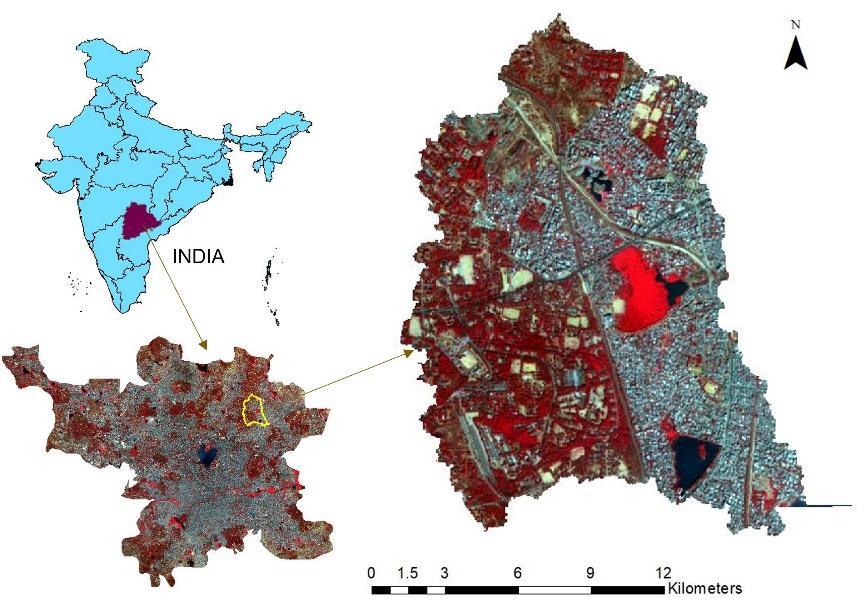
The current study area lies between 17°27'28.805"N, 78°30'56.782"E and 17°29'45.006"N, 78°32'37.005"E. It includes sections of the Cantonment area and Malkajgiri circleofGreaterHyderabadMunicipalCorporation(GHMC). ItisthemainresidentialneighborhoodinGHMC'sMalkajgiri circle.Neredmet,RamakrishnaPuram,andSafilgudaaresome oftheresidentialareas.Thestudyareaincludeswatersheds of two large lakes, Ramakrishnapuram and Safilguda. This regioncoversanareaof772.34hectaresintotal.Allofthe
amenitiesofasuburbancityareavailable,includingmedical, educational, retail, offices, and public transit. Military establishmentsoccupythemajorportionofthestudyarea, and civilian trespassing is not allowed. It implies that the studyareaismoreorlessprotected.Theotherportionofthe studyareahasmanyresidentialcoloniesthathavedeveloped tremendouslyrecently.
2.2 Data Sources and Methodology
For the current study, Satellite imagery procured from National Remote Sensing Centre (NRSC) IRS-1C PAN (panchromatic)imagewasusedfor1997,andResourceSAT LISS IV for 2008 and 2016. All the data procured were relativelycloudfreeandatmospheric-corrected.
2016, Resourcesat LISS IV satellite image was used for featureextractionusingasemi-automaticfeatureextraction technique using the object and pixel-based hybrid feature extraction method on the ERDAS Imagine platform. The imagewasclassifiedintosixLULCclassesandcorrectedby visualinterpretationformisclassificationerrors.Thisvector layergeneratedwasthenoverlaidonthepreviousimagesof 2008 and 1997 and classified. These LULC layers for 1997,2008,and2016were cross-verifiedusingveryhighresolutiongoogleearthimageryofthesamedates.
LULCclassification:FortheLULCclassificationofthestudy areaIndianSpaceResearch'Organization’sNaturalresource censusLULCclassificationschemawasreferenced.Thestudy area was classified into six categories; built-up-compact, built-up-mixed,built-up-sparse,vegetatedopenarea,lakes, andshallowponds.
Built-up area: Areas where the land cover is totally convertedduetoanthropogenicactivitieswithconcreteand are inhabited by people for residential and commercial purposes.Built-upareaiscategorizedunderthreeclassesAreaswithlessthan10%ofvegetatedareasareclassified
underthebuilt-upcompact.Areaswith11-40%ofvegetated areaswithmostlyshrub-typevegetationareclassifiedunder built-up-sparse. Areas above 40% and below 60% of vegetated areas, mostly covered with large trees, are classifiedasbuilt-up-mixed.Thesevegetatedareasinclude all the parks, recreational areas, cemeteries, and the vegetationalongtheroads,usuallytreeswithlargecanopies.
Vegetatedopenarea:Thisclassincludesallareascovered withshrub-typeandthorn-typevegetationcover.
Shallow ponds: These include non-perennial waterbodies filled during the monsoon period and usually dry in nonmonsoonperiods.Theseareusuallysmalldepressionsfor 10-20feetindepth.
Lakes: These are perennial waterbodies filled with water throughouttheyearandareusuallymorethan30feetdeep.
3. RESULTS AND DISCUSSIONS
The present study's LULC change analysis reveals a significantdecreaseinvegetatedareas.Ithasdecreasedin size from 134.59 ha in 1997 to 17.95 ha in 2016. Nonperennialwaterbodies,whichoriginallyaccountedfor15.20 hain1997,werealsoencroacheduponfordevelopment.The results show that the number of residential communities createdin1997waslower,withgreatergreenspace.Builtuphasgraduallyexpandedduetothemigrationofresidents fromnearbytownsandruralregions.Thepresentresearch area comprises cantonment areas that are occupied by militaryestablishmentsanddefenseresidencesandarenot eligibleforcivilianresidentialdevelopment.Asaresult,this region features a mixed built-up kind of land use, with buildings surrounded by large trees and lush vegetation coveringaround60%ofthearea.
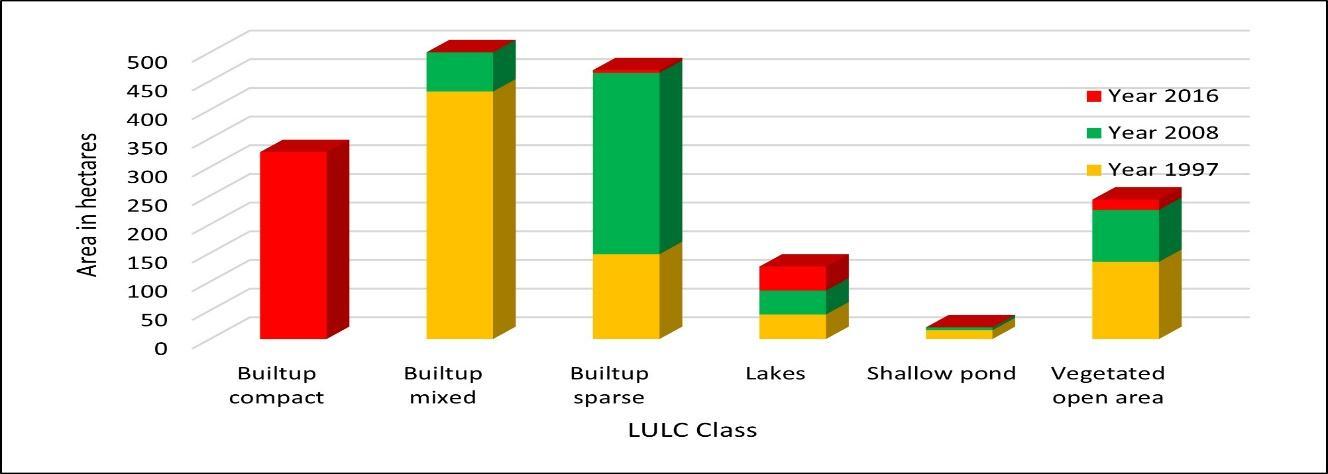
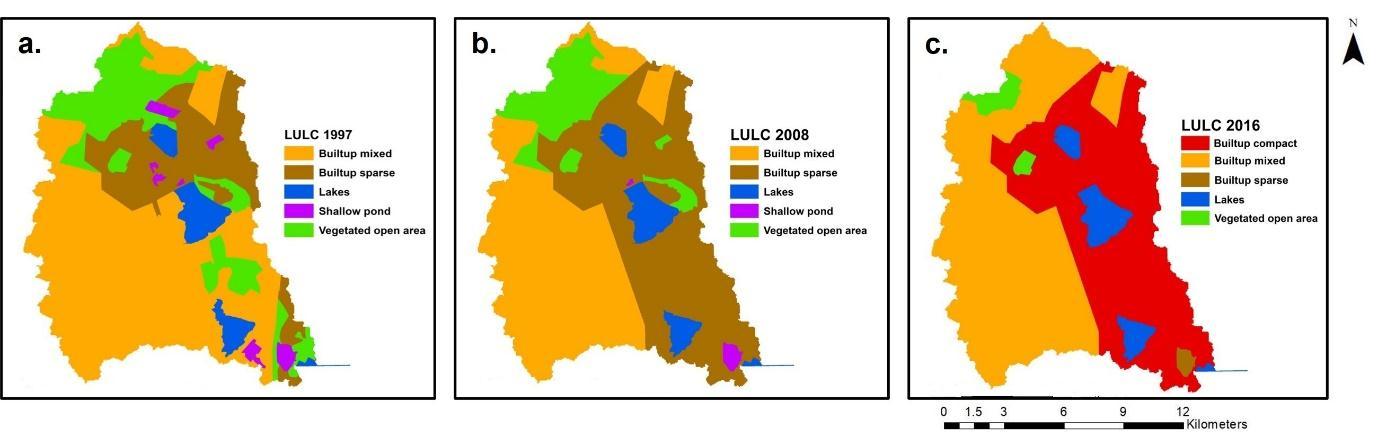
The present study's LULC change analysis reveals a significantdecreaseinvegetatedareas.Ithasdecreasedin size from 134.59 ha in 1997 to 17.95 ha in 2016. Nonperennialwaterbodies,whichoriginallyaccountedfor15.20 hain1997,werealsoencroacheduponfordevelopment.The results show that the number of residential communities createdin1997waslower,withgreatergreenspace.Builtup has gradually expanded due to the migration of residents fromnearbytownsandruralregions.Thepresentresearch area comprises cantonment areas that are occupied by militaryestablishmentsanddefenseresidencesandarenot eligibleforcivilianresidentialdevelopment.Asaresult,this region features a mixed built-up kind of land use, with buildings surrounded by large trees and lush vegetation coveringaround60%ofthearea.
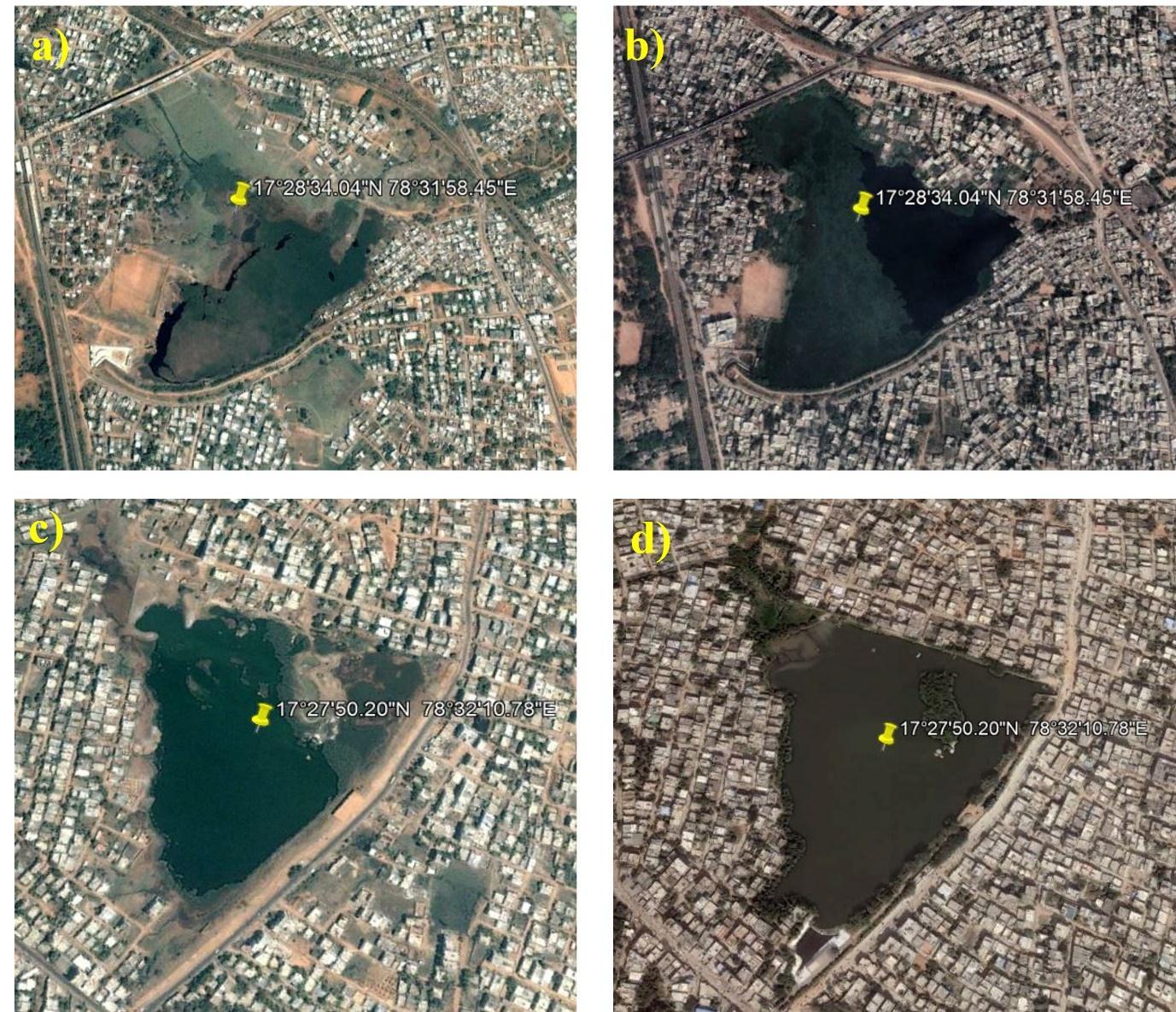
The Neredmet,RamakrishnaPuram,andSafilgudaarethe major residential localities included in the study regionTheseplaceshavealloftheinfrastructureadvancesof suburbs,aswellasgoodeducationalinstitutions,aredistant fromcitytraffic,andaremorepeacefulandgreen.Asaresult manypeoplehavemigratedtotheselocalitiesandcontinue so even today. From 1997 to 2016, these places saw significant built-up class transformations. There was no built-up compact class in 1997, which grew dramatically only after 2008. In 2016, the built-up compact class accounted for 325.92 hectares in these locations and was continuouslygrowinginaverticaldirectiontodate.These residentialneighborhoodsareclosetovariousgovernment organizations like ECIL, NFC, South Central Railways, and others that are within a 6-8 km radius. The region is well connected to the railway station and has excellent bus service.Thishasencouragedmorenumberofresidents to addeveryyearintheseareas.Allinfrastructureprojectsin thestudyregionhaveignoredthepreservationofvegetation cover in favor of developing built-up areas to meet rising demand. This has finally resulted in the invasion of waterbodies (shown in fig. 4) and the narrowing of stormwaternalas.Fromtheresults,itisseenthatby2016 42% of the total area has converted to built up compact class.In1997,there wasno compactbuilt upinthestudy region. Other major conversions are seen in the built up categoryitselfwheremixedandsparsebuitupareashave converted to compact built up in 2016. Overall, there is a significantriseinimpermeablesurfacesinthestudyregion.
Increases in impermeable surfaces increase surface runoff volumes, resulting in floods. The current research area containstwowatersheds,eachwithalargelakeintowhich waterfromalldirectionsdrainsduringthemonsoons.The peripheryofthesetwolakeshasbeenencroachedupon,and theshallowpondhasbeentotallybuiltover,limitingcarrying capacity.Localizedfloodinginnorthernandeasternpartsof Greater Hyderabad has become common lately. Several localities are flooded even for a small spell for short
durations.Encroachmentsofnon-perennialwaterbodiesand nalas have increased the surface runoff volumes during monsoons.Thenalas,whichshouldbemorethan10meters wide, have shrunk to two meters at several places in the study area, failing to carry away the storm waters. In Hyderabad, the built-up area has grown rapidly in the northeastdirection,upstreamoftheMusiRiver.Thereare severalhigh-risebuildingssprungupintheseareas.Thelack ofaseparatestormwaternetworkinthecityexacerbatedthe floodsituation.
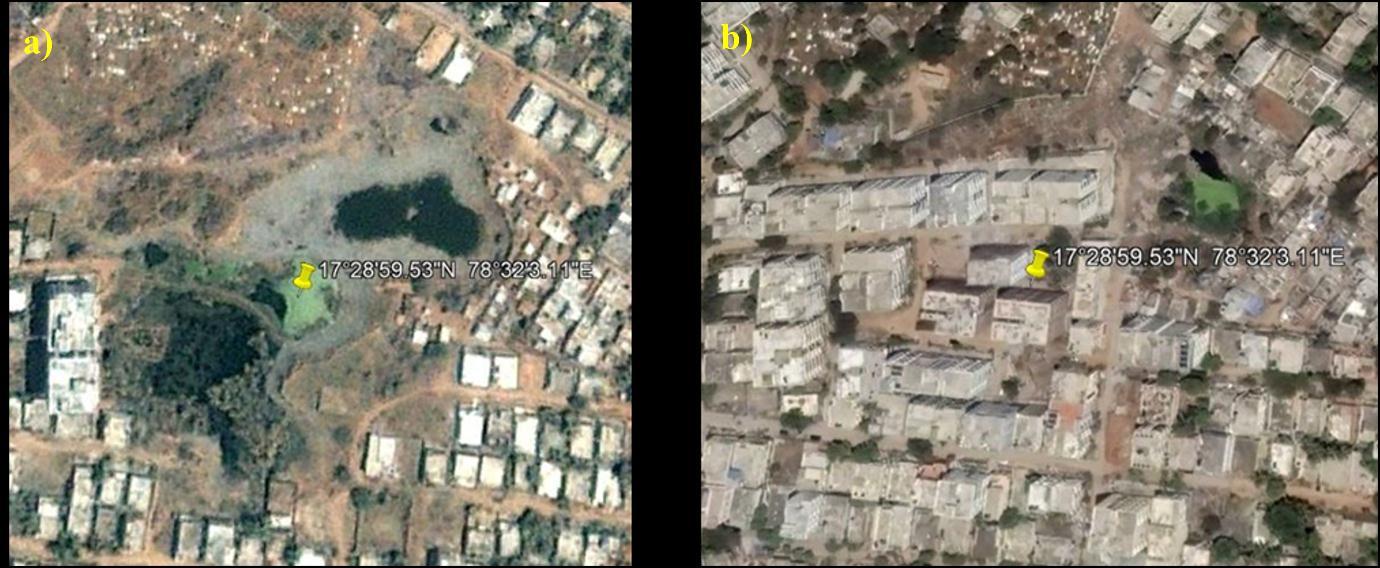
The increase in population has resulted in an increase in sewage volume. The sewage flow into the nalas, which is eventually discharged into the lakes, is not monitored. During the monsoons, the added load of sewage into stormwaternalascausesalocalizedflood-likeimpactinthe area.Severalroutineconstructionalactivitiesarereducing thevegetationcover.Alltheconstructiondebrisgeneratedis illegallybeingdumpedintothelakes,reducingtheircarrying capacity.Duetoencroachment,shallowpondshavetotally vanishedinthearea(showninfig5.).Thiswaterwhichcan becapturedintheselakesduringmonsoons,isoverflowing ontheroadsandthestreams,causingfloods.Alltheexcess runoffgeneratedduringthemonsoonsoverflowsontothe streets,causingfloodsintheselocalities.After2016almost all built-up class is completely impervious and prone to floods, even for low-intense spells. Several incidents are reported yearly that these localities of Safilguda and Neredmet face floods even with rainfall for small periods. From the current study, it is clear that the reduction in vegetationcoveristhemaincauseoffloodingintheseareas. Itrequiresamorescientificstormwatersystemdesignthat is cost-effective and eco-friendly, like the green infrastructuretobeconstructedintheseareastoreducethe effectsofflooding.
4. CONCLUSIONS
According to the findings of the study, the conversion of vegetated open space to built-up space is extensive in the area.Thearea'sinfrastructuredevelopmenthasignoredthe conservationofnaturalwaterbodiesandhasnotdeveloped any structures for collecting stormwater or groundwater recharge systems. Population growth has resulted in the
ACKNOWLEDGEMENT
constructionofmultiplehigh-risestructures,whereexcess sewerage load is discharged into storm drains and lakes, diminishing carrying capacity. Construction waste is frequently dumped into waterbodies, eventually accumulatingandreducingthestoragecapacity.Appropriate scientific methodologies are required for infrastructure designinordertopreservethenaturallandscapeandcontrol theintensityoffloods.
HGthanksUGCforthefacultypositionthroughFacultyRechargeProgramme.
REFERENCES
[1] AgarwalChetan,GreenGlenM.,GroveMorgan,EvansTomP.,S.C.(2002).AgricultureAReviewandAssessmentofLandUseChangeModels :DynamicsofSpace,Time,andHumanChoiceChetanAgarwal.July2016.
[2] Aithal, B., Shivamurthy, V., & Ramachandra, T. (2017). Characterization and Visualization of Spatial Patterns of UrbanisationandSprawlthroughMetricsandModeling.CitiesandtheEnvironment,10(1),31.
[3] Anand,V.,&Oinam,B.(2020).Futurelanduselandcoverpredictionwithspecialemphasisonurbanizationandwetlands. RemoteSensingLetters,11(3),225–234.https://doi.org/10.1080/2150704X.2019.1704304
[4] Erener, A., & Düzgün, H. (2009). Prediction of Population in Urban Areas by Using High Resolution Satellite Images. Ocw.Metu.Edu.Tr.
http://ocw.metu.edu.tr/pluginfile.php/3808/mod_resource/content/0/UA_CD/ek_kaynaklar/rast_population.pdf
[5] Halmy,M.W.A.,Gessler,P.E.,Hicke,J.A.,&Salem,B.B.(2015).Landuse/landcoverchangedetectionandpredictioninthe north-western coastal desert of Egypt using Markov-CA. Applied Geography, 63, 101–112. https://doi.org/10.1016/j.apgeog.2015.06.015
[6] Herrick,J.E.,Beh,A.,Barrios,E.,Bouvier,I.,Coetzee,M., Dent,D.,&Elias,E.(2016).TheLand- - Potential Knowledge System ( LandPKS ): mobile apps and collaboration for optimizing climate change investments. March. https://doi.org/10.1002/ehs2.1209
[7] Jha,A.K.,Bloch,R.,&Lamond,J.(2012).CitiesandFlooding.InCitiesandFlooding :AGuidetoIntegratedUrbanFloodRisk Management for the 21st Century. World Bank. © World Bank (Vol. 8, Issue 1). The World Bank. https://doi.org/10.1596/978-0-8213-8866-2
[8] Liu,J.,Kuang,W.,Zhang,Z.,Xu,X.,Qin,Y.,Ning,J.,Zhou,W.,Zhang,S.,Li,R.,Yan,C.,Wu,S.,Shi,X.,Jiang,N.,Yu,D.,Pan,X.,& Chi,W.(2014).Spatiotemporalcharacteristics,patterns,andcausesofland-usechangesinChinasincethelate1980s. JournalofGeographicalSciences,24(2),195–210.https://doi.org/10.1007/s11442-014-1082-6
[9] Mooney,H.A.,Duraiappah,A.,&Larigauderie,A.(2013).Evolutionofnaturalandsocialscienceinteractionsinglobal changeresearchprograms.ProceedingsoftheNationalAcademyofSciencesoftheUnitedStatesofAmerica,110(SUPPL. 1),3665–3672.
https://doi.org/10.1073/pnas.1107484110
[10] Rajesh,V.(2018).Rjces.6(October),1–4.
[11] Rawat, J. S., Biswas, V., & Kumar, M. (2013). Changes in land use/cover using geospatial techniques : A case study of Ramnagartownarea,districtNainital,Uttarakhand,India.TheEgyptianJournalofRemoteSensingandSpaceSciences, 16(1),111–117.https://doi.org/10.1016/j.ejrs.2013.04.002
[12] Rogan,J.,&Chen,D.(2004).Remotesensingtechnologyformappingandmonitoringland-coverandland-usechange. 61(July2003),301–325.
https://doi.org/10.1016/S0305-9006(03)00066-7
[13] Singh,S.K.,Mustak,S.,Srivastava,P.K.,Szabó,S.,&Islam,T.(2015).PredictingSpatialandDecadalLULCChangesThrough CellularAutomataMarkovChainModelsUsingEarthObservationDatasetsandGeo-information.EnvironmentalProcesses, 2(1),61–78.https://doi.org/10.1007/s40710-015-0062-x
[14] Umukiza, E., Raude, J. M., Wandera, S. M., & Petroselli, A. (2021). Impacts of Land Use and Land Cover Changes on PeakDischargeandFlowVolumeinKakiaandEsamburmbur.i.