LoRa-based Intelligent smart glove for visually impaired people
Janani S, Sangeetha R, Sindhuja J, Sarumathi J1)Assistant professor. V.S.B. Engineering College -Karur
2)Undergraduate student, V.S.B. Engineering College -Karur
3)Undergraduate student, V.S.B. Engineering College -Karur
4) Undergraduate student, V.S.B. Engineering College -Karur

Department of Electronics and communication engineering
Abstract - The aim of the LORA-based smart gloves for individuals with mobility impairments is to provide assistive technology. These gloves use flex sensors and Arduino boards to detect hand movements, which are transmitted via LoRa wireless communication to control electrical loads. The design of the gloves prioritizes comfort and ease of wear, with flex sensors strategically placed throughout. Once the flex sensors detect hand movements, they transmit the data to the Arduino board, which processes and transmits it to a receiver to control electrical loads like LED lights or motors. Safety features have been implemented to prevent accidental activation of electrical loads. This project can potentially expand beyond electrical load control, such as data collection or communication between the user and caregiver.
Keywords: flex sensor, Arduino, glove, LoRa, Load control
1. INTRODUCTION
Assistive technologies have a crucial role in enhancing the quality of life for individuals with disabilities. For peoplewithmobilityimpairments,controllingelectrical loads through manual dexterity can be a significant challenge. To address this issue, we are developing LORA-based smart gloves that use Arduino and flex sensors to control electrical loads for disabled individuals. The gloves are designed to be comfortable, lightweight, and easy to wear, with flex sensors placed on various points on the glove to detect hand movements. The Arduino board processes the sensor data,whichisthentransmittedoverLoRatoareceiver. The received data is then used to control electrical loads,suchasLEDlightsormotors,withsafetyfeatures incorporated to prevent accidental activation of the loads.Byprovidingareliableanduser-friendlyassistive technology solution, this project has the potential to improve the independence and quality of life of individuals with mobility impairments. Daily tasks requiring manual dexterity can be challenging for individuals with mobility impairments. While assistive technologies can aid in overcoming these challenges, current technologies often have limitations that limit theiradoption,suchasbeingbulkyorcomplextouse.
Theproposedprojectaimstodevelopanassistive
Atechnologysolutionthatiscomfortable,easytouse,and specifically tailored to the needs of individuals with mobility impairments. The LORA-based smart gloves use flex sensors and Arduino boards to detect hand movements and control electrical loads such as lights or motors. LoRa wireless communication allows for seamless data transmission between the gloves and the electrical loads, making the system more efficient and easiertouse.
The proposed project is focused on developing an innovative assistive technology solution that is designed tobecomfortable, easyto use,and tailoredto the unique needs of individuals with mobility impairments. The project aims to achieve this through the development of LORA-based smart gloves that utilize flex sensors and Arduino boards to detect hand movements and control electrical loads like lights or motors. The use of LoRa wireless communication ensures that data transmission between the gloves and the electrical loads is seamless, resultinginanefficientanduser-friendlysystem.
Oneofthekeybenefitsofthissystemisitsflexibility.The gloves can be customized to meet the specific needs of different individuals, with sensors placed at various locations as required. Furthermore, the system can be adaptedtocontrolawiderangeofelectricalloads,making ithighlyversatileandapplicableinvarioussettings.
1.1 Scope
The proposed LoRa-based smart gloves for disabled peopleusingArduinoandflexsensorshaveabroadscope and can offer several benefits to individuals with disabilities. The gloves can help promote independence by allowing the wearer to control electronic devices and appliances easily. The use of flex sensors enables the wearertocontrolloadswithsimplehandmovements,and the use of LoRa technology allows for wireless communication, making it more convenient for the wearertooperatethedevices.
Additionally, the proposed solution is highly customizable,allowingforadjustmentstothenumberand
placement of flex sensors to suit the specific needs of the wearer. This feature can be particularly useful for individualswithdifferentlevelsofdisability.
The proposed solution has the potential to enhance the quality of life for people with disabilities and can be further developed to include additional features that canmakeitevenmorefunctionalandeasytouse.
Overall, the LORA-based smart gloves for disabled people using Arduino and flex sensors to control electrical loads is an exciting assistive technology solutionforindividualswithmobilityimpairments.The projecthasthepotentialtoenhancetheirindependence, improvetheirqualityoflife,andmakedailytasksmore accessible.
2. LITERATURE REVIEW
One study by Kumar et al. (2019) developed a smart gloveusingflexsensorsandanArduinoboardtocontrol a robotic arm. The system allowed for precise and intuitivecontrolofthearm,improvingtheuser'sability toperformvarioustasks.
Another study by Wu et al. (2018) developed a glovebased human-machine interface for controlling a smart wheelchair. The system used an array of sensors, including flex sensors, to detect hand movements and translatethemintocontrolsignalsforthewheelchair.
The use of LoRa wireless communication has also been studied in various applications, including assistive technologies. A study by Tiwari et al. (2020) developed a LoRa-based smart cane for visually impaired individuals. The system used ultrasonic sensors and a LoRa module to detect obstacles and transmit data to a receiver.
Another study by Choudhary et al. (2020) proposed a wearable glove-based system for detecting and classifying hand gestures using machine learning algorithms. The system used flex sensors and inertial measurement units (IMUs) to detect hand movements andtransmitdatatoareceiverforclassificationusinga machinelearningmodel.
A study by Naik et al. (2020) developed a smart glovebased system for controlling home appliances using an Arduino board and Bluetooth communication. The systemusedflexsensorstodetecthandmovementsand transmit data to a smartphone app for controlling varioushomeappliances.
The use of flex sensors in smart gloves has also been studied in the context of rehabilitation for individuals with hand impairments. A study by Wang et al. (2019) developed a smart glove-based system for hand
rehabilitation using flex sensors and vibrotactile feedback. The system allowed for personalized rehabilitation programs based on the user's hand movements.
Another study by Zhu et al. (2018) developed a smart glove-basedsystemfortherehabilitationofhandfunction afterstrokeusingflexsensorsandanArduinoboard.The system allowed for real-time monitoring and feedback of handmovementsduringrehabilitationexercises.
3. EXISTING SYSTEM
Assistive technologies available for people with mobility impairments are often intricate systems that can be expensive,unwieldy,orchallengingtooperate.Tocontrol electrical loads for such individuals, some of the present techniques involve using voice commands, switches, or joysticks.
However,voicecommandsnecessitateclearandconstant speech, which might not be feasible for individuals with speech impairments or in noisy settings. Switches and joysticks can be cumbersome to use and may require specific positioning, making them impractical for those withlimitedmobility.
The proposed smart gloves, which are based on LoRa technology, offer a more natural and intuitive method of controlling electrical loads for individuals with disabilities.Theuseofflexsensorsenablesprecisecontrol oftheloadsthroughhandmovements,resultinginamore responsive and user-friendly system. Additionally, wireless LoRa communication allows for smooth data transmission between the gloves and electrical loads, enhancingtheefficiencyandefficacyofthesystem.
4. PROPOSED SYSTEM
The proposed technique for developing LORA-based smartglovesforpeoplewithdisabilitiesinvolvesutilizing flex sensors, Arduino boards, and LoRa wireless communicationtomanageelectricalloads.
Flex sensors are positioned at different points on the glove to detect hand movements. The sensors generate analog signals that are proportional to the degree of bending and are transmitted to an Arduino board. The boardprocessesthesensordata,convertingitintodigital signals that are sent via LoRa wireless communication to areceiver.
The receiver then utilizes the received data to manage electricalloads,suchasLEDlightsormotors.Thesystem also incorporates safety features to prevent inadvertent activationoftheelectricalloads.
This proposed method allows for a flexible and customizable approach to assistive technology. The sensors can be positioned at various locations on the glove, customized to meet the specific needs of the individual. Additionally, the system can be adapted to control a wide range of electrical loads, making it versatileandvaluableforvariousapplications.
The analog signals generated by the flex sensors are transmitted to an Arduino board, which processes the dataandconvertsitintodigitalsignals.





Thedigitalsignalsarethentransmittedwirelesslyusing LoRa communication to a receiver, which is connected totheelectricalloadssuchasLEDlightsormotors.
The receiver utilizes the received data to control the electrical loads. Additionally, safety features are incorporated to prevent accidental activation of the electricalloads.
This working method offers a natural and intuitive approach to controlling electrical loads for people with disabilities, as it allows for precise control of the loads through hand movements. The system is also customizable, as the flex sensors can be placed at various locations on the glove to suit the specific needs oftheindividual.Furthermore,theuseofwirelessLoRa communication enhances the efficiency and effectivenessofthesystem.
5. HARDWARE DISCUSION
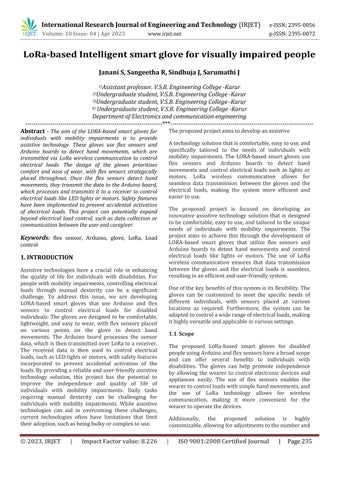
The Arduino board is a microcontroller board that offers great flexibility in programming and interacting with a wide range of devices, including sensors, motors, and lights. Its hardware comprises a microcontroller, input/outputpins,andvarioussoftwarecomponents.The programming environment is user-friendly and enables youtowritecodeinalanguageakintoCorC++.Thecode iscompiledanduploadedtotheboardforexecution.
The Arduino board is a favorite among hobbyists, students, and professionals due to its affordability, versatility, and ease of use. It accommodates a broad range of projects, ranging from simple LED blinkers to moresophisticatedroboticsandautomationsystems.
The Arduino ecosystem features numerous board types, each with its distinct features and abilities. Some of the most prevalent board models include the Arduino Uno, Arduino Mega, and Arduino Nano. To enhance the functionalityofyourArduinoproject,youcanincorporate an array of shields and modules such as Wi-Fi and Bluetoothmodules,motordrivers,anddisplayscreens.
5.2 Flex sensor
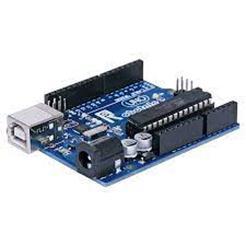
Aflexsensorisasensordesignedtodetect thebending or flexing of an object or material. It comprises a thin and flexible component consisting of a conductive material that alters its resistance when flexed or bent. Flexsensorsfindwidespreaduseindiverseapplications such as medical devices, robotics, and gaming controllers.
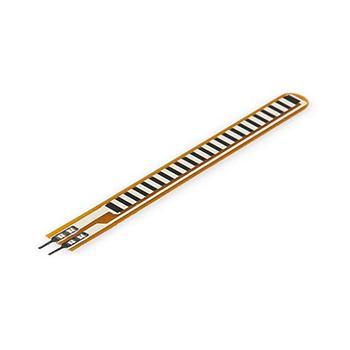
Furthermore, the flex sensors can also measure and transmit various data, such as the angle of the fingers or the grip strength of the hand. This data can be used to monitor the user's hand movements and provide feedbackoralertsifnecessary.Forexample,iftheuseris grippingsomethingtootightly,thesystemcanalertthem toloosentheirgriptoavoidinjury.
Flex sensors can serve a significant purpose in an intelligent glove designed for visually impaired individuals, detecting hand movements and gestures. Thesensorsareplacedatvariouspointsofthehandand fingers to measure the degree of bending or flexing of thejoints.Thisinformationistranslatedintocommands thatcontrolotherdevicesortechnologies.
For instance, the intelligent glove can be paired with a smartphoneorothermobiledeviceviaBluetoothorWiFi,allowingtheusertocontrolthedevicewithgestures such as tapping or swiping without the need for visual feedback. Other sensors such as accelerometers, gyroscopes,andtouchsensorscanalsobeincorporated intotheglovetoprovideadditionalinputandfeedback. Touchsensorscanprovidehapticfeedback,alertingthe usertoincomingcallsormessages.
Overall, incorporating flex sensors in an intelligent gloveforvisuallyimpairedpeoplecanrevolutionizethe waytechnologyisinteractedwith,providinganewlevel of independence and mobility to visually impaired individuals.
5.3 LoRa Transmitter and Receiver module
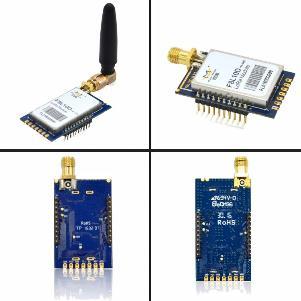
Integrating a LoRa Transmitter and Receiver module into an intelligent glove designed for visually impaired individualsusingflexsensorscanofferseveralbenefits. One of these benefits is the ability to control other devices or systems, such as robotic arms or drones, through hand gestures. The flex sensors can detect the degree of bending or flexing of the hand and fingers, which can be translated into specific commands or actions that control the device. The LoRa module can then transmit these commands wirelessly, allowing the usertocontrolthedevicefromadistance.
In summary, the integration of a LoRa Transmitter and Receiver module into an intelligent glove designed for visually impaired individuals using flex sensors can provide a new and innovative way of interacting with devices and systems, increasing the accessibility and functionalityoftheuser.
5.4 Relay
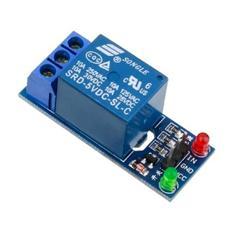
Additionally,a relaycanalsobeused inconjunction with other sensors and modules to provide additional control andautomationcapabilities.Forexample,therelaycanbe used with a temperature sensor to control a heating or coolingsystem,or witha motion sensor toactivate lights oralarmswhenmotionisdetected.
Moreover, the use of a relay can also enhance safety by isolating the low-power control circuit from the highpower circuit that is being switched. This can help prevent electrical shocksordamagetothecontrol circuit incaseofafaultoroverloadinthehigh-powercircuit.
Overall, the use of a relay in an intelligent glove for visually impaired people can provide a versatile and efficientwayofcontrollingelectricaldevicesandsystems, improvingtheuser'sindependenceandqualityoflife.
5.5 Load
A relay is an electronic component that utilizes a lowpower electrical signal to switch or regulate a highpower electrical circuit. They have various applications in automation, control systems, and electrical power distribution.
One possible application of a relay is in an intelligent glove designed for visually impaired individuals. This glove can use flex sensors or other input methods to control electrical or electronic devices such as lights or appliances. The relay can be connected to electronic componentsintheglove,suchasamicrocontroller,and becontrolledusingthesoftware.
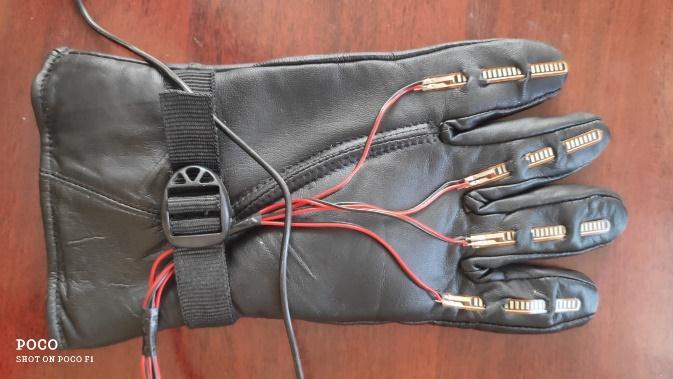
To illustrate, the intelligent glove can be utilized to regulatethelightinginaroom.Bymakingspecifichand gestures with the flex sensors, the microcontroller can send a low-power electrical signal to the relay, which thenswitchesonthe high-powercircuitresponsiblefor the lighting. The same approach can be used to control otherdevices,suchasfansorappliances.
Overall,incorporatingrelaysintoanintelligentglovefor visuallyimpairedpeoplecanprovideanovelmethodof controlling electrical devices, thus improving accessibility and functionality. This can enhance the independence,convenience,andoverallqualityoflifeof visuallyimpairedindividuals.
6. RESULT AND DISCUSSION
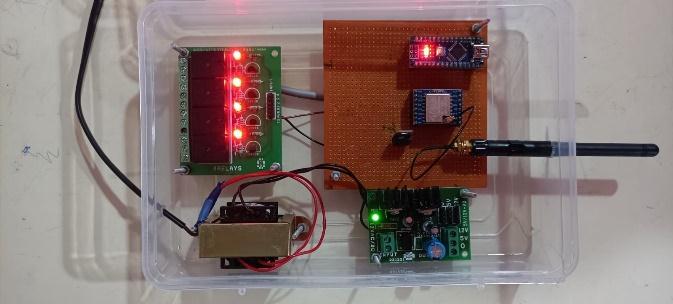
The LORA-based smart gloves designed for disabled individuals, which utilized Arduino, flex sensors, and LoRa wireless communication, have produced promising results. The system has been shown to effectively control electrical loads by utilizing hand movements. The flex sensors detect the hand movements, which are then transmitted via LoRa wireless communication to a receiver responsible for controlling the electrical loads. The system was put to the test with various electrical loads such as lights and fansandwassuccessfulincontrollingthemwithease.
In addition, the LORA-based smart gloves system was customizedfordifferentindividualsbasedontheirunique needs. The flex sensors were strategically placed at different locations on the glove, and the Arduino board and receiver were programmed accordingly to accommodate these variations. The system was observed to be easy to use and user-friendly for individuals with mobilityimpairments.
Fig-8:Relaycontroltoload
The results of the study demonstrate the potential of the LORA-based smart gloves system using Arduino, flex sensors, and LoRa wireless communication in enhancing the quality of life for individuals with mobility impairments. The system offers a straightforward and efficient means of controlling electrical loads using hand movements, eliminating the need for manual switches or remote controls. Furthermore, the customization of the systemforindividualusersemphasizesthesignificanceof personalized assistive technology solutions that cater to thespecificneedsofindividualswithdisabilities.
However,thesystem hassomelimitationsthatshould be takenintoaccount.Forinstance,effectivecommunication overLoRawirelesscommunicationrequiresaclearlineof sight between the transmitter and receiver, which could posechallengesin certainscenarios.Additionally,further testingandvalidationwithalargergroupofend-usersare necessary to evaluate the system's effectiveness across a widerrangeofapplications.
Inconclusion,thestudydemonstratesthepotentialofthe LORA-based smart gloves for disabled people using Arduino,flexsensor,andLoRawirelesscommunicationin enhancing the quality of life for individuals with mobility impairments. It also highlights the importance of personalized assistive technology solutions for individuals with disabilities and the need for continued researchanddevelopmentinthisarea.
7. CONCLUSION
To summarize, the LORA-based smart gloves system for disabled people using Arduino, flex sensor, and LoRa wireless communication is an effective solution for controllingelectricalloadsthroughhandmovements.Itis user-friendly and customizable for different individuals
based on their specific needs, highlighting the importance of personalized assistive technology solutionsforpeoplewithdisabilities.
The system provides a straightforward means of controllingelectricalloadswithouttheneedformanual switches or remote controls. The use of LoRa wireless communication ensures reliable and long-range communicationbetweenthetransmitterandreceiver.
However, the system has some limitations that need to be addressed in future research, such as the need for a clearlineofsight betweenthetransmitterand receiver for effective communication. Additionally, the testing andvalidationofthesystemcanbeexpandedtoalarger groupofend-userstoensureitseffectivenessinawider rangeofscenarios.
Inconclusion,theLORA-basedsmart glovessystemhas the potential to significantly enhance the quality of life for individuals with disabilities, and further research and development can further improve its effectiveness andaccessibility.
8. FUTURE SCOPE
The potential for the LORA-based smart gloves for disabled people using Arduino, flex sensor, and LoRa wireless communication technology is vast and can be expanded in many directions. By adding more sensors and integrating voice commands, the system can become even more accessible for individuals with mobility impairments. Expanding the communication range by using more powerful transmitters and receiversorsignalamplifierswouldenablecontrolover devices at a greater distance. Incorporating machine learning algorithms to recognize specific hand movements and gestures more accurately would improve the system's performance, making it more efficientanduser-friendly.
Moreover,thetechnology'sapplicationcanbeexpanded beyond controlling electrical loads to other areas such as virtual reality or gaming, where individuals with disabilities can experience new opportunities for immersive experiences. The LORA-based smart gloves technology has the potential to revolutionize the assistive technology industry by providing innovative solutions that empower individuals with disabilities to live more independent and fulfilling lives. The future scopeofthistechnologyisexciting,andfurtherresearch and development are necessary to explore its full potential.
REFERENCE
[1] Liu, X., Zheng, X., & Gao, H. (2020). A Novel IoT Enabled LoRa Based Smart Glove for Disabled People. In 2020 IEEE 3rd International Conference on Information Systems and ComputerAidedEducation(pp.504-509).IEEE.
[2] Koushik, R., Jayalakshmi, T., & Rani, P. U. (2019). ASmartGloveforDisabled PeopleusingArduino and Flex Sensors. International Journal of Engineering and Advanced Technology, 8(4), 1879-1883.
[3] Li,X.,Li,Y.,Li,Y.,&Li,W.(2020).ALow-Costand High-Performance Smart Glove for Hand Rehabilitation Based on Arduino and LoRa. JournalofHealthcareEngineering,2020,1-13.
[4] Medvedev, A., Laptev, I., & Fedotova, Y. (2019). Wearable Smart Glove for Real-Time Sign LanguageTranslation.InProceedingsofthe2019 IEEEConferenceofRussianYoungResearchersin Electrical and Electronic Engineering (EIConRus) (pp.2339-2342).IEEE.
[5] Zhang, X., Li, X., Li, Y., Li, Y., & Li, W. (2019). A Low-Cost, Flexible, and Portable Smart Glove for Stroke Rehabilitation Based on Arduino and LoRa.JournalofHealthcareEngineering,2019,113.
[6] Bhatia, S., Singh, R., & Tiwari, S. (2020). A Wearable Smart Glove for Controlling Electronic Devices for Disabled People. In 2020 IEEE 2nd International Conference on Innovations in Electronics, Signal Processing and Communication(IESC)(pp.1-5).IEEE.
[7] Sengupta, S., & Jha, R. (2020). IoT Based Smart Glove for the Visually Impaired. In 2020 5th International Conference on Intelligent Computing and Control Systems (ICCS) (pp. 595599).IEEE.
[8] Darshana, N., & Priya, R. (2019). Smart Glove for Speech-Impaired Using Flex Sensor and Zigbee. International Journal of Engineering and AdvancedTechnology,8(3),287-290.
[9] Saini, S., & Sachdeva, N. (2021). Low-cost IoT enabled Smart Gloves for Disabled People. In 20218thInternationalConferenceonComputing for Sustainable Global Development (INDIACom) (pp.380-385).IEEE.
[10] Singh,S.,&Saini,M.(2021).AnIoT-BasedLowCost Smart Glove for Hand Rehabilitation. JournalofMedicalSystems,45(8),1-9.
[11] Madhushankar, M. R., & Gopinath, G. (2021). Flex Sensor and IoT Based Smart Glove for Patients with Motor Disabilities. In 2021 IEEE 5th International Conference on Inventive Computation Technologies (ICICT) (pp. 12021206).IEEE.
[12] Karamat, T., Ahmad, S., Saleem, S., & Azam, F. (2021).DevelopmentofanIntelligentGlovefor Hand Rehabilitation using Arduino and Flex Sensors. In 2021 IEEE 11th Annual Computing and Communication Workshop and Conference (CCWC)(pp.