“A REVIEW STUDY ON STEEL STRUCTURE SUBJECTED TO BLAST LOADING”
 Parth S. Pandya1, Aakash Suthar2
Abstract - The recent terrorist assaults on the infrastructure have severely damaged property and lives, necessitating in-depth study of the progressive collapse analysisofmulti-storybuildingssubjectedtoblastloading. Typically,muchoftheresearchiscenteredonAlternatePath Method (APM) withsudden column removal,ignoring the optimalsiteoftheblastloading.A3Dmodel ofa 12-story steel building with a direct simulation of the blast load is suggested in this thesis. Additionally, the effect of blast loadingatvariousplaceshasbeeninvestigated.
Vehicle-borne and package-borne blast events have both beentakenintoconsideration.Theblastloadisanalytically determinedbythenumericalmodelofthestructure,which was developed using the "SAP 2000" software. The publishedexampleofatubularsteelbeamsubjectedtoblast loadsisusedtovalidatethenumericalmodel.Onthebasisof theresultsofthefinalanalysis,suggestionshavebeenmade topreventthecollapseofsteelbuildings.
Key Words: Blast load, Displacement, Shear force, Bending moment, SAP 2000, ABAQUS, ATBLAST.
1. INTRODUCTION
Whileitmaynotbepossibletototallypreventterrorist attacksonbuildings,therearemanywaystogreatlyreduce the damage that these assaults do to buildings and other facilities.Findingtheapproachesthataremostlikelytobe successful in limiting the negative impacts of the assaults requiresanunderstandingofthebuilding,itsintendeduse, andanypotentialhazardsbroughtonbyterroristattacks. Whencomparedtothetotallifetimecostsofthebuilding,the costofenhancingitfora"certainlevel"ofresistanceagainst terroristattacksmaynotbeconsiderable(includingtheland value and security monitoring). Several components of terrorism risk management are discussed in this chapter together with related financial and technological legal concerns.
Abombexplosioninsideoraroundabuildingcanhave catastrophic results, causing interior or external building componentstobedamagedordestroyed.Largeframework, walls, doors, and windows are destroyed, and building servicesareinterrupted.
Theoccupantmaysustaininjuriesorlosetheirlivesasa resultoftheblast'sdebris,fire,andsmokeimpact.
Buildingdamagefrombombsisinfluencedbythetype and design of the structure, the material utilised, the location'sexplosivedevice'srange,andthechargeweight.
The case studies, which are drawn from a variety of nations,arebynomeansexhaustivebecausetheremaybe many more explosions in the future and more reports of collateraldamagetobuildingsubsystems.
2. LITRETURE REVIEW
1. ProbabilisticProgressiveCollapseAnalysisOfSteel FrameStructureAgainstBlastLoads
Author:YangDing,XiaranSong,Haitaozhu
Journal:Engineeringstructure(2017)
The purpose of this paper is to examine a study of the progressivecollapseofasteelframebuildingwithaten-story seismicdesignthatwasattackedbyavehicle-borneexplosive device.Inthisstudy,thecollapsepotentialofastructureis assessedusingatwo-stepprocess.
The sophisticated Delayed Rejection Adaptive Markov Chain Monte Carlo Simulation algorithm first assesses the structuraldamage.WiththeaidoftheprogramLS-DYNA,a numericalmodelofasteelbuildingiscreatedinthesecond step. In second stage, two case studies are selected for numerical model analysis. In the first case study, the basement-levelcolumnC6andB6areimmediatelytargeted bytheexplosiveexplosion.
3. DynamicResponseAndRobustnessOfTallBuilding UnderBlastLoading
Author:FengFu
Journal: Journal of constructional steel research (2012)
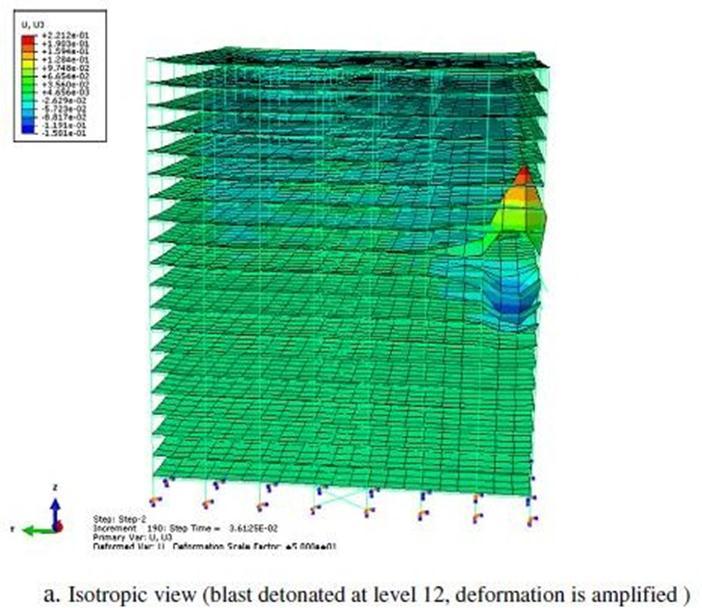
In this research, a 3D numerical model with direct simulation of blast load is proposed to analyze the true behaviorofa20-storytallbuildingunderblastloading.Inthis paper,atypicalpackagebombchargeof15kgwasdetonated on the 12th floor at column A1. Comparisons are made betweentheoutcomesoftheABAQUS,ATBLAST,andAPM (alternativepathapproachfromtheGSAguideline).
2. Progressive Collapse Potential Of A Typical Steel BuildingDueToBlastAttacks
Author:
H.M.Elsanadedy, T.H. Almusallam, Y.R. Alharbi,Y.A.Al salloum,H.AbbasJournal: Journal of constructional steel research (2014)
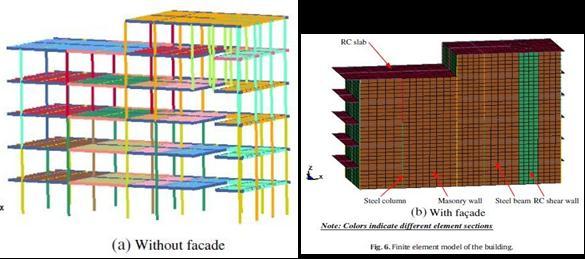
This study seeks to analyze the progressive collapse analysisofatypicalRiyadhsteel-framed6-storystructureto determineitssusceptibilitytoexplosionscenarioscausedby accidentsorterroristattacks.ThebuildingreactiontoblastgeneratedwaveswassimulatedusingthecommercialFEA programedLS-DYNA.Usingtheanalysisresultsofaspecific structuralmembersubjectedtoblastload,anumericalmodel was validated. In this study, two different types of structures those without a façade wall and those with a facadewall aretakenintoaccount.
Thestandoffdistanceoftheblastmustbegreaterthan2 m in order to prevent the steel building's potential for progressive collapse. This can be done by limiting vehicle accesstothebuildingbyperimetercontrol,whichmayentail addingsecuritycheckpointsanderectingbollardsaroundit.
UndertheprogramABAQUS,theresponseofstructuresis governed by the nonlinear dynamic analysis method. The load is computed as DL + 0.25LL in accordance with GSA guidelines. Another exact replica of the model was also constructed in order to compare the outcomes with the alternativepathapproach.ThismodelusedtheAPMforthe analysis. In the analysis, the column A1 on level 12 was suddenly removed at the same locationas its counterpart. Thestructure'sresponsewascaptured.
TheshearcheckshouldbeprovidedsincetheAPMtechnique overlookstheshearforcecausedbytheblasteffectonthe column.Thepackagebombonlydamagesspecificstructural memberslocally.Alsoitishardtotriggerthewholebuilding. Byenhancingthecolumnshearcapacityandincreasingits ductility,itcanbeavoided.
Table1:ComparisonbetweenAPMandmethodfromthis paperisshowninfollowingtable
4. Distributed Column Damage Effect On ProgressiveCollapseVulnerabilityInSteelBuilding ExposedToAnExternalBlastEvent
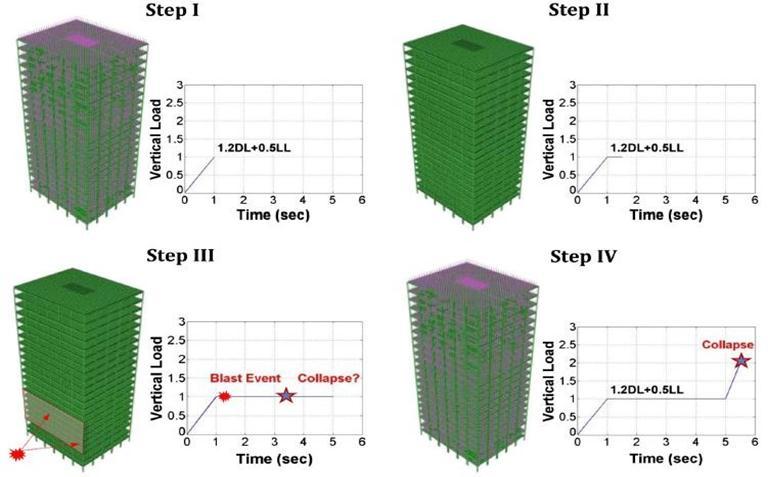
3. The actual blast loading process is the third analytical step. This technique of studysuggestsa totalperiodof5s,whichissufficientforvibrationto dissipate and adequately record the evolution of structurereaction.Thisprocesshastwooutcomes: either the structure reaches a steady and stable conditionoritcollapses.
4. Further vertical load is added if the structure managestosurvivethebombscenarioofstep3,and it increases until the program does not display a warning of structural failure. The final load that causes collapse is calculated as 1.2DL+0.5LL from step1plusanadditionalverticalloadfromstep4.
Toensurethesystem'sstructuralintegrityoncetheblast attackhasended,thebiggercolumnsectionofthebuilding with the perimeter moment-resisting frames serves as a safetyvalve.WhenastructurehasaninteriorRCstiffcore, theexternalcolumnsareunabletostabilizethereactionof theentiresystem,andacompletecollapseisinevitable.
Author:
Jenny Sideri, Chris Mullen, Simos Gerasimidis,GeorgeDeodatisJournal: Journal of performance of constructed facilities (2017)
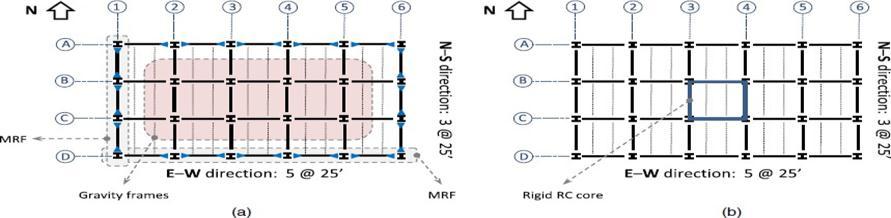
Inordertoexaminetheresponseanddamagetoframe membersalongthebuildingexteriorfacinganexternalblast, the purpose of this paper is to investigate a detailed 3D nonlinear finite element dynamic analysis of a steel frame building.In this work, three casestudies of steel buildings withdistinctstructuralsystemsarestudied.
The first one is prior to comparing the outcomes with individual single degree of freedom (SDOF) column responsesobtainedfromananalyticalapproach,ahigh-rise 20-storybuildingisfirstsubjectedtoablastloadscenario.A secondtypicalmidrise(10-story)officesteelbuildingwith perimetermomentresistingframing(MRF)isconsidered.A third typical midrise (10-story) office steel building with insidereinforcedconcreteandastiffcoreisexamined.
Step-by-stepsimulationofablast:
1. Theapplicationofverticalloadstothestructureis the initial phase in the study. These loads are calculated using the load combination of 1.2 DL + 0.5LL(DODguideline2009forprogressivecollapse analysis).
2. Itservesasatransitionstepbetweentheapplication ofaverticalloadandtheblasteventtoensurethat the structure is in a stable condition prior to the blastloading.
5.
Author:YangDing,YeChan,YanchaoShi
Journal:Advancesinstructuralengineering(2016).
Thisarticleprovidesapreciseanalyticalmodelfor assessing how a steel building that had been subject to a restricted explosion and post-explosion fire gradually collapsed.Topreciselyanalyzetheimpactofblast-induced damageonthefireresistanceofsteelstructures,theinternal blast load is calculated using the finite element program AUTODYN. The USA's National Institute of Standards and Technology (NIST) designed a steel-framed, ten-story structure that was utilized for the progressive collapse analysis.TheFEApackageLS-DYNAwasusedtoconstruct thenumericalmodel.Asmall-spancompositesteelbuilding wassimulatedaspartofanexperimentalprogramtoverify theaccuracyofthenumericalanalyticalmodel.
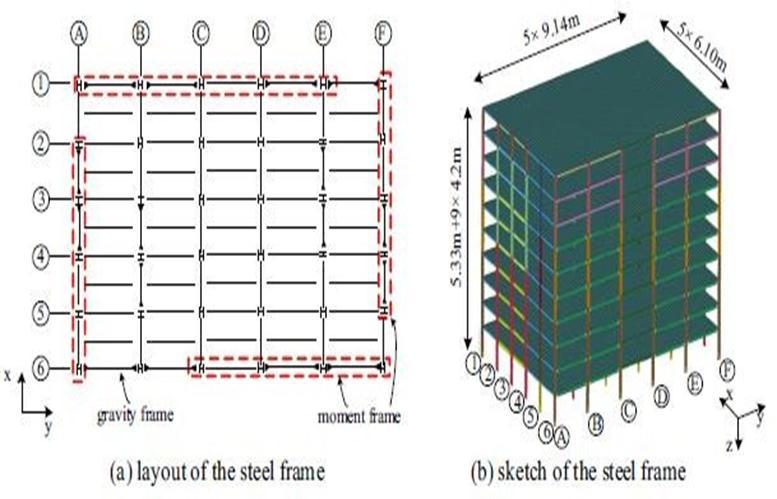
The progressive collapse analysis was performed using a steel-framed structure created by the National InstituteofStandardsandTechnology(NIST)oftheUSA.The structureisa10-storyofficebuildingwitha45.7mx30.5m layout. 9.14 m by 6.10 m is the usual compartment dimension.Duetothebuilding'sseismiccategoryDdesign,a uniquemomentstructureisusedtowithstandlateralloads. Withtheuseof22mmbolts,A325highstrengthbolts,and 9.5mmA36sheartabs,thegravitybeamandgravitycolumn arejoinedtogetherbyasheartabconnection.Momentframe usesareducedbeamsection(RBS)connectionwitha50% smallerRBSflange.Thecompositefloorismadeupofa76 mm-deepsteeldeckandalightweightRCslabwithan82.5 mmthickness.
Three casesanalyses of progressive collapse are takenintoconsideration:(1)Innercompartment:216kgof charge(2)Peripheralcompartmentcase,196kgofcharge weight (3) Corner compartment case: 216 kg of charge weight.
Thisarticlecomestothefollowingconclusion:The membraneactionofthefloorresists progressivecollapse. Whenthefloor'scontinuityisdisrupted,asinthecaseofan inner compartment under multiple hazards, or when the floor'srestraintconditioniscompromised,asinthecaseof peripheralandcornercompartmentsunderfireormultiple hazards,collapseoccurs.
Failure of the gravity column in the inner and peripheral compartments starts the progressive collapse. When a column in the inner MRF fails in a corner compartment,theprogressivecollapseisstarted.Incontrast to the periphery and corner examples, the interior compartment scenario does not experience connection problems.Thegravitycolumn,whichiscrucialtostructural stability,ismostlikelytoexperiencebucklingfailurefirst. WhileinteriorMRFcolumnsrepresenttheweakestlinkof the building, it is advised that MRF columns be placed at externalcolumns.Betterresistancetoprogressivecollapseis providedbythesheartabconnection'sincreasedtoughness. The corner compartment is subject to a combined hazard
scenario, whereas the peripheral compartment, which is onlysubjecttoafirecase,istheweakestlocationinasteel building.
3. NEED FOR STUDY, OBJECTIVES OF WORK AND SCOPE OF WORK
3.1 NEED FOR STUDY
Recent technology and computational tools have empowered chemists, physicists, blast consultants, and structural engineers and improved the accuracy of their analyses and the effectiveness of their designs. Also, the demand has grown. In an effort to address the growing concernfromawidergroupofclientswhofearanexposure thattheydidnotanticipateinthepastandfrequentlydidnot bring upon themselves, a larger group of architects, engineers,blastconsultants,andsecurityconsultantshave joinedthesmallcontingentofdesignersskilledintheartand science of creating structural designs that will resist explosiveforces.
Riskassessment,riskreductionprograms,security systems,threatdesignbases,calculatingexplosionpressures and impulses, and cost-effective structural design are all tasksthatarebeingthrownatconsultantswhohavenever hadtodothembefore.Manypeoplelacktheskillstoreact.
Notonlyforgovernmentandmilitarybuildings,but alsoforotherhigh-riskbuildingslikehospitals,banks,and global commercial headquarters, the blast design of structures has grown in importance. The structure and neighboringstructuressustainsignificantdamageasaresult ofthehighexplosion.Thedetrimentaleffectcanbemanaged ifthestructureisadequatelydesignedforthisloading.
3.2 Objectives of Work
To look into how steel buildings with multiple stories react dynamically to both internal and externalblastloads.
Intheeventthatgradualcollapsehappens,lookat thechainmechanism.
Describe practical ways to lessen the explosion effect.
3.3 Scope of Work
Usingthecomparisonoflateraldisplacementsand member force support reactions, it will be attemptedtocomparethestructuralresponseofa steel frame under blast load and under no blast load.
The computer program SAP2000 is used for modellingandanalysis.
Theanalysisofvariousstructuregeometriesboth withandwithoutblastloadisdone.
Followeddirective:IS4991:1968.
Locatingtheanticipatedcollapsearea.
Itwillbeattemptedtouseconventionaltechniques toidentifytherequiredtreatments.
4. METHODOLOGY
Forthestudyofthe blastloadingeffect,thefinite elementmethodistobeadopted.Acommontechniquefor numericallyresolvingdifferentialequationsthatappearin engineering and mathematical modelling is the finite element method (FEM). The classic domains of structural analysis, heat transfer, fluid flow, mass transport, and electromagnetic potential are among the issue areas of interest.
Using two or three spatial variables, the FEM is a general numerical method for solving partial differential equations (i.e., some boundary value problems). The FEM breaks down a complex system into smaller, more manageable pieces known as finite elements in order to solveanissue.Thenumericaldomainforthesolution,which hasafinitenumberofpoints,isimplementedbycreatinga meshoftheobjectusingaspecificspacediscretizationinthe spacedimensions.
Intheend,asetofalgebraicequationsemergesfrom theformulationofaboundaryvalueproblemusingthefinite element method. The technique makes domain-wide approximationsoftheunknownfunction.Thesmallsystem of equations that describes these finite elements is then combinedwithotherequationstomodelthefullissue.The calculus of variations is used by the FEM to minimize an associatederrorfunctionandthenapproximateasolution.
5. CONCLUSION
A reliability analysis of steel frame structures againstblastloadsispresentedinthispaper.TheSSmethod andatwo-stepprogressivecollapseevaluationapproachare combinedintheriskassessmentframework.Anenhanced MarkovmodelisaddedintotheSStechnique.
Theefficiencyofcalculatingthefailureprobability ofuncommoneventsisimprovedbytheChainMonteCarlo algorithm.Asadeterministicanalysis,thetwo-stepcollapse evaluation approach is used to determine whether the sample points fall within the failure region. By adding damage severity and responses of individual structural
components into structural numerical models in collapse evaluation, it takes the impact of blast load scenarios into consideration.WithregardtovariousVBIEDscenarios,blast reliability curves for ten-story steel frame structures are developed.
REFERENCES
1) Ding,Y.,Song,X.,&Zhu,H.T.(2017).Probabilistic progressive collapse analysis of steel frame structures against blast loads. Engineering Structures, 147,679-691.
2) Elsanadedy,H.M.,Almusallam,T.H.,Alharbi,Y.R., Al-Salloum, Y. A., & Abbas, H. (2014). Progressive collapsepotentialofatypicalsteelbuildingdueto blast attacks. Journal of Constructional Steel Research, 101,143-157.
3) Fu,F.(2013).Dynamicresponseandrobustnessof tall buildings under blast loading. Journal of Constructionalsteelresearch, 80,299-307.
4) Sideri,J.,Mullen,C.L.,Gerasimidis,S.,&Deodatis,G. (2017). Distributed column damage effect on progressivecollapsevulnerabilityinsteelbuildings exposed to an external blast event. Journal of Performance of constructed Facilities, 31(5), 04017077.
5) Ding, Y., Chen, Y., & Shi, Y. (2016). Progressive collapse analysis of a steel frame subjected to confined explosion and post-explosion fire. Advances in Structural Engineering, 19(11), 1780-1796.
6) IS4991(1968)-Criteriaforblastresistantdesignof structuresforexplosionsaboveground