Volume: 10 Issue: 04 | Apr 2023 www.irjet.net

Volume: 10 Issue: 04 | Apr 2023 www.irjet.net
J D College of Engineering and Management, Nagpur Dr. Babasaheb Ambedkar Technological University, Lonere, India ***
Abstract:
The rate of road accidents is rising continuously, the majority of an accident are caused due to people's negligence and ignorance. There is a lot of work going on continuously to reduce these numbers. Many solutions are based on IoT-based applications for identifying traffic accidents, but these systems have their drawbacks. Therefore, we aim to develop a system with the objective of helping the existing system to increase accuracy. we are currently focusing on highways to reduce accidents and want to utilize this system in cars in the initial phase. We can gain accuracy by using dash cams of the cars to monitor the road to detect accident by third-party vehicles. We have also added a feature where we will continuously monitor the driver's face and detect the negligent behavior of the driver e.g sleepy and not focused. Considering that the majority of modern automobiles have a camera system will be costefficient. We are utilizing machine learning algorithms to make the system more efficient and accurate. If an accident occurs, the nearby automobile will detect and reports it to the emergency services, and we may then act quickly to preserve the life of the person who is injured.
Keywords: Accident detection, Accident of highways, CNN, Drowsiness alertness System, Machine learning,.
1. Introduction:
According to different reports, traffic accidents claim the lives of around 1.3 million people each year. According to TheTimesOfIndia,theNationalHighwayshadthelargest number of fatalities in road accidents in India, accounting for 34.5% (53,615 out of 1,55,622), followed by State Highways (25.1%). (39,040 deaths). In 2021, 62,967 (40.5%) people died in car accidents on other roads. According to a Times of India article, truck drivers get sleepybydrivingcontinuallytofinishworkontime,which is a significant cause of road accidents. Most of the time, whenanaccidentoccurs,thewoundedindividualdoesnot receive sufficient emergency care; this is one of the consequences of rising deaths in road accidents. After considering all of these scenarios and causes we are developingthissystemwhichcanhelptoreduceaccidents, especiallyonhighways.Ifthedriverappearstobedrowsy, the system sounds an alert, and we can propose that he
should take a rest. At the same time, the road will be monitored by the system until it sees an accident. If an accident occurs system reports it to the emergency services, and we may act quickly to preserve the injured person’slife.Byincorporatingthissystemintoa car,we can save a priceless life of a person. This effort assists individuals in remaining safe and reaching their destination.Thisprojecthasthepotentialtosavethelives ofthousandsofpeople.
VivekUpadhyayet.al.focusestodevelopingasystemthat can detect and report an accident. Their system provides methods to prevent an accident because of a speed breaker, blind turns, pits, stop signs, etc. Their Integrated Accident Prevention Detection and Response System (IAPDRS) prototype includes a GPS module to locate the accident sites and report the accident to nearby emergency services. In this proposed model they have used micro-controllers to report a message to the Emergencyserviceslikerelatives,police,firebrigade, etc., whether an accident happens or not (Ex. If an accident happens then alerting message “ACCIDENT OCCURREDNEED AMBULANCE” have been sent to the ambulance controller. In the research paper[2] provides an overview ofautomatedtraffic-detectingmethodsforaccidents.They combine various deep learning algorithms with smartphone technology, GSM and GPS, vehicle ad-hoc networking, and mobile applications for use while traveling.Thetechniquespromptlyletemergencyservices knowabouttheaccidentregion,workingtosavelivesand lower the number of fatalities related to accidents. These techniques have some drawbacks, including limited accuracy, low reliability, and hardware problems. Therefore, there is a chance to develop effective accident detection techniques. We also investigated how the problem of drowsiness is solved so far [3] they made a system that is completely based on Micro-controller, Sensors, GSM module, GPS module, and Power Source Accident Detection and Response System (ADRs) is an auto-detection system inside a vehicle based on a microcontroller platform that detects the type of accident, performs error checking, and notifies a central control systembasedonMatlab,informingthemvia text message of the location of the nearest medical personnel,
ambulance, hospital, police, and vehicle owner contact. The biggest disadvantage of the system is any component failstodetectlocationduetotechnicalissuesthatareone of the projects.[4] So in further study, The goal of this work was to provide an analysis of accelerated weights and the adjustment coefficient parameter to increase the accuracy ofclassification of the MRBM training algorithm. they followed over-fitting and under-fitting issues, and modified RBM was used instead of conventional RBM. Multiple types of accidents have been identified in a varietyofvehicles.[5]Theauthorhasusedtechnologylike Python, JUPYTER Lab, Image Processing, and Machine Learning.Inthisproject,theeyecounterissetto„20.The eye is detected as the eye is not blinking or not in a set countered number then shows a driver is drowsy in his vehicle dashboard. Mohsen Poursadeghigan, et. al. [6] drivingsimulatorbuiltonavirtualrealitylabattheKhajeNasir Toosi University of Technology was used to analyse fivesuburban drivers.The Villa-Jonesalgorithm wasused to identify the facial expressions and eye locations. Eye trackingcriteriafordetectingdrivers'levelsofdrowsiness included eye blink duration and frequency as well as PERCLOS, which was used to validate the findings. Levels of tiredness in drivers are directly correlated with blink frequency and length. Data entered into the network for testinganddataenteredintothenetworkfortraininghad mean squared errors of 0.0623 and 0.0700, respectively. Inthemeantime,thedetectionsystem'saccuracyratewas 93percent.Weobservedthatcurrently,manysystemsare using IoT devices which consist of RADAR and LIDAR systems, in this system the distance between vehicles is a problem, if the distance between vehicles increases, the system fails to do its work. In a few papers where an IoT systemusesvibrationtodetectanaccidentifthemachine breaks during an accident, a normal vehicle crash can resultinanaccidentoccurredresponse.Thesystemisnot abletodeterminewhetheranaccidenthasoccurredornot with high accuracy. We propose the solution by adding a feature where neighbour cars will detect the accident to maintain accuracy. When an accident occurs on the road, the neighbour’s car or the passer-by car captures it and sends the coordinates to the emergency system using machine learning. Machine learning drastically increases the accuracy compared to existing methods. The system detects the sleepiness of the drivers and if the module detects that the driver is not alert, it wakes the driver up andaskshimtotakeabreaktomaintainahealthydriving state. In smart cars, there are cameras placed on the car body to monitor the road which gives ease to the fundamentalrequirementsoftheproposedsystem
3. Objective:
Theobjectivebehindtheprojectisasfollows:
3.1Enhance safety on highways by reducing the number ofaccidentscaused byinattentiveordrowsydrivers.This objectivecanbeachievedbyusingadvancedtechnological
solutions that can detect and alert drivers who exhibit signsofdrowsinessorinattentionwhiledriving.
3.2Reducing deaths in accidents on highways by informingemergencyservicesforquickdeliveryofcareto thepersoncaughtinanaccident.
4. Problem Statement:
4.1 How to reduce accidents caused by drowsiness and alertthedriver?
4.2 Give immediate medical assistance as soon as an accidentisverifiedwithhighaccuracy?
Despite various efforts to reduce accidents on highways, inattentiveorsleepydriverscontinuetoposeasignificant risk to road safety. These drivers often fail to react to potential hazards, leading to collisions and accidents. The problem is compounded by the fact that emergency servicesmaynotbeimmediatelyawareoftheseaccidents, leading to delays in care delivery. Therefore, there is a need for an effective solution that can alert inattentive or sleepydriverstopotentialhazardsandinformemergency services for quick delivery of care, thereby reducing the numberofaccidentsonhighways.
5. Research Methodology:
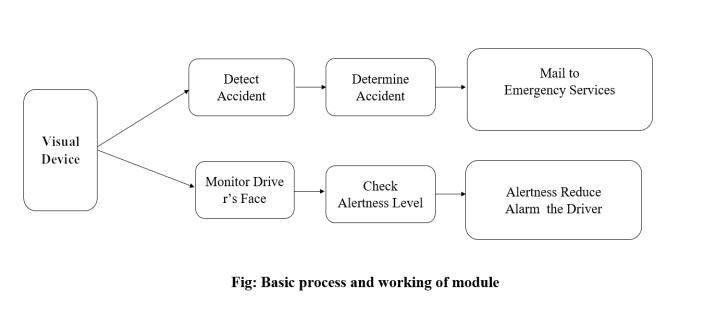
6.Thiswholeprojectissplitintotwomodules:
Maintain the driver’s focus on driving. There are various reasons for why a driver is distracted like picking up the phone, being drunk, being lost in thought, etc. Out of studies,wearedeterminingthebehaviorofapersonfrom thefacecamtopreventthedriverfromdrowsinessorany othernegligence.
Accident detection system. This module continuously monitorstheroadandtriestoidentifytheaccidentwhich wasoccurredorisoccurringlive.Ifit catchesanyofthese scenarios, it will immediately send a message to the emergency services with the location. It will help to providemedicalsupportassoonaspossible.
128filters.Eachconvolutionallayerisfollowedbya maxpooling layer with a 2x2 kernel and a stride of 2. The output of the third convolutional layer is flattened and passed to the fully connected layers. The first fully connectedlayerhas512neurons,andthesecondhastwo neurons, representing the binary classification output: accidentornon-accident.Ifthemodel detectsanaccident, it sends an alert to emergency services, either by triggering an automatic alert system or notifying the drivertocallforhelp.
7. Result:
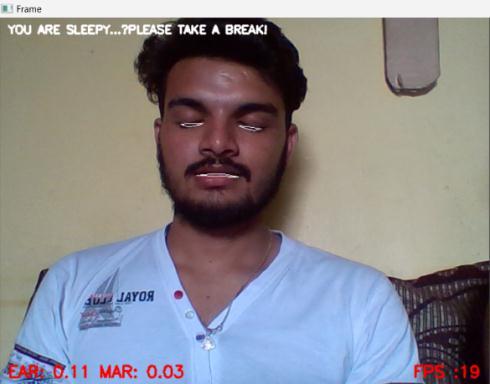
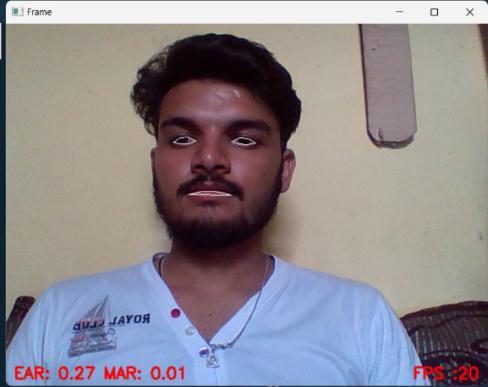
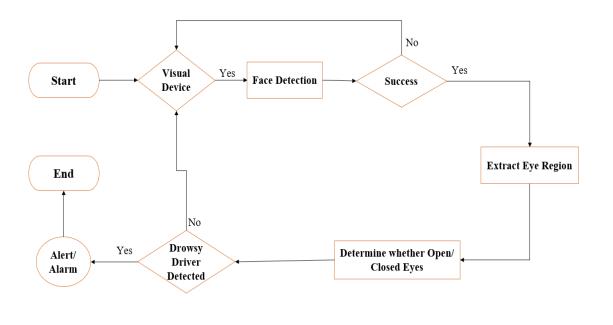
In this project, the input video is captured by using a camera and then it will be extracted. The face and eye detection are done by using OpenCV with the help of 68face landmarks. By using the Euclidean eye aspect ratio, we can get the eye blinking ratio, which helps to detect whethertheeyesareopenorclosed.Iftheeyesandmouth ratioislessthan0.21andgreaterthan0.35respectively,it will detect that the driver feels sleepy. If the eyes are closed more than a given time interval it will warn the driver by playing the alarm or if eyes are open it will display the message “eyes open” and then it will go to takingthevideoofthedriverandtheprocesswillgoon
Theprojectusesadatasetofdash-camvideosthatinclude both accident and non-accident footage. The data set was collected from various sources and includes a range of lighting conditions, weather conditions, and types of accidents. The data set was split into training and testing sets, with 70% of the data used for training and 30% usedfortesting. The model processes the video frames andextractsfeaturesfromeachframeusingconvolutional layers. The feature maps are then passed through fully connectedlayerstoproduceabinaryclassificationoutput:
The accident detection system using the camera has successfully run: image (9) showing the active driver's status and image(10) displays the drowsy driver's status. These images can be used to identify and monitor drivers whomaybeatriskofcausingaccidentsduetodrowsiness, allowing for early intervention to prevent accidents and promoteroadsafety.
Accident or non-accident. The CNN model used in this project consists of three convolutional layers followed by twofullyconnectedlayers. Theconvolutional layersusea 3x3 kernel and a stride of 1. The first convolutional layer has 32 filters, the second has 64 filters, and the third has
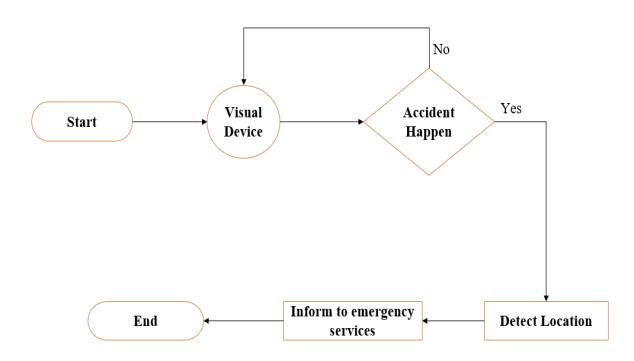
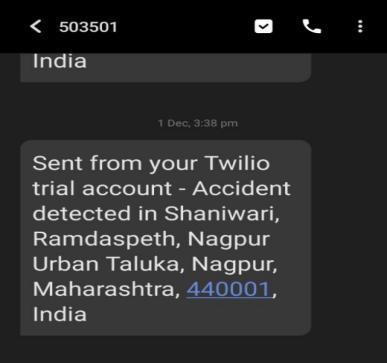
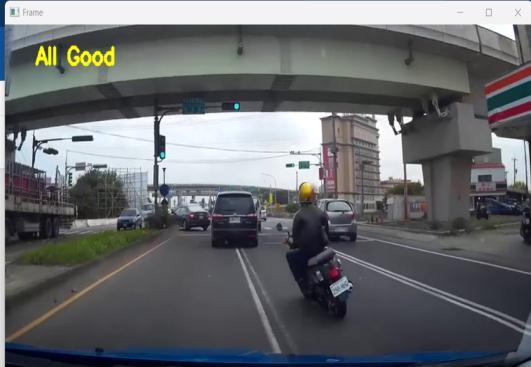
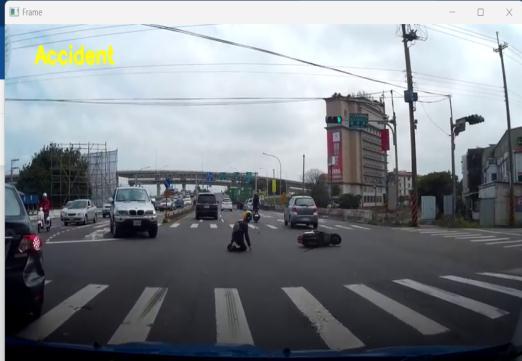
The accident detection system using a dash cam has produced this result. In this three images, The first image(11) shows a status of "no accident", indicating that the system has detected no unusual events or danger on the road. The second image(12) shows that an accident has been detected, allowing for prompt response to the situation. The third image(13) displays an SMS alert that has been sent, providing necessary information about the accident to the relevant authorities and emergency services.Thesystem'saccuratedetectionandtimelyalerts canhelptominimizetheseverityofaccidentsandprevent lossoflifeorpropertydamageontheroad.
8. Advantages:

1. Reduce the Rate of Road Accidents by helping existingsystems.
2. Thissystemismorecost efficient and can be used in smartauto-drivingcars
3. Itimprovesself-drivingcapability.
4. It would help to reduce fatalities due to vehicle accidents by decreasing the response time of emergencyservices.
9. Disadvantages:
1. Accuracymightbereducedduetoheavyrain.
2. lack of Internet Coverage might affect the system in sendingtheexactlocationoftheaccidentspot
3. Require a special unittoanalyzetheaccidentimages in case it sees a scrap of a car it will detect the accident.
10. Future Scope:
1. ThePossibleFutureImplementationisifadrivergets drowsy more than one time then the Engine of the carwillturnOffAutomaticallywithanalarm
2. If he tries to restart the car without taking a break, then the system will share his car details with the policeforfurtheractiononit.
3. This system can be implemented in heavy motor vehicles(Trucks,Buses,etc.)
11. Conclusion:
Thisprojectwill provide effectiveandoptimizedsoftware that can alert the driver if he is sleepy or distracted. The model will detect the accident using a dash cam more accurately to deliver immediate help. The project will reduce accidents on highways which will drastically reducethedeathrateduetoaccidents.
12. Reference:
[1]Vivek Upadhyay, Simran Gupta, Snigdha Chaturvedi, Dhirendra Singh, “Integrated Accident Prevention Detection and Response System (IAPDRS) ”, Journal: International Journal of Engineering and Advanced Technology (IJEAT) ISSN: 2249-8958 (Online), Volume-9 Issue-3,February2020.
[2]Renu1,DurgeshKumarYadav2,IftishamAnjum3and Ankita 4 and Assistant Professor 1, Department of Computer Science and Engineering, Greater Noida, Uttar
Pradesh,India,“AccidentDetectionusingDeepLearning:A Brief Survey”, Journal:International Journal ofElectronics Communication and Computer Engineering Volume 11, Issue3,ISSN(Online):2249–071X.
[3] Mochitha Vijayan1, Chakshu Ishan Kaplas2 and Samhita Ganguly3 1Department of Computer Science and Engineering,S.R.M.University,Chennai,TamilNadu,India, “ Accident Detection and Response System with Error Avoidance”, Journal: International Journal of Applied Engineering Research ISSN 0973-4562 Volume 12, Number13(2017)pp.3562-3565.
[4] Roohullah, Fazli Wahid, Sikandar Ali, Irshad Ahmed Abbasi, Samad Baseer andHabib Ullah Khan, “Accident Detection in Autonomous Vehicles Using Modified Restricted Boltzmann Machine, Journal: Volume2022|Article ID6424835|https://doi.org/10.1155/2022/6424835, Accepted23Apr2022;Published30Jun2022.
[5] Prof. Swati Gade, Kshitija Kamble, Aishwarya Sheth, Sakshi Patil, Siddhi Potdar, “Driver Drowsiness Detection Using Machine Learning”, Journal: International Journal forResearchinAppliedScience&EngineeringTechnology (IJRASET) ISSN:2321-9653; IC Valur; SJ Impact Factor:7.538VolumeIssue10IssueIIIMar2022.
[6] Mohsen POURSADEGHIYAN,1,2Adel MAZLOUMI,3,*Gebraeil NASL SARAJI,3MohammadMehdi BANESHI,4Alireza KHAMMAR,5andMohammad Hossein EBRAHIMI, “Using Image Processing in the Proposed Drowsiness Detection System Design”, Journal: Iran J Public Health.2018 Sep; 47(9): 1371–1378., PMCID:PMC6174048PMID:30320012
[7] Arun Francis, Gottursamy, Ranjit Kumar S, Vignesh M, Kavin T P, “Accident Detection and Alerting System Using GPS & GSM”, Journal: International Journal of Advanced Science and Technology Vol. 29, No. 3, (2020), pp. 3598 –3601
[8] Arsalan Khan et al, “Accident Detection and Smart RescueSystemusingAndroidSmartphonewithReal-Time Location Tracking”, (IJACSA) International Journal of Advanced Computer Science and Applications, Vol. 9, No. 6,2018
[9] Kader H.A. Al-Shara Department of Computer Engineering,”AutomaticVehicleAccidentDetectionBased on GSM System.” Journal for Computers and Informatics (IJCI)Vol.[43],Issue[2],Year(2017)