
Machine Learning Approaches to Predict Customer Churn in Telecommunications Industry
B Vamsi Krishna1 , K V Bramha Reddy2 , U Sai Praneeth31 Electronics and Communication, Vellore Institute of Technology

2 Electronics and Communication, Vellore Institute of Technology
3 Electronics and Communication, Vellore Institute of Technology ***
Abstract - This project aims to develop machine learning models for predicting customer churn in the telecommunications industry. The project will analyze various customer behavior and demographic data, such as tenure, payment method,monthly charges, total charges, etc to identify patterns and build predictive models. The project will use advanced techniques, such as logistic regression, decision trees, support vector machine and random forests, to predict customer churn accurately. The study will help the telecommunications industry to understand the reasons behind customer churn and implement effective strategies to reduce customer churn rates. The results of this project can be useful for improving customer retention and enhancing the overallcustomer experience inthe industry.
Key Words: Machine Learning, Logistic Regression, Random Forest, Decision Tree, Support Vector Machine
1. INTRDUCTION
The telecommunications industry is highly competitive, withcompaniesvyingtoprovidethebestservicestoattract andretaincustomers.Oneofthemostsignificantchallenges faced by this industry is customer churn-the rate at which customers switch to another service provider. Customer churncanbea costlyissuefortelecomcompanies,asitcan lead to lost revenue, decreased profitability, and damage to their reputation.To address this challenge, companies are increasingly turning to machine learning approaches to predict customer churn and take appropriate measures to retain customers. This project aims to develop machine learning models using decision tree, random forest, logistic regression, and SVM algorithms to predict customer churn inthetelecommunicationsindustry.Theprojectwillusea comprehensivedatasetcontainingcustomerattributessuch as gender, senior citizen status, tenure, phone service, multiple lines, internet service, and various other service usage patterns. By analyzing this data using machine learningmodels,weaimtoidentifythemostcriticalfactors that contribute to customer churn and develop predictive models to reduce churn rates and improve customer retention. The project's findings could be beneficial to the telecommunicationsindustry,enablingthemtotakea more proactive approach towards customer churn. By
anticipating customer churn, companies can implement preventive measures, such as offering incentives, personalizedservices,or discounts,to retaincustomers. The results of this project can also help to enhance the overall customer experience by addressing the issues that lead to churn.
2. Tools
3. METHODOLOGY
Designing of system is the process in which it is used to define the interface, modules and data for a system to specifiedthedemandtosatisfy.Systemdesignisseenasthe application of the system theory. The main thing of the design a system is to develop the system architecture by giving the data and information that is necessary for the implementationofasystem.
A. Data collection:
Collect a comprehensive data set containing customer attributes such as demographics, service usage patterns, paymentmethods,andchurninformation.
B. Data pre-processing:
1. Checkforandhandleanymissingorirrelevantdata.
2. Transformcategoricaldataintonumericalvalues
3. .Normalize or standardize the data to ensure that all featureshaveequalimportance.
C. Model selection:
Selectappropriatemachinelearningmodelsthatcanhandle the problem of predicting customer churn. In this project, decision tree, random forest, logistic regression, and SVM algorithmsarechosen.
D. Training and validation:
1. Split the pre-processed data set into training and validationsets.

2. Traintheselectedmodelsonthetrainingset.
3. Validate the models' accuracy and reliability on the validationset.
E. Evaluation:
1.Evaluatetheperformanceofeachmodelusingvarious metricslikeaccuracy,precision,recall,andF1score.
2.Compare the performance of different models and select the best-performing model based on the evaluation metrics.
F. Final model:
1. Fine-tune the selected model to improve its performancefurther.
2. Trainthefinalmodelontheentirepre-processeddata set.
3. Test the final model's performance on a new, unseen datasettoensureitsaccuracyandreliability.
4. MOTIVATION OF THE PROJECT
The telecommunications industry is a highly competitive market,andcustomerchurnposesasignificantchallengefor companies. Churn refers to the rate at which customers switchtocompetitors orterminatetheir servicesaltogether. High churn rates can result in substantial revenue loss and negativelyimpactacompany'sreputation.
The motivation behind this project is to develop machine learning models to predict customer churn in the telecommunications industry. By accurately predicting churn, companies can take proactive steps to retain customers, improve customer satisfaction, and ultimately, increase revenue. The project's findings can help telecom companiesgainvaluableinsightsintocustomerbehaviorand develop targeted marketing and retention strategies to reducechurnrates.
5. ALGORITHMS
The algorithms which we are using for this project are Logisticregression,Randomforest,Decisiontree,support, vectormachine
A. LogisticRegression:
It is a well-liked classification method utilised in artificial intelligence. It is a statistical technique used to examineadatasetinwhichanoutcomeisdeterminedbyone ormoreindependentfactors.Logisticregressioncanbeused tocategoriseclientsaseitherlikelytochurnorlikelytostay based on their prior actions and demographics when predicting new mobile internet customers. Using a logistic function, the logistic regression model calculates the likelihood of the binary result (churn or no churn). The logistic function is an S-shaped curve that transfers each real-valued number to a probability between 0 and The model determines whether a new client is likely to churn or not by learning the link between the independent variables andthechanceofchurn
B. SupportVectorMachine:
A well-liked supervised learning approach for classification and regression analysis is called Support Vector Machines (SVM). Based on the data that is currently available,SVMcanbeutilisedinthisprojecttodetermineif a new customer is likely to churn or not. SVM algorithm works by finding the best hyperplane that separates the dataintodifferentclasses.Thehyperplaneisdefinedbythe support vectors, which are the points closest to the hyperplane from each class. SVM tries to maximize the margin between the support vectors and the hyperplane, whichhelpsingeneralizingthemodeltonewdata.


C. DecisionTree:
Anon-parametricapproachknownasadecisiontreeis utilisedforbothclassificationandregressionproblems.The process divides the data into subsets based on the most important features iteratively until a stopping requirement is satisfied. The end result is a structure that resembles a tree,witheachinternal nodestandinginfora feature, each branch for a decision rule, and each leaf node for a class label ornumericvalue. In the context of this project, a decision tree model can be used to identify the most important features that affect the churn rate of mobile internet customers. By examining the decision rules of the tree, we can understand the factors that are most closely associated with customer churn and develop strategies to mitigatetheriskofcustomerattrition.
D. RandomForest:
AneffectivemachinelearningtechniquecalledRandom Forest is used for both classification and regression problems. A number of decision trees are built using this ensemble learning technique, and they are then combined to get a final forecast. A Random Forest model could be trainedtopredictwhetherornotanewclientwillchurnin the context of predicting new mobile internet subscribers utilisingfactorslikecustomer demographics,serviceusage, and billing data. A final forecast is made by combining the predictions from all the decision trees created by the Random Forest method, each of which was created using a differentrandomsubsetoffeaturesanddatapoints.
6. RESULTS
B. Support Vector Machine: Fig4:accuracyforSVMfrom


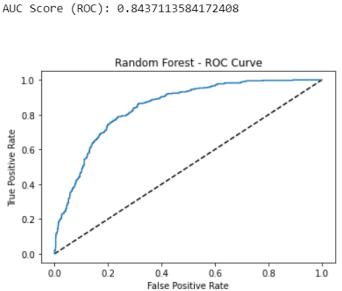 Fig5:AUC(ROC)ScoreforSVMalgorithm
Fig6:F1andAUC(PR)ScoreforSVM
C. DecisionTree:
Fig7:accuracyforDecisionTreefromconfusionmatrix
Fig8:AUC(ROC)ScoreforDecisionTreealgorithm
Fig9:F1andAUC(PR)ScoreforDecisionTree
D. RandomForest:
Fig10:accuracyforRandomForestfromconfusionmatrix
Fig5:AUC(ROC)ScoreforSVMalgorithm
Fig6:F1andAUC(PR)ScoreforSVM
C. DecisionTree:
Fig7:accuracyforDecisionTreefromconfusionmatrix
Fig8:AUC(ROC)ScoreforDecisionTreealgorithm
Fig9:F1andAUC(PR)ScoreforDecisionTree
D. RandomForest:
Fig10:accuracyforRandomForestfromconfusionmatrix
International Research Journal of Engineering and Technology (IRJET) e-ISSN: 2395-0056
[2] ZHAO, Ming-sheng & WU, Wei. (2018). Analysis and Prediction of Mobile Internet Users’ Behavior Preferences. DEStech Transactions on Computer Science and Engineering. 10.12783/dtcse/CCNT2018/24780
[3] Alharbi, Y., & Alfares, H. K. (2018). Predicting customer churn in telecommunication industry usingdataminingtechniques.JournalofBusiness Research, 89, 212-227. https://doi.org/10.1016/j.jbusres.2018.03.044
Fig12:F1andAUC(PR)ScoreforRandomForest
[4] Fu, Y., Liu, X., & Wu, T. (2019). Predicting customer churn in the telecommunications industry using machine learning algorithms. Journal of Business Research, 104, 291-303. https://doi.org/10.1016/j.jbusres.2019.06.034
[5] Huang, X., Li, Y., & Li, C. (2018). Predicting customer churn in telecommunications industry using data mining techniques: A case study. Journal of Intelligent & Fuzzy Systems, 35(6), 7049-7060. https://doi.org/10.3233/JIFS-179190
7. CONCLUSION
This project aimed to predict whether a customer would churn or not. The project utilized four different machine learning algorithms, namely logistic regression, SVM, random forest, and decision tree. The accuracy score, AUC score (ROC), F1 score, and AUC score (PR) were calculatedforeachalgorithmtoevaluatetheirperformance.

Overall, the logistic regression algorithm performed the best in terms of accuracy and AUC score (ROC), making it the recommended algorithm for predicting customer churn in this context. However, it is important to note that thereweretradeoffs betweenthedifferentalgorithms,such as the Random forest algorithm having a higher AUC score (PR) but a lower F1 score (PR). Additionally, the project identified potential outliers in the dataset that could be furtherinvestigatedandaddressed.
ACKNOWLEDGEMENT
We would especially want to thank PROF. MUTHU RAJASforgiving us thechancetopresentourprojectand report, as well as for assisting us at every step of the way. We also like to express our gratitude to VIT, Vellore, for givingusaccesstothisplatform.
REFERENCES
[1] Kayaalp, Fatih. (2017). Review of Customer Churn Analysis Studies in Telecommunications Industry. Karaelmas Science and Engineering Journal. 7. 696705.10.7212/zkufbd.v7i2.875.
[6] Kim, S. M., & Han, J. H. (2019). A comparison of machine learning algorithms for customer churn predictioninthetelecommunicationsindustry.Journal of Industrial Engineering and Management Science, 2(1), 41-54. https://doi.org/10.1016/j.jiems.2019.03.001
[7] ang, Y., & Liu, K. (2018). Predicting customer churn in the telecommunication industry: A machine learning approach. Journal of Computational Science, 27, 312321.https://doi.org/10.1016/j.jocs.2018.06.007
[8] Breiman,L..(2001).Randomforests, machinelearning 45.JournalofClinicalMicrobiology.2.199-228.
[9] [Jayaswal, Pretam & Prasad, Bakshi & Tomar, Divya & Agarwal, Sonali. (2016). An Ensemble Approach for Efficient Churn Prediction in Telecom Industry. International Journal of Database Theory and Application.9.211-232.10.14257/ijdta.2016.9.8.21.
[10] Óskarsdóttir, María & Bravo, Cristián & Verbeke, Wouter & Sarraute, Carlos & Baesens, Bart & Vanthienen,Jan.(2020).SocialNetworkAnalyticsfor Churn Prediction in Telco: Model Building, EvaluationandNetworkArchitecture.
[11] Li, Weilong & Zhou, Chujin. (2020). Customer churn prediction in telecom using big data analytics. IOP ConferenceSeries:Materials