Modeling of Solar System with MPPT Based Inverter Synchronization with Grid in Simulation
 Rahul Meshram1
,
Anita Singh2, Dimpal Zade31,2B.Tech Students, Department of Electrical Engineering
3Professor, Department of Electrical Engineering
Shri Sai College of Engineering and Technology (SSCET), Chandrapur, Maharashtra, India ***
Abstract - This paper presents a simulation study of a solar photovoltaic (PV) system with a maximum power point tracking (MPPT) based inverter synchronized with the grid. The modeling of the solar PV system and the MPPT based inverter is performed using MATLAB/Simulink software. The simulation results demonstrate the effectiveness of the proposed MPPT fuzzy logic algorithm in maximizing the power output of the solar PV system. The inverter uses a switching strategy that combines sinusoidal pulse width modulation (SPWM) Additionally, the inverter is able to synchronize the output power with the grid, ensuring that the power injected into the grid is of high quality and does not cause any disturbances. The proposed systemcan be implemented inreal-time to provide a reliable and efficient power generationsystem.
Key Words: Photovoltaic System, Maximum Power Point Tracking, Fuzzy logic Algorithm, Sinusoidal Pulse Width Modulation
1. INTRODUCTION
Renewableenergysourcesarebecomingincreasingly important intoday'sworld, andsolarenergy isoneofthe mostpromisingsourcesofrenewableenergy.Solarenergy systems have the potential to provide clean and sustainable energy for a variety of applications, including residential, commercial, and industrial use. However, to fully realize the potential of solar energy, it is essential to optimizetheenergyoutputofthesystem.
Maximum power point tracking (MPPT) based inverters are commonly used in solar energy systems to improveenergyoutputbyoptimizingtheoperationofthe photovoltaic (PV) panels. In addition, synchronization with the grid is crucial for ensuring stable and reliable operation of the system. Simulation models are powerful tools for analyzing the performance of solar energy systems, and they can provide valuable insights into the behavior of the system under different operating conditions.
Inthiscontext,theresearchpaper"ModelingofSolar SystemwithMPPTBasedInverterSynchronizedwithGrid in Simulation" presents a simulation model of a solar energy system that includes an MPPT-based inverter
synchronized with the grid. The paper discusses the modeling of the PV panel, MPPT-based inverter, and the grid, and presents the results of the simulation to demonstratetheeffectivenessoftheMPPT-basedinverter inoptimizingenergyoutput.
Overall,thisresearchpaperisavaluablecontribution to the field of solar energy, providing insights into the designand operationof solarenergysystemswithMPPTbased inverters. The simulation model presented in the paper can be used as a tool for further analysis and optimization of solar energy systems, and it can help to promote the use of renewable energy sources for a sustainablefuture.
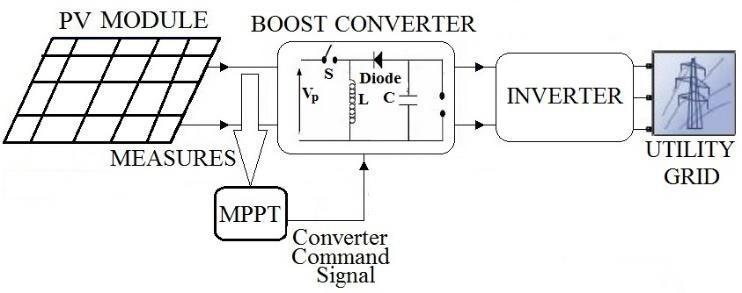
PVcellmodelinginvolvesthemathematicalmodeling of the behavior of the photovoltaic cell under different operating conditions. The model should take into account the effects of solar radiation intensity, temperature, and other environmental factors on the output of the cell. MPPT algorithm The maximum power point tracking algorithm is an important component of the photovoltaic system.Itis responsiblefor tracking themaximum power point of the PV array and adjusting the operating point of the system to extract maximum power from the array. DC/DC converter this component is responsible for convertingthelowvoltageDCoutputfromthePVarrayto ahighervoltageDCoutputthatcanbefedintotheDC/AC inverter. A boost converter is commonly used in PV
systems to increase the voltage level. DC/AC inverter converts the DC voltage from the DC/DC converter to AC voltagethatcanbesynchronized withtheutilitygrid.The inverter also provides the necessary control functions to ensure proper synchronization with the grid. Overall, the modeling of the PV cell and the design and control of the DC/DCconverterandDC/ACinverterarecriticalelements of a photovoltaic system. The use of advanced power electronics components and control algorithms can help improve the performance and efficiency of the system, allowing for greater penetration of solar energy into the powergrid.
3. MAXIMUM POWER POINT TRACKING (MPPT)
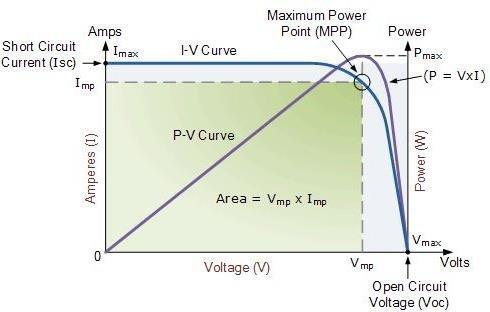
Maximum Power Point Tracking (MPPT) is a crucial technique used in photovoltaic systems to optimize the energyoutputofsolarpanelsbycontinuouslytrackingand adjusting the load impedance to maintain the panel's maximum power point. The MPPT algorithm adjusts the output voltage and current of the PV system to maintain the optimal operating point, ensuring maximum energy transfer from the solar panels to the load. MPPT is essential for the efficient operation of photovoltaic systems, particularly in applications where the available solarenergyislimited.
There are several types of MPPT algorithms used in photovoltaicsystems,suchasPerturbandObserve(P&O), Incremental Conductance (IncCond), Fractional Open Circuit Voltage (FOCV), Model Predictive Control (MPC), andArtificial Neural Networks (ANN). TheP&Oalgorithm is a simple and widely used MPPT algorithm that periodicallyperturbstheoperatingpointofthePVsystem and measures the power output. The IncCond algorithm uses the derivative of the power-voltage curve to determinethedirectionoftheoperatingpointadjustment. The FOCV algorithm estimates the maximum power point based on the open-circuit voltage of the solar panel. The MPC algorithm uses a mathematical model of the PV system to predict the optimal operating point. Finally, the ANN algorithmuses machinelearning techniques tolearn theoptimaloperatingpointfromhistoricaldata.
Fuzzy MPPT is another MPPT algorithm that uses fuzzy logic control to determine the optimal operating point of a photovoltaic system. Fuzzy logic is a mathematical framework that allows for approximate reasoning based on linguistic variables, making it wellsuited for control systems that involve imprecise or uncertain information. In a fuzzy MPPT system, the input variables are typically the solar irradiance and the temperature,whicharefuzzifiedintolinguistictermssuch as "low," "medium," and "high. The output variable is the duty cycle of the DC-DC converter, which is adjusted to maintaintheoptimaloperatingpoint. Thefuzzyrulesthat govern the system behavior are derived from the expert knowledgeofthesystemandareencodedasif-thenrules.
In conclusion, MPPT is a critical technique for maximizing the energy output of photovoltaic systems, and there are several types of MPPT algorithms available, each with its own advantages and disadvantages. Fuzzy MPPT is one such algorithm that can be useful in situations where the environmental conditions are highly variable or uncertain, and where the system behavior is difficulttomodelaccurately.
pointinPVcharacteristics
4. FUZZY LOGIC CONTROL BASED MPPT
Fuzzy Logic Control Based MPPT (FLC-MPPT) is an MPPT algorithm that uses fuzzy logic control to optimize the energy output of photovoltaic systems. FLC-MPPT combines the advantages of fuzzy logic and MPPT techniques to achieve maximum power point tracking in varyinganduncertainweatherconditions.
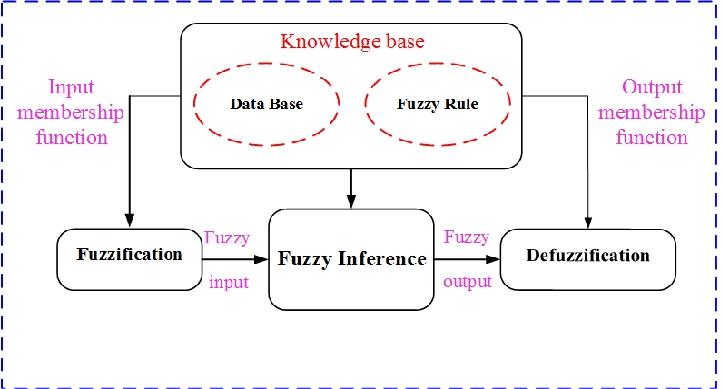
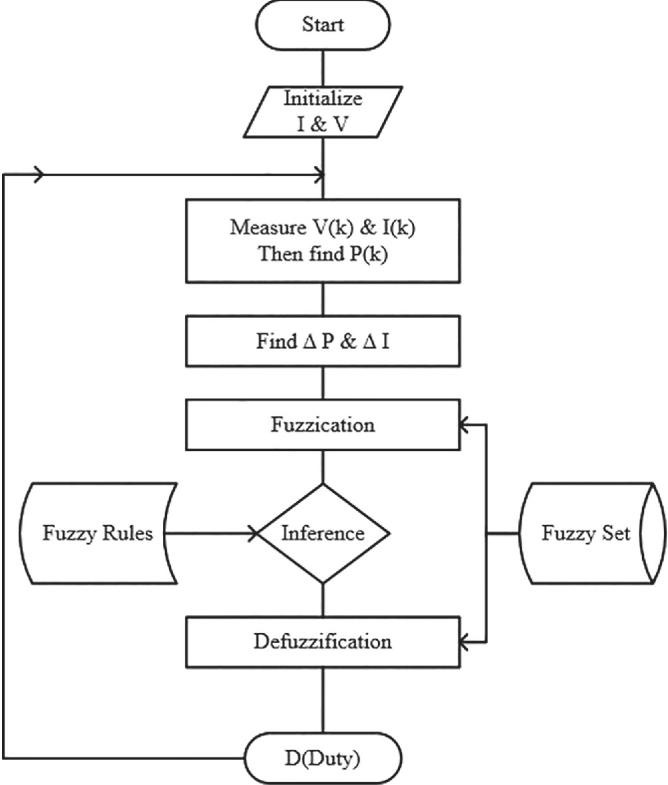
In FLC-MPPT, the input variables are typically the solar irradiance and the temperature, which are fuzzified into linguistic terms such as "low," "medium," and "high. The output variable is the duty cycle of the DC-DC converter, which is adjusted to maintain the optimal operating point. Fuzzy rules that govern the system behavior are derived from the expert knowledge of the system and are encoded as if-then rules. These rules map theinputlinguistictermstooutputlinguisticterms,which are then defuzzified to obtain the duty cycle of the DC-DC converter.
FLC-MPPT is advantageous over traditional MPPT algorithms in situations where the environmental conditionsarehighlyvariableoruncertain,andwherethe systembehaviorisdifficulttomodelaccurately.Thefuzzy logic control can handle imprecise and uncertain information and adjust the system's output accordingly. Moreover, FLC-MPPT can handle multiple inputs and outputs,makingitsuitableformorecomplexsystems.
However, FLC-MPPT has some disadvantages. It can be computationally expensive, requiring significant computing power and time to optimize the system's output. Additionally, the fuzzy rules used in the system require expert knowledge, and it can be challenging to optimizetheserulestoachievethebestperformance.
5. Boost Converter
AboostconverterisaDC-DCconverterthatconverts a lower DC voltage into a higher DC voltage. It is also known as a step-up converter since it steps up the input voltage level to a higher output voltage level. A boost converter typically consists of an inductor, a switching element (such as a MOSFET or a BJT), a diode, and a capacitor. The input voltage is applied to the inductor, which is then switched on and off by the switching element at a high frequency. This causes the inductor to store energy when the switch is on and release energy whentheswitchisoff.
During the on-time of the switch, the inductor charges, and the output voltage is equal to the input voltage plus the voltage across the inductor. During the off-time,theinductordischarges,andtheoutputvoltageis equal to the input voltage plus the voltage across the capacitor. The diode prevents the current from flowing backtotheinputsourceduringtheoff-timeoftheswitch.
The boost converter is commonly used in applicationswhereaDCvoltageneedstobesteppedupto a higher voltage level, such as in solar power systems or battery charging systems. It can also be used in applicationswhereastableDCvoltageisrequired,suchas in LED lighting systems or in low-power electronic devices.
One of the advantages of the boost converter is its simplicity and efficiency. It can be designed to achieve high efficiency with low power loss. However, it is not suitable for high current applications since the inductor current is limited by the duty cycle of the switch. Additionally, the output voltage ripple can be relatively high,requiringadditionalfilteringtoreducenoise.
Theconverteroutputisgivenby:
Fig – 4: FLCalgorithmflowchart
In conclusion, FLC-MPPT is an MPPT algorithm that uses fuzzy logic control to optimize the energy output of photovoltaicsystems.Althoughithassomedisadvantages, it is advantageous in situations where the environmental conditionsarehighlyvariableoruncertain,andwherethe systembehaviorisdifficulttomodelaccurately.
Where,V������isnominatedforoutputvoltage,V����for the input voltage, D is for duty cycle, �� is the converter frequency,∆Irepresentscurrentripple,��1and��2arethe capacitances of the capacitors, ∆�������� is given for the output voltage ripple and ���������� is for the load resistance givenby��������/��������.
6. DC to AC Converter
DC to AC converter, also known as an inverter, is to convert a DC voltage into an AC voltage with a specific frequencyandwaveform.Thebasicprincipleofoperation is to use electronic switching devices, such as transistors or MOSFETs, to turn the DC input on and off at a high frequency.
The switched DC voltage is then filtered by an inductor-capacitor (LC) filter to produce a quasisinusoidal AC voltage. The output voltage can be adjusted byvaryingthedutycycleoftheswitchingdevice,whichis theratiooftheon-timetotheoff-timeoftheswitch.
The waveform of the AC output can be modified by using pulse width modulation (PWM) techniques. PWM is a technique that involves varying the width of the pulses of the switched DC voltage to produce a waveform that closelyapproximatesasinusoidalACwaveform.
ThefrequencyoftheACoutputisdeterminedbythe frequency of the switching device and the LC filter. In order to synchronize the output frequency with the grid frequency in grid-connected applications, a phase-locked loop (PLL) can be used. The PLL compares the output frequency with a reference frequency and adjusts the switching frequency to synchronize the output with the gridfrequency.
In summary, the principle of a DC to AC converter is to use electronic switching devices and filtering techniquestoconvertaDCvoltageintoanACvoltagewith a specific frequency and waveform. The output voltage andwaveformcanbeadjustedbyvaryingthedutycycleof the switching device and using PWM techniques. The output frequency can be synchronized with the grid frequencyusingaPLL.
A. Phase Locked Loop (PLL)
Phase-Locked Loop (PLL) is to generate an outputsignalwithaphaseandfrequencythatislocked to the phase and frequency of an input signal. This is achieved by comparing the phase of the input signal with the phase of a voltage-controlled oscillator (VCO) output signal using a phase detector. The phase detector generates an error signal which is filtered and used to control the VCO frequency. The VCO generates an output signal whose frequency is proportional to the control voltage. By adjusting the control voltage, the VCO can be used to generate an output signal that is synchronized in frequency and phase with the input signal. PLLs are used in a variety of applications such as frequency synthesis, phasemodulation,andsynchronizationofdigitalsystems.
B. LC Filter
An LC filter, also known as a low-pass filter or a smoothingfilter,isanelectroniccircuitthatusesinductors (L) and capacitors (C) to remove high-frequency noise or ripple from a signal. The filter works by passing the lowfrequency components of a signal while attenuating the high-frequencycomponents.InanLCfilter,theinductoris placed in series with the load, and the capacitor is placed in parallel with the load. The inductor offers high impedance to high-frequency components and low impedance to low-frequency components, while the capacitor offers low impedance to high-frequency components and high impedance to low-frequency components. As a result, the LC filter attenuates highfrequency components of the signal while passing lowfrequencycomponentstotheload.Thecutofffrequencyof the filter is determined by the values of the inductor and capacitor.LCfiltersarecommonlyusedinpowersupplies to remove ripple and noise from the output voltage, in audio amplifiers to remove high-frequency noise, and in RF applications to filter unwanted signals. In DC to AC converters used in grid-connected applications, an LC filterisoftenusedtosmooththeoutputvoltagewaveform andfilterouthigh-frequencyswitchingnoise.
7. Results and Analysis
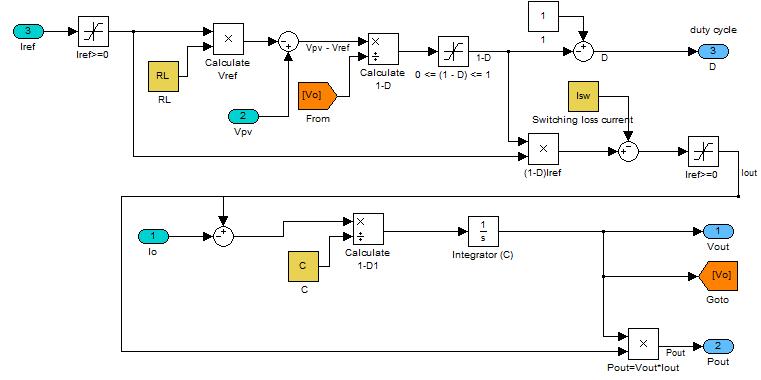
Grid-tied systems are tested with single-phase loads. The full circuit model is shown as in figure 6. In the proposed model, all current compensation is done using anLClow-passfilter.Inthisprocess,theRMSvalueofthe voltage source (network) is given as 220v and the singlephase general purpose bridge rectifier non-linear RL load is due to the harmonics entering the system. network synchronizationisachievedusingthePLLshowninfigure 7. The power from this model is shown in figure 8. load whenusedbythegridOntheotherhand,whentheoutput oftheinverterismorethanexpected,moreelectricitywill be fed into the grid , this can be determined by the negativehalfoftheelectricaldiagram.
8. Conclusion
Themodelingandsimulationofasolarsystemwithan MPPT based inverter synchronized with the grid have been presented in this study. The proposed system consists of a boost converter, H-bridge inverter, and LC
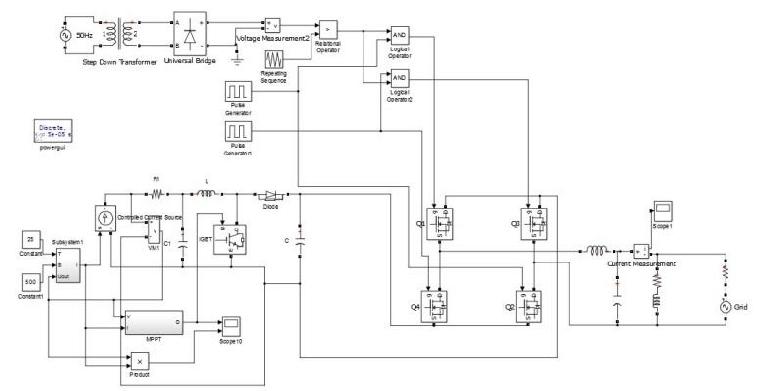
filter,withaswitchingstrategybasedonacombinationof SPWM and square wave along with grid synchronization conditions. An intelligent PV module system was also implemented using a simple MPPT method to increase system efficiency. The simulation results showed that the proposed system achieved higher efficiency and power output compared to non-MPPT systems. The grid synchronizationmethodusedalsohadasignificantimpact on the overall performance of the system. The system demonstratedstableandreliableoperationundervarying conditions, indicating its potential for practical application. In conclusion, this study provides valuable insightsintothedesignandoptimizationofgrid-tiedsolar powersystemsusingMPPT-basedinverters.Theproposed system can contribute significantly to the development of renewable energy sources, especially in residential applications. However, further research and development are needed to address the limitations of the proposed system, such as the impact of environmental factors on systemperformance.
9. References
1) E. Ahmed, M. Nabil, A. Ahmed, "Grid Connected Photovoltaic System Based on Two-Stage Boost Inverter with MPPT Control Strategy", Journal of Renewable Energy,vol.2020,ArticleID3452107,12pages,2020.
2) T. Esram, P.L. Chapman, "Comparison of Photovoltaic Array Maximum Power Point Tracking Techniques", IEEE TransactionsonEnergyConversion,vol.22,no.2,pp.439449,Jun.2007.
3) M. Enslin, L. Snyman, "Implementation of a GridConnected Photovoltaic System with Maximum Power PointTracking",IEEETransactionsonEnergyConversion, vol.21,no.1,pp.117-124,Mar.2006.
4) M. Tariq, M. S. Zubair, M. S. Gondal, and H. A. Karim, "Implementation of a Single-Phase Grid-Connected Photovoltaic System with MPPT Control for Residential Applications," in 2018 IEEE 7th International Conference onPowerandEnergy(PECon),2018,pp.63-68.
5) H. Altas, A.M. Sharaf "A photovoltaic array simulation model for matlab simulink GUI environment", in Proceedingsofthe37thIEEEPowerElectronicsSpecialists Conference,pp.1942-1947,2006.
6) M. H. Rashid, Power Electronics: Circuits, Devices and Applications,Prentice-Hall,Inc.,1993.
7) N.Mohan, T.Undeland, W.Robbins, PowerElectronics: Converters, Applications and Design, John Wiley & Sons, Inc.,1995.
8) S. P. Singh, S. Srivastava, "Grid-Connected Photovoltaic SystemUsingBoostInverterandFuzzyLogicBasedMPPT
Algorithm", in Proceedings of the 3rd International Conference on Energy Systems and Applications (ICESA), pp.1-6,
9) F. Liu, Y. Liu, B. Liu, "Design of Maximum Power Point Tracking Controller for Photovoltaic Power System with Fuzzy Logic", in Proceedings of the 8th International Conference on Electrical Engineering, Computing Science andAutomaticControl(CCE),pp.1-5,2011.
10) Y. C. Chu, C. S. Lin, H. Y. Chu, "Design and Implementationofa FuzzyMPPTControllerforPVPower System", in Proceedings of the 2007 International Conference on Intelligent Pervasive Computing (IPC), pp. 286-289,2007.
11) M. Benammar, A. Kheloui, R. Kedadouche, "A hybrid fuzzy logic-PSO-based maximum power point tracking controller for photovoltaic systems under partial shading conditions", International Journal of Electrical Power & EnergySystems,vol.67,pp.116-127,Mar.2015