
Bioswales: Green Alternative for Storm Water Management & Flash Flooding
Srishti ChavanDept. of Civil Engineering, Vishwakarma Institute of Information Technology, Pune, Maharashtra, India. ***

Abstract - Flash flooding and storm water management are two of major concerns faced in urban settlements in relation with water channeling and management. As the requirement of land will keep on increasing, more land will be used for construction and paving thus making it impervious. This will lead to comparatively less surface area on the ground for percolation of water. Urbanization also causes pollution of storm water as it passes through the city to nearest water body by gravitational force. This degrades the quality as well as quantity of storm water that percolates into the ground water table. The purpose of this paper is to explore the concept of bioswales and how they can be effectively used to percolate maximum pure storm water in the water table. In general, we can say that bioswales are effective in removing water pollutants in urban areas. Bioswales are very sustainable, cost effective, environmentally friendly and easy to construct. They are an excellent example of green infrastructure.
Key Words: bioswales,stormwatermanagement,vegetated swales, green infrastructure, water harvesting structure, potentialrecharge
1.INTRODUCTION
Aflashfloodcanbedefinedas:“afloodthatrisesandfalls quiterapidlywithlittleornoadvancewarning,usuallyasa resultofintenserainfalloverarelativelysmallarea”.Despite the increase in advanced technologies, society is still vulnerabletoflashfloods.Peopleareexposedtohigherrisks ascitiesareexpandingatanacceleratedpaceandeconomies arefueledbyurbanization.Flashfloodscontinuetoclaimthe livesofmanypeopleallaroundtheworld.Theyalsocause damagetopropertyandinfrastructureandincureconomic losses. Flash floods severely affect the surrounding environment.Nowadays,thereisastrongdemandforland for buildings, along with agricultural land and sites for various industrial projects. The land that is used for urbanizationandindustrializationhasimpervioussurface. Thisleadstodecreaseinthelandsurfaceforsurfacerunoff andwaterchannelingintheurbanareas.
Thisstudylooksintothetopicofbioswalesandspecifically its possible use in metropolitan areas. The development donehaslastingconsequencesontheurbanlandscape,with oneofthemostnotableelementsoftransitionbeingurban densification and loss of public open space/green areas. Urban densification and increased paved surfaces have majorenvironmentalconsequences,includingflashflooding,
waterpollution,andhabitatdestruction.Traditionalstorm watersystemsarefrequentlyinsufficienttoabsorbandtreat all surplus water runoff, resulting in flooding in diverse urbanareas.Modernstormwatermanagementmeasures,on theotherhand,haveyettobeadopted.Thisstudybelieves that using bioswales as green infrastructure components couldconsiderablyimprovestormwatermanagement.Asa result,thisstudyexploresthekeyurbandesignconceptsof bioswales, investigates typical urban environments that utilize these green infrastructure elements, and evaluates thefeasibilityoftheirapplicationinurbanareas.
2. LITERATURE REVIEW
1) BIOSWALESASELEMENTSOFGREENINFRASTRUCTURE – FOREIGN PRACTICEANDPOSSIBILITIESOFUSEIN THE DISTRICT OF THE CITY OF NIŠ, SERBIA (Milena DinićBranković, Petar Mitković, Ivana Bogdanović-Protić, Milica Igić,JelenaĐekić)
Implementingbioswalesasgreeninfrastructurefeatures canconsiderablyimprovestormwatertreatmentaswellas the architecture of diverse urban forms, resulting in more positiveenvironmentalconsequences.Thisreportproposed somepotentiallocationswherebioswalescouldbeusedas green infrastructure to remediate storm water runoff in a residentialdistrictoftheCityofNi.Vegetatedswalesarelowcostandappealing,andtheycanprovidewildlifehabitatas well as visual advantages. Urban regions gain long-term sustainability by including bioswales into retrofit projects andnewbuildings.
2) PERFORMANCE OF TWO BIOSWALES ON URBAN RUNOFFMANAGEMENT(QingfuXiao,E.GregoryMcPherson, QiZhang,XinleiGeandRandyDahlgren)
Thisstudylookedattheeffectivenessoftwobioswalesin Davis, California, eight years after they were built. The treatmentbioswalewas9m1m1minlength,width,and depth.Thenativeloamsoilwasreplacedwithanengineered soilmix(75%nativelavarockand25%loamsoil).Aftereight years, the bioswale with estimated soil mixtures was operating at full capacity. When compared to a standard controlplotbioswaleutilizingnativesoil,thebioswaleusing engineered soil mixes removed significantly more contaminants. The research shows that bioswales with engineered soil mixes can be quite useful in storm water management. Trees planted in engineered soil mixes
flourished as well as trees planted in natural productive agriculturalsoil.
3) EVALUATINGTHEWATERQUALITYBENEFITSOFA
BIOSWALE
IN
BRUNSWICK
COUNTY,
NORTH (Rebecca A. Purvis, Ryan J. Winston, William F. Hunt, Brian Lipscomb, Karthik Narayanaswamy, Andrew McDaniel, Matthew S. LaufferandSusanLibes)
Typical roadside plantedswales do notalways provide constantpollutantremoval.Bioswalesareconstructedwith an underlying soil media and an underdrain to promote infiltration and pollutant removal. Total suspended solids (TSS),totalvolatilesuspendedsolids(VSS),enterococcus,E. coli,andturbiditywereallmeasuredinthesamples.Forall contaminantstested,underdrainflowwasmuchcleanerthan untreatedroadrunoff.Filtrationremovedmorethan55%of FIB and more than 85% of TSS, indicating that it is an effectiveremovalmechanismforthesepollutants.Bioswales canbebuiltwithinexistingrights-of-way,andthewaterthat infiltratesthemediaiscleanerthansurfaceflowforcommon pollutants. This case study shows that the function of bioswalesshouldbeinvestigatedfurtherasafunctionofthe watershedsizetobioswalelengthratio,theimpactofslope, drainageareafeatures,soilmediatype,andsoon.Thiswill enableforthecreationofdesignstandardsforbioswales.
4) BIOSWALESANDGREENINFRASTRUCTURE:THE NATURAL PURIFICATION OF POLLUTED WATER (Lauren Wilmoth,KatherineLebrun,Matthew
Jaros)Bioswaleshavethepotential toreplaceandimproveupon man-made methods of water purification. Bioswales and greeninfrastructurearelow-cost,requireasmallnumberof resources, and can be constructed in nature without disturbingdelicateecosystemsordisplacinglocalpopulation. Bioswales that use plants to purify water should only be implementedinareaswheretheplantsarenativetoavoid invasivespeciesandensureeffectiveness.Environmentally, bioswalescombatwaterpollution,strengthenthepresenceof plant species in their native environments, and contribute towarda healthierecosystem forall life. Bioswales relieve strain on neighboring grey infrastructure, lowering maintenancecostsaswell.Socially,bioswalesmaketheworld around them more beautiful and healthier. Water quality enhances quality of life, and access to green space boosts mood. At the moment, bioswales are not totally replacing grey infrastructure, but they can improve water filtration systemsthatarealreadyinuseinmetropolitanareas.Itis feasible that bioswales and other forms of green infrastructurewillultimatelybecomewidespreadenoughto graduallyreplacegreyinfrastructure.
3 METHODOLOGY
Before we begin studying the details of bioswales, it is imperativethatwestudyhowpercolationworksondifferent landscapes. In order to understand this, we are going to
study the experiment conducted by Dr. Robert Thompson fromtheUniversityofReading’sDepartmentofMeteorology in the UK. This experiment demonstrates the dangerous effect that heatwaves can have on the ground’s water percolation rate. In this experiment, a glass of water was upturnedonwetgrass,moistgrassandparchedgrass.Wet grass took nine seconds to absorb the water, moist grass took52secondsandparchedgrasstookapproximately15 minutes. The water given to the parched grass was also pronetopuddlingontopoftheground,ratherthanbeing absorbedintoit.Bycomparingthetimetakenbyeachglass, theexperimentdemonstrateshowheavyrainfallinaarea withlesstonovegetationcanbehazardousandleadtoflash flooding.

1:Effectsofheatwavesonground’swatertable
From this experiment, we can conclude that land covered with vegetation are comparatively better equipped to combatflashfloodingthanaregularchannelsusedforstorm watermanagement.
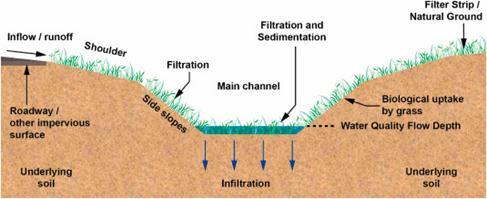
A bioswale, also known as a vegetated swale, is a linear design for bio retention that is used to partially improve storm water runoff quality, reduce risk of flooding, and channel storm water away from vital infrastructure. Bioswales are gently sloping depressions that are planted with lush vegetation or grass to treat storm water runoff from rooftops, streets, and parking lots. The slope allows watertoflowmoreeffectivelythroughthesystem.Bioswales absorb low-flowing runoff or transport it to storm sewer inlets or directly to surface waters during heavy rains. Bioswales can serve as an alternative or supplement to standardstormsewersasconveyancesystems.
2:Bioswaleanditscomponents
Design of Bioswales: Bioswales are usually trapezoidal or parabolic shaped channel which is designed to treat and infiltrateincomingstormwater.Thiswaterisusedtohelp directlargestormwaterflowvolumefromalargecatchment area to a connected discharge point and further to a bioswale. Themaximumdesigncapacityofabioswaleisof drainageareasupto1acre. Theidealdesignofbioswalehas 1to2percentslopeuptomaximum5percent.Checkdams can be used in case of steeper slopes in order to reduce stormwatervelocityandpreventerosion.Thefiltermedia usedinthebioswaleisablendofloam,sand,andcompost specificallyengineeredtomeettherequiredinfiltrationrates andporosityneededforstormwaterfiltrationandenhanced waterqualityforsupportingplantlifeinbioretentionareas.
iii. The effectiveness of bioswales is dependent upon the retentiontimeofthestormwaterinthebioswale.Thelonger the retention time, generally, the higher the removal efficiency.
iv. The type of vegetation and the life cycle that the vegetation also effects the pollutant removal rate. Native species should always be preferred for plantation in bioswalesastheyrequirelessmaintenance.
v. The vegetation used in bioswale must provide a dense coverandrootsthatholdsthesoilinplaceinordertoresist erosionandduringheavyrunoffflow,itmuststandupright inordertoprovidemaximumretentiontimeandpollutant removal.
vi. Vegetation should tolerate a bioswales’ soil conditions (pH,compaction,composition)andtolerateperiodicflooding anddrought.
vii.Vegetationusedshouldbeperennialandmustbeactive duringtheentireperiodoftheyearsothattheimpuritiesare treatedproperly.
v. Since bioswales are primarily used for storm water channeling,itisimperativethatthecontoursoftheareaare studiedwhiledecidingthepathofthebioswale.
4. CONCLUSIONS
Figure3:SectionofBioswale
Whilethereareveryfewspecificcalculationswhichneedto considered while designing a bioswale, there are some details that should be taken into considered that are as follows:
i. Bioswales are usually built surrounding or towards the sloping end of high volume water flow areas like parking lots,highways,largeopenspaces,etc.

ii. Thebioswalesneedtobedesignedtoaddressacertain stormeventsuchasthetwoyearortenyear24-hourstorm event.
The studies have shown that bioswales can indeed be a sustainableoptionforstormwatermanagementandriver basin channeling. If done on a wider scale, it can help in reducingtheimpactof flashfloodingona large scale.The main objectives of building bioswales are storm water managementandpurificationofstormwaterrunoff. While atthecurrentstage,bioswalescannotcompletelyreplaced the gray infrastructure which is used but it can be supplementaryinthepurificationprocessasbioswalescan help in immobilizing or breaking down a large number of contaminantsfoundinstormwaterrunoff.Ithasachieved highlevelsofremovalofsuspendedsolids(TSS),turbidity, and oil and grease as found in various studies conducted. Theycanalsoeliminateamodestpercentageofmetalsand nutrientsinrunoff.
Bioswales have been implemented as pilot projects in variouspartsoftheworldsuchasCalifornia,Serbia,etc.The resultshaveprovenbioswalestobeeffectivein managing stormwaterrunoffaswellasreducingtheimpuritiesinthe runoff to a large extent. They are environmentally sustainableandcost-effectiveascomparedtothecurrently used infrastructure for managing storm water runoff on smallscale.
REFERENCES
[1] D. Kornack and P. Rakic, “Cell Proliferation without NeurogenesisinAdultPrimateNeocortex,”Science,vol. 294, Dec. 2001, pp. 2127-2130, doi:10.1126/science.1065467.
[2] M.Young,TheTechnicalWriter’sHandbook.MillValley, CA:UniversityScience,1989.
[3] R. Nicole, “Title of paper with only first word capitalized,”J.NameStand.Abbrev.,inpress.
[4] K. Elissa, “Title of paper if known,” unpublished. 1. William W. Groves, Phillip E. Hammer, Karinne L. Knutsen,SheilaM.RyanandRobertA.Schlipf,Analysis of Bioswale Efficiency for Treating Surface Runoff, Donald Bren School of Environmental Science and Management
[5] 2. Dennis Jurries, PE, Biofilters (Bioswales, Vegetative Buffers, & Constructed Wetlands) For Storm Water Discharge Pollution Removal, DEQ Northwest Region Document,January2003
[6] 3. Lauren Wilmoth, Katherine Lebrun and Matthew Jaros,BioswalesandGreenInfrastructure:TheNatural PurificationofPollutedWater,UniversityofPittsburgh, Swanson School of Engineering First Year Conference Paper,March2019
[7] 4. Milena Dinić - Branković, Petar Mitković, Ivana Bogdanović – Protić, Milica Igić and Jelena Đekić, BioswalesasElementsofGreenInfrastructure–Foreign PracticeandPossibilitiesofUseintheDistrictofthecity of Nis, Serbia, International Conference of Urban Planning,November2018.
[8] 5. Dr. S. Chandramouli, G. N. V. Prasad, Design of Rainwater Harvesting System (RWHS), IJSRDInternational Journal for Scientific Research & Development,Vol.3,Issue07,2015
[9] 6.RebeccaA.Purvis,RyanJ.Winston,WilliamF.Hunt, Brian Lipscomb, Karthik Narayanaswamy, Andrew McDaniel, Matthew S. Lauffer and Susan Libes, EvaluatingtheWaterQualityBenefitsofaBioswalein Brunswick County, North Carolina (NC), USA, Water MDPI,January2018.
[10] 7. V. K. Bhatt, A. K. Tiwari, R. P. Yadav and D. R. Sena, Augmenting Groundwater Recharge by Water Harvesting Structures in Northwest India, Hydrology Journal,Vol.35Issue1&2January-June2012,1-10
[11] 8. Alessandro G. Colombo, Javier Hervás and Ana Lisa VetereArellano,GuidelinesonFlashFloodPrevention andMitigation,InstitutefortheProtectionandSecurity
of the Citizen, Technological and Economic Risk Management Natural Risk Sector I-21020 Ispra (VA) Italy
[12] 9. Dipika Rana, Kulraj Singh Kapoor and Vidya Ram Ratan Singh, Hydrological and Ecological Studies towards Integrated Water Resource Management: A Case Study of Shimla Water Catchment Sanctuary Himachal Pradesh, Asia Pacific Workshop on Forest Hydrology Water and Forests: Beyond Traditional ForestHydrology
[13] 10. OperationandMaintenanceofGreenInfrastructure ReceivingRunofffromRoadsandParkingLots,United States Environmental Protection Agency, September 2018.
[14] 11.QingfuXiao,E.GregoryMcPherson,QiZhang,Xinlei GeandRandyDahlgren,PerformanceofTwoBioswales on Urban Runoff Management, Infrastructure MDPI, September2017.
[15] 12. Prof. Aradhna Ganvir, Aarif Sayyed, Akhilesh Agrawal, Rishikesh Sawant, Siddhnat Wayal, Storm Water Management using Bioswales, International Research Journal of Engineering and Technology (IRJET),Volume:07Issue:05,May2020
[16] 13. Storm Water Best Management Practice Grassed Swales,UnitedStatesEnvironmentalProtectionAgency
[17] 14. Joshua Lelemia Irvine and Albert S. Kim, Understanding bioswale as a small water and wastewater treatment plant: A theoretical review, DesalinationandWaterTreatment,September2018.
[18] 15. Rajapriya R, Akila M, Kuraloviya Respna K I, MahalakshmiMandShivaniP,UpshotsofBioswalesin Stormwater Management: A Pilot-scale Study, International Journal of Advances in Engineering and Management(IJAEM)Volume3,Issue5May2021
[19] 16.SreejaniTP,KalyanAVSandSChandramouli,Water Resources Management of Freshwater Ecosystems, ResearchGateConferencePaper,February2016
[20] 17. Km Vandana and Dr. SriRam, Flash flood and its PreventiveMeasuresinHillyAreas,IJSRD-International Journal for Scientific Research & Development, Vol. 2, Issue10,2014