Solar-Powered Peltier Refrigeration System: Design, Applications, and Limitations
Rohan Pratap Singh Dhirendra Patel Rishav Singh Rajput Mechanical Engineering Assistant Professor Mechanical Engineering Amity University Greater Noida Amity University Greater UniversityAbstract:
This research paper investigates the feasibility of utilizing a refrigeration system powered by solar energy and based on the Peltier effect. The paper presents a comprehensive analysis of the system, including its key components, operating principles, and advantages. The study also explores the potential applications of the solar-powered Peltier refrigeration system in various domains, such as pharmaceutical and medical transportation, food preservation, and air conditioning. Additionally, the paper examines the challenges and limitations associated with the design and operation of this system, such as efficiency, cost, and scalability. Ultimately, the research evaluates the viability of implementing the solar-powered Peltier refrigeration system on a larger scale and offers suggestions for further research and development. The findings suggest thatthesolar-poweredPeltierrefrigerationsystemcould transform the refrigeration industry by providing a sustainable,cost-effective,andeco-friendlyalternativeto traditionalrefrigerationsystems.

Keywords- Peltier effect, Solar power, Refrigeration, System design, Applications, Limitations, Energy efficiency
Solar power refrigerating system:
A solar-powered refrigeration system is a type of refrigeration system that utilizes solar energy as the primarypowersourcetooperatethesystem.Itisanecofriendly and sustainable alternative to conventional refrigeration systems that rely on electricity from the gridorothernon-renewableenergysources.
A solar-powered refrigeration system is composed of severalelements,suchasasolarpanelorarray,abattery, a charge controller, an inverter, and a refrigeration unit. Thesolarpanelorarrayabsorbssunlightandtransforms it into electrical energy, which is then stored in the battery. To prevent overcharging or undercharging, the charge controller manages the flow of energy between thesolarpanel,battery,andinverter.Inturn,theinverter converts the DC power from the battery into AC power, whichisusedtooperatetherefrigerationunit.
The use of solar power in refrigeration systems offers severalbenefits.First,itisacleanandrenewableenergy source that reduces dependence on non-renewable energy sources and reduces greenhouse gas emissions. Second, it can be used in remote or off-grid locations where access to electricity is limited or non-existent. Third,itreducesoperatingcostsandprovideslong-term savings by eliminating the need for electricity from the grid.
The applications of solar-powered refrigeration systems are varied and include both commercial and residential settings. They can be used in the food and beverage industry, medical facilities, and transportation to store andtransportperishablegoods,vaccines,andmedicines. Inresidentialsettings,theycanbeusedforhomecooling andrefrigerationpurposes.
However, there are also some limitations to the use of solar-powered refrigeration systems. The efficiency of the system is affected by factors such as weather conditions,theamountofsunlightavailable,andthesize and capacity of the system. Moreover, the initial cost of installation and maintenance of the system can be high, whichmaydetersomepotentialusers.
Despite these limitations, the viability of solar-powered refrigeration systems on a large scale is promising. The technology is constantly evolving, and ongoing research and development efforts are focused on improving the efficiencyandreducingthecostofthesystem.Thebasics of the Peltier and Seebeck effect, which are the underlying principles of solar-powered refrigeration systems, are important to understand in order to fully appreciatethepotentialofthistechnology.
Components used in the design:
A solar-powered refrigeration system is a complex system that requires several components to function properly. These components include the solar panels, batteries, charge controller, inverter, compressor, condenser,evaporator,andrefrigerant.
Thecoreofthesolar-poweredrefrigerationsystemisthe solar panels, which transform sunlight into direct current (DC) electricity. The solar panels usuallyconsist of photovoltaic (PV) cells that can be interconnected in series or parallel to generate the required voltage and current. The size and number of solar panels required depend on the size of the refrigeration system and the amountofenergyneededtooperateit.
To store the surplus solar energy produced during the day, high-quality batteries with a long lifespan are employed. The charge controller regulates the flow of energy from the solar panels to the batteries to avoid overchargingorundercharging.
To convert the DC electricity from the batteries into alternating current (AC) electricity that powers the compressorandotherACappliances,aninverterisused. The compressor is a vital component that compresses the refrigerant gas, which is then circulated through the condenser and evaporator. The condenser functions to dissipatetheheatgeneratedbythecompressionprocess, while the evaporator absorbs the heat from the environment,coolingitdown.
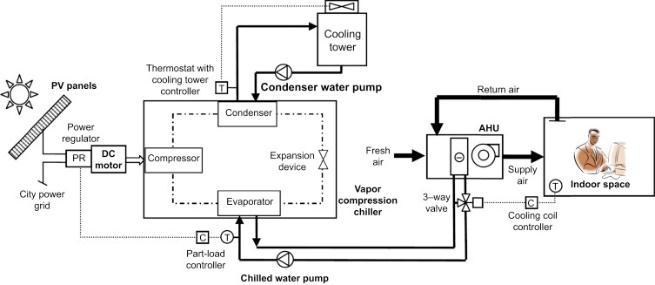
Therefrigerantisacrucialcomponentofthesystemasit is responsible for absorbing and releasing heat, thereby providing the cooling effect. There are various types of refrigerants used in solar-powered refrigeration systems, including hydrofluorocarbons (HFCs), hydrocarbons (HCs), and natural refrigerants such as carbondioxide(CO2)andammonia(NH3).
Overall, the components used in a solar-powered refrigeration system are designed to work together to ensureefficientandreliableoperation.Thedesignofthe system must be carefully considered to ensure that it meets the specific requirements of the intended application.
Benefits of such model:
Solar-powered refrigeration systems offer various advantages. Using solar energy for refrigeration reduces dependence on fossil fuels, which are finite resources and cause environmental pollution. These systems are particularlyusefulinremoteregionswheregridpoweris either unavailable or unreliable, providing refrigeration access to people who may not have access to it otherwise. Furthermore, solar refrigeration systems are cost-effective in the long term since they eliminate the need for costly electricity bills and fuel expenses. They arealsoquietandrequireminimalmaintenance,making themapracticaloptionforcertainapplications.
Furthermore, solar refrigeration can also be used in refrigerationtrucksandvans,whicharecommonlyused to transport temperature-sensitive goods. This eliminates the need for diesel-powered refrigeration units, which are not only expensive to operate but also contribute to air pollution. In the agricultural sector, solar-powered refrigeration can be used for preserving crops and improving their shelf life, which can help farmers increase their income by reducing post-harvest losses. Solar-powered refrigeration systems are beneficial for reducing the refrigeration industry's carbon footprint, as it is a major contributor to greenhousegasemissions.
Applications:
Solar-powered refrigeration systems have a broadrange of potential applications in both developed and developing countries. Here are some examples of the applicationsofthesesystems:
1. Food Preservation: The most common application of refrigeration is for food preservation. Solar-powered refrigeration systems have the potential to store and transportperishablefooditems,includingfruits, vegetables,dairyproducts,meat,andfish.These systems can be particularly useful in remote regionswithoutaccesstoelectricity,allowingfor longer-term food preservation, reducing food waste, and increasing the availability of fresh produce.
2. Vaccine Storage: Proper storage of vaccines is critical to their effectiveness. Solar-powered
refrigeration systems can be used to store vaccines in areas where there is no access to electricity. These systems can maintain the required temperature range and prevent spoilage of vaccines, ensuring that they remain effective.
3. Air Conditioning: Solar-powered refrigeration systems can also be used for space cooling and air conditioning in residential and commercial buildings. Thesesystemscanbeintegratedwith the building's existing HVAC system, reducing electricitycostsandcarbonemissions.
4. Off-Grid Refrigeration: Solar-powered refrigeration systems have the potential to powerrefrigeratorsandfreezersinremoteareas without grid access. These systems can benefit homes, schools, health clinics, and other facilities,ultimatelyimprovingthe qualityoflife forindividualslivinginsuchareas.
5. Transportation: Solar-powered refrigeration systems can also be used in transportation to transport perishable goods like fruits, vegetables, and meat. These systems can be installed in trucks, vans, and other vehicles, ensuring that the goods remain fresh during transportation.
Overall, solar-powered refrigeration systems have the potential to improve access to refrigeration and reduce energy costs and carbon emissions in various applications.
Limitations of such model:
Despite their numerous benefits, solar-powered refrigeration systems have some limitations that should beconsideredwhencontemplatingtheiruse.
1. Dependence on sunlight: As solar refrigeration systems rely on sunlight to generate electricity, their performance can be influenced by various weather conditions, including cloudy days or reduced sunlight during the winter season. This meansthatthesesystemsmaynotbeasreliable as conventional refrigeration systems that are poweredbyelectricityfromthegrid.
2. High upfront costs: Solar refrigeration systems require a significant upfront investment for the solar panels, batteries, and other components. The cost of implementing solar-powered refrigeration systems can be a deterrent for small businesses or households with financial constraints.
3. However, the long-term savings in electricity costs can help offset the initial investment over time.
4. Limited cooling capacity: Solar refrigeration systems are often limited in terms of their cooling capacity, which can make them unsuitable for larger cooling needs, such as in commercialorindustrialapplications.Theymay be better suited for small-scale or household use.
5. Battery storage limitations: The batteries used to store energy generated by solar panels can have limited storage capacity, which can be a challengewhenusingthesystemduringtimesof low sunlight or at night. This means that users may need to have backup power sources, such asgeneratorsorbackupbatteries.
6. Maintenance requirements: Solar refrigeration systems require regular maintenance to ensure that the components are working properly and to prevent potential breakdowns. This can includecleaningandinspectingthesolarpanels, checking the batteries, and ensuring that the refrigerationunitisfunctioningcorrectly.
Overall, while solar-powered refrigeration systems have many benefits, such as lower operating costs and environmental sustainability, their limitations should be carefully considered before choosing to use them for specific applications. Proper planning and maintenance can help mitigate some of these limitations and ensure thatthesystemfunctionseffectivelyovertime.
Viability on large scale:
The viability of a solar-powered Peltier refrigeration systemonalargescaleisanimportantconsiderationfor its practical implementation. While the technology has thepotentialtobeasustainableandefficientalternative totraditionalrefrigerationmethods,severalfactorsmust betakenintoaccountwhenconsideringitsscalability.
One key limitation of the system is its low coefficient of performance (COP) compared to conventional refrigeration systems. This means that it requires more energyinputtoachievethesamecoolingeffect,makingit less efficient and cost-effective. The cost of solar panels andothercomponentsrequiredforthesystem mayalso makeitmoreexpensivetoimplementonalargescale.
Anotherlimitationisthedependenceonsolarirradiance for energy input. The effectiveness of the solar refrigeration system can be influenced by the weather, particularlyoncloudyorovercastdays whenthesystem
may not receive an adequate amount of solar energy. This can result in inconsistent cooling performance and make it difficult to rely solely on solar power for refrigerationneeds.
In addition, the design of the system may need to be adapted to suit the specific needs of large-scale applications.Forexample,thecoolingcapacitymayneed to be increased, and the system may need to be integrated with other energy storage systems to ensure consistentperformance.
Despitetheselimitations,therearestillseveralpotential applications for a solar-powered Peltier refrigeration system on a large scale. These include refrigeration for food storage in remote areas, refrigerated transport for goods, and cooling systems for buildings and industrial processes.
Overall, the viability of a solar-powered Peltier refrigerationsystemonalargescaledependsonarange of factors, including cost, efficiency, and adaptability to different applications. Continued research and developmentinthefieldwillbeessentialforovercoming these limitations and improving the practicality and effectivenessofthetechnology.
The basics of Peltier and Seebeck effect:
The Peltier and Seebeck effects are two closely related phenomena that are commonly used in thermoelectric devices,includingsolar-poweredrefrigerationsystems.
ThePeltiereffectisascientificconceptthatdescribesthe absorption or release of heat at the junction of two differentmaterialswhenanelectriccurrentisappliedto them. This effect is rooted in the thermoelectric properties of the materials, which is their capacity to transformtemperaturedifferencesintoelectricalvoltage or the reverse. When a current is passed through two dissimilar materials in a circuit, one material absorbs heat from the surrounding and cools down, while the other material releases heat and gets hot. The temperature difference between these materials can be utilized to create a temperature gradient, which can be usedforrefrigerationorpowergeneration.
The Seebeck effect describes the production of an electric potential or voltage withina material asa result ofatemperaturedisparitybetweentwodistinctpointsin the material. The amount of potential generated is proportional to the temperature difference and the thermoelectric characteristics of the material. The Seebeck effect can be used to generate electrical power from temperature differences, such as in thermoelectric generators.
Both the Peltier and Seebeck effects are based on the sameunderlyingprincipleofthermoelectricity,andthey arecloselyrelatedtoeachother.Infact,thePeltiereffect can be thought of as the inverse of the Seebeck effect. That is, if a current is passed through a material that is subjected to a temperature gradient, the Peltier effect causesheattobeabsorbedorreleasedatthejunctionsof thematerial,whiletheSeebeckeffectcausesavoltageto begeneratedinthematerial.
In solar-powered refrigeration systems, Peltier devices are commonly used for cooling. They consist of two different materials, usually semiconductors, that are joined together. When a current is passed through the device, one side absorbs heat and cools down, while the other side releases heat and gets hot. By using solar power as the energy source for driving the current, the device can provide refrigeration without the need for a compressororothermechanicalcomponents.
In conclusion, the Peltier and Seebeck effects are fundamental to the operation of thermoelectric devices such as solar-powered refrigeration systems. They enable the conversion of heat into electrical energy and viceversa,andhavesignificantpotentialforapplications in renewable energy, waste heat recovery, and other fields.
Conclusion:
To sum up, solar-powered refrigeration systems provide an optimistic and eco-friendly substitute to traditional refrigeration systems. These systems help to decrease the reliance on non-renewable fossil fuels and consequently lower greenhouse gas emissions by using solar energy as a clean and renewable energy source. They find application in various sectors, including food and beverage industry, medical facilities, transportation, and residential settings, especially in remote or off-grid locations.
Despite some limitations, such as weather conditions and installation costs, ongoing research and development efforts are focused on improving the efficiency and reducing the cost of solar-powered refrigerationsystems.Withadvancementsintechnology, these systems have the potential to revolutionize the refrigeration industry, offering significant benefits in terms of environmental sustainability, cost savings, and reduced reliance on non-renewable energy sources. Solar-powered refrigeration systems are a key solution towardsagreenerandmoresustainablefuture.
Furtherresearchcanfocusonoptimizingthedesignand performance of solar-powered refrigeration systems, exploringnewmaterialsandtechnologies,andassessing their economic viability in different regions.
Policymakers, industry stakeholders, and researchers need to work collaboratively to promote and accelerate the adoption of solar-powered refrigeration systems, as they can contribute to mitigating the impacts of climate changeandadvancingsustainabledevelopmentgoals.
References:
1. O. Abdelaziz, A. Fathy, and R. Saidur, “A review on solar-powered refrigeration and cooling methods,” Renewable and Sustainable Energy Reviews,vol.32,pp.380–392,2014.
2. R. Zaky, A. H. Mahmoud, and M. A. Badr, “Modeling and simulation of a Peltier solar refrigeration system,” International Journal of Refrigeration, vol. 35, no. 7, pp. 1934–1945, 2012.
3. A. J. Borrego, F. dos Santos, M. A. Sousa, and R. Chacartegui, “Performance analysis of a solar Peltier-based refrigeration system for domestic applications,” Energy Conversion and Management,vol.127,pp.452–463,2016.
4. M. A. Adaramola and O. K. Ojo, “Design and analysis of a solar-powered absorption refrigeration system for air-conditioning application,” Journal of Renewable and Sustainable Energy, vol. 3, no. 3, p. 033105, 2011.
5. A. Mellit, O. Sahli, S. A. Kalogirou, and S. Larbes, “Performance analysis of a combined adsorption-compression solar cooling system,” EnergyConversionandManagement,vol.89,pp. 387–398,2015.
6. G.Chen,Y.Wang,X.Lu,andY.Liu,"Areviewon solar-poweredadsorptionrefrigerationsystem," RenewableandSustainableEnergyReviews,vol. 15,no.1,pp.380-391,2011.
7. M. Ma, B. Zhao, Y. Zhao, and H. Chen, "Experimental investigation of a solar-powered thermoelectric cooling system," Solar Energy, vol.156,pp.459-466,2017.
8. M. O. Adebayo, H. Adekunle, and A. M. Aibinu, "Experimental investigation of a solar powered Peltier effect refrigeration system," International Journal of Energy and Environmental Engineering, vol. 5, no. 2, pp. 139-148,2014.
9. R. K. Yadav, S. S. Chand, and S. K. Tyagi, "Performance analysis of Peltier cooling system
for solar powered refrigeration," International Journal of Energy Research, vol. 43, no. 7, pp. 3341-3352,2019.
10. Y. Wang, W. Wu, and J. Li, "Experimental study on solar Peltier refrigeration system for small refrigeration," Journal of Renewable and Sustainable Energy, vol. 8, no. 1, p. 013703, 2016.