International Research Journal of Engineering and Technology (IRJET)

Volume: 10 Issue: 04 | Apr 2023 www.irjet.net
Volume: 10 Issue: 04 | Apr 2023 www.irjet.net
MRN.Saravanan1, A. Kaviya2, G. Kobika3, S. Shanmathii4, R. Sugasahila5 .
1MRN.Saravanan. Assistant Professor, Department of Electronics and Communication Engineering, Vivekanandha College Of Technology for Women, Tamil Nadu, India
2,3,4,5 Students, Department of Electronics and Communication Engineering, Vivekanandha College Of Technology for Women, Tamil Nadu, India
Prior to a fire consuming their houses, people need to be warned, and fire alarm systems are crucial for this. But in today's world, installing fire alarm systems takes a lot of wiring and labour. Users become less inclined to put them in their residences as a result. As a result, we are suggesting a wireless, simple-to-install fire alarm system that is based on the Internet of Things. The suggested system is an ad hoc network that is dispersed throughout the home. This system uses an infrared flame sensor and a microcontroller (ESP8266 node MCU), which continuously senses the environment to look for fire. The microcontrollers establish their own Wi-Fi network. When a sensor detects a fire, the sensor sends a signal to a microcontroller, which activates a local alarm, an SMS to the user, and a call to the user. Sending an SMS to the system allows the user to inquire about the status of his home. A prototype of the suggested system was created, and it successfully implemented the intended functionalities with an average latency of less than 30 seconds.
Key words: Node Mcu, Buzzer, LED,IOT Cloud.
Thetwofirealarmboxesthatcamewiththeclassicfire alarmsystemeachhadatelegraphickey.Whensomeone saw a fire, they would turn the handle on the fire alarm box, which would then broadcast the fire alarm box number and the specifics of the incident to a central alarm station. The fire department reaction team would beinformedofthebox'spositionassoonasthestation's telegrapherreceivedthemessage.
Since we are in the twenty-first century, everything has beenupdated.Theseoutdatedtechniqueswon'tallowus to save everything. We are launching the IoT-based fire alarmsecuritysystemforthisreason.Ourtimeandlives maybesavedbythis.
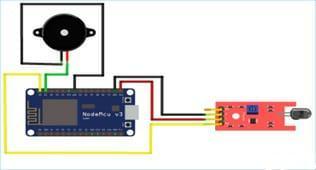
One of the most dangerous fire tragedies has a solution: the fire alarm system. ESP8266 Node MCU, Flame sensor, and Buzzer are only a few of the hardware
components that must be integrated to create a Smart IoT-basedFireAlarmSystem.Thesedevicesmustalsobe connected to a computer for data handling and transmission. Using the Twilio app, which will communicate the message to the system, makes it possible to accomplish more. As a result, the hardware and software components that make up the Fire Alarm System's fundamental building blocks are both present. This makes it easier for us to spot and put out fires immediately.
In[1],theresearchonfireusingfirealarm systemsisdiscussed.In[3], Fire Behaviour andFire line Safety is discussed. In [5], Review on Forest Fire Detection using sensors is discussed. In [7], Forest Fire Smoke Video Detection Using Spatiotemporal and Dynamic Texture is discussed. In [10], Multilayer Neural Network Based Fall Alert System Using IOT is discussed. Inthispaper,weintroduceNodeMCUinsteadofArduino. Itwillconsumelesspowerfromthesource.
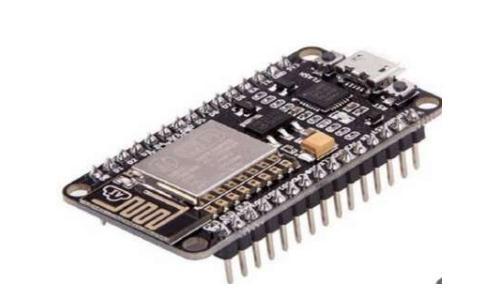
The term "Internet of Things" (IoT) refers to a scenarioinwhichobjects(includingpeople,animals,and machines)aregivenuniqueidentifiersandthecapability to automatically transmit data over a network without requiring human-to-computer interaction. ESP8266 Node MCU is an open source IoT platform that includes firmware that runs on the low cost Wi-Fi enabled ESP8266 Wi-Fi SoC from Espressif Systems and hardwarethatisbasedontheESP-12module.InthisIoT FireAlarm, we areusing twoGPIO pinto getthedigital data from the flame sensor. ESP8266 NodeMCUisa key componentoftheInternetofThings.
Chemical factories, shopping centers, neighbourhood stores, educational institutions, parking lots, businesses, etc.areallusedinoursystem.
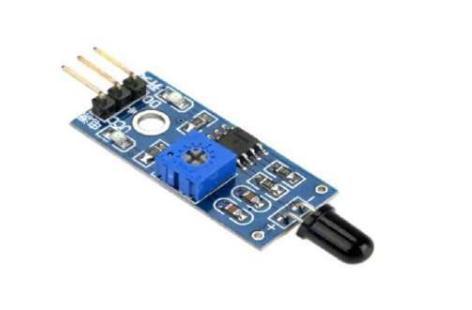
The existence of a fire source or any other bright light sources can be found using a flame sensor. A flame sensor can be implemented in a number of different ways, however the module used in this project is an infraredradiationsensitivesensor.
A LM393 comparator chip is used by the module to produce a steady digital output signal. The driving capacity of this comparator is 15 mA. Fire alarms and other fire detecting systems or projects are just a few applicationsforthisflamedetectorsensor.
Opensourceprototypingboarddesignsareavailablefor the Node MCU firmware, which is accessible for free download. Combining the words "node" and "MCU," the term "Node MCU" (micro-controller unit).Rather than the related development kits, the firmware is strictly speaking referred to as the "Node MCU" in this context. The prototyping board designs as well as the firmware are both free source. Using IoT Twilio, it also alerts the relevantauthorities
ProgrammingintheC languageispossibleforthis system.WiththehelpoftheSMTP(SimpleMailTransfer Protocol)infrastructure, youcanautomaticallysendand receive a lot of emails from distant locations. Due to its quick and dependable service, it is primarily utilised by developers and marketers to save time while sending emails securely. Its servers and data centres are dispersed across the globe, allowing it to choose the nearestserverandhenceofferthefastestconnectionfor sending and receiving emails. It can be used in IOT applicationstosendemailsautomaticallywhenaspecific job occurs. When fire is detected by the flame sensor in thisproject,emailwarningswillbesentusingSMTP2GO.
Flexible: There are currently fire alarms available that can also be monitored on mobile devices and can get messagesfromthealarm,includinganalertevent;which detector has triggered so you know the location of the potentialfire.
Accessible:Throughthesystemoramobiledevice,itcan beusedfromanywhere.
Firesafetyis one of the crucial factors to ensurethe safety of your premises, be it home or office. It is essential to have a good quality fire alarm system in place to protect the premises and warn people when a firebreaksout.Incaseyouownacommercialproperty,it is your fundamental duty to install a conventional fire alarm control panel to ensure 100% safety of the employeesandresources.Themaingoalofestablishinga fire alarm system is to be alerted when smoke or fire is discovered in a building, allowing people adequate time to escape. You can choose a fire alarm based on your location's needs from a variety of models that offer a rangeoffeatures. Thereisnothingmoreimportantthan protecting the lives of individuals visiting your home or place of business, thus installing a fire alarm in your premises should be at the top of your priority security checklists.
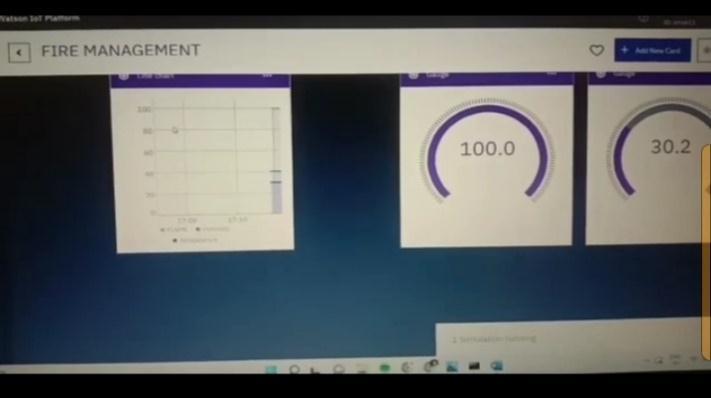
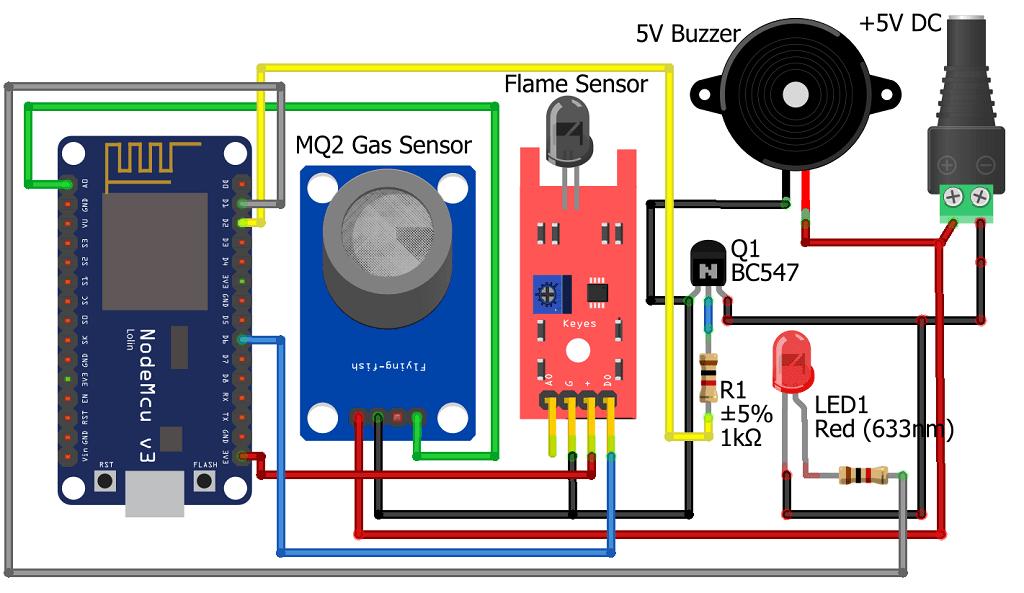
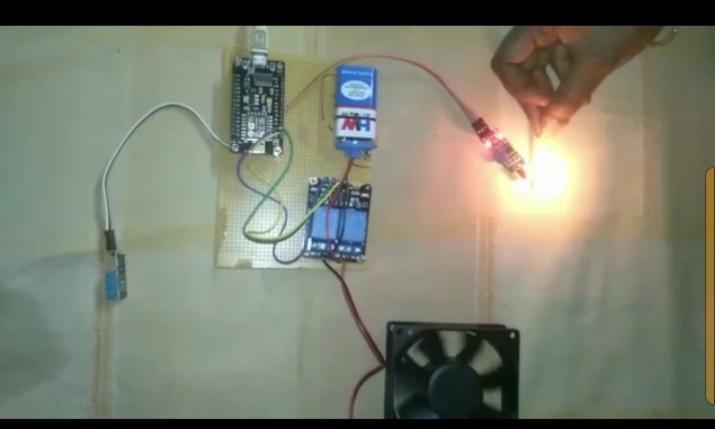
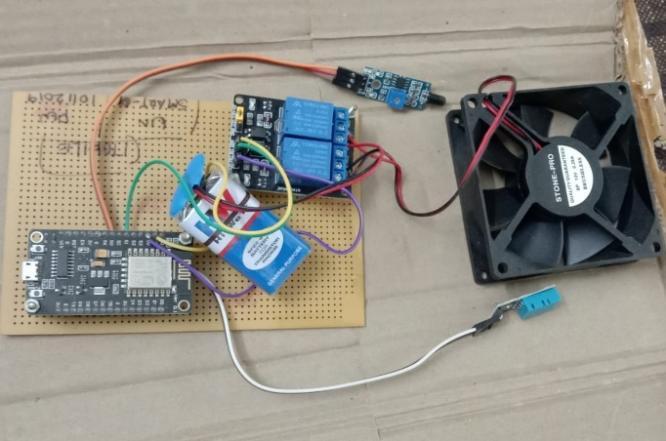
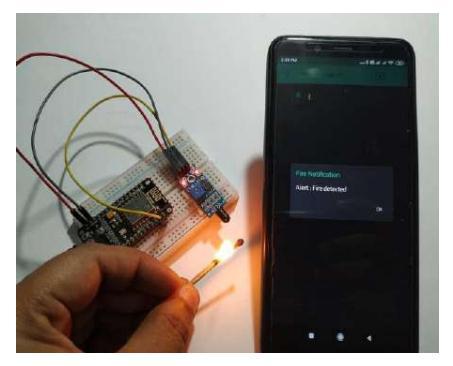
The hardware prototype that has been created to implement the suggested methodology is shown in the image below. The tests were carried out using the experimentalset-uplistedbelow.
All of the fire alarm modules in a building are managed
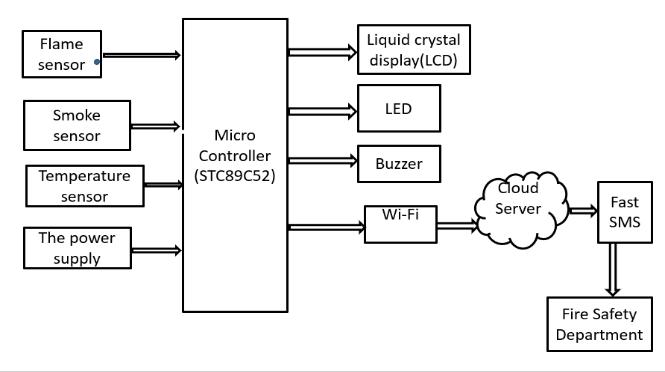
byafirealarmsystem,whichisanactivefireprevention system. It is made up of power supplies, wirings, fire control units (sprinkler systems or fire extinguisher systems), alarm initiating devices (smoke detectors and heat sensors), alarm notification appliances (sirens or devices that make loud noises), and alarm initiating devices (smoke detectors and heat sensors). Smoke detectors,heatdetectors,oramanualactivationmethod can all activate the fire alarm system. These sensors are programmed to recognise specific heat or smoke levels that might be a fire sign. To warn people within the structure, a resounding bell or siren, sometimes accompaniedbyblinkingorflashinglightsforthosewith hearing difficulties, blasts. Let's look more closely at the fire alarm system's components so that you can comprehendhowitoperateson a deeperlevel.Asmoke detectortodetectsmokeorfireisalwayspresentinafire alarm system. The system's procedure The Node MCU boardestablishesaninternetconnectionwiththeTwilio cloudassoonasthesystemisturnedon.TheTwilioapp interfacewillthenletusturnthissystemONandOFF.As soon as the red LED and buzzer are turned on in the event of a fire when the system is turned on, the smartphone receives a push notice. Then, the system returns to its original state. After that, the green LED bulbisturnedon.
The non-contact fire alarm security system built on the Internet of Things was thus successfully created and validated. Using GSM (Global System Mobile) for long distance can expand the suggested strategy. Since they have a very high efficiency and can be used for security purposes, electronic circuits can therefore be designed for fire-based alarms. The best way to achieve early fire detection is to install and maintain fire detection equipment in all rooms. Since they have a very high efficiency and can be used for security purposes, electronic circuits can therefore be designed for firebased alarms. Installing and maintaining fire detection systems in all rooms and other sections of the home or business is the best way to accomplish early fire detection. The above experiment's findings demonstrate that different types of fire detectors have varying sensitivitytofire.Bothtypesofequipmentareactivefire protection systems, according to the trial. Two distinct typesofheatdetectorswereutilisedtocomparethemfor the heat detector. The outcome demonstrates that the Rate of Temperature Rise Detector is more sensitive to heat; it took 192.57 seconds to sense heat, compared to 183.70secondsfortheHeatDetector(60°C)SetPoint.
[1] Breejen E. D. et al 2003–2012 In Proceedings of 3rd International Conference on Forest Fire Research and 14thConference on Fire and Forest Meteorology (Luso, Portugal)Autonomousforestfiredetection1620.
[2] Hartung C. and Han R. 2006 Fire WxNet: A Multi Environments 4thInternational Conference of Mobile Systems,ApplicationsandServices.
[3] Viegas D.X. 1993 Fire Behaviour and Fire line Safety Annual Mediterranean Burns Club. Scott J. H. 2012
Introduction to Wildfire Behaviour Modelling National Interagency Fuels, Fire and Vegetation Technology, WildlandFireManagementRD&A.
[4]Alkhatib A. A. A. 2014 A Review on Forest Fire Detection Techniques International Journal of DistributedSensorNetworksArticleID:597368.
[5]Vicente F. B., Carbajal N., Felipe L. and Martínez L. P. 2014 Estimation of Total Yearly CO2 Emissions by Wildfires in Mexico during the Period 1999-2010 AdvancesinMeteorologyArticleID:958457,2014.
[6]Zhao Y., Zhou Z. and Xu M. 2015 Forest Fire Smoke Video Detection Using Spatiotemporal and Dynamic Texture Features Journal of Electrical and Computer EngineeringArticleID:706187,2015.
[7]Vijayabaskar V. and Rajendran V. 2010 Analysis and modelling of wind dependence of ambient noise in shallow water of Arabian sea European Journal of ScientificResearch5028-34SJRIF:0.21,Nov.
[8]Manjula P. and Balachandra P. Information and Communication Technology for Sustainable Development. Lecture Notes in Networksand Systems9 edD.Mishra,M.NayakandA.Joshi(Singapore:Springer) An Analysis on Pricing Strategies of Software ‘I-Med’ in HealthcareIndustry.
[9]ShahadaSA,HreijiSM,Atudu SIandShamsudheenS 2019MultilayerNeuralNetworkBasedFallAlertSystem Using IOT International Journal of MC Square Scientific Research111-5.