ASSESSMENT OF URBAN DYNAMICS IN LAND USE AND DEMOGRPAHY USING GIS TECHNIQUES
Nivetha.M1 , Sudhan
Srinivas.N21M.plan Student ,school of planning Architecture and Design Excellence SPADE, Hindustan Institute of science of Tecchnology and Science(HITS), Chennai,
2Assitant professor, school of planning Architecture and Design Excellence SPADE, Hindustan Institute of science of Tecchnology and Science (HITS), Chennai,Tamilnadu ***
Abstract - The process of urbanization is occurring rapidly in poorer nations and causing significant shifts in land use. This is linked to population expansion and poses challenges for managing urban growth and land use. To address these challenges, integrated urban policy approaches and sustainable urbanization strategies are necessary. This study uses literature reviews and case studies from both national and international contexts to identify various models, methods and approaches for managing urban growth and land use. The study focuses on sampling techniques, data collection and GIS techniques to analyse case studies andprioritize indicators for future land use changes. The conclusion of this dissertation highlights the importance of adapting to various urbanization scenarios considering the spatial and temporal scale of change and implementing sustainable urbanization strategies. The use of GIS tools for analysing future land use changes leads the way forward for planning and managing urban growth, creating properly planned cities, and promoting the quality of life for inhabitants and the environment. Overall, this study contributes to a deeper understandingofthedynamicsofurbangrowthandtherole of land use and demography in shaping the future of urban environments
Key Words: Land use and land cover, Population, Remote sensing, ARC GIS , LANDSAT images .

1.INTRODUCTION
Urbanization is a complex and multidimensional process that is occurring at an unprecedented rate and scale worldwide. As the world's population continues to grow the cities are becoming the primary centers of economic and social activity resulting in significant changes in land use and patterns of urban growth. While urbanization is happening at different rates and scales across the globe, developing countries are experiencing particularly rapid urbanization, which is directly linked to population growth. The process of urbanization involves a transformation of the natural landscape including the conversionofrurallandtourbanlanduseresultinginthe lossofnaturalhabitats,biodiversity,andopenspaces.The impacts of urbanization on the environment and human
health are significant and complex ranging from pollution and resource depletion to social and economic inequality. Managing urban growth and land use change is a critical challenge for policymakers and planners in both developed and developing countries. Sustainable urbanization strategies and integrated urban policy approaches are essential to ensure that urbanization occurs in a manner that is socially, economically, and environmentallysustainable.Understandingthedynamics of urban growth and land use change taking into account of spatial and temporal considerations is essential to developing effective policies and strategies for managing urbanenvironments.
1.1 Aim
To Study Urban Dynamics using Geospatial tools such as Geographic Information System (GIS) and Global positioningsytem(GPS)
1.2 Objective Of The Study
Theobjectiveofthisstudyistogainanunderstanding of the urban dynamics in major cities in both nationally and internationally. This includes examining the land use patterns, demographic profiles, and population densities in these areas. Another goal of the study is to explore the use of GIS in analysing land use patterns and identifying future land use scenarios which can be used to inform urbanplanningandmanagementstrategies
1.3 Scope
The objective of the study is to understand the reasons behind unplanned urban expansion in cities due tounequalpopulationanddevelopmentgrowth.Thestudy will also focus on analysing the dynamics of land use resultingfromchangingpopulationdemand.
1.4 Limitation Of The Study
The objective of the study is to understand the reasons behind unplanned urban expansion in cities due tounequalpopulationanddevelopmentgrowth.Thestudy
will also focus on analysing the dynamics of land use resultingfromchangingpopulationdemand.
1.5 Methodology
Themethodologyofa study referstotheapproachor method used to understand and identify various classifications for the research. This involves a series of stages such as selecting a research design, defining the research problem. Proper execution of these stages is crucialforproducingreliableandvalidresearchoutcomes.
multiple factors. The analysis with co-concurrence network can help identify the causes and effects of land use changes and forecast future scenarios [2]. Accurate forecasting of land use and land cover (LULC) changes is essential for sustainable planning and management. The use of Cellular Automata-Artificial Neural Network (CAANN) and Modules to Identify Impacts of Maximum Changes on Agricultural and Water Bodies in LULC (MOLUSCE)canhelpforecastfutureLULCdataandassess theimpactsonagriculturalandwaterbodiesovertime[3] TheLanduse changesusingMOLUSCE,(CA-ANN),SLEUTH tocategorizedthedominantandconvertedclasessinland usechanges[4]
To effectively manage land use and land cover changes, it is important to recognize that these phenomena are complex and influenced by multiple factors. Fortunately, researchershaveproposedvarioustoolsandmodels,such as fuzzy decision and Markov models, co-concurrence network analysis, CA-ANN, and MOLUSCE, that can be used to address these issues. These tools and models can forecast future LULC data and evaluate the impacts on agriculturalandwaterbodiesovertime.Byutilizingthese models,sustainableplanningandmanagementoflanduse changescanbeachieved.
2.2 Different method of data collection techniques used





Fig1Methodologyofthestudy
The search for 5 literature reviews and 8 case studies publishedfrom2005to2022wasconductedusingvarious databases with search terms related to land use changes and population density analysis using GIS. The studies were manually analysed to determine their study designs and outcomes. A comprehensive review was undertaken tosummarizethefindingsfromthesestudies.
2. Literature Study
After reviewing the literature and case studies several key indicators related to land use changes and population density analysis using GIS were identified. Further study should be conducted to understand how these indicators impact land use changes and population density and how GIS can be used to inform decision makingintheseareas.
2.1 APPROACH USED FOR LAND USE AND LAND COVER
Land use and land cover changes are important spatial problems that require effective management and decision-making.Fuzzy decisionandMarkovmodelshave been proposed as tools for addressing these issues [1]. Land use changes are complex phenomena influenced by
Mapping land use and land cover changes is important for understanding the spatial patterns and dynamics of the landscape. The use of Global Positioning System(GPS)andGeographicResourcesAnalysisSupport System (GRASS) Open Source Software can help to map landuseandlandcoverchangesoveracertainperiod [1] Monitoring land use changes is essential for sustainable land use planning and management. The use of Web of Science (WOS) bibliographic database and Geographic Information System (GIS) can help to collect data and monitorlandusechangesata rangeofscales [2] Theuse of Landsat images and Arc GIS overlay analysis can providea powerful toolfor preparingand analysing LULC data.Decision-makerscanusethisapproachtodetermine changes between LULC sub-classes and make informed choices for sustainable land use planning and management[3] Monitoringurbangrowthandpopulation is essential for understanding the dynamics of urbanization. The use of Logic Scoring Preference (LSP) can help to identify high-density urban growth areas and provide insights into urbanization patterns [5] The accurate mapping of land use is essential for sustainable land use planning and management. The use of QGIS can helpcollectandpre-processrasterdatatocreatelanduse maps[4]
The use of a diverse range of tools and technologies such as GPS, GRASS Open Source Software, WOS bibliographic
database, GIS, Landsat images, Arc GIS overlay analysis, LSP, and QGIS can assist in mapping and monitoring changes in land use over time. These technologies can provide decision-makers with valuable insights into the spatialpatternsanddynamics ofthelandscape,whichcan inform sustainable land use planning and management strategies. Furthermore, monitoring the growth of urban areas and population is crucial for comprehending the impact of urbanization on the environment and LSP can aid in identifying regions of high-density urban growth. Ultimately,accuratemappingoflanduseisfundamentalto sustainable land use planning and management with different leveraging tools and technologies can help achievethisobjective.
2.3 FORECASTING AND EVALUATING DEMOGRAPHY
Forecasting urban growth is essential for sustainable urban planning and management. The use of Analytical Hierarchical Process (AHP) and Multi-Criteria Evaluation can help for the next 10 years [1] Urban growth can lead to a range of social, economic, and environmental challenges. The use of Urban Growth Analysis (UDSA) with decision support systems and stakeholder engagement can help upgrade land use policiestofacilitatesustainableurbandevelopment[5].
The use of a diverse range of tools and technologies such as GPS, GRASS Open Source Software, WOS bibliographic database, GIS, Landsat images, Arc GIS overlay analysis, LSP, and QGIS can assist in mapping and monitoring changes in land use over time. These technologies can provide decision-makers with valuable insights into the spatial patterns and dynamics of the landscape which can inform sustainable land use planning and management strategies. Furthermore, monitoring the growth of urban areas and population is crucial for comprehending the impact of urbanization on the environment and LSP can aid in identifying regions of high-density urban growth. Ultimately,accuratemappingoflanduseisfundamentalto sustainable land use planning and management, and leveraging different tools and technologies can help achievethisobjective.
2.4 INFERENCE
Effective management and decision-making for land use and land cover changes require accurate data collection, forecasting, and evaluation techniques. Various approaches have been proposed such as fuzzy decision, Markov models, co-concurrence network, CA-ANN, MOLUSCE, SLEUTH, GPS, GRASS, WOS, GIS, Landsat images, Arc GIS overlay analysis, LSP and QGIS. Furthermore, forecasting and evaluating demography are crucial for sustainable urban planning and management. Techniques like AHP, multi-criteria evaluation, UDSA, and stakeholder engagement can facilitate sustainable urban development. These methods and techniques help
decision-makers understand the spatial patterns and dynamics of land use changes, forecast future scenarios and make informed choices for sustainable land use planningandmanagement.
3. CASE STUDY ( National and International )
In order to attain through understanding the challenges andissues concerning land use and landcover changes in India .It is imperative to analyse national case studies. These studies provide valuable insights into the spatial patterns and dynamics of such changes along with the socio-economic and environmental factors that influence them. Furthermore, national case studies can assist in formulating policies and making informed decisions for sustainable land use planning and management in the nation.
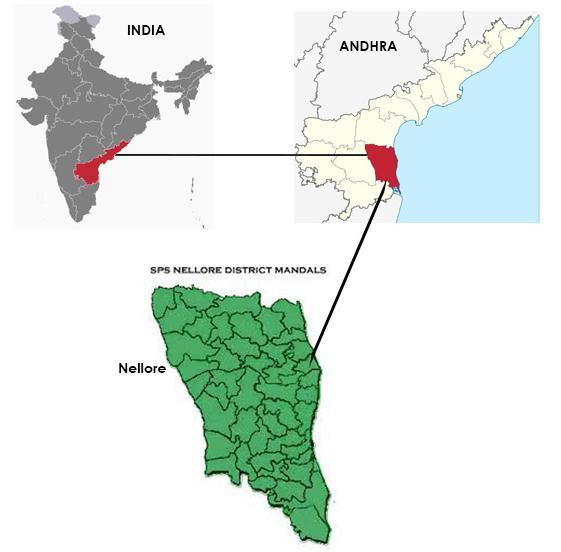
3.1 Study Area – Nellore in Andhra Pradesh, India .
The paper "Land Use and Land Cover Analysis of Nellore
Using GIS and Remote Sensing Techniques" discusses the approaches and methods employed to study land use and land cover changes in the Nellore district of Andhra Pradesh, India. It explores various data collection techniques and remote sensing in GIS tools utilized to analyse the spatial patterns and dynamics of land use changes[6]
This research focuses on the Nellore district in Andhra Pradesh, India, covering an area of around 13076 sq.km withapopulationdensityof182persq.km.Thestudyarea lies between latitude 14°30’24” – 14°38’38” N and longitude80°04’18”–80°13’08”E fallinginSurveyofIndia Toposheet No: 66B02. The eastern part of the district is relatively fertile and prosperous, while the coastal belt, extendingabout5to6kminland issandy[6].
Two image classification methods, supervised and unsupervised, were employed in the Land Use and Land Cover Analysis of Nellore using GIS and remote sensing techniques. These methods were used to identify the significant increase in agriculture and built-up areas, whichcanaidintheimplementationoflanduseschemes. ThematicandtopographicmapswerecreatedthroughArc GISsoftwaretorepresentthetone,size,shape,andtexture of the land use image. The thematic maps provided information on land use categories such as agriculture, built-upareas,andwaterbodies.Thetopographicmapson theotherhanddepictedtheterrainelevationandslopeof the study area. The study also employed a change detectionanalysistoidentifythetemporalchangesinland useandlandcoverpatterns.Thisinvolvedcomparingtwo setsofsatelliteimagestakenatdifferenttimeperiods,and analysing the differences in land use and land cover classes.
3.2 Study Area - Raiganj Urban Agglomeration, India
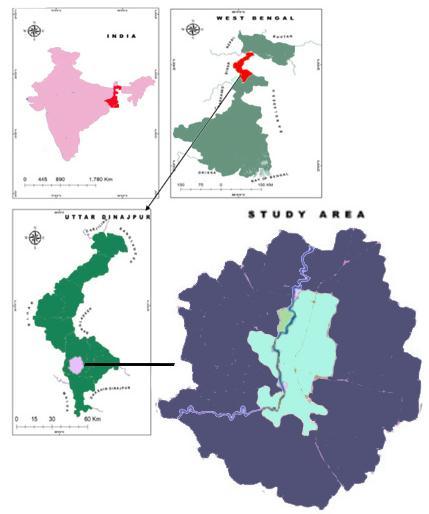
The research was conducted in the southwestern part of Uttar Dinajpur district located in West Bengal, India. The area spans across 110.80 square kilometers and has a population of 199,690 individuals. Raiganj, an urban agglomeration consisting of the Raiganj municipality, Kasba,andNachhratpurKatabaricensustown fallsunder categoryIUAs/townsasperthe2011census[7].
The research paper titled "Monitor Dynamics Using Remote Sensing And GIS Techniques Of Raiganj Urban Agglomeration,India"aimstoinvestigatethelanduseand land cover changes in the Raiganj urban agglomeration areainIndiausingremotesensingandGIStechniques.The studyfocusesontheapproachandmethodsusedforland useandlandcoveranalysisincludingthecollectionofdata using various techniques and the forecasting and evaluationofdemography[7]
The study employs Kappa coefficient to analyse the land use and land cover classes and identify the continued expansionofbuilt-upareasandmajorlossesinotherland useclasses.TheAccuracyAssessmentmethodisutilizedto predict accurate data and indicate the allocation of builtup areas and higher urban sprawl. To identify urban growth and typology, Pearson's Chi-square and Shannon Entropy are used to analyse high growth sprawl in the edge and beginning of the Raiganj area. The results show that built-up areas have increased significantly in the urban agglomeration. The study also examines the demographic changes in the region through forecasting and evaluation techniques. The findings indicate a substantial population increase in the area and a corresponding rise in demand for urban infrastructure andservices
3.3 Study Area - Miami Area, South Florida, Usa
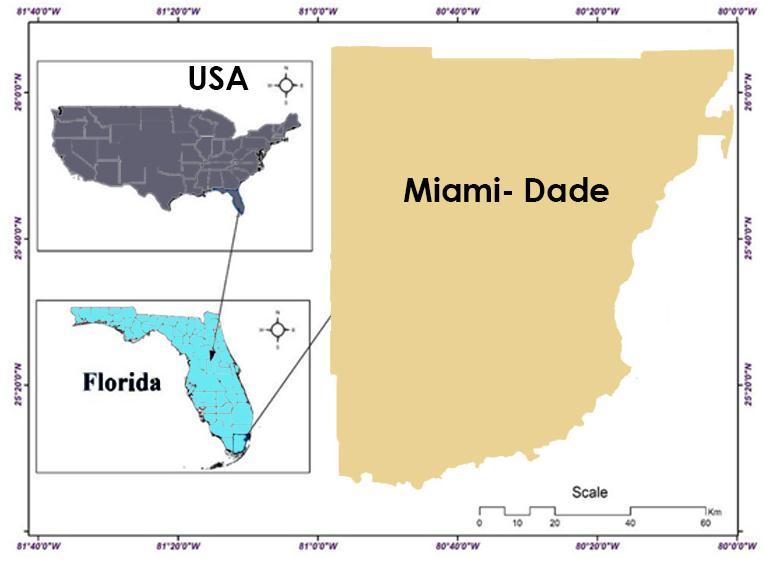
The study examines Miami-Dade County, the most populous country in Florida, which is made up of 34 incorporated municipalities, cities, towns, and villages. MiamioneofthesmallestmajorcitiesintheUnitedStates covers 93.2 sq.km of land and 52.0 sq.km of water. According to the Florida geological survey, the county's baserockiscomposedofsedimentaryrocksandlimestone fromtheOrdovician-Devonianera[8]
4–StudyAreaof MiamiDadeCounty
The research utilized linear statistical and regression models to predict land use maps, with a specific focus on urban built-up and vegetation areas. To analyse the color ofeachpictureinthelandusemapthestudyemployedthe open-source color palette software "Image Color Extract and PHP tool." A supervised classification approach was utilized for the land use classification and the kappa coefficient was used to assess the accuracy of the classification. The study collected data from various sourcesincludingsatelliteimagery,topographicmaps and field surveys. Additionally the study calculated the normalizeddifferencevegetationindex(NDVI)toquantify thevegetationcoverinthestudyarea.Thelandusemaps were generated using ArcGIS 10.1 software and the analysis was conducted using SPSS 22 software. The findings showed significant expansion of urban built-up areas over the study period accompanied by a decline in vegetation areas. Overall, the study underscored the effectiveness of remote sensing and GIS techniques in monitoringurbangrowthdynamics
3.4 Study Area – Opole , Poland
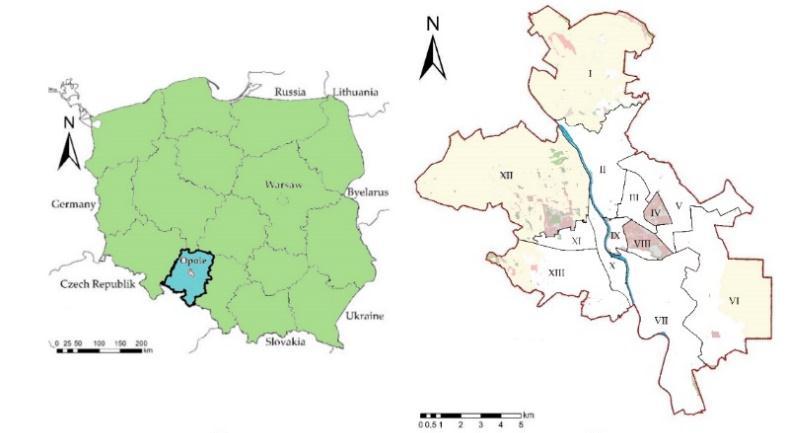
The study focuses on the city of Opole, situated in the south-western region of Poland, which serves as the capital of Opole Province and the core of Opole Agglomeration. As the largest economic, academic and culturalcenterintheregionitholdsgreatsignificanceasa labor market for its residents and the surrounding areas. The city's area was expanded to 149 Sq.km in 2017 by including 12 new villages, ranking it 15th among Polish districts and cities in terms of area. Previously, Opole coveredanareaof97km2.ThecityislocatedintheOdra Rivervalley[9].
Fig5Poland,CentralEurope
The study employed a supervised maximum likelihood classificationalgorithm(MLC)toexaminechangesinland useandcoverduetounregulateddevelopmentofbuilt-up areas.Todeterminefuturelandusemaps theresearchers utilized ArcGIS and SNAP software for image processing, spatial raster analysis, and digital GIS creation. This approachfacilitatedaccuratemappingoflandusechanges and could provide valuable insights for policymakers whendevelopingsustainablelandusepolicies.Inaddition, the study utilized demographic forecasting techniques to evaluate population growth rates (PGR) and avoid a decreaseinpopulationprojections.TheLCRandPGRwere applied to identify areas for potential growth and development while reducing negative urbanization impacts.
3.5 Inference

Thestudyexaminedchangesinlanduseandcoverdue to unregulated development of built-up areas using remote sensing and GIS techniques. The researchers utilized supervised maximum likelihood classification algorithm and demographic forecasting techniques to identify areas for potential growth and development while reducing negative urbanization impacts. The study utilized linear statisticalandregressionmodelstopredictlandusemaps with a specific focus on urban built-up and vegetation areas. It shows significant expansion of urban built-up areas over the study period, accompanied by a decline in vegetation areas. The study also examined the demographic changes in the region through forecasting and evaluation techniques indicating a substantial population increase in the area and a corresponding rise indemandforurbaninfrastructureandservices.
Two image classification methods, supervised and unsupervised were employed in the Land Use and Land Cover Analysis of Nellore using GIS and remote sensing techniques.Thematicand topographic mapswerecreated through Arc GIS software to represent the tone, size, shape, and texture of the land use image, providing information on land use categories such as agriculture, built-upareas,andwaterbodies.Thestudyalsoemployed
a change detection analysis to identify temporal changes inlanduseandlandcoverpatterns,comparingtwosetsof satelliteimagestakenatdifferenttimeperiods.Theresults showed a significant increase in agriculture and built-up areas which can aid in the implementation of land use schemes. The study highlighted the effectiveness of remote sensing and GIS techniques in monitoring urban growth dynamics providing valuable insights for policymakers when developing sustainable land use policies.
4. Findings
The findings of the research suggest that remote sensing and GIS techniques along with accurate data collection, forecasting, and evaluation techniques, are essential for effectivelanduseandcovermanagement.Theintegration of machine learning and artificial intelligence techniques canprovidevaluableinsightsintothespatialpatternsand dynamics of land use changes, while citizen science and participatory approaches can enhance stakeholder engagement and promote sustainable urban planning and management
The integration of machine learning and artificial intelligencetechniquesinlanduseandcovermanagement has the potential to provide more accurate and comprehensive insights into spatial patterns and dynamics of land use changes. Machine learning models can be trained to automatically detect land use changes classify land use categories and forecast future scenarios based on historical data. Additionally machine learning algorithms can be used to analyse satellite imagery and otherremotesensingdatatoidentifytemporalandspatial changes in land use patterns. By integrating machine learning techniques with existing land use management strategies stakeholders can make informed decisions that leadtomoresustainableandresilienturbandevelopment. participatory approaches can also play a crucial role in enhancing the accuracy and sustainability of land use managementdecisions
There is a lack of coordination in planning and implementation of growth management strategies for effectivelanduseandcovermanagement.Whileadvanced techniques such as statistical and regression models, supervised and unsupervised classification methods, and evaluation techniques such as AHP and multi-criteria evaluation can aid in effective land use management, the lack of coordination among stakeholders can hinder the implementation of these strategies. Therefore, further research can focus on developing innovative approaches for stakeholder engagement and collaboration in growth management planning and implementation. Another research gap is the need to explore the use of advanced softwaresuchasMOLUSCEandSLEUTHformicro-studies with smaller areas. While these software are commonly
used in larger area studies, they can also be applied in micro-studies to enhance the accuracy and sustainability oflandusemanagementdecisions.Additionally,thereisa need to explore the use of satellite imagery in microstudies, as this can provide more detailed and accurate data for land use mapping and management. Further research can focus on developing and testing these approaches in micro-studies to evaluate their effectiveness in enhancing land use and cover management.
3. CONCLUSIONS
In conclusion, rapid urbanization has led to significant changes in the landscape structure and had negative consequences on the environment and ecology. Urban policy and sustainable development plans are required to addresstheseissuesbyintegratingmethodsthattakeinto considerationthespatialandtemporalscaleofchangesin the processes affecting the city's development. Land use changes caused by ongoing urban sprawl processes are among the most significant and frequently irreversible types of environmental change that have an impact on howwelive.
To prevent demographic suburbanization and land use changes, it is important to identify and implement land uses that will meet community needs while securing resources for the future. By studying various models, methods and indicators from literature and case studies. wecanplanforlanduseanddemographicchangesinurba areas to create a properly planned city in the future. Geographic information system tools can be used to analyse future land use models which can lead the way forward in addressing the challenges of urbanization. The implementation of these tools and techniques can help us to create sustainable cities that are environmentally friendly and provide a high quality of life for their residents. It is therefore essential that we continue to studyandapplythelatesturbanplanningapproachesand technologiestoaddressthechallengesofurbanization.
REFERENCES
[1] H.A. Bharath, T. R. (2017). Modelling urban dynamics in rapidly urbanising Indian cities. The Egyptian JournalofRemoteSensingandSpaceSciences.
[2] Bielecka, E. (2020). GIS Spatial Analysis Modeling for LandUseChange. geosciences.
[3] Pandi, D. (2021). Assessment of Land Use and Land CoverDynamics. Environmentalstudies,Pol.J.Environ. Stud.Vol.31,No.3(2022),2779-2786.
[4] dawid, W. (2022). GIS-based land cover analysis and prediction based on open-source software and data. Sciendo,pp.75–86.
[5] Shen,S.(2021).GIS-basedLogicScoringofPreference method for urban densification suitability analysis. Computers,EnvironmentandUrbanSystem.
[6] Pradeeep, P. S. (2019). Land use and Land Cover Analysis of Nellore . International Journal of EngineeringResearch&Technology,ISSN:2278-0181.
[7] Roy, B. (2021). Monitoring urban growth dynamics usingremotesensingandGIS. The Egyptian Journal of Remote Sensing and Space Sciences, The Egyptian Journal of Remote Sensing and Space Sciences 24 (2021)221–230.
[8] Divya, Y. (2020). Color slices analysis of land use changesduetourbanization ina city. Modeling Earth SystemsandEnvironment
[9] Stokowska,A.(2021).Spatial-Temporal LandUseand Land Cover Changes in Urban Areas Using Remote Sensing Images and GIS Analysis. geosciences, Geosciences2021,11,312.