SYSTEM FOR ATTENDANCE TRACKING BASED ON THE INTERNET OF THINGS THAT MAKES USE OF A FINGERPRINT SENSOR ACCESS BY STAFF AND PARENT
1A.Anand Babu. Assistant Professor, Department of Electronics And Communication Engineering, VivekanandhaCollege of Technology for women, Tamil Nadu, India
2,3,4,5 Students, Department of Electronics And Communication Engineering, VivekanandhaCollege of Technology for women, Tamil Nadu, India.
Abstract:
A trendy method for tracking attendance records in schools, colleges, and companies is an IoT-based attendance monitoring system that uses a fingerprint sensor. The solutionlinksafingerprintsensortoacloud-baseddatabase using Internet of Things (IoT) technology, providing realtime tracking of attendance records. To verify users' identities and keep track of their attendance, the system employs a fingerprint sensor. The collected data is subsequently sent to a cloud-based database, where it is safely kept and accessible to authorized individuals whenever and wherever needed. The method reduces the possibility of fraud or mistakes and does away with the necessity for human attendance records. This paper discusses the design, implementation, and evaluation of an IoT-basedattendancemonitoringsystemusingafingerprint sensor and a cloud-based database for both teachers and parents.
Keywords: Arduino, LCD16x2, Fingerprint Sensor, RTC Module,cloud,IoT
1. Introduction
The term Internet of Things or IoT refers to a network of gadgetsthatareconnectedtotheinternetandarecapable of exchanging data. IoT may be utilized to build an attendance tracking system that employs a fingerprint sensor to track attendance and stores the information in the cloud. The technology functions by capturing each person'sspecificbiometricinformationusingafingerprint sensor. To confirm the person's identification, the sensor nextcompares the data ithascollectedwitha database of fingerprints that have already been saved. Once the person's identification has been verified, the system logs theirattendanceanduploadstheinformationtothecloud. A network of distant servers utilized for data processing,

management, and storage makes up the cloud. The cloud maybeused tostoreall of theuser'sattendance data in a single location for an attendance tracking system. As long as there is an internet connection, this enables access to the data from anywhere in the globe. The benefits of utilizing an IoT attendance tracking system For acquiring student attendance, the suggested system employs a fingerprintrecognitionapproach.Becauseofthesimplicity and precision of fingerprints, humans have been utilizing themforrecognitionreasonsforaverylongtime.
The identification of fingerprints is dependent on two factors;1.Persistence: the core qualities and attributes do not change over time.2.Individuality: every person in the world has a unique fingerprint. Current fingerprintmatching techniques were developed in the late 16th century and advanced significantly in the twentieth century. Fingerprints are commonly employed in forensic laboratories and identification units and are regarded as one of the most mature biometric technologies.1. Accuracy: Fingerprint sensors offer great accuracy in confirming a person's identification, lowering the possibility of mistakes in attendance records.2. Convenience: The system saves time and reduces paperwork by doing away with the need for manual attendancerecords,makingiteasyforbothemployersand employees.3. Security: Because fingerprint information is personal to each person, nobody can fabricate attendance records.4. Accessibility: Since data on the cloud is accessible from anywhere in the globe, it is simpler for employerstotrackattendancefromadistance. Overall,an IoT-based attendance monitoring system equipped with a fingerprint sensor provides a dependable, accurate, and securemethodoftrackingattendancedata.
1.1 Contribution of the Work
Attendance monitoring is accurate because of the use of fingerprint technology, which eliminates the chance of mistakes or false entries. Saving time: The technology removes the need for manual attendance monitoring, saving both instructors and students time. Improved security: The system guarantees that only authorized users have access to attendance records, eliminating the chance of tampering or illegal access. Tracking real-time attendance data: The system may give real-time attendance data, which can be valuable for following attendance trends and spotting possible problems. Costeffective: When compared to traditional attendance tracking systems, the usage of IoT technology with fingerprint technology can be cost-effective. Simple integration: The system can simply link with other school administration systems, such as student information systems, making attendance records and student data managementeasier.
1.2 Related works
There are several existing methods of IoT-based attendancemonitoringsystemsusingArduino.
(i) RFID-based Attendance System Using Arduino: RFIDtagsareaffixedtoindividualIDcardsinthismanner. RFIDscannersattachedtoanArduinoboardpositionedat entry points scan RFID tags in real-time to collect attendance statistics. With IoT technology, the acquired dataissubsequentlytransferredtoacloud-baseddatabase foradditionalprocessingandanalysis.[2]
(ii) BluetoothBeacon-basedAttendanceSystemUsing Arduino: Bluetooth beacons are put at entrance points in this manner. When the beacons come within range, they sendasignaltotheindividual'smobiledevice.Themobile devicedeliversasignaltoanArduinoboard,whichcollects and transmits attendance data to a cloud-based database utilizingIoTtechnology[8]
(iii) Smart Camera-Based Attendance System Using Arduino: Smart cameras with face recognition technology are deployed at access points in this manner. The camera takes a picture of the person's face, which is then evaluatedbyanAIsystemtoidentifythepersonandtrack attendance statistics. With IoT technology, the gathered data is subsequently transferred to a cloud-based database[1]
2.Proposed Model
The proposed system will have client-server architecture, withtheArduinoboardactingastheclient,sendingdatato theserverviatheWi-Fimodule.Thisdatawillbestoredin a database, and a web interface will be provided for teachers to view and manage attendance records. The client-server architecture will ensure that the data is securely stored and that the system is easy to use and manage. The Arduino board will be used to store the reading of the Fingerprint sensor as well as to control the Wi-Fi module and send the data to the server. The server will store the data in a database, which will be accessible viaawebinterface.
Thewebinterfacewillallowteacherstoviewandmanage attendance records. They will be able to view attendance for a particular day or a range of days. They will also be able to add new students to the system, edit existing studentrecords,anddelete studentsfromthesystem.The interface will also allow teachers to generate reports and graphs based on attendance data. The system will be secured using encryption, ensuring that the data is kept safeandsecure.
The system will also be designed to be user-friendly, enabling teachers to easily manage attendance records. Overall, the proposed system will provide an efficient, secure, and user-friendly way for teachers to manage studentattendancerecords.Itwillallowthemquicklyand easilyview,edit,anddelete attendancerecords,aswell as generatereportsandgraphsbasedonthedata.Thesystem will also include advanced security features such as encryption and authentication to guarantee the privacy andintegrityofattendancerecords.Encryptionwillensure that the data is protected and cannot be accessed by anyone who does not have the right key to decode the data. Authentication will ensure that only authenticated userscanaccessthesystemanditsdata.Furthermore,the system will also include additional authentication measures such as multi-factor authentication and biometricstoensurethatonlyauthorizeduserscanaccess thesystem.
The system will also have various levels of access control so that users can only access certain parts of the system and its data. Furthermore, the system will also have detailedauditlogs,sothatanychangesmadetothesystem anditsdatacanbetrackedandmonitored.
Finally, the system will also have an automated backup feature, so that the data is always up to date and can be
quickly restored in case of any disruptions to the system. Overall, the system will include robust security measures to guarantee the privacy and integrity of attendance records.
Overall, the system captures attendance data through the biometricsensor,processesitusingtheArduinoboardand IoT module, and sends it to the central server for storage and reporting. The user interface allows teachers or administrators to view attendance data in real-time, makingiteasiertomanageattendancerecords








2.1 Arduino UNO
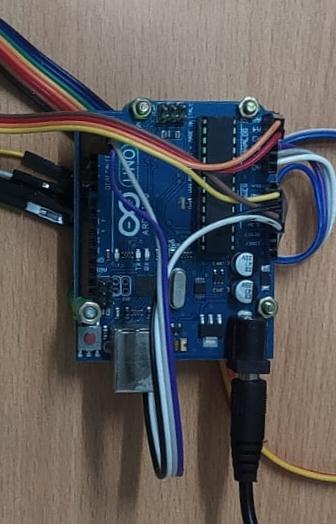
To automate the process of taking attendance and lessen the effort of teachers or administrators, attendance trackingsystemscanemployArduino.
Biometric Sensor: This component is responsible for capturing attendance data. The biometric sensor detectsfingerprints.
Arduino Board: This component acts as the main controller for the system. It receives data from the biometric sensor and sends it to the IoT module for furtherprocessing.
IoT Module: This component is responsible for connectingtheArduinoboardtotheinternet.Itcanbe a Bluetoothmodule that sends attendance data to a centralserver.
Central Server: This component receives attendance data from the IoT module and processes it. It stores the attendance data in a database and generates reportsbasedonit.
User Interface: This component is responsible for displayingattendancedatatotheuser.Itcanbeawebbased dashboard or a mobile application that shows real-time attendance data to teachers or administrators.
The following are some of the capabilities of Arduino in systemsfortrackingattendance:
Data collection: To gather attendance information, Arduino can be connected to a variety of sensors, barcode scanners, and biometric sensors. The Arduino board is then usedtoprocessandstoretheobtaineddata.
Processing: Arduino can process sensor-based attendance data and carry out several tasks such as studentidentification, attendance percentagecalculation,andreportgeneration.
Display:Arduinocan show real-timeattendance data on an LCD panel or transfer the data to a computerormobiledevicefordisplay.
Communication: Arduino may exchange data with other devices using Bluetoothto send
attendance information to a central database foradditionalprocessingandanalysis.
Ultimately, the role of Arduino in an attendance monitoring system is to deliver a cost-effective and efficient solution for gathering and processing attendance data,lessentheadministrativeorinstructorworkloadand enhancetheaccuracyofattendancerecords.
2.2 Fingerprint Sensor:
An attendance monitoring system can make use of a fingerprint sensor to precisely track each person's attendanceusingtheirparticularfingerprintpattern.
Integration: To automate the attendance tracking process and produce real-time attendancereports,fingerprintsensorscanbe readily combined with other devices like microcontrollersorPCs.
2.3 RTC(Real Time Clock)
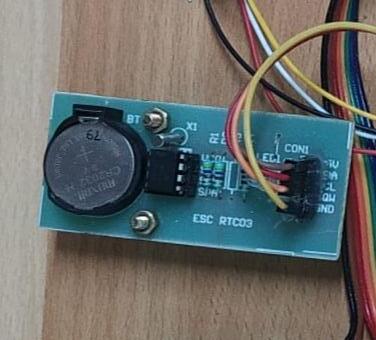
A real-time clock (RTC)is an important component in an IoT-based attendance tracking system that employs fingerprint identification. The RTC provides accurate and dependable timekeeping, which is necessary for keeping trackofattendancerecords.
Figure2.2BiometricSensor
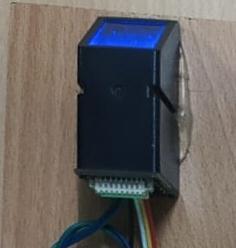
A fingerprint sensor in an attendance monitoring system candothefollowingtasks,forexample:
Identification: Based on each person's distinctive fingerprint pattern, a fingerprint sensormaysuccessfullyidentifythem.Whena person places their fingertip on the sensor, the sensor records an image of their fingerprint and compares it to the templates that have been recorded to identify the person.
Data collection:Atthestartandendofa class orwork session,a fingerprintsensorcantake a person's fingerprint to record their attendance. The gathered information is subsequently put into a database for processingandanalysis.
Accuracy: As each person's fingerprints are distinctive and difficult to replicate or fake, fingerprint sensors offer a high level of accuracyfortrackingattendance.
Here's how an RTC can be integrated into an IoT-based attendance monitoring system using fingerprint recognition:
When an employee scans their fingerprint, thesystemrecordsthescan'stimestamp.
The timestamp is subsequently sent to the RTC module, which synchronizes it with the currenttime.
The timestamp is subsequently saved in a database alongside the employee's identity information.
The system may then create reports that reflecteachemployee'sattendancedata.
ByincludinganRTCintheattendancetrackingsystem,the system can ensure that attendance data are accurate and trustworthy even when there is no internet connection accessible. The RTC guarantees that the system's time is alwayscorrect,independentofexternalvariables.
2.4 Display
A 16*2 LCD screen The following methods can be used to construct an IoT-based attendance tracking system with a fingerprintsensor:
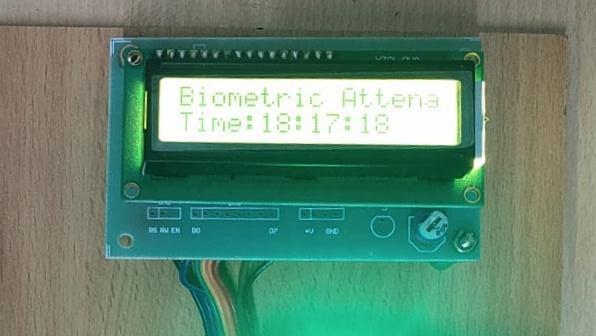
LCD configuration: The LCD must be programmed to display pertinent information suchasthedate,time,andattendancedata.
IoT setup: To enable remote access and control of the attendance monitoring system, the IoT module must be coupled with the microcontroller board. This can be accomplished through the use of Wi-Fi or otherwirelesscommunicationprotocols.
Attendance tracking: By putting the user's finger on the fingerprint sensor, the attendance monitoring system is triggered. The fingerprint will be recognized by the system, and the user's attendance will be recorded. The attendance records may be viewed on theLCDandaccessedremotelyvia theIoTmodule.
Dataanalysis:Toprovideinsightsandreports, attendance records may be evaluated using data analytics technologies. This can be beneficial in recognizing patterns and trends in attendance behavior and, if appropriate, implementingremedialsteps.
2.5 Cloud database
Aclouddatabasecanbeusedinanattendancemonitoring system to store and manage attendance data. Here are someofthefunctionsofaclouddatabaseinanattendance monitoringsystem:
Figure2.4BiometricAttendance
Hardware setup includes attaching the 16*2 LCD panel and fingerprint sensors to a microcontroller board such as Arduino or Raspberry Pi. The proper cables and jumper wirescanbeusedtomaketheconnections.
Setup of the fingerprint sensor: The fingerprint sensor must be programmed to detect the fingerprints of the users whose attendance must be recorded. The fingerprint data can be saved in the memory of the sensor.
Storage: A cloud database can store attendance data in a centralized location, making it easily accessibleandsecure.Theattendancedatacanbe stored in various formats such as text files, spreadsheets,ordatabases.
Access: A cloud database allows authorized users to access the attendance data from anywhere, anytime. This makes it easier for teachers, administrators,andstudentstoaccessandreview attendancerecords.
Security:Aclouddatabaseprovidesahighlevelof security by encrypting attendance data and providing access only to authorized users. This helps to prevent unauthorized access, data theft, ordataloss.
Real-time Updates: A cloud database allows attendance data to be updated in real-time as individuals scan their fingerprints. This provides immediate feedback and ensures accurate attendancerecords.
Reporting:Aclouddatabasecangenerateteacher, student, and administrator attendance reports This helps to track overall attendance rates, identifyattendancepatterns,andtakeappropriate actionwhennecessary.
Overall, the function of a cloud database in an attendance monitoringsystemistoprovideasecureandefficientway to store, manage, and access attendance data from anywhere,anytime.
2.5 IMPLEMENTATION
The sensor module records the fingerprint image when a person presses their finger against the fingerprint sensor. To confirm a person's identification, the fingerprint recognition algorithm analyses the fingerprint picture. If the identification is confirmed, the microcontroller uses the Ethernet or Wi-Fi module to send the attendance record to the cloud. The software application stores the attendance record in the cloud. Using the IoT platform account, the attendance record is available for access and analysis from any location. For optional real-time monitoring, the attendance record can be shown on the displaymodule.
3.5 Experimental Results and Discussion
The results of an attendance monitoring system using IoT andArduinowouldinclude:
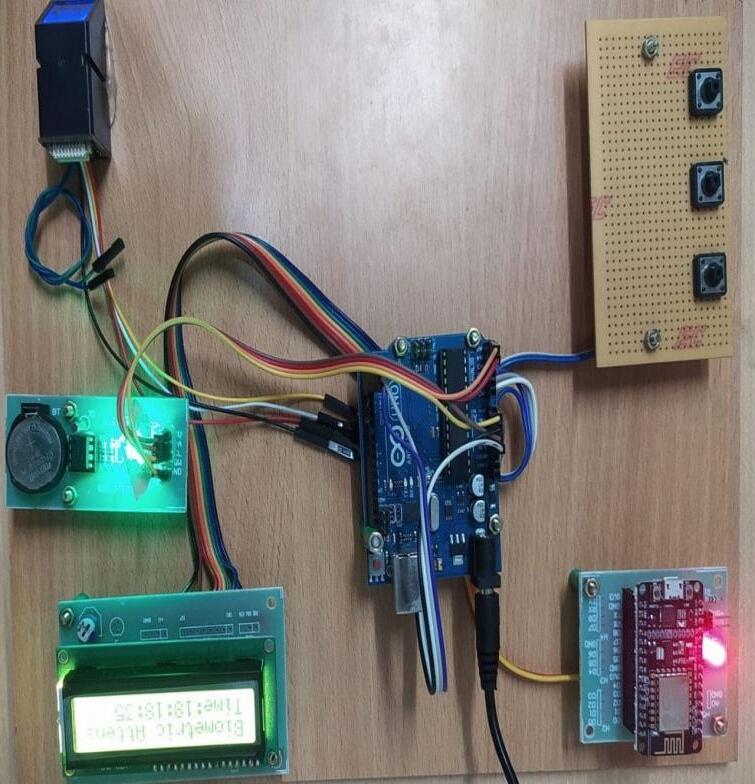
AccurateAttendanceRecords:TheuseofIoT and Arduino in attendance monitoring systems ensures accurate attendance records. The attendance data is captured in real-time, and there is no need for manual recording,reducingthechancesoferrors.
Real-Time Feedback: The attendance monitoring system using IoT and Arduino provides real-time feedback to users on their attendance status. This provides a senseofownershipandencouragesusersto bepunctual.
Improved Security: The use of biometric authenticationin the attendance monitoring system ensures that only authorized users canregistertheirattendance.Thisimproves security and reduces the chances of attendancefraud.
Remote Access: The attendance data captured by the IoT-based attendance monitoringsystemisstoredinacloud-based database, which can be accessed remotely by authorized users. This allows for easy monitoring of attendance data from anywhere,anytime.
Cost-Effective:TheuseofArduinoandIoTin attendance monitoring systems is costeffectivecomparedtotraditionalattendance monitoring systems. It eliminates the need formanualrecording,reducesthechancesof errors,andrequiresminimalmaintenance.
Overall, the implementation of an attendance monitoring systemusingIoTandArduinoprovidesaccurate,real-time attendance data, improves security, and reduces costs, makingitavaluabletoolfororganizationsandinstitutions.
3. Conclusion
Figure2.5Hardwareofsystem
The IoT-based attendance tracking system using Arduino andafingerprintsensorisaneffectiveandefficientwayto manage attendance in various settings, such as schools, universities,andbusinesses.Thesystemprovidesaccurate andreal-timeattendancedata,reducesthetimeandeffort
required for manual attendance management, and eliminates the possibility of attendance fraud. With the integration of IoT technology, the system allows for remote access to attendance data, making it easier for administrators and educators to monitor attendance trends and identify areas for improvement. Additionally, the use of Arduino and a fingerprint sensor ensures the security and privacy of the attendance data. Overall, the IoT-basedattendancetrackingsystemusingArduinoanda fingerprint sensor is a cost-effective and reliable solution that can significantly improve attendance management processesinvarioussettings.
References
1. Dipak Gadekar1, Sanyukta Ghorpade2, Vishakha Shelar3, Ajay Paithane4, “Iot BASED ATTENDANCE MONITORING SYSTEM USING FACEANDFINGERPRINT”inIRJETMay2018
2. A. Lakshmi Sudha, Shirish Shinde, Titus Thomas, ArisAbdugani,“Barcodebasedstudentattendance System”inIEEEConferenceJune2015.
3. Jones Kevin Arthur, Thomas Robinson, “Implementation aspects of the biometric system in the electronic voting machine by using embeddedsecurityandbigdataapproach”inIEEE ConferenceMay2014.
4. Seema Rao, Prof. K J. Santoa, “An attendance monitoring system using biometrics authentication”inIEEEConferenceApril2013.
5. AarushiJalundhwala, Pratik Jhaveri, Amit Deshmukh, Sandeep Khudanpur, “Wireless fingerprintattendancemarketingsystem,”inIEEE ConferenceDecember2014.
6. Mr. R. Deekshath, Ms. P. Dharanya, Ms. K. R. DimpilKabadia Mr. G. Deepak Dinakaran, Mrs. S. Shanthini, “IoT Based Environmental Monitoring System using Arduino UNO and Thingspeak” in IJSTEMarch2018.
7. Unnati Koppikar [1], ShobhaHiremath [2], AkshataShiralkar [3], AkshataRajoor[4], V. P. Baligar [5], “IoT based Smart Attendance Monitoring System using RFID” in 2019 1st International Conference on Advances in InformationTechnology.
8. Riya Lodha[1],Suruchi Gupta[2],Harshil Jain[3],Harish Narula[4] International Conference on Advanced Computing Technologies and Applications (ICACTA-2015) “Bluetooth Smart basedattendancemanagementSystem”.
9. Sri Madhu B.M, KavyaKanagotagi, Devansh, “IoT based Automatic Attendance Management System”, in International Conference on Current Trends in Computer, Electrical, Electronics, and Communication(ICCTCEEC-2017).
10. RakibHasan*,SajedulIslam,Md.HabiburRahman, Mohd. Saifuzzaman, SyedaFarjanaShetu, Nazmun Nessa Moon, “Implementation of Low-Cost Realtime Attendance Management System: A Comparative Study”, in 2020 8th International Conference on Reliability, Infocom Technologies and Optimization (Trends and Future Directions) (ICRITO) Amity University, Noida, India. June 4-5, 2020.
11. Geralde, D. D., Manaloto, M. M., Loresca, D. E. D., Reynoso, J. D., Gabion, E. T., &Geslani, G. R. M. (2017). Microcontroller-based room access control system with professor attendance monitoring using fingerprint biometrics technology with a backup keypad access system. 2017IEEE 9th International Conference on Humanoid, Nanotechnology, Information Technology, Communication and Control, Environment, and Management (HNICEM). doi:10.1109/hnicem.2017.8269432.
12. Shah,D.K., Bharadi, V.A., Kaul, V.J., Amrutia, S. (2015), “End-toEnd Encryption Based Biometric SaaS: Using Raspberry Pi as a Remote Authentication Node” on IEEE Sponsored International Conference on Computing Communication Control and Automation, 26-27 Feb. 2015, Pune, India. Doi: 10.1109/ICCUBEA.2015.19.
13. Shafi,Q.Khan,J.Munir,N.Baloch,N.K.,Fingerprint Verification over the Network and its Application in Attendance Management, 2011 2nd International Conference on Electronics and InformationEngineering,IEEE2010.