THALACARE – MOBILE APPLICATION FOR THALASSEMIA PATIENTS
1, 2, 3,4Student, Computer Engineering, K.C. College of Engineering and Management Studies and Research, Thane Maharashtra, India
5Asst. Professor, Computer Engineering, K.C. College of Engineering and Management Studies and Research, Thane Maharashtra, India ***
Abstract - Thalassemia is an inherited blood complaint in which the body cannot produce hemoglobin typically. Since cases with this condition admit blood transfusion regularly,ironbuildsupprimarilyinorganssimilarasthe heart,liver,andendocrineglands.Accumulationofironin the organs necessitates chelation remedy. These cases must visit the sanitarium constantly to access and follow up on their health condition. Thalassemia will affect the capability of the body to produce hemoglobin and red blood cells. The end of this study is to apply a Mobile Application expert system for thalassemia cases to give diet plan support the lifelong healthcare of cases. The system provides patient-affiliated details, organization campdetails,inreal-time.
Key Words: Thalassemia, Computer Science, Android Application, Blood Bank, Blood Disorder
1. INTRODUCTION
A large maturity of the cases belongs to financially underprivilegedfamiliesandanestimated66,000units of blood are needed by them every time. Thalassemia is an inheritedbloodcomplaintthatrequireslifelongcomplaint operation and thus poses a financial challenge in public healthoperations.Thalassemiawillaffectthecapabilityof thebodytoproducehaemoglobinandredbloodcells.The end of this study is to apply a Mobile Application expert systemforthalassemiaCasestogiveDietplansupportfor the lifelong healthcare of cases. The system provides patient-affiliateddetails,OrganizationCampdetailsinreal time.
1.1 Scope
By observing the daily life problem related to Thalassemia patients it is difficult to manage for the care workeraswellasforthemedicalworker,toovercomethis issue,wehavedecidedtobuildanapplicationthatwillhelp apatientby-
1.ManagingdietplansforThalassemia.
2.Arrangingbloodbagsontime.
3.Arrangingblooddonorsonthespot.
4.Organizingbloodcamp.
5.Documentverification.
1.2 Methodology
Software:
1) General:
I. Creatingthehomepage.
II. Connecting all the sections and adding the levelup.
III. Adding Seeker(requester), Donor, Diet plan, Organizationuserinterface
2) UserInterfaceSystem:
I. Create Requester, Donor Module user interface.
II. After login Requester can make a request for donation, once requester finds the donor they canschedulethemeet.
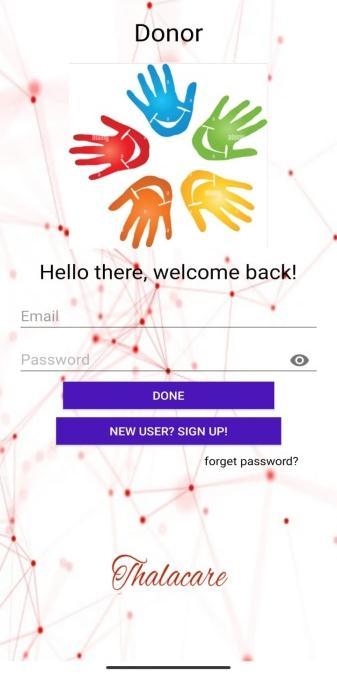
III. Donor will form with all the necessary information; once donor finds the requester theycanschedulethemeet.
IV. Diet Plan section is the additional module in our application where user can explore the dietplansforgoodhealth.

2. LITERATURE SURVEY
This section discusses finding and observation done by some research works on application of Thalassemia patients. The gathered information on these related papersstrengthensandsupportstheresearchstudy.
[1]Inordertodiagnose
This disease, CBC is the primary screening test and now machine learning technique like LDA provides an affordable, less complex, and effective solution to predict the acute disease using the CBC report parameters only. The proposed scheme makes it significant for the diagnosis of thalassemia patient by analyzing the most important parametric values of the CBC report. Various machinelearningexperimentsareexecutedtoidentifythe
most suitable risk factors for the prognosis of the said disease that selected RBC, HB, and HCT as the most importantriskfactors.
[2]The sphere of medical decision making process is heavily affected by vagueness and query issues and – for copying with them – different type of Clinical Decision Support System( CDSS) s, bluffing mortal expert clinician logic, have been designed in order to suggest opinions on treatment of cases. In this paper, they exploit fuzzy conclusion machines to ameliorate the knowledgegrounded CDSS actually used in the day- by- day clinical careofβ-thalassemiacases.
[3]In this paper they present a prototype mobile health (MHealth)operationthatwillhelpcases,careworkersand medical interpreters in administering thalassemia complaint operation. The ubiquity and propinquity of smartphonesasaparticulardevicewillallowittotakeup anassistivepartintheoperationprocess.
[4]Inthispaper,wepresenttheknowledgerepresentation developed to represent a frame of the forestallment and control program (PCP) for thalassemia in Southeast Asia. The ontology called PCPThalOnto was developed to representsphereknowledgeofthePCPbysphereexperts and following the guidelines for the content of PCP for thalassemia including particularity and pattern opinion, screeningsystem,treatmentforsymptomsandcomforting strategies. The PCPThalOnto consists of two factors class to represent conception and relation to represent logical linkamonggeneralitiesandcase.
3.
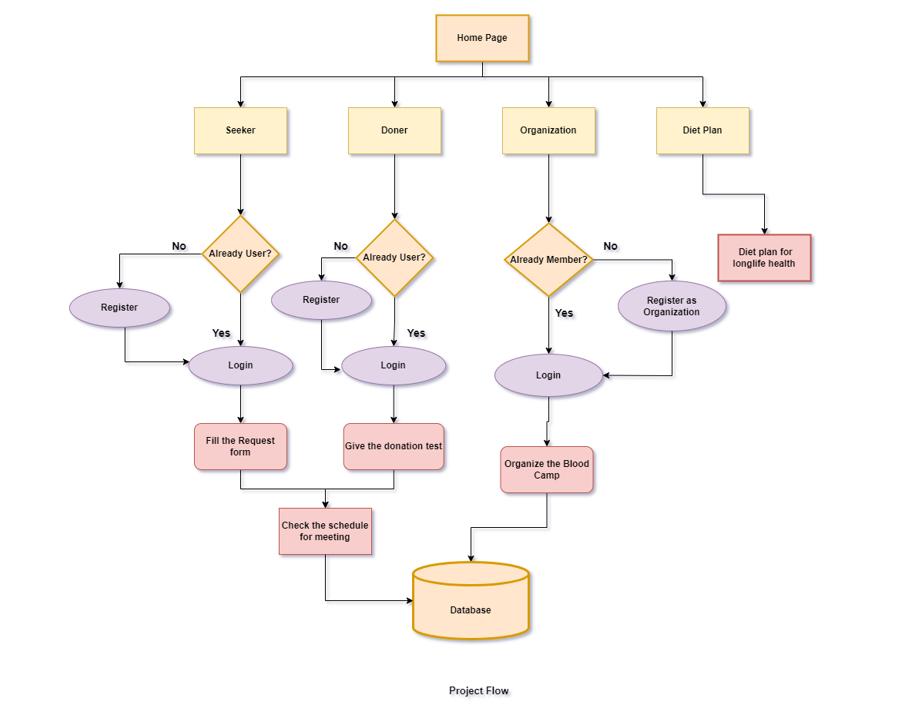
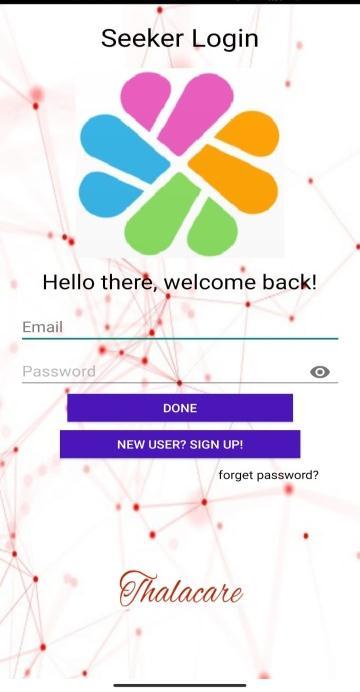
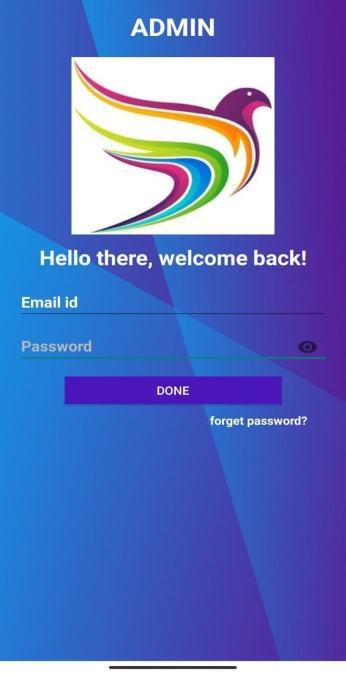
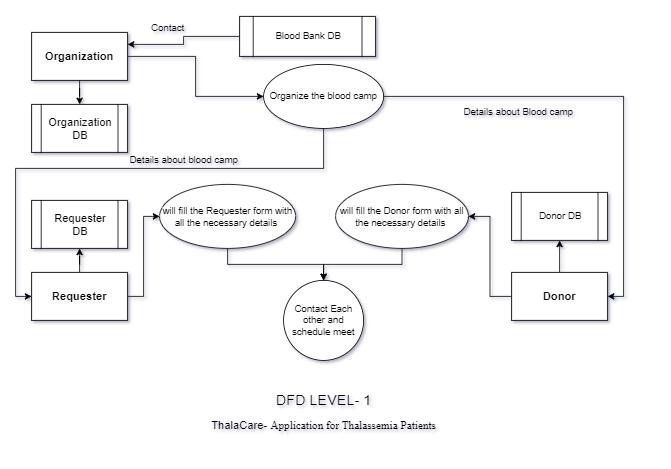
I. We are working on mainly four modules i.e., seeker, donor, organization and diet plan. Each of them will be having a Login and registrationsystem.
II. Once the user registers into a system he/she will beabletoaccessthesystem.
III. If a user registers in the seeker module, then he/she needs to fill a form where the user needs to give some important information i.e., name, contact, Blood Group, any other disease etc. after thathe/shewillbeabletomakearequest.

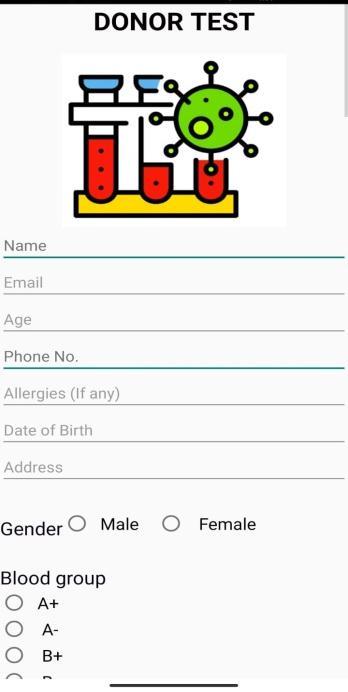
IV. Ifauserregistersasadonorthenhe/sheneedsto fill a donation test form with information regarding drinking, smoking habits, any blood diseaseinthelastsixmonthsetc.
V. Afterthatbothseekeranddonorcanschedulethe meet.
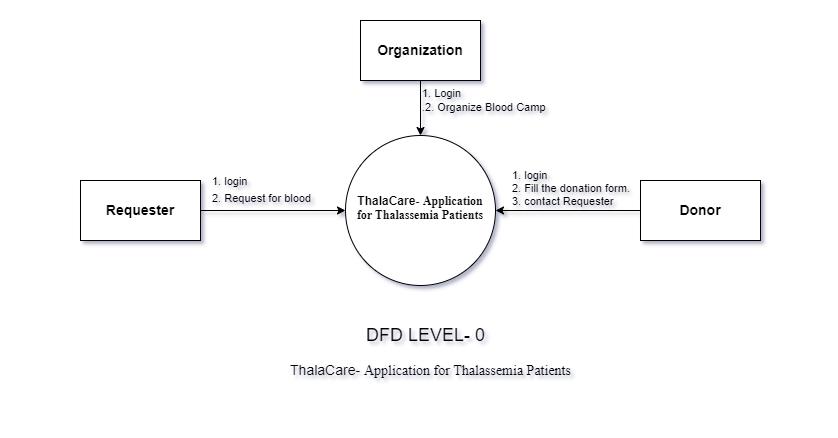
VI. In the organization section, blood organizations canorganizethebloodcamp. DFD DIAGRAMS
4. RESULTS
5. CONCLUSIONS
Technology can enhance the management of thalassemia. The Mobile-based expert system provided the Requested, Donor and organization interface in real-time. Thalassemia is a complicated and hazardous disease that requires proficient treatment and proper involvement of botha patientandhis orherfamilyinit.Additionally,the expertsystemcansupportDietplanbyrecommendingthe appropriate care. The donor and requester can communicate with each other and schedule the meeting. In future, the system can be upgraded by implementing a map area vies to know the nearest blood bank and the thalassemiahospital.
REFERENCES
Faheem Akhtar, Anum Shakeel, Jianqiang Li, Yan Pei, Yanping Dang, “Risk Factors Selection for Predicting Thalassemia Patients using Linear Discriminant Analysis”,2020
S. Santini, A. Pescape, A. S. Valente, V. Abate, G. Improta, MariaTriassi,P.Ricchi,A.Filosa“Usingfuzzylogicfor improving clinical daily-care of β-thalassemia patients”,2017
Parveen Bal, Shahir Shamsir, Nabil Warid, Azli Yahya, Jasmy Yunus, Eko Supriyanto, and Chin Fang Ngim “MHealth application: Mobile thalassemia patient managementapplication”,2014
anunchai assawamakini, nopphadol chalorthamh, taneth ruangrajitpakornt, chanin limwongseh, thepchai supnithit and sissades tongsimai “A development of
knowledge representation for thalassemia prevention andcontrolprogram”,2012
https://www.freepressjournal.in/india/mumbai-bloodbanks-to-reserve-blood-units-for-patient-with-blooddisorder
BIOGRAPHIES
VaishnaviNalawade,Computer Engineering,K.C.Collegeof Engineering,ThaneMaharashtra, India
Tejasvi Mayekar, Computer Engineering, K.C. College of Engineering, Thane Maharashtra, India




Deepika Sahu, Computer Engineering, K.C. College of Engineering, Thane Maharashtra, India

PranavTanna,Computer Engineering,K.C.Collegeof Engineering,ThaneMaharashtra, India
Prof. Vedika Patil, She is Asst. Professor in K. C College of Engineering of Mumbai University.