Kissan Konnect – A Smart Farming App
1,2,3,4Dept. of Computer Engineering, VESIT Affiliated To The University Of Mumbai, Maharashtra, India

5Professor, Dept. of Computer Engineering, VESIT Affiliated To The University Of Mumbai, Maharashtra, India ***
Abstract Agricultureis thebasic economic backbone of every country. India being the developing country has agriculture as its main occupation. Almost 50% of the population has agriculture as their main occupation.The idea is to develop an application that will be useful for farmers and reduce their dependencies. Farmers today follow traditional agriculture cultivation methods. Cultivating same crop repeatedly and that results in degradation of the soil quality. To solve such issues and morewe have developedwebapplication.TheApplication will recommend the best crop to be yielded according to theweather,soiltype,rainfall,temperature,humidityand pH. Another important feature that has been implemented is the disease detection module. The proposed machine learning model will scan the images uploaded by the farmers and diagnose the disease. Some farmers do not own the modern tools due to the cost. The proposed solution for that problem is the "tool rental module". In this way the application is able to make significant contribution to the lives of the farmers and increase the crop cultivation
Keywords—Agriculture,Cropprediction,Plantdisease detection, Soil, Image processing
INTRODUCTION
AroundhalfofthepopulationinIndiahasagricultureas an occupation. Agriculture has a major role in the overall economic growth and development of our country. With consistentgrowthand populationincrease, recentstudies indicateaneedtoincreasefoodproductionto70to90%by 2050. Thus, adopting a new age method in certain agriculturalactivitieswiththehelpofthelatesttechnologies andsoftwareswillprovetobeverybeneficialforthefarmers andtheconsumers.Priorcroppredictionalgorithmscame into action, the same task was performed on the basis of farmers’ past experiences and intuitions for a particular location. The yield could be harmed by improper crop rotations and unplanned use of specific soil nutrients. Consideringalltheseproblems,weareplanningtodesign our system which will act as a remedy and satisfy certain agricultural needs. This paper presents a system that will recommendtheappropriatecropforaparticularland,based on different parameters like weather, soil type, rainfall, temperature, humidity and pH. Hence by utilizing our system, farmers will be able to cultivate profitable crops which will actually yield in large numbers and prove beneficial over the long term too. Our system will
intelligentlyrecommendthecropthatcanbecultivatedand would be the most profitable. Farmers use chemicals and pesticidestokeeptheinsectsatabay.Butwhenoverused,it maydamagethecrop.Unknowinglytheyieldofthecropis affected. Leaves are one of the most sensitive parts of the plant from where we can first detect the symptoms of disease.Itisnecessarytobeginmonitoringthecropsfroma veryearlystageoftheirlifecycletillthetimetheyareready to be harvested. Initially plants were observed and monitoredtopreventdiseasesusingtraditionalnakedeye observation which is a time-intensive technique and requiresverycarefulobservation.Mostly,thesymptomsof thediseasescanbeseenontheleaves,thestemorthefruits. Mostofthetime,leavesoftheplantareconsideredforthe detection of disease. Many times farmers do have enough andadequateknowledgeaboutthecropsandthediseases fromwhichthecropsareatrisk.Withnewbreedsofcrop, newdiseasesarealsobeingdiscovered.Byusingoursystem thefarmerscaneffectivelyincreasetheiryieldandprotect thecropsfromdiseaseswithouthavingtovisitanyexpert.
AwebapplicationnamedKissanKonnect-SmartFarming Solutionwasdeveloped.Theproposedsystemhasvarious smart farming solutions which can be utilized from anywhere&anytime.TheservicesincludeCropprediction which will take input parameters like soil pH, rainfall, air humidity,airtemperatureandsoilhumidityofthelandand using Random Forest Classifier. The ML model will help predictthebestsuitablecroptobecultivatedconsideringall theseaspects.Also,thewebapplicationoffersaservicethat willassistfarmersindetectingthediseasethathasaffected thecrop.Thephotographsthatthefarmerhassubmittedfor diagnosiswereused.Theuploadedphotoswillbecompared to thedatabase, and the module will identify the disease usingamachinelearningmodel.Also,thewebsitewilloffera possible treatment for the identified illness. Plant Disease Recognitionservice[2]willuseimageprocessingformodel constructionandaftertakingtheimageinputoftheaffected leaf it will accurately diagnose the disease. The proposed system also providesaservicewherefarmerscanrenttools fromnearbyfarmersinsteadofbuyingthem.Thiswillhelp inreducingthecultivationcost.Reachingthetoolswillbe simpler because they will be displayed depending on location.Emailandphonenumbersareavailableforcontact. Thenewsfeedservicewillkeepthefarmersupdatedabout newmethods,technology,agriculturerelated.Farmerswill benefit from the weather forecast function by being informedofbothpresentandupcomingweatherforecastsso theymaybereadyforupcomingcircumstances.Forthisrest
APIs were used. The climate feature will fetch the informationabouttheweatherconditionsofanyparticular cityfarmerswillgettoknowtheclimate[3]justsearchingit. WeatherAPIswereusedfortheimplementation.
Madhuri,ArushiandSubba[1]proposedasystemthataims to discover the best crop production model that can help decidethetypeofcroptogrowbasedonclimaticconditions and the presence of nutrients in the soil. Their paper compared several popular algorithms, including the KNN ,decisiontreeandtherandomforestclassifier.Theresults show that random forest has the highest accuracy of the three. Entropy and Gini index were used to calculate the performance of the model. The results indicate that the effectivenessofthesuggestedmachinelearningalgorithms iscomparedtothebestaccuracywithrespecttoprecision, recall,andF1score.
According to the authors of this paper[2], deep learningbased models are widely used to extract significant crop features for prediction, but they have the following shortcomings:theyareunabletocreateadirectnonlinearor linearmappingbetweenrawdataandcropyieldvalues,and theperformanceofthosemodelsishighlydependentonthe quality of the extracted features. They proposed that combining the intelligence of reinforcement learning and deep learning, deep reinforcement learning builds a completecropyieldpredictionframeworkthatcanmapthe raw data to the crop prediction values. The main goal to achieve favorable results is the integration of Deep Recurrent Q networks (DQN) with Recurrent Neural Networks(RNN).Thesuggestedmethodgivestheimpression ofimplementingamoregeneralizedyieldpredictionmodel. Onobservingtheexperimentalvaluesandresultsobtained forthepaddycropdataset,thedeepreinforcementlearning modelisfoundtopredictthedatawithbetteraccuracyand precisionof93.7%overtheotherexperimentedalgorithms.
The objective of this paper[3] is to use machine learning classificationtechniquestodetectdifferentplantdiseases. The diseases can be recognized by examining the plant's leaves,stem,androots.Leafdiseasescanbedetectedusing digitalimageanalysis.Forvariouskindsofcrops,theauthors performed studies using various classification techniques such as SVM ANN, KNN Fuzzy classifier, and CNN. The accuracyobtainedusingtheSVMclassifieronvariousplants rangedfrom90to95%.TheprecisionoftheANNclassifier wasaround93%.FuzzyandKNN,ontheotherhand,could onlyreach90%accuracy.Toconcludetheresultshownthat CNN classifier detects more number of diseases with high accuracy but SVM classifier is used by many authors for classificationofdiseases
Theidentificationofplantdiseasesisessentialformanaging and producing crops. Although it requires a high level of
experience and specialization, it can be effectively accomplished through optical observation of changes in plant leaves by scouting specialists. Artificial intelligence (AI)-based data analysis techniques used in novel technologiescanincreasethereliabilityofdiagnosesand,as a result, be incorporated into tools for effective therapy. MethodsthatcombineAIwithpicturefeatureanalysiscan help identify plant diseases even more successfully. The workdonebytheauthorsofthispaper[4]islimitedtovine leaves.They demonstratedanautomaticwayofcropdisease identificationby employing localbinarypatterns(LBP)for feature extraction and one class classification for classification.
Averyhighdegreeofgeneralizationbehavioronothercrops wasachievedwhenalgorithmstrainedonvineleaveswere testedonarangeofcrops.Forall46oftheplantconditions that were tested, the authors were able to obtain a 95% overallsuccessrate.
The paper [5] focuses on supervised machine learning techniques such as Naive Bayes, decision trees, K Nearest Neighbour,SupportVectorMachineandRandomForestfor maizeplantdiseasedetectionwiththehelpofimagesofthe plant. The authors compared the said classification techniquesonbasisof accuracy.
Theaccuracyofvariousalgorithmswere:
SVM-77.56
NB77.46
KNN76.16
DT74.35
RF79.23
Randomforesthasbeenfoundtohavethehighestaccuracy in detecting various maze leaf diseases. The proposed methodologywasusedtotraintheclassificationmodelusing labelledimagedata.
TitleofPaper Abstract
Pantazi,XanthoulaEirini, Dimitrios Moshou, and Alexandra A. Tamouridou. "Automated leaf disease detection in different crop species through image features analysis and One Class Classifiers." Computers and electronics in agriculture 156 (2019): 96-104.
This paper compares various algorithms for best crop prediction module like KNN,Decision Tree,Random Classifier.Itwasconcludedthat Random Forest has the best accuracy.
D. Elavarasan and P. M. D. Vincent, "Crop Yield Prediction Using Deep Reinforcement Learning Model for Sustainable Agrarian Applications," inIEEEAccess,vol.8,pp. 86886-86901,2020
U, S., Nagaveni, V., & Raghavendra, B. K. (2019). A Review on Machine Learning ClassificationTechniques for Plant Disease Detection. 2019 5th InternationalConference onAdvancedComputing & Communication Systems(ICACCS).
Pantazi,XanthoulaEirini, Dimitrios Moshou, and Alexandra A. Tamouridou. "Automated leaf disease detection in different crop species through image features analysis and One Class Classifiers." Computers and electronics in agriculture 156 (2019): 96-104.
Panigrahi, Kshyanaprava Panda, et al. "Maize leaf disease detection and classification using machine learning algorithms." Progress in Computing,Analyticsand Networking:Proceedings of ICCAN 2019. Springer Singapore,2020.
The paper researched about combining the deep learning and reinforcement learning techniques to form deep reinforcement learning model.The proposed model wasabletoachieveaccuracyof 93.7%.
Theauthorscomparedvarious machine learning techniques like SVM ANN, KNN Fuzzy classifier, and CNN.On further work,it was concluded that CNN classifier detects more number of diseases with high accuracy but SVM classifier is used by many authors for classificationofdiseases.
.Theworkdonebytheauthors ofthispaperislimitedtovine leaves.They demonstrated an automaticwayofcropdisease identification by employing local binary patterns(LBP) for featureextractionandoneclass classification for classification.Overall,95% accuracywasobtained.
number of challenges when renting farm equipment, including limited access for borrowers, no appointments, high prices, and untrustworthy transportation. Farmers' yieldsarereducedasaresultofthesedifficulties.Tractors and harvesters are extremely expensive for small and medium-sized farmers. They must therefore obtain rental services from other machinery owners. Manik rakhra RandeepSinghTarunKumarandMohammedShahbazhave conductedsurveyofabout562farmers.Itisfoundoutthat most of the farmers lie under the burden of Debt because they are unable to buy new machinery. They made an information system name Smart Tillage which can accommodate the farm equipment sharing and renting considering seasonal fluctuations, market demand and pricingasperthecropcycles.
PROPOSED SYSTEM
A. Architecture
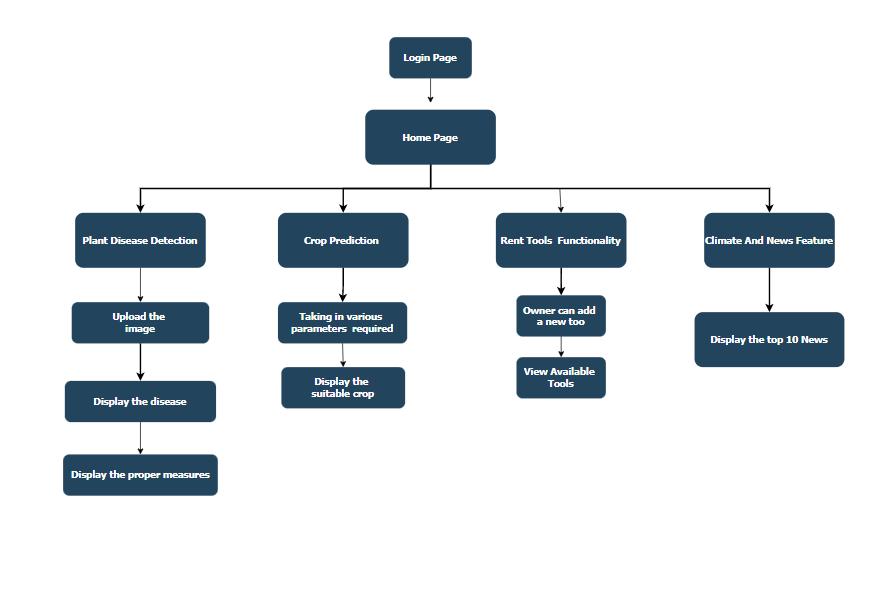
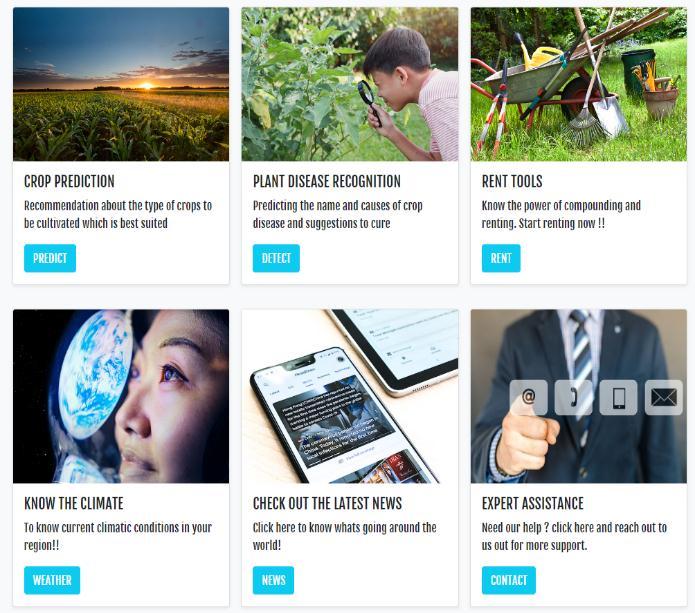
Referringtothearchitectureinfigure1.Theuserlaunches theapplicationandmustfirstregisterhimself/herselfand createanaccount.Afterloggingin,thevariousfeaturesare displayed.Tousefeaturessuchascropproduction,theuser mustenterthePHvalueofthesoil,humidity,rainfall,and temperature. For plant disease recognition, the user must uploadimages,preferablyoftheplant'sleaves.Theclimate servicecanbeusedtofindoutthetemperatureandweather indifferentpartsofthecountry.Themostrecentnewscan be read using a news feed. When needed, the expert assistancefeaturewillprovideassistance.Finally,theuser maylogoutofhis\heraccount.
The paper focuses on supervised machine learning techniques such as Naive Bayes,decisiontrees,KNearest Neighbour, Support Vector Machine and Random Forest for maize plant disease detection with the help of images of the plant. The authors compared the said classification techniques on basisof accuracy.Again,itwas found out that random forest hasthebestaccuracy.
Aspertheauthors[6],inIndia,lessthan30%offarmlandis mechanised.Thisisduetothefactthat75%offarmershave lessthanonehectareofland.Thislimitedlandownership preventsfamiliesfrom purchasingagricultural equipment solely for their own use. Farmers lease machinery from peoplewholendmoneyfortheirequipment.Farmersfacea
B. Methodology Used :
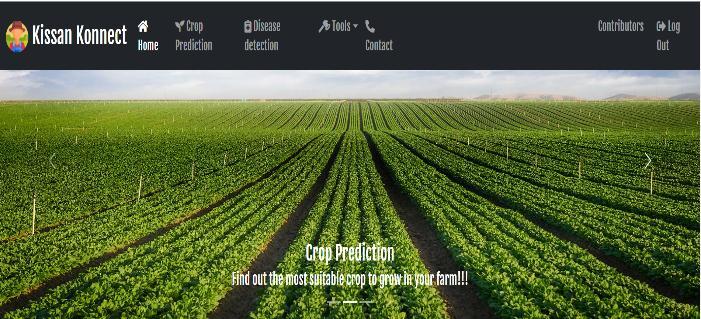
Thesystemhasatotalof6submodules-Cropprediction, Plant disease detection, tool renting, Weather forecast, fetchingtop10NEWSheadlinesandprovidingcontactsof agenciesthatcanhelpoutfarmersintimeofneed.
1. PlantDiseaseDetectionmodule:
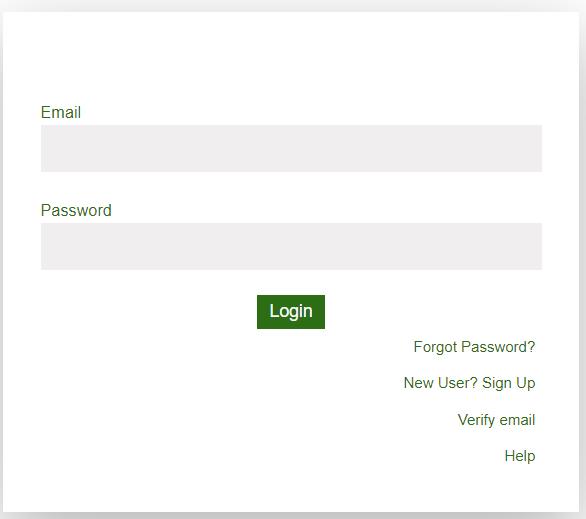
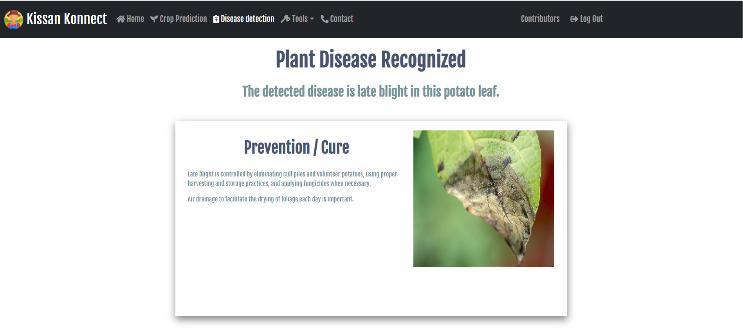
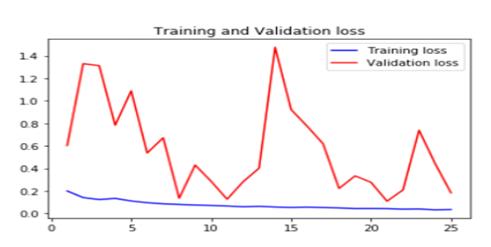
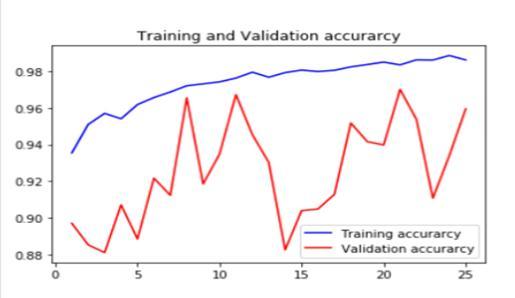
Theplantdiseaseidentificationmodulemadeuseof theextensivedatasetwhichincludedtomato,potato,pepper bell,andotherplantleaves.UsingKeras,diseasedetectionof leaf pictures were found. Keras is a Python-written deep learningAPIthatrunsontopofamachinelearningplatform. WeutilizedthesequentialAPItobuildamodel.Atfirst,we setsomedefaultsettingsforparameterslikeepoch,image size, image width, and image height.The processing phase involvedconverting imagesintoarray.WeusedopenCVto readtheimages,andtheKeraspreprocessingfunctioncalled ImgtoArraytotransformimagesintoarrays.Labelbinarizer was used to transform multi-class leaf disease labels to binarylabels,andthenumpylibraryinPythonwasusedto changetheimage'sdatatypetofloat.Afterthat,thedatawas divided into testing and training sections. In order to strengthenthemodelandreduceoverheadmemoryusage, wehavereal-timepictureaugmentationwhilealsotraining our model. A stochastic gradient descent method called Adam optimization was used for optimizing the results of ourmodel.The testaccuracywewereabletoachievewas 95.94%.
2. CropPredictionModule:
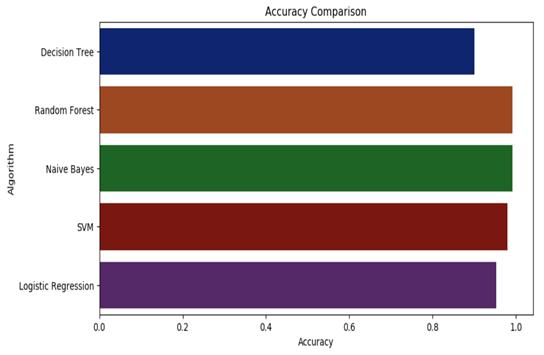
Thedatasetusedismadeupofvarious soilattributes, suchastheNPKvaluesofthesoil,temperature,humidity, soil pH, rainfall, etc. The crops that can be grown will be intelligentlyrecommendedbythealgorithm.Itconsistsofa variety of cultivable crops. The data set was divided into trainingand testingset.Datafromthetrainingsetmakeup 80%, while data from the testing set make up 20%. The decisiontreeclassifier,randomforestclassifier,naivebayes algorithm, SVM, and logistic regression were among the manyclassificationtechniquesweused.Thealgorithmwith thehighestaccuracywasRandomforest(95%),accordingto our calculations. As a result, it should be used to predict crops.
3. RenttoolsFunctionality:
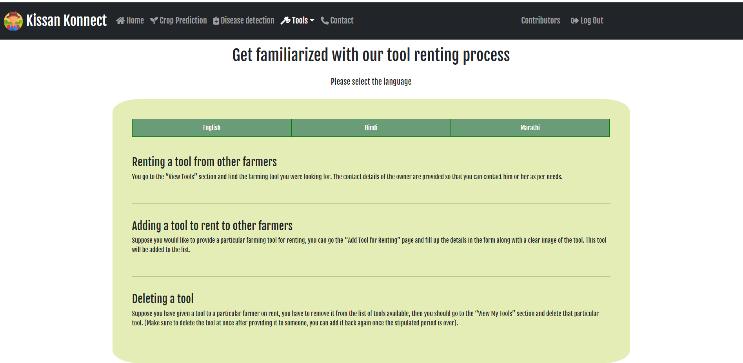
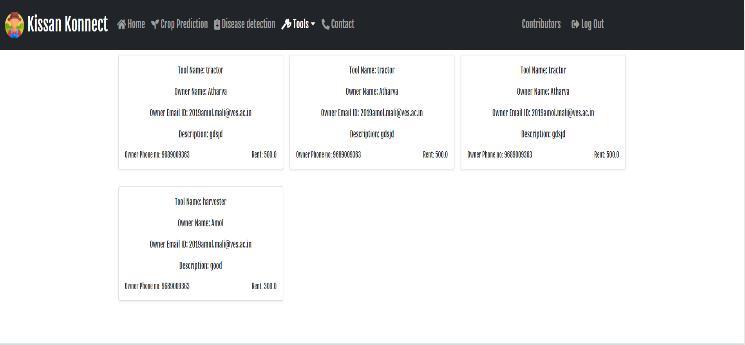
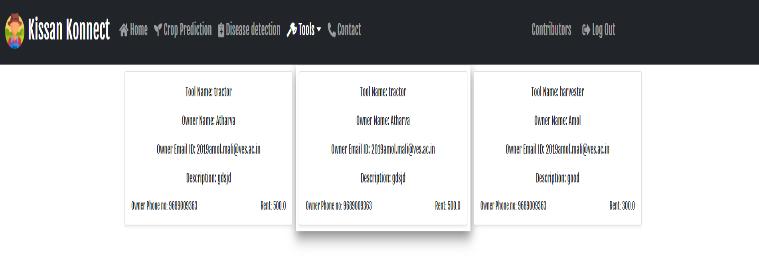
Farming requires the use of numerous tools and equipment.Notallfarmershavethenecessaryequipment. WeknowthattheeconomicconditionsofIndianagriculture industryworkersarenotalwaysstable,sowebuiltafeature intooursystemtoaccountforthis.Thisfeatureisavailable inthreelanguages:English,Marathi,andHindi,anditallows farmers to rent tools from other farmers rather than buy them, allowing them to save and earn money while also makingcommunicationeasierbecauseapreferredlanguage canbeselected.Farmerscanprovidetoolsthattheyarenot currentlyusingbyrentingthemtootherfarmerswhomay requirethem.Alongwiththerent,thecontactinformation for the farmers is made available. This will assist the agriculturalcommunitytoearnmore.
4. ClimateandNewsFeature:
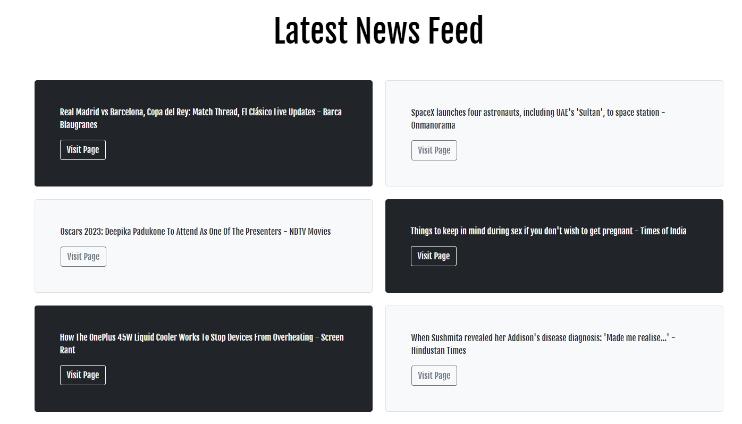
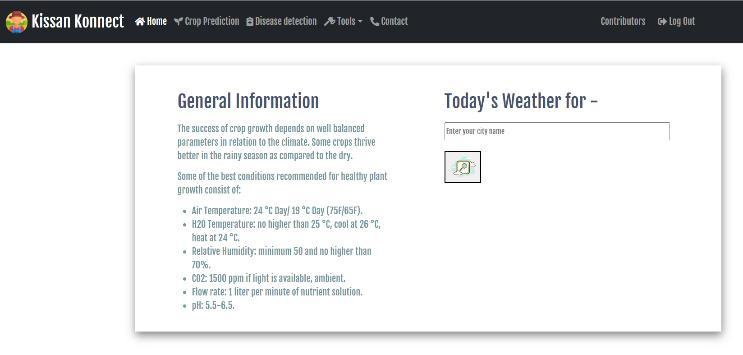
When growing any given crop, the weather is a significant factor. So, the farmer must be aware of the weather in the region where he or she farms. The online application also includes a built-in feature for weather forecasts. Any farmer can use the tool to learn about the climateandtheweatherforecast,whichwillhelphimplan hisnextagriculturalactivities.WeusedtheRestAPItodo this. To ensure that farmers are informed of all recent developmentsinthefarmingindustry,wealsointroduceda featurethatliststhetop10news.
RESULTS

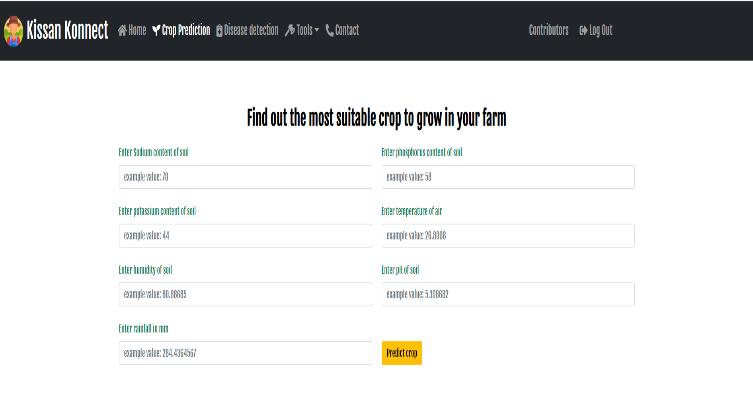
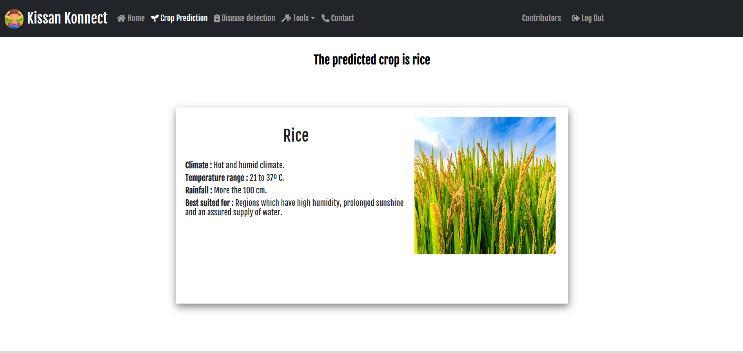


As per figure after training the model with different classification algorithms like Decision tree classifier, Random forest classifier, Naive bayes, SVM and logistic regression,theaccuraciesare90%,99.09%,99.05%,97.95% and 95.22% respectively which shows Random Forest classifier gives the best accuracy for the prediction of the most favorable crop based on N, P, K values of soil and temperature,humidity,soilpH,

rainfall.
CONCLUSION
Therewerevariousstudypublicationsthatcovered subjectsincludingdetectingplantdiseases,predictingcrops, and renting equipment. In our proposedsystem, we have combined all three components into one project while raising the accuracy of each module individually. Farmers canaccessalloftheservicesthankstothewebapplication.
The Keras library was usedfor the plant disease detectionmodule.Themodel'soutputswereenhancedusing the Adam optimization stochastic gradient descent approach. 95.94% test accuracy was obtained. Random forest classification was used to predict crops based on a varietyofcharacteristics,andaccuracyof95%wasattained. NPKlevels,temperature,humidity,rainfall,andpHwereall takenintoaccount.Anyfarmercanlisttheirtoolsforrental inthefeatureforrentingtools.Farmersinneedwhocannot afford to purchase costly equipment can rent one of the manytoolsonhand.Thewebapplicationportalalsohasa tool that displays the local weather forecast and current conditions.Thetop10newsstoriesatanyparticulartime will be displayed by a news feature that was also implemented. Agriculture industry makes a significant contributiontotheIndianeconomy,sothesystemshouldbe quicker,safer,andmorecomfortableforalltypesofusers. This paper strongly believes that our innovation and technologyinthisfieldwillbeasignificantcontributionin thissector.
FUTURE SCOPE
Amobile-friendlyapplicationwithenhancedfunctions canbecreatedinthefuture.Theuseofapaymentmethod canbeaddedfortoolrentalservices.Thevarioustoolscan befilteredbasedonthelocation.Significantimprovement can be done by including even more plants for disease prediction.
REFERENCES
1. Pantazi, Xanthoula Eirini, Dimitrios Moshou, and AlexandraA.Tamouridou."Automatedleafdisease detection in different crop species through image features analysis and One Class Classifiers." Computers and electronics in agriculture 156 (2019):96-104.
2. D. Elavarasan and P. M. D. Vincent, "Crop Yield Prediction Using Deep Reinforcement Learning Model for Sustainable Agrarian Applications," in IEEE Access, vol. 8, pp. 86886-86901, 2020, doi: 10.1109/ACCESS.2020.2992480.
3. U,S.,Nagaveni,V.,&Raghavendra,B.K.(2019).A Review on Machine Learning Classification Techniques for Plant Disease Detection. 2019 5th InternationalConferenceonAdvancedComputing&
Communication Systems (ICACCS). doi:10.1109/icaccs.2019.8728415
4. Pantazi, Xanthoula Eirini, Dimitrios Moshou, and AlexandraA.Tamouridou."Automatedleafdisease detection in different crop species through image features analysis and One Class Classifiers." Computers and electronics in agriculture 156 (2019):96-104.
5. Panigrahi, Kshyanaprava Panda, et al. "Maize leaf diseasedetectionandclassificationusingmachine learning algorithms." Progress in Computing, Analytics and Networking: Proceedings of ICCAN 2019.SpringerSingapore,2020.
6. Rakhra, Manik, et al. "Metaheuristic and machine learning-basedsmartengineforrentingandsharing ofagricultureequipment." Mathematical Problems in Engineering 2021(2021):1-13.
7. M. Kalimuthu, P. Vaishnavi and M. Kishore, "Crop Prediction using Machine Learning," 2020 Third International Conference on Smart Systems and InventiveTechnology(ICSSIT),2020,pp.926-932, doi:10.1109/ICSSIT48917.2020.9214190.
8. S. Ramesh et al., "Plant Disease Detection Using MachineLearning,"2018InternationalConference on Design Innovations for 3Cs Compute Communicate Control (ICDI3C), 2018, pp. 41-45, doi:10.1109/ICDI3C.2018.00017.
9. M.Gulzar,G.AbbasandM.Waqas,"ClimateSmart Agriculture: A Survey and Taxonomy," 2020 International Conference on Emerging Trends in Smart Technologies (ICETST), 2020, pp. 1-6, doi: 10.1109/ICETST49965.2020.9080695
10. Y. Yadhav, T. Senthilkumar, S. Jayanthy and J. J. A. Kovilpillai, "Plant Disease Detection and Classification using CNN Model with Optimized Activation Function," 2020 International Conference on Electronics and Sustainable Communication Systems (ICESC), 2020, pp. 564569,doi:10.1109/ICESC48915.2020.9155815.
11. EFFICIENT CROP YIELD PREDICTION USING MACHINELEARNINGALGORITHMS,ArunKumar, NaveenKumar,VishalVats,InternationalResearch Journal of Engineering and Technology (IRJET) 2018.
12. A. Usman, "Sustainable development through climatechangemitigationandbiomassagriculture: India's perspective," 2017 IEEE Conference on TechnologiesforSustainability(SusTech),2017,pp. 1-7,doi:10.1109/SusTech.2017.8333504.
13. Plant Disease Detection Using Different Algorithms.Trimi Neha Tete, Sushma Kamlu,DOI: 10.15439/2017R24
14. T.N.TeteandS.Kamlu,"Detectionofplantdisease usingthreshold,k-meanclusterandannalgorithm," 20172ndInternationalConferenceforConvergence in Technology (I2CT), 2017, pp. 523-526, doi: 10.1109/I2CT.2017.8226184.
15. Barbedo, J. G. A. (2016). A review on the main challengesinautomaticplantdiseaseidentification based on visible range images. Biosystems engineering,144,52-60.
16. Suresh,V&Krishnan,Mohana&Hemavarthini,M& Jayanthan,D.(2020).PlantDiseaseDetectionusing Image Processing. International Journal of Engineering Research and. V9. 10.17577/IJERTV9IS030114.
17. Pujari, J. D., Yakkundimath, R., & Byadgi, A. S. (2015).Imageprocessingbaseddetectionoffungal diseasesinplants.ProcediaComputerScience,46, 1802-1808.
18. Samer D. M , Subramaniya Raman M. K, 2020, EFarming: A Breakthrough for Farmers, INTERNATIONAL JOURNAL OF ENGINEERING RESEARCH & TECHNOLOGY (IJERT) Volume 09, Issue07(July2020).