Four Wheel Steering Mechanism
1,2,3,4 Diploma Students, Department of Mechanical Engineering, St John College of Engineering and Management (St John Polytechnic), Palghar, Maharashtra, India 401404

5Lecturer, Department of Mechanical Engineering, St John College of Engineering and Management (St John Polytechnic), Palghar, Maharashtra, India, 401404 ***
Abstract - The progress of automobiles for transportation has been intimately associated with the progress of civilization. The automobile of today is the result of the accumulation of many years of pioneering research and development. An attempt has been made in this project; the Automobile four wheels to act as a steering so that the u turn occurs very easily when compared to ordinary vehicles. Our foremost aim in selecting this project is to use a four-wheel two mode steering system by using bevel and spur gear mechanism. Itisalsogoodwithregardtoeconomicconsiderationsand automobile applications. The most conventional and general steering arrangement is to turn the front wheels using a hand operated steering wheel which is positioned in front of the driver. The four-wheel two mode steering system is a modification for the present steering which is usedfortheimprovementofeasinessforvehiclehandling. The four-wheel two mode steering system assists the driver by controlling the steering angle of vehicle’s four wheels as the requirement of the driver, for making the parking and handling at congested areas easier. For meetingtheapplication,therearwheelssteerinthesame direction of the front wheels, allowing reduced turning radius or sliding of vehicle to sideways if we are able to transmitthemotionthatisgivenonsteeringwheel tothe rear wheels and able to control like front wheels as our requirements, which is the basic idea of our project fourwheelthreemode.Inconvertiblefour-wheelsteeringwith two mode operation two steering modes can be changed as needed which assists in parking at heavy traffic conditions, when negotiating areas where short turning radiusisneededandinoffroaddriving.
Key Words: Automobile, Four-wheel, Steering
1. INTRODUCTION
Nowadays, the condition of increasing road traffic makes the handling of vehicles more difficult. The present scenario demands an exploration of new vehicle handling mechanisms,whichinturnforcesustofindanalternative way instead of the current system or a modified steering mechanismforbetterhandling.Whilethevehicleentersa congested or narrow area there would be no one who doesn’t wish for, if they would be able to reduce the turning radius of their vehicle or if they could move the
whole vehicle sideways without turning the vehicle. Here, comes the application of Four Wheel Three Mode which provides the same by steering the rear wheels too as our requirement. It should not be confused with four-wheel drive in which all four wheels of a vehicle are powered. With the help of this system, the rear wheels also can be turned with respect to the direction of front wheels whenever required. The vehicle can be controlled more effectively especially during cornering, parking or when we get into a congested/narrow area. This system finds application mainly in off-highway vehicles such as forklifts, agricultural and construction equipment and mining machineries. It is also useful in passenger cars, mainly SUVs. When both the front and rear wheels steer toward the same direction, they are said to be in-phase andthisproducesakindofsidewaysmovementofthecar other arrangements are sometimes found on different types of vehicles, for example, a tiller or rear–wheel steering. Tracked vehicles such as tanks usually employ differentialsteeringthatis,thetracksaremadetomoveat different speeds or even in opposite directions to bring aboutachangeofcourse
1.1 Steering
Themostconventionalsteeringarrangementistoturnthe frontwheelsusingahand–operatedsteeringwheelwhich ispositionedinfrontofthedriver,viathesteeringcolumn, which may contain universal joints to allow it to deviate somewhat from a straight line. Primary function of the steering system is to achieve angular motion of the front wheels to negotiate a turn. This is done through linkage and steering gear which convert the rotary motion of the steering wheel into angular motion of the front road wheels.
1.2 Problem Statement
Many four-wheel steering systems faded from popularity by the early 2000s, but the technology has made a comebackwithmodernmachinessuchasthePorsche911, LexusLC500,Mercedes-AMGGTRandGTC,Lamborghini Aventador, Ferrari 812 Superfast, Ferrari GTC4Lusso, and others. From the GMC Sierra, to the Honda Prelude, allwheelsteeringhasbeenofferedinmanydifferentvehicles of all shapes and sizes for the past few decades. While
four-wheel steering is not a new concept in cars, it has seen a resurgence in the last few years. Four-wheel steering technology is beneficial because it increases the vehicle’s steering response time and helps keep the vehicle stable at higher speeds. With all four wheels steering, instead of only the front two, this technology offers unprecedented control and manoeuvrability. That being said, 4-wheel steering takes some getting used to. Four-wheel steering systems, as safe and useful as they are, are typically reserved for higher-end makes and models. They require significantly more components and calibrationthantraditionalsteeringsystems,whichcomes at a price. Consider the vehicles that currently offer fourwheel steering as an example. Four-wheel steering is available on models from Audi, BMW, Lexus, Porsche, Lamborghini, Ferrari, Mercedes-Benz, and Acura. They're all Import vehicle manufacturers, which are generally more expensive to buy and maintain. We want you to know what you're getting into at Master Mechanic. Because four-wheel steering systems contain numerous mechanical and electrical components, if one fails, the entire steering system may be jeopardized. Four-wheel steeringsystemsrequiremoretimetorepairbecausethey aremorecomplicated.Whilethesecostsmaynotbeadeal breaker for a Ferrari owner, they are something you should consider if the car is going to be your daily driver. Therearemanyproblemsinbigcitiesthatthepeopleface daily. Among them, traffic jams are one of the big problems. On almost every road, the volume of traffic has increased manifold. Especially in Mumbai, the traffic situation is getting worse with every passing day. Traffic snarls up every day and one of the causes of these traffic jams is an increase in the number of vehicles in the city. The flow of traffic is disrupted due to chingchi rickshaws, which are usually driven by underage drivers who often violate traffic rules and risk citizens’ lives. If there is a traffic jam anywhere in the city, it presents the scene of a battlefront, where everyone desperately tries to reach their destination. It seems as if there is no think tank to foresee these problems. I request the departments of traffic and transport to make genuine efforts for improving the transportation and traffic system in Mumbai. It is high time that the government should pay attention to resolving the problem of traffic mess on our roads.
2. LITERATURE REVIEW
SoniAayush,AdarshSahu,PrakharShrivastava,Dr.(Mrs.)
ShubhrataNagpal(2021)[1]Presently,allvehicleshavea two-wheel steering system irrespective of the vehicle being front wheel driven, rear wheel driven or all-wheel drive. A four-wheel steering system known as “quadra steering” system is a system in which both the front wheelsandrearwheelsgetsteeredaccordingtothespeed ofthevehicleandspaceavailableforturning.Thissystem makes the vehicle more stable and enhances its
performance.Inthisreport,theperformanceofthequadra steering system has been considered under low speed, mediumspeedandhigh-speedconditions.Forparkingand low speed conditions, rear wheels are turned in the opposite directions while at medium and high-speed conditions,rearwheelsandfrontwheelsareturnedinthe same direction. As a result, the vehicle becomes more stable and its turning radius reduces greatly. Mubina Shekh, O. P. Umrao Dharmendra Singh (2020) [2] Mostly, two-wheelsteering(2WS)systemsareusedtocontrolthe vehicle.Butmanyresearchersareworkinginthisarea,for anarrowspacehowacarcantakeaturnorbackwithout anyfailure.Therearedifferenttypesofdrivesinavehicle suchasfront-wheel,rear-wheelorall-wheeldrive(2and4 WS). But for the reason of safety, four-wheel steering (4 WS)vehiclestermedasQuadraSteeringSystemarebeing used. In this paper, the features of different models of car steering system used have some drawbacks like failing at high speed, slipping of the tracks, and a higher turning radius. To overcome these drawbacks, a suitable and appropriatesteeringsystemhasbeenproposedandithas beenpresentedhere. SedaPOSTALCIOĞLU(2019)[3]The aimofthisstudyisimprovingthevehiclesafetyanddriver comfort. Four Wheel Steering (4WS) is used with Lane Keeping System (LKS) for confirming the efficiency of the integrated controller. A two-degree-of freedom model is used for simulation. Simulation is described for different driver models, different speeds on the vehicle with controllers.Asseenfromthesimulationresults,4WShelps thevehiclenottoswervebutincreaselateraldisplacement and driver workload. LKS is used to solve this problem. 4WS is supported by LKS. System is evaluated using performanceindexes.
Simulation results show that using the driver assistance systems together, improves vehicle. safety and driver comfort. T Liu1 , L N Jia , M N Yang, C S Li (2019) [4] Nowadays, people have higher and higher requirements onautomobileperformance.Asanimportantperformance of a vehicle, the handling stability not only affects the driver’sdrivingexperience,butalsorelatestothesafetyof the occupants. In order to improve the handling stability ofvehicles,asimulationofthefour-wheel-steeringsystem in the linear range based on the time domain was conductedinthispaper.Sideslipangleandyaw rate were taken as control targets. Proportional feedback control andPIDcontrolwereintegratedinthecontrolsystem.The comparison of the front-wheel-steering system and the four-wheel-steeringsystem indicatedthatthefour-wheelsteering system had an obvious effect on improving the handling stability of the vehicle. Anurag Tirumala , & Anurag Josh (2019) [5], The objective of this paper is to assessthe4-wheelsteeringmechanismforautomobiles.A Four-Wheel Steering mechanism, which is a new technology that improves handling in cars, & other four wheelers.Ingeneral,two-wheelsteeringvehicles,therear wheels do not play any role in association with the
steering, they follow the path of the front wheels, this resultsinalargeradiusofturn.Inafour-wheelsystemthe rear wheels are made to turn left & right as per the requirements. With four wheels steering the rear wheels turnwiththefrontwheelsthusincreasingtheefficiencyof the vehicle and decreasing the radius of turns, the performance of four wheels steer provides Control for parking and low-speed manoeuvres, the rear Wheel steer in the opposite direction of the front wheels, allowing much sharper turns. At higher speeds, the rest of the wheelssteerinthesamedirectionasthefrontwheels.The resultismorestabilityandlessbodyleanduringfastlane changes and turns because the front wheels don’t have to dragnon-steeringrearwheelsontothepath. S.Sundar,T. Sudarsanan, Radha Krishnan (2018) [6], This review paper proposed the various methodology of the steering system in automobile industries. Most of the automobile industries prefer the Ackerman steering system. This review paper used to find out the research gap and implementation steps in a steering system. The steering system should have good vibration resistance, flexible rotationandeaseofassembly.Four-wheelsteeringsystem has been developed through the study of previous work.
Fei-XiangXu,Xin-HuiLiu,WeiChen,ChenZhouandBingWei Cao (2018) [7], Considering the demand for vehicle stability control and the existence of uncertainties in the four-wheel steering (4WS) system, the mixed H2/H∞ robust control methodology of the 4WS system is proposed. Firstly, the linear 2 DOF vehicle model, the nonlinear 8 DOF vehicle model, the driver model, and the rear wheel electro hydraulic system model was constructed. Secondly, based on the yaw rate tracking strategy, the mixed H2/H∞ controller was designed with the optimized weighting functions to guarantee system performance, robustness, and the robust stability of the 4WSvehiclestabilitycontrolsystem.TheH∞methodwas appliedtominimizetheeffectsofmodellinguncertainties, sensor noise, and external disturbances on the system outputs, and the H2 method was used to ensure system performance. Finally, numerical simulations based on MATLAB/Simulinkandhardware-in-the-loopexperiments were performed with the proposed control strategy to identify its performance. Abe, Masato. (2018) [8], In this paper, a quasi-steady-state method is applied to fourwheel-drive(4WD)vehiclestostudytheeffectsoftraction forcedistributioncontrolson thevehicleturningbehavior during acceleration and power off braking. Solving the quasi-steady-state equilibrium equations, the steering wheel angle to turn with a certain turning radius of curvature with respect to lateral acceleration is obtained for various longitudinal acceleration to describe understeer/oversteer(u.s./o.s.) characteristics in acceleration and power off braking in a turn having the same implication as in a steady state turning. The optimum traction force distribution control having relation to tire vertical loads with additional rear wheel steer to attain vehicle turning behaviour which are
insensitive to acceleration and power off braking as well as to get high acceleration capabilities is investigated. PengHang;FengmeiLuo;ShudeFang;XinboChen.(2017) [9], Compared with the traditional front-wheel-steering (FWS) vehicles, four-wheel-independent-steering (4WIS) vehicles have better handling stability and path-tracking performance. In this paper, a novel 4WIS electric vehicle (EV)isproposedanditisviewedasacontrolledobjectfor pathtracking.Thenonlineardynamicalmodelofthe4WIS EV is built based on the nonlinear Dug off tire model. For controller design, the nonlinear dynamical model is simplified as a longitudinal displacement. The main objectiveoftheMPCistominimizetheerrorbetweenthe reference signals and measurement signals. In the procedure of solving MPC, the constraints are taken into consideration including actuator constraints, tire slip angle constraints and the lateral acceleration constraint. To evaluate the performance of the designed controller, two simulation conditions are carried out using the nonlinearvehiclemodelwithdegreesoffreedom(DOF)in MATLAB/Simulink. Simulation results show that the designed MPC has good path-tracking performance and strong robust performance against parametric perturbations. Ansari Rehan, Rafiuddin Khan, Ansari Sarfaraz, Shoaib Sayyed, Shaikh Abid, Karan K. Sharma (2019) [10], The objective of this paper is to analyse the steering mechanism of an automobile for the purpose of making a mechanism which is capable of turning all the four wheels of the automobile simultaneously whether in same or different directions as per the requirement so as to utilize the steering mechanism of the automobile in an effective way and to reduce the efforts applied by the driver to park the vehicle in a limited space or to reverse thevehicledirection.Thesteeringmechanismplaysavital roletobalanceallthefourwheelsoftheautomobilewhile a vehicle moves in a definite direction. In this paper an attempt has been made to develop such a mechanism which can turn all the four wheels of automobiles simultaneously which could be beneficial to make an effectiveturnaswell ascanassistinparking thevehicles. The radius covered by the vehicle to reverse its direction by both two wheel and four-wheel steering mechanism hasbeencalculatedaswellasexperimentallyevaluated.
3. OBJECTIVES
An innovative feature of this steering linkage design is its ability to drive all four Wheels using a single steering actuator. Having studied how 4WS has an effect on the vehicle's stability and driver manoeuvrability, we now lookatwhatthefuturewillpresentus with.Itssuccessful implementation will allow for the development of a fourwheel, steered power base with maximum manoeuvrability, uncompromised static stability, frontand rear-wheel tracking, and optimum obstacle climbing capability. The advanced system of "Four-wheel steering" willworkmanuallywiththehelpofgears.Thesystemwill
control and direct the turning left and right of the rear wheels.
4. METHODOLOGY
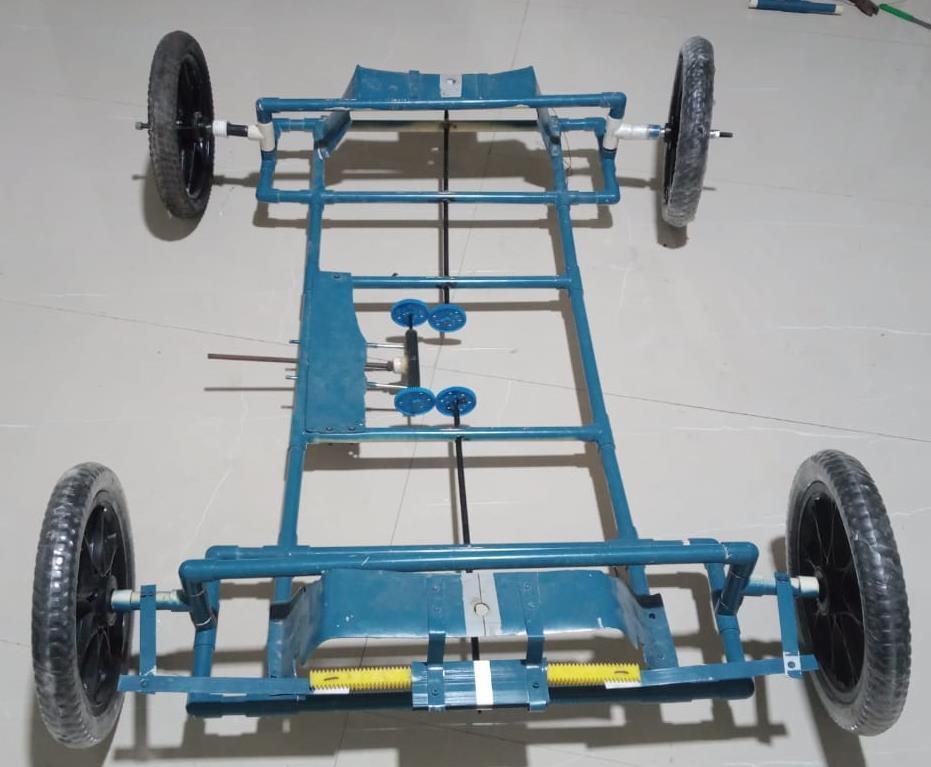
After finalization of our topic the first step we did was to collect information regarding our project on the internet then we did a group discussion through telephonic conversation and planned on how to execute the project. We estimated the whole cost of the project which came around 4000rs/- so each member had to contribute 1000rs/-perpersontomakeupthebudgetoftheproject. After receiving the money from each group member, we ordered components which were required to execute the project. While we were waiting for components to arrive through online shopping sites (amazon, flip kart) in the meantime we did the rough calculation & developed a timetable. Then with the help of pvc pipes we made the basic structure/frames of the vehicle. We fixed two bearings at the front and backside for connecting rods to rotate. We made a rough rack and pinion & mechanism arrangement for taking the measurements. After taking measurementswecarefullystartedfixingthemechanisms (rack & pinion turning mechanism, sliding mechanism, etc.). After everything was in place checked weather, everything wasworking/moving properly. Then wemade theslidingmechanism,forthetirestoturnintherequired direction. 4 small cycle tyres containing bearings were used. We installed tyres at the last stage of making the project.Atfinal the shaftandtyrecontainingnutand bolt getstightenin4WS
5. DETAILS OF DESIGN
5.1 Components
The4WScontains:-
1.PVCPipe.
2.SmallCycleTyrewithbearings.
3.Rack&Pinion.
4.BevelGears.
5.SpurGears.
6.PipeJoints,ElbowJoints&T-Joints
5.2 Working
When the driver turns the steering wheel at low speeds, the front wheels turn in the direction of travel while the rear wheels also turn in the same direction, effectively reducing the car's turning circle. This makes low-speed manoeuvresquickerandeasier.
6. RESULT
Four-wheel steering system also known as Quadra Steering System controls all the 4 wheels while turning therearemultiplecomponentswhicharerequiredforthis steering system design. These are Rack and Pinion, Bevel Gears, Steering, Wheel, Hinge Joint, Spur Gear. The fourwheel two-mode steering system is an improvement over the current steering system that aids vehicle control. The four-wheel two-mode steering technology supports the driverbyadjustingthesteeringangleofallfourwheelsto the driver's preference, making parking and maneuvering in congested locations more convenient. This four-wheel steeringsystemoperatesinthreemodeswhichare
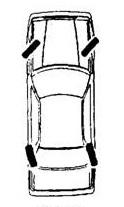
6.1 Negative Mode
In this mode both the front and the rear wheels of the vehicle move in opposite direction with respect to each other.Thistypeofmodeisusefulforslowdrivingcaseand a steep curve or during parking of the vehicle as this requires very less space for turning of the vehicle as compared to other modes. This mode is very much beneficialwheretrafficisabigproblem
Fig. 1 NegativeMode
6.2 Neutral Mode
Inthismodeonlythefrontwheelsaresteeredandtherear wheels remain straight. This mode is simply the conventionalsteeringmechanism.
6.3 Positive Mode
Inthis mode the front and rear wheelsrotate in thesame direction. This mode is very much beneficial for the lane changingduringdrivingatcomparativelyhigherspeeds.
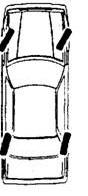
Table-1: TechnicalSpecification
Totallength 40inches
Totalwidth 36inches
Heightofvehicle 30inches
Radiusofwheel 6.75inches
Lengthofadjustingnut 12inches
7 ADVANTAGES AND DISADVANTAGES
7.1 Advantages
1. CorneringStability
2. TighterTurning
3. BetteronTougherTerrains
4. StraightLineStability
5. ChangingLanes
7.2 Disadvantages
1. Additionalcostisrequired
2. Additional space is required to install this arrangementinvehicles
8. CONCLUSIONS
Fig. 2 PositiveMode
All these 3 modes can be brought in action as per our requirement. For this a lock nut can be provided in the main arrangement which will engage and disengage the positive mode or negative mode as and when required. Whenthelocknutisremovedfromthemainarrangement thesteeringoperationiscarriedoutinnormalconditions. In this normal condition only, front wheels will steer. When the lock nut is inserted into the engaging mechanism the other two modes can be used. When the locking nut is pushed to one position, the attached gears get engaged and the steering of rear wheel is provided in same direction as that of the front wheels. When the locking nut is pushed to other side secondary gears get engagedandtherearwheelsteersinoppositedirectionto thefrontwheel.Thisresultsinnegativemodesteering.
The steering mechanism's precise structure. We can change the design, performance, and efficiency based on the findings of the review. The four steering mechanisms can take use of the unique process as well as the safe environment. The four-wheel steering mechanism can be modified based on previous research and future goals. In ordertoachievein-phaseandcounter-phaserearsteering with regard to the front wheels utilizing pure mechanical linkages without requiring any electrical devices, we developed a revolutionary 4-wheel active steering mechanism that is feasible to build, quick to install, and highly efficient. This device aids in lane change at high speeds and better turning. It solves the challenges that comewithsharpturns.Itlowerstheradiusoftheturning circle.Itsolvesthechallengesthatcomewithsharpturns. It achieves neutral steering by reducing the car's turning circle radius and improving manoeuvrability and control while driving at high speeds. Furthermore, the components in this system are simple to build, the materials utilizedarepracticable,dependable,andreadily available in the market, and the cost is quite low. The systemissimpletoassembleandlightinweight,makingit suitableforuseinmanytypesofvehicles.
REFERENCES
[1] Soni, Aayush, Chhattisgarh Durg, and Shubhrata Nagpal. "Study of four-wheel steering systems viability in futureautomobiles."(2021)
[2] Shekh, Mubina, O. P. Umrao, and Dharmendra Singh. "Kinematic Analysis of Steering Mechanism: A Review." Proceedings of International Conference in Mechanical andEnergyTechnology.Springer,Singapore,(2020).
[3] POSTALCIOĞLU, Seda. "Improvement of Four-Wheel Steering System." Journal of the Institute of Science and Technology9.4(2019):1876-1886.
[4]Liu,T.,etal."Researchonthehandlingstabilityoffourwheel steering vehicles." Journal of Physics: Conference Series.Vol.1213.No.5.IOPPublishing,(2019).
[5] Tirumala, Anurag, and Anurag Joshi. "Analysis of a four-wheeled steering mechanism for automobiles." AIP Conference Proceedings. Vol. 2148. No. 1. AIP Publishing LLC,(2019).

[6] Sundar, S., T. Sudarsanan, and Radha Krishnan. "Review of Design and Fabrication of four-wheel Steering system." International Journal of Recent Trends in Engineering&Research(IJRTER)4.10(2018):1034-1049.
[7] Xu, Fei-Xiang, et al. "Improving handling stability performance of four-wheel steering vehicles based on the H2/H∞robustcontrol."AppliedSciences9.5(2018):857
[8] Abe, Masato . "Effects of Tracton Force Distribution Control with Additonal Rear Wheel Steer on Turning Behavior of 4WD Vehicle." The Dynamics of Vehicles on roadsandontracks.CRCPress,(2018).1-12.
[9] Hang, Peng, et al. "Robust control for four-wheelindependent-steering electric vehicles with a steer-bywire system." International Journal of Automotive Technology18.5(2017):785-797.
[10] Rehan, Ansari, et al. "Design & Synthesis of FourWheel Steering Mechanism." International Refereed JournalofEngineeringandScience6.4(2017):17-20.
BIOGRAPHIES
Pranit Prashant Mehata
He is currently a lecturer in department of mechanical engineering at St John Polytechnic Palghar. He has pursued his masters of engineering in Mechanical Design from Savitribai Phule Pune University. He has total 5 yearsofexperience.