Propulsion System in Hypersonic Spacecraft Rocket: A Review of Recent Development and Future Prospects
Mukul Waykul11Student, Dept. of Mechanical Engineering, Prof. Ram Maghe Institute of Technology & Research Badnera, Maharashtra, India ***

Abstract - Hypersonic spacecraft propulsion is an area of active research due to its potential to revolutionize space travel. Hypersonic vehicles can travel at speeds greater than Mach 5, which could drastically reduce travel times to and from space. However, achieving hypersonic speeds presents numerous engineering challenges, particularly in the design anddevelopmentofpropulsionsystems.Thispaperprovidesa comprehensive review of current research on hypersonic spacecraft propulsion, focusing on the various propulsion technologies being developed and the challenges associated with each. Additionally, future directions for research in this areaarediscussed,includingthepotentialfor newpropulsion technologies to enable even faster and more efficient hypersonic travel.
Key Words: Hypersonic propulsion, Fuels, Hypersonic vehicle,Propulsionsystem.Turbojet,Ramjet,Scramjet.Airbreathingengine.Specificimpulse.
1.INTRODUCTION
Intheaviationindustry,largeraircraftmanufacturershave shifted their focus towards developing more efficient, reliable,andenvironmentallyfriendlydesignsthatarealso cheapertoproduce.However,achievingthesegoalsrequires addressingseveralaspectsthatareessentialforefficientand affordable designs. The design and development of hypersonic vehicles pose many challenges, including the need to travel beyond a Mach 5 and the capability to transport passengers or cargo from one destination to another in a significantly shorter time than conventional aircraft.
The use of hypersonic vehicles has both commercial and space applications. In commercial aviation, hypersonic vehiclesofferfasterandmoreefficienttravelbetweenlong distances,withaTokyotoLosAngelesjourneytakingonly 110minutes.Inthespaceindustry,hypersonicvehicleshave revolutionizedspacelaunchesbyofferingcost-effectiveand more efficient access to orbit without the need for expendablelaunchvehicles.
The history of hypersonic vehicles dates back to the mid20thcenturywhenDr. Walter Dornberger,a key figure in World War II rocket programs, initiated research and developmentinhigh-speedandlong-rangemissilesduring the Cold War. The development of hypersonic vehicles
continued in the 1960s with the launch of the first space launchvehiclethatcarriedastronautsandcosmonautsinto space.Inrecenttimes,theNationalAeronauticsandSpace Administration (NASA) has made significant progress in developingsupersonicpropulsiontechnologysuchasramjet andscramjetengines.
Thedesignanddevelopmentofhypersonicvehiclesrequire consideration of several challenges, including lift to drag ratio,whichaffectstheaerodynamicefficiencyundergiven flightconditions.TheUSAirForceinitiatedtheDyna-Soar programin1957toaddressthelowlifttodragratio,which limitedtheflexibilityofthemissionprofile.Recentresearch inhypersonictechnologyaimstodevelopmoreflexibleand efficientdesignsthatcanaccomplishspacemissionsmore readily.
This review paper discusses the historical background, recent progress, and challenges in the design and developmentofhypersonicvehicles.Thepaperwillfocuson variousaspectssuchastheenginetypes,designchallenges, and lack of research challenges, along with the progress madebytheaviation
2. Brief History
Hypersonic propulsion has been a topic of significant interest in the aerospace industry for several decades, as researchers and engineers continue to explore the possibilities of supersonic and hypersonic flight. Early experimentsintheearly20thcenturypavedthewayforthe development of rocket engines in the 1940s, which could propelaircrafttohypersonicspeeds.Thisledtothecreation ofexperimentalplanesliketheX-15,whichsetseveralspeed recordsinthe1960s.
In the 1950s, ramjet engines were developed that could sustainsupersonicandhypersonicspeedswithouttheneed for onboard oxygen. This technology was later integrated intomissilesandunmannedaerialvehicles.The1990ssaw the first successful test of a scramjet engine, which compressesandignitesairmovingathypersonicspeedsand operatesatevenhigherspeedsthanramjetengines.
Hypersonic propulsion has significant potential to revolutionize air travel by substantially reducing travel times. Therefore, several countries, including the United
States,China,andRussia,areinvestinginthedevelopmentof hypersonic technologies for military and civilian applications.Overall,thehistoryofhypersonicpropulsionin aerospace is one of continuous innovation and progress, withresearchersandengineerspushingthelimitsofwhatis possibleinhigh-speedflight

The development of hypersonic vehicles has been an ongoing process for many decades. One of the earliest examples of such a vehicle was the Silbervogel, or "Silver bird," which was proposed by German rocket scientist Eugene Sanger in 1930. This rocket-powered boost-glide vehiclewasneverbuilt,butitlaidthegroundworkforfuture hypersonicvehicles.
One such vehicle was the X-15, which was developed by AmericanAviationin1954.TheX-15wasarocket-powered aircraftthatwasdroppedfromamodifiedB-52aircraftat high altitude. It set numerous altitude and speed records, withamaximumaltitudeof107.96kmandatopspeedof 7273 km/h. The X-15 program paved the way for the developmentoftheSpaceShuttle,whichbeganin1969as theSpaceTransportationSystem.
The Space Shuttle was a partially reusable shuttle system thatwasinusefrom1981to2011.Itwasthefirstspacecraft capableofcarryinglargepayloadsintoorbitandreturning themtoEarthintact.Althoughtheprogramwassuccessfulin many respects, it was also plagued by technical problems and safety concerns. This led to the development of other hypersonic vehicles, such as the Soviet Union's Buran spaceplane,whichwaslighterthantheSpaceShuttlebutwas cancelledin1988duetolackoffunding.
More recently, the SpaceShip was developed by Virgin Galactic and made its first flight on May 20, 2003. This aerospacevehiclewasthefirsttolaunchthreepeopletoan altitude of at least 100 km. While it achieved a maximum speedofonlyMach3,itrepresentedasignificantmilestone inthedevelopmentofhypersonicvehicles.
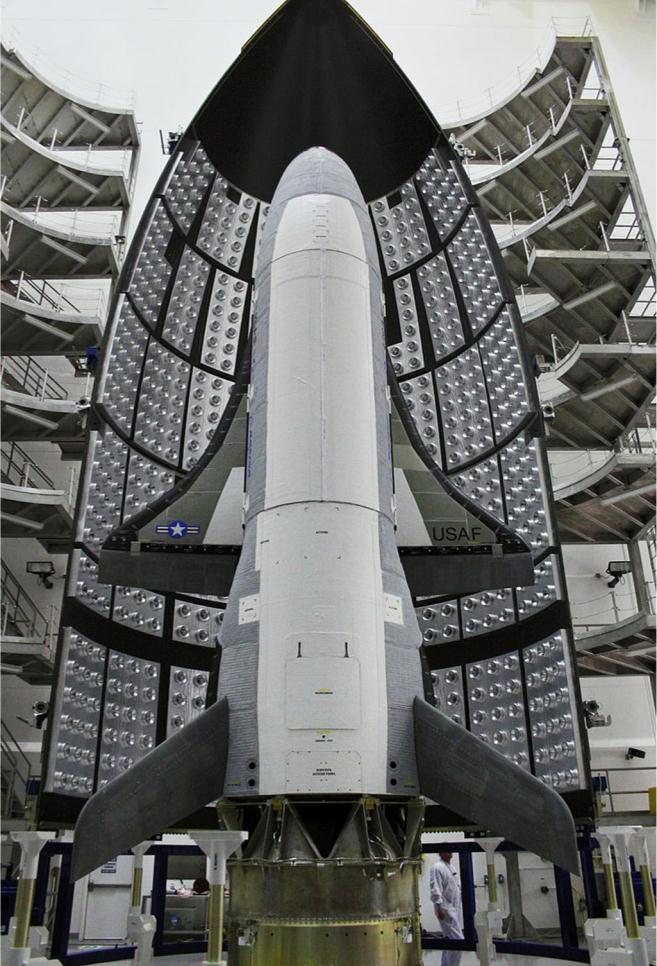
AnotherhypersonicvehicleistheBoeingX-37OrbitalTest, an unmanned aerospace vehicle that was developed since 1999 and made its first flight on April 22, 2010. It was launchedontopofanAtlasVrocketandhasbeenusedfor variousmilitaryandscientificmissions.
Inconclusion,thedevelopmentofhypersonicvehicleshas beenalongandchallengingprocess,markedbysuccesses and setbacks. The vehicles mentioned above represent importantmilestonesinthisongoingendeavor,andfurther research and development will undoubtedly lead to even moreadvancedhypersonicvehiclesinthefuture.
3. Propulsion System
The propulsion systems that are powered by rockets may useeithersolidorliquidpropellants.Inthecontextofspace missions,therearetwowaysinwhichrocketscantakeoff andland:horizontaltake-offorverticaltake-offandlanding. Vertical landing offers greater flexibility similar to that of airplanes.Thekeyparametersforrocketpropulsionsystems include specific impulse (Isp), the thrust ( ), and the inert massfraction(finert),where
3.1 Nuclear Rocket Propulsion System
It works similarly to liquid propulsion systems. The fuel, combined with oxygen, is transferred to a combustion chamber,whereasparkisgeneratedtoignitethemixture. The resulting exhaust gases pass through a convergentdivergentnozzlesectionathighvelocity.Inanuclearrocket, the fuel is passed through a heat addition section, where heat is generated from a nuclear fission reaction. The exhaustgasesthenpassthroughtheconvergent-divergent nozzle section at high velocity. This technology was developed between the late 1940s and the 1960s, but its complexity and weight of the nuclear reactor remain significantdrawbacks.
Nuclearrocketenginesareatypeofpropulsionsystemthat use nuclear energy to heat a working fluid, usually liquid hydrogen, which is then expanded in a nozzle to generate high ejection velocities. There are two types of nuclear energysourcesthathavebeeninvestigatedforthispurpose: thefissionreactorandthefusionreactor.
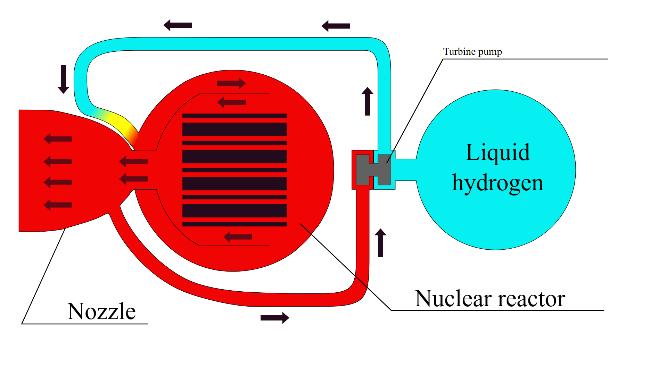
Inanuclearfissionreactorrocket,heatisgeneratedbythe fissionofuraniuminthesolidreactormaterial,whichisthen transferred to the working fluid. This type of engine is primarilyahigh-thrustengine,withspecificimpulsevalues up to 900 sec. However, concerns about endurance of materials at high temperatures and intense radiations, power level control, cooling a reactor after operation, moderatinghigh-energyneutrons,anddesigninglightweight radiation shields have prevented further ground tests of nuclearfissionrocketengines.
On the other hand, fusion is an alternate way to create nuclearenergy,whichcanalsoheataworkingfluid.Several conceptshavebeenstudied,butnonearecurrentlyfeasible orpractical.
Despitethepotentialbenefitsofnuclearrocketpropulsion, concerns about the accidental spreading of radioactive materials in the environment and the high cost of development programs have prevented the experimental developmentoflargenuclearrocketengines.Unlessthere are significant new findings and a change in the world attitude towards nuclear radiation, it is unlikely that a nuclearrocketenginewillbedevelopedorflowninthenext fewdecades.
Overall,whilenuclearrocketengineshavepotentialforhigh performance and flexibility in interplanetary travel, the current limitations and concerns make it unlikely to be a viableoptionforhypersonicpropulsionsystemsinthenear future

StanleyandPilandnotedthathydrogenpropulsionsystems aremoreefficientthanSpaceShuttleMainEngines.Theuse of dual fuel designs incorporating solid and liquid propellants has been incorporated into many hypersonic vehicleconceptsproposedsince1988.
The Orbiter staging Mach number for a Two-Stage-TwoOrbit system depends on various criteria, including the theoreticalpotentialoftheorbiter,requirementsforrealistic air-breathingandrocketpropulsionsystems,andthrust-to-
weight ratio of the orbiter components. The theoretical velocitypotentialfunctionversussecond-stageweightgraph showsthatanorbitalvelocityof185kilometersrequiresan orbiter with a thrust of 100 Newton and a staging Mach numberof0.8,0.6,and8.0.


usedinavarietyofapplications,fromrocketenginestoairbreathing engines. The specific impulse ranges for these devicescanvary widely,dependingon factorssuchasthe type of engine, the propellant used, and the operating conditions. In this context, understanding the specific impulse ranges for various propulsion devices fueled by hydrogenorhydrocarbonsisessentialforoptimizingtheir performanceandachievingmoreefficientandcost-effective spacetransportation.
When launching a vehicle with a booster powered by airbreathingpropulsionsystems,suchasscramjets,atMach8, theorbitermustweighapproximately2.45millionNewtons. Air-breathingpropulsionsystemsincludeturbojet,ramjet, and scramjet propulsion, with scramjet being used in hypersonicspeedvehicles.
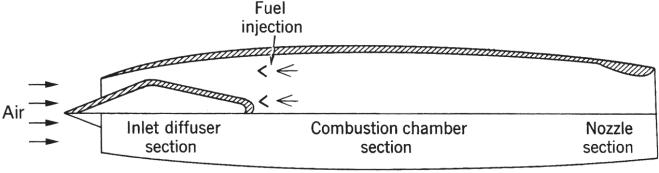
Theair-breathingpropulsionsystemrequiresconsideration of the thermodynamic conditions, propulsion system, structure,andflightcontrolsystem.Turbojetpropulsionhas a Mach number limit when the combustion chamber heat exceeds the limit. Ramjet concept is used when the Mach number limit of turbojet is reached. For hypersonic propulsion, a multi-stage propulsion system is needed, whichmightoperateasaturboacceleratoruptoMach4.0, thentransitiontosubsonicramjetoperationuptoMach6.0, andfinallyoperateasa supersoniccombustion enginefor speedsaboveMachnumber7.0.
Foster et al. on reference no. [4] note: ‘‘Combined Cycle Engines’functionallyandphysicallyintegratemorethanone propulsionenginecycleintoasingleengineassembly.They should not be confused with ‘combined cycle vehicles’, ‘combinationpropulsionsystems’,‘multi-cycle’propulsion or ‘Multi-Mode Vehicles’ having more than one physically separatepropulsioncycleinasinglevehicle.’’
The development of efficient propulsion devices has been crucial to the advancement of space exploration and transportation. Specific impulse, which measures the efficiency of a propulsion system, is a key factor in determiningtheperformanceofthesedevices.Propulsion systemsfueledbyhydrogenorhydrocarbonsarecommonly
3.2 Duct Jet Propulsion:
These air-breathing engines use oxygen from the atmospheretoburnfuelstoredintheflightvehicle,andthey offersuperiorrangecapabilitiesatrelativelylowaltitudes comparedtochemicalrockets,whichrequirecarryingtheir ownoxidizer
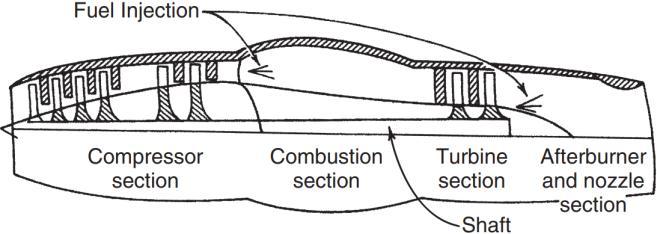
The most common ducted engine is the turbojet engine, while ramjets become attractive for flight within the atmosphere at supersonic speeds above Mach 2. Ramjets work by increasing the momentum of the air as it passes through the engine, similar to the turbojet and turbofan engines,butwithouttheneedforcompressorsorturbines.
Ramjets with subsonic combustion and hydrocarbon fuel haveanupperspeedlimitofapproximatelyMach5,while hydrogen-fueledramjetswithhydrogencoolingcanreachat least Mach 16. Scramjets, which have supersonic combustion,haveflowninexperimentalvehicles
Allramjetsrequirerocketboostersorothermethods,such as being launched from an aircraft, to reach their design flightspeedandbecomefunctional.Ramjetswithsubsonic combustion have been primarily used in shipboard and ground-launchedantiaircraftmissiles,butthereispromising researchonhydrogen-fueledramjetsforhypersonicaircraft.
Finally,asupersonicflightvehiclecombinesaramjet-driven high-speedairplanewithoneortwo-stagerocketboosters, enablingittotravelatspeedsuptoaMachnumberof25at altitudesofupto50,000meters.
Insummary,theuseofcombinationsofductedjetengines and rocket engines is critical to the development of hypersonicpropulsionrockettechnology.Theprinciplesof rocket and ramjet engines can be combined to achieve higherperformanceintermsofspecificimpulse,andsolid fuelramjetsofferanalternativemethodofpropulsion.These propulsionsystemsarekeytoachievingthehighspeedsand altitudesrequiredforhypersonicflight.
4. Fuels
Thehypersonicair-breathingengineusestwotypesoffuels: hydrocarbon and liquid hydrogen. The detailed specificationsofthesefuelsarediscussedinTableNo.1
3.3 Combination of Ducted jet Engine and Rocket Engine
The use of combinations of ducted jet engines and rocket enginesisacriticalaspectofhypersonicpropulsionrocket technology.OneexampleofthisistheTomahawksurface-tosurface missile, which uses two stages of propulsion in sequence.Thesolidpropellantrocketboosterisdiscarded afteritsoperation,whileasmallturbojetenginesustainsthe low-levelflightatnearlyconstantspeedtowardthetarget.
Inaddition,theuseofaductedrocket,alsoknownasanairaugmented rocket, combines the principles of rocket and ramjet engines. It gives higher performance in terms of specific impulse than a chemical rocket engine, while operatingwithintheearth'satmosphere.Theductedrocket is boosted to operating speed and uses the rocket componentsmoreasafuel-richgasgenerator.
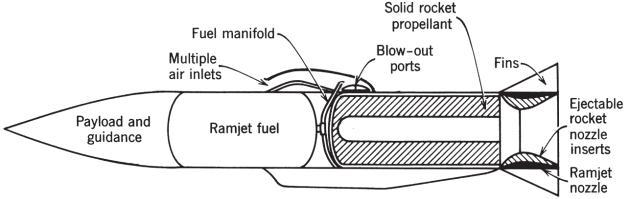
Theprinciplesoftherocketandramjetenginescanalsobe combined,asshownintheintegralrocket-ramjetpropulsion system.Thislow-volumeconfigurationcanbeattractivein air-launchedmissilesusingramjetpropulsion.Thetransition fromtherockettotheramjetrequiresenlargingtheexhaust nozzle throat, opening the ramjet air inlet-combustion chamberinterface,andfollowingthesetwoeventswiththe normalramjetstartingsequence.
Furthermore,solidfuelramjetsuseagrainofsolidfuelthat gasifies or ablates and reacts with air. Good combustion efficiencies have been achieved with a patented boroncontainingsolidfuelfabricatedintoagrainsimilartoasolid propellant and burning in a manner similar to a hybrid rocketpropulsionsystem.
Hydrocarbon fuels are easily extracted and have a much lower cost of preparation compared to hydrogen fuel. However, liquid hydrogen has several advantages over hydrocarbonfuels,includingalargerheatofcombustionand specificimpulse.
Additionally, liquid hydrogen is able to cool the engine significantly, which prevents permanent damage to the nozzlewallduetothehightemperatureoffuelcombustion. These advantages make liquid hydrogen a promising fuel optionforhypersonicpropulsionsystems.
5. Challenges and Future Directions
Hypersonic propulsion systems have seen significant progress in recent years, but there are still numerous challenges that need to be addressed. These challenges
include the development of advanced materials and manufacturingtechniquesthatcanwithstandtheextreme temperaturesandpressuresofhypersonicflight,aswellas the need for a better understanding of the fluid dynamics and combustion processes involved in hypersonic propulsion.Anotherchallengeistheneedformoreadvanced control systems to manage the complex interactions betweenthepropulsionsystemandtheairframe.
Despite these challenges, future research in hypersonic spacecraftpropulsionislikelytofocusonthedevelopment ofnewpropulsiontechnologiesthatcanenableevenfaster andmoreefficienthypersonictravel.Oneareaofresearch that shows promise is the use of alternative fuels, suchas hydrogen, which can provide higher energy density and combustion efficiency than traditional hydrocarbon fuels. Furthermore, advances in materials science and additive manufacturingtechniquesmayenablethedevelopmentof newmaterialsthatcanwithstandtheextremeconditionsof hypersonicflight.
Several agencies have been working on hypersonic technologiesinrecentyears.Forexample,NASA'sX-59Quiet Supersonic Technology (QueSST) aircraft completed its preliminary design review in 2020, marking a significant milestoneintheagency'seffortstodevelopquietsupersonic flight technology. DARPA's Hypersonic Air-breathing WeaponConcept(HAWC)programhasalsobeenworkingon developing high-speed, air-launched weapons capable of strikingtargetsatlongranges.Additionally,Boeing'sX-51A WaveRidersetanewrecordforthelongesthypersonicflight byajet-poweredaircraftin2013,reachingspeedsofupto Mach5.1.In2021,theNationalHypersonicScienceCenter (NHSC)wasestablishedasajointresearchcenterbetween the University of Virginia and the University of Texas at Austintoadvancetheunderstandingofhypersonicflightand developnewhypersonictechnologies.Lastly,theEuropean SpaceAgency'sSpaceRiderisaplannedreusablespaceplane thatisbeingdevelopedforuseinarangeofspacemissions, including scientific research and satellite servicing, and is expected to be capable of hypersonic flight during its reentryphase.
6. Nomenclature:

-inertmassfraction,


-inertmass -propellantmass
-inertmass
REFERENCES
[1]Sziroczak,D.,&Smith,H.(2016). A reviewofdesignissues specific to hypersonic flight vehicles. AerospaceScience andTechnology,55,02-03.
[2]Bertin, J. J., & Cummings, R. M. (2013). Fifty years of hypersonics: where we’ve been, where we’re going. ProgressinAerospaceSciences,60,512-527
[3]Sutton, G. P., & Biblarz, O. (2010). Rocket Propulsion Elements (8th ed.). JohnWiley&Sons,Inc.,02-11.
[4]Foster,R. W.,Escher,W.J.D.,&Robinson, J. W.(1989). Studies of an extensively axisymmetric rocket based combined cycle (RBCC) engine powered SSTO vehicle. AIAAPaper89-2294.
[5]Gregory, T. J., Petersen, R. H., & Wyss, J. A. (1965). Performance tradeoffs and research problems for hypersonictransports. JournalofAircraft,2(4),266-271.
[6]Sänger, E., Bredt, J., "A Rocket Drive for Long Range Bombers(ÜbereinenRaketenantriebfürFernbomber)," Deutsche Luftfahrtforschung, Ainring, August 1944. Translated by Hamermesh, H., Radio Research Laboratory.
[7]NationalAeronauticsandSpaceAdministration.(2005). X-37Demonstratortotestfuturelaunchtechnologiesin orbitandreentryenvironments[FactSheetnr.FS-200305-65-MSFC]. Retrieved from http://www.nasa.gov/centers/marshall/news/backgro und/facts/x37facts2.html
[8]USAirForce.(2010).BoeingX-37Binsidepayloadfairing before launch [Photograph]. Retrieved from http://media.dma.mil/2010/Apr/14/2000374856/-1/1/0/100405-O-1234S-001.JPG
[9]Humble,R.W.,Henry,G.N.,&Larson,W.J.(1995).Space propulsionanalysisanddesign.NewYork,NY:McGrawHillSpaceTechnologySeries.
[10]Stanley, D. O., & Piland, W. M. (1994). Technology requirementsforaffordablesinglestagerocketlaunch vehicles.SpaceTechnology,14(5),319-330.
[11]Gord, P. R., Langan, K. J., & Stringer, M. E. (1990). Advanced launch vehicle configurations and performance trades.In Spacevehicleflight mechanics (AGARDCP-489).
Isp
-Specificimpulse
-Thrust
[12]Blankson, I. M. (1990). Air-breathing hypersonic waveriders: A survey of research needs. In J. D. Anderson,M.J.Lewis,J.Corda,&I.M.Blankson(Eds.), Proceedings of the First International Waverider
Symposium,UniversityofMaryland,CollegePark,MD, October1990.
[13]Yanagawa, T., Fujita, T., Miyajima, H., & Kishimoto, K. (1985). High Altitude Simulation Tests of LOX-LH2 Engine LE-5. Journal of Propulsion and Power, 1(3), 180-186.
[14]Grosch, R. J. (1968). Micro-Meteorological System (Report TR-68-37). Air Force Rocket Propulsion Laboratory.AD678856.
[15]Chemical Propulsion Information Agency. (1969). Handbook for Estimating the Uncertainty in Measurements Made with Liquid Propellant Rocket EngineSystems,Handbook180,April30(AD855130).
BIOGRAPHIES
MR MUKULR WAYKUL B.E inMechanicalEngineering