
Projective exploration on individual stress levels using machine learning
Kavitha S Patil1 , Pranav Sivaprasad2 , Udhay Kiran K3 , Sujay G S4Abstract - Students are facing so many mental health problems such as depression, pressure, stress, interpersonal sensitivity, fear, nervousness etc.. Though many industries and corporate provide mental health related schemes and try to ease the workplace atmosphere, the issue is far from control. Stress Prediction in college students is one of the major and challenging tasks in the current education sector. Stress is regarded as a major thing that is used to create an imbalance in the life of every character and it is additionally regarded as a major issue for psychological adjustments and trauma reduction. Numerous studies work on stress management in school students. The students who are pursuing their secondary and tertiary education are widely facing the on-going stress level issues. It can be many times decided as day to day movements for a hassle-free mind to pay attention to lecturers. To decrease the individual stress rate, human societies have been in a position to boost a complete stage of progress in monitoring the stress stage of students and make them score well in academics.
Lack of stress administration can result in some drastic injury which can sometimes affect the education completely and can even cause extreme injury to the fitness of the students at a variety of stages.
Key Words: Microcontroller, Cloud Server, IOT, Sunlightintensitydetection,LED.
1. INTRODUCTION
Mental health problems, such as depression, pressure, stress, interpersonal sensitivity, fear, and nervousness, are increasingly prevalent among college students worldwide. These problems can be caused by a range of factors, including academic pressures, social isolation, financial stress, and personal relationships. The negative effects of these issues can be far-reaching, impacting academic performance, physical health, and overall quality of life. While many industries and corporations provide mental health support and try to ease the workplace atmosphere, the problem of mental health among college students remainsfarfrombeingcontrolled.




One of the major and challenging tasks in the current education sector is predicting stress levels in college students. Stress prediction is essential to identify students whoareatriskofdevelopingstress-relatedproblemsandto
provide timely interventions. However, the existing system for stress prediction in college students is a manual process that involves collecting data through surveys or interviews, which can be time-consuming and prone to errors. Furthermore, the subjective nature of self-report data can make it difficult to accurately identify students who are experiencingstress.
Toaddressthesechallenges,thereisaneedforanautomated system that can accurately predict stress levels in college studentsbasedontheirprofilesandbehaviors.Suchasystem can help to identify and mitigate stress-related problems, which can have far-reaching benefits for the health and wellbeingofcollegestudents.Inrecentyears,therehasbeen growinginterestindevelopingmachinelearningmodelsthat can predict stress levels in college students. However, many of these models are limited in their scope and accuracy, and there is a need for further research to develop more robust andreliablemodels.
2. LITERATURE REVIEW
Saskia Koldijk, Mark The paper "Detecting work stress in officesbycombiningunobtrusivesensors"proposesasystem for detecting work stress in office environments using unobtrusive sensors, which collect data on physiological and behavioral indicators of stress. The data is then analyzed using machine learning algorithms to predict the level of work stress experienced by employees. A pilot study conducted in a real-world office environment demonstrates the feasibility and effectiveness of the proposed system, suggesting that unobtrusive sensing can be an effective approachfordetectingworkstress.Theproposedsystemcan help employers and employees take proactive steps to manageandreduceworkplacestress.
Christina S. Malfa the paper "Psychological distress and Health-Related Quality of Life in public sector personnel" investigates the relationshipbetween psychological distress and health-related quality of life (HRQoL) in public sector employees. The study found that higher levels of psychological distress were associated with poorer HRQoL, and certain sociodemographic factors, such as gender, age, and education level, were also associated with both psychologicaldistressandHRQoL.Thefindingssuggestthat interventions aimed at reducing psychological distress may have positive effects on the HRQoL of public sector
© 2023, IRJET | Impact Factor value: 8.226 | ISO 9001:2008 Certified Journal | Page1449

personnel. This study provides important insights into the impact of psychological distress on HRQoL in publicsector employees, which can inform the development of effective interventions to improve their wellbeing. better performancecomparedtotheexistingsystems.
JacquelineWijsman,BernardGrundlehner,Hao Liu,HermieHermens,andJulienPendersWearableThe paper "Towards Mental Stress Detection Using Physiological Sensors" presents a study on detecting mental stress using wearable physiological sensors. The study used a dataset collected from 14 participants who performed a stress-inducing task while wearing sensors, and analyzed the data using machine learning algorithms. The proposed system achieved an accuracy of 89.7% in detecting stress periods, with electrodermal activity sensors having a higher accuracy than electrocardiogram sensors. The findings suggest that wearable physiological sensors can be an effective approach for detecting mental stress,withpotentialapplicationsinstressmonitoringand management. This study provides valuable insights into the potential use of wearable physiological sensors for mentalstressdetection,whichcaninformthedevelopment ofeffectivestressmanagementtools.
Disha Sharma This IEEE paper “ Stress Prediction of students using machine learning ”explores the use of machinelearning algorithmsfor predictingstresslevels in students. The study collects data from students using wearable physiological sensors and evaluates the performance of various machine learning algorithms in predicting stress levels. The findings of the study can provide insights into the feasibility of using machine learning algorithms for stress prediction in students and inform the development of effective stress management tools. This research contributes to the field of stress managementandcanprovideabasisforfutureresearchin thisarea.
3.THE OBJECTIVE OF PROJECT
Thespecificobjectiveofthisprojectwas
1. Proposedsystemisanrealtimeapplication.
2. The model classifies the students into Stress and StressFree.
3. Proposed system gives better decision and also improvisethebusiness.
4. Proposed system makes use of data science technique“classificationrules”forpredicting stressincollegestudents.
5. Proposedsystemismeantforstressprediction.
5.FLOWCHART
6.WORKING
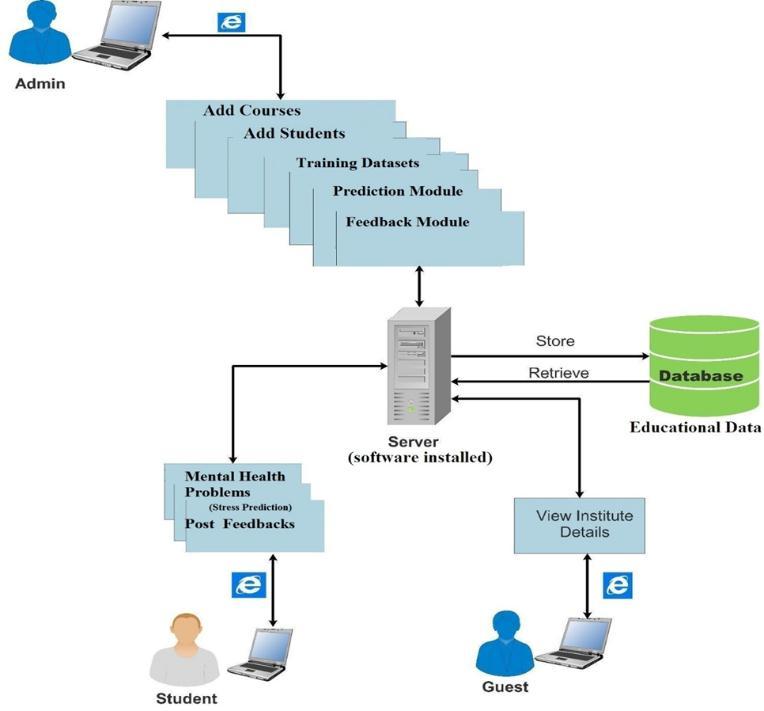
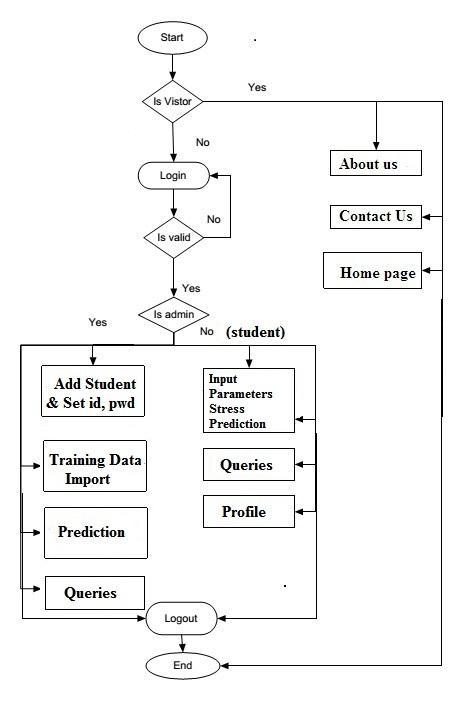
The proposed web application has three types of users: admin, student, and guest. The admin is responsible for managing the system and has a unique login credential
provided by the management. They are authorized to add student details, such as their mail id and unique student number (USN), as well as add any new courses introduced by the institution. The admin plays a critical role in providing personalized solutions to the students who requiremoreattention.
The student, on the other hand, logs into the system using thecredentialsprovidedbytheadminorbychangingthem later. Oncelogged in,theyanswer a set of questions which areusedtopredicttheirstresslevels.Basedontheanswers given by the student, the system provides a solution that canbeimplementedtosortouttheirproblems.Incasethe student requires additional assistance or a different solution,theycanraiseaquerytotheadmin,whoprovides accurateanswers.
Thethirdtypeofuseristheguest,whohaslimitedaccessto the system and can only view information about the institution.Allthedata,includingstudentdetailsandstress level predictions, are stored in a database that can be modifiedorretrievedatanytime.Theadminisresponsible for managing and updating the database when necessary. Overall,thissystemaimstoprovideaplatformforstudents to manage their stress levels and seek personalized solutions,ultimatelyimprovingtheirmentalwell-being
7.ALGORITHM
7.1 K-NEAREST NEIGHBOR
K-Nearest Neighbor (KNN) is a supervised machine learning algorithm used for classification and regression tasks. It is a non-parametric algorithm that makes predictions based on the similarity between data points. The basic idea behind KNN is to find the k-nearest data points to a given test point and use their labels to predict thelabelofthetestpoint.
InKNNclassification,thelabelofatestpointisdetermined by a majority vote among its k-nearest neighbors. In KNN regression, the predicted value for a test point is the averageofthevaluesofitsk-nearestneighbors.
Thechoiceofk isansignificantstrictureinKNN.Asmaller valueofkmeansthealgorithmismoresusceptibletonoise, while a larger value of k makes the algorithm more robust butmaycauseover-generalization.
KNNisasimpleandeasy-to-understandalgorithmthatcan be used for both classification and regression tasks. However, its performance can be sensitive to the choice of distance metric andthecurse of dimensionality,where the algorithmmaybecomecomputationallyexpensiveforhighdimensionaldata.
7.2 Naïve Bayesian Algorithm
NaiveBayesianalgorithmisaprobabilisticalgorithmusedfor classificationtasks.ItisbasedonBayes'theoremandassumes thatthefeaturesinadatasetareconditionallyindependentof each other given the class label. This is known as the naive Bayesassumption,whichisoftenviolatedinpractice,butthe algorithm can still perform well in many real-world applications.
Thealgorithmworksbyfirstcalculatingthepriorprobability ofeachclasslabelbasedonthefrequencyofoccurrenceinthe training data. Then, for a given test data point, the algorithm calculates the likelihood of each featurevalue given the class label using probability distributions such as Gaussian, multinomial, or Bernoulli. These probabilities are then combined using Bayes' theorem to calculate the posterior probabilityofeachclasslabelforthegiventestdatapoint.The class label with the highest posterior probability is then assignedtothetestdatapoint.
Naive Bayesian algorithm is a simple and efficient algorithm that can work well with high-dimensional datasets. It is also less prone to overfitting than other machine learning algorithms. However, it assumes independence between features, which may not hold true in many real-world applications. Nevertheless, it is widely used in various applications such as spam filtering, sentiment analysis, and textclassification.
7.3 Linear Discriminant Analysis
Linear Discriminant Analysis (LDA) is a supervised learning algorithm used forclassification tasks. It works byprojecting the original high-dimensional feature space onto a lowerdimensional space while maximizing the separation between the classes. The projection is done by finding a linear combinationofthefeaturesthatmaximizesthebetween-class distanceandminimizesthewithin-classdistance.
Thealgorithmassumesthatthedataforeachclassisnormally distributedwiththesamecovariancematrix,andthedecision boundary between the classes is a hyperplane. This means that the algorithm is sensitive to the distributional assumptions and may not work well if the assumptions are violated. LDA is often used for dimensionality reduction beforeapplyingotherclassificationalgorithmssuchaslogistic regressionorsupportvectormachines.Itcanalsobeusedfor feature extraction, where the projection coefficients can be usedasnewfeaturesforotheralgorithms.
LDAisasimpleandcomputationallyefficient algorithm thatworkswellforlinearlyseparableclasses.However,itmay notperformwelliftheclassesarenotwell-separatedorifthe covariance matrices for the classes are not equal. In such cases, other algorithms such as Quadratic Discriminant Analysis (QDA) or non-linear classifiers may be more appropriate
8.ADVANTAGES
Earlydetectionandpreventionofmentalhealth issues: The proposed system can detect early signsofmentalhealthissuessuchasdepression, anxiety, and substance misuse, and provide personalized solutions to prevent these issues from escalating. This can help students to maintaingoodmentalhealthandwell-being.
Improved academic performance: The system can help students to improve their academic performance by providing personalized solutions to manage stress and anxiety. When studentsare lessstressedand anxious, they are more likely to focus better on their studies and performbetter.
Increased participationincollegeactivities: The systemcancreatealow-stressenvironmentthat makes students more comfortable in coming to college and participating in various activities. This can lead to a more engaged student body, which can enhance the college experience for everyone.
Reduced healthcare costs: By reducing the burdenofchronicillnessescausedbystress,the proposed system can help to reduce healthcare costs.Whenstudentsarehealthier,theyareless likely to need medical attention for stressrelated illnesses, which can save on healthcare resourcesandcosts.
Promotes a proactive approach to mental health: The proposed system promotes a proactive approach to mental health, which is crucial in preventing mental health issues from developing. By providing students with tools andresourcestomanagestressandanxiety,the system can empower them to take control of their mental health and prevent issues from arising.
Personalized solutions: The proposed system provides personalized solutions to manage stress and anxiety based on each student's individual needs. This ensures that students receive tailored support that addresses their uniquechallengesandconcerns.
Increased awareness about mental health: The proposedsystemcanhelptoincreaseawareness about mental health and well-being among students. By providing students with informationandresourcestomanagestressand anxiety, the system can help to destigmatize
mental health issues and promote a culture of opennessandsupport.
Easy access to support: The proposed system provideseasyaccesstosupportforstudentswho may not be comfortable seeking help in person. This can be especially helpful for students who may be hesitant to reach out for support due to stigmaorotherbarriers.
Improved retention rates: The proposed system can help to improve retention rates by reducing the number of students who drop out of college due to mental health issues. When students are able to manage stress and anxiety effectively, they are more likely to stay in college and completetheirstudies.
Long-term benefits: The proposed system can provide long-term benefits for students by promoting good mental health and well-being. When students are able to manage stress and anxiety effectively, they are more likely to develophealthycopingmechanismsthattheycan carrywiththemthroughouttheirlives.
9. PERFORMANCE METRICS
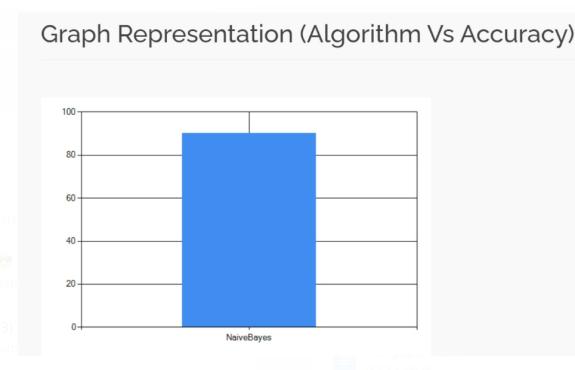
A stress predicting machine's performance can be assessed using a variety of criteria. Here are a few potential choices: Accuracy: The most typical metric for evaluating the effectiveness ofa machinelearning model is accuracy. It calculates the model's accuracy rate for predictions. By comparing the anticipated stress level withtheactualstresslevel,itispossibletodeterminethe accuracy of a stress prediction machine. Precision and recall are two metrics that are employed in binary classification issues. Precision measures the proportion of positive instances (i.e., high-stress events) that the model properly predicts out of all the positive instances thatitpredicts.Thisprojectgivesanaccuracyupto93% accuracyforthedatasetused
10.RESULT
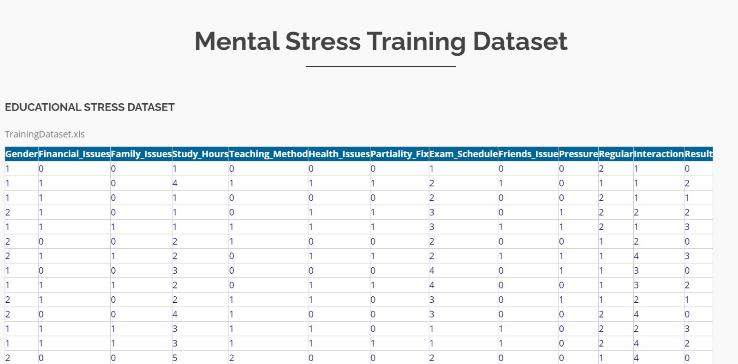
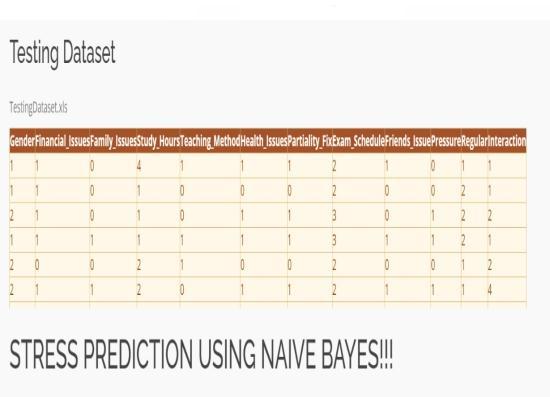
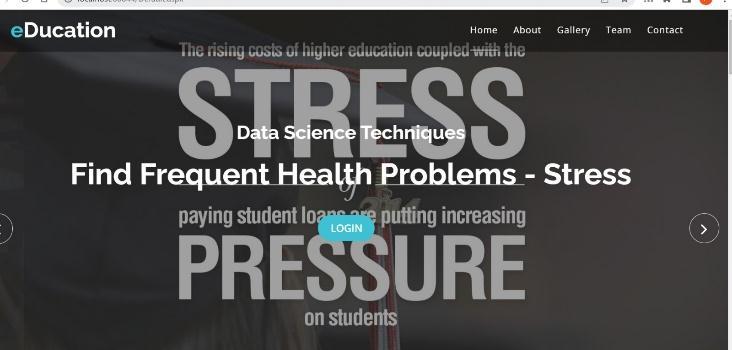
The project is a website thatanalyzes the stresslevels of the individuals logged in to the system and predicts the type and cause of stress caused along with the course of actionthatneedstobetakentoavoidit.
11. CONCLUSION AND FUTURE ENHANCEMENT
College students are at a high risk of developing mental health problems due to a range of factors such as academicpressure,socialisolation,andfinancialstress.
Itcanbemanytimesdecidedasdaytodaymovementsfor a hassle-free mind to pay attention to lecturers. To decrease the individual stress rate, human societies have beeninapositiontoboostacompletestageofprogressin monitoring the stress stage of students and make them scorewellinacademics.
Lack of stress administration can result in some drastic injury which can sometimes affect the education completely and can even cause extreme injury to the fitnessofthestudentsatavarietyofstages
These problems can have a significant impact on their well-being, academic performance, and overall quality of life. In order to address these challenges, the proposed system utilizes machine learning techniques to predict student stress levels and provide personalized solutions to manage stress and anxiety. The system works by analyzing past data on student stress levels and identifyingpatternsandtrends.Thisdatacanbegathered through surveys or other assessments that measure various factors related to mental health, such as anxiety, depression, and perceived stress. By applying machine learning algorithms to this data, the system can identify the most important predictors of stress and develop a model for predicting future stress levels. Once the model is developed, the system can provide personalized solutions to manage stress and anxiety based on each student's individual needs. These solutions may include recommendations for stress-management techniques, self-care strategies, and other resources to support mental health and well-being. By providing personalized support,thesystemcanhelpstudentstodevelophealthy copingmechanismsandpreventthedevelopmentofmore serious mental health conditions. In addition to utilizing machine learning techniques like the Naive Bayes classifier, the proposed system can be further enhanced by implementing deep learning techniques like CNNs. These techniques can help to improve the accuracy and effectiveness of the model by enabling it to learn from more complex and nuanced data. Overall, the proposed system has the potential to make a significant impact on the mental health and well-being of college students. By utilizing machine learning techniques to predict and managestresslevels,thesystemcanhelptocreateamore supportiveandpositivelearningenvironmentandreduce thenegativeeffectsofmentalhealthconditions.
11.REFERENCE
[1] Disha sharma, nikitha Kapoor, Dr.sandeep. “Stress Prediction of students using machine learning”. Trans stellar,vol.10,issue3,June2020.
[2] Saskia Koldijk, Mark A.” Detecting work stress in offices by combining unobtrusive sensors”. Radboud respositoryuniversity,Nov09,2021.
[3]Christina S.Malfa,”PsychologicalDistressandHealthRelated Quality of Life in Public Sector Personnel”. Environmentresearchandpublichealth,feb14,2021.
[4] Xiyu Liu and Yanliang zhang.” How COVID-19 affects mental health of college students and its countermeasures”. International conference on public healthanddatascience(ICPHDS),2020.
[5] Pramod Bobade, Vani M.” Stress Detection with MachineLearningandDeepLearningusingMultimodal PhysiologicalData“IEEE,sep06,2020.
[6] John paul”, Mental stress detection using wearable sensors”,IEEE,Aug,2020
[7] John canny,” A study on stress management among theemployeesinmanufacturingindustries”.
[8] Enrique gorcia, venet osmani and Oscar mayora. “Automatic stress detection in working environments fromsmartphones”
[9]Yuan shi,Minh hoai Nguyen, Patrick belt.” Personalized Stress Detection from Physiological Measurements”.IEEE,2019