IoT based Smart Agriculture Monitoring System

Ajit Divakaran Mini
Department of Electronics Engineering
Shah and Anchor Kutchhi Engineering College
Mumbai 400088, India
Jagdale Satyam Suyog Rekha
Department of Electronics Engineering Shah and Anchor Kutchhi Engineering College
Mumbai 400088, India
Minchekar Ansh Suresh Anuradha
Department of Electronics Engineering
Shah and Anchor Kutchhi Engineering College
Mumbai 400088, India
Mr. Santosh Kamble
Department of Electronics Engineering
Shah and Anchor Kutchhi Engineering College
Mumbai 400088, India
Abstract India is an agricultural country with agriculture contributing significantly to the country's GDP [2]. However, the Indian agricultural sector is facing several challenges such as inefficient water usage, poor soil quality, and unpredictable weather conditions, which directly impact crop yield and profitability. In recent years, there has been an increasing demand for smart agriculture systems that can help farmers optimize their crop yield and reduce resource wastage [1]. In this paper, we propose an IoT-based smart agriculture robotic system that is designed to sense the temperature, humidity, and moisture levels in the soil, and transmitthisdatatoanIoTplatformviatheinternet. The system is also equipped with wireless and manual control capabilities via a mobile application using Bluetooth, enabling farmers to control the movements of the robotic system in real-time. Compared to the complex and expensive smart agriculture systems currently on the market, our proposed system is both cost-effective and easy to use. This allows farmers to optimize resource usage and reduce waste, and take corrective measures to prevent crop loss when soil moisture falls below a predetermined threshold. The system's rechargeable lithium-ion batteries offer a costeffective and sustainable power supply solution, especially in rural areas with limited access to reliable electricity. Overall, this system has the potential to improve crop yield and profitability while reducing resource waste and environmental damageintheagriculturalsectorofIndia.
Keywords— SmartAgriculturesystem,Internetof Things (IoT), Robotic Car, Mobile application, Bluetooth
Gupta Satyam Ramdayal Asha
Department of Electronics Engineering Shah and Anchor Kutchhi Engineering College
Mumbai 400088, India
Mrs. Manjusha Kulkarni
Department of Electronics Engineering
Shah and Anchor Kutchhi Engineering College
Mumbai 400088, India
I. INTRODUCTION
The agriculture sector is one of the most important sectorsinIndia,asitprovideslivelihoodsforasignificant portionofthe populationandcontributessignificantlyto thecountry'seconomy.However,thesectorfacesseveral challenges, including water scarcity, inadequate irrigation, and a lack ofreal-time monitoring and control systems. In order to address these challenges, there is a need for innovative and cost-effective solutions that can enable farmers to optimize resource usage and increase cropyields.
The need to increase farm productivity has become urgent due to factors such as the exponential expansion of the global population, which would require the globe to produce 70% more food by 2050(according to the UN Food and Agriculture Organization), shrinking agricultural lands, and depletion of finite natural resources, the need toenhance farm yield has become critical. The problem has been made worse by the limited supply of natural resources including fresh waterandarablelandaswellas declining yield patterns in a number of essential crops. The agricultural workforce's changing organizational structure is another hindering factor. Inaddition, agricultural work has decreased in themajorityofthenations.Thedemand for physical labour has decreased as a result of the shrinking agriculturalworkforce, which has prompted the introduction of internet connectivity solutions in farmingtechniques.
The traditional farming methods are no longerefficient and cannot meet the increasing demand for food production. The agricultural sector needs tomodernize and embrace technology to meet the challenges. Precision agriculture is a new approach that uses
technology to optimize crop production while minimizing resource usage. IoT-powered smart agriculture systems have the potential to revolutionize the agricultural sector by providing real-time data about the crops and the environment. Such systems can help farmers make informed decisions about irrigation, fertilization,andothercriticalaspectsoffarming.[3][4]
One of the significant challenges faced by farmers is the lack of access to accurate and timely information about the crops and the environment. IoT-powered smartagriculturesystemscanprovidefarmerswithrealtimedataaboutthetemperature,humidity,andmoisture content of the soil. The data can be used to make informed decisions about the timing and amount of irrigationandfertilization.
Another challenge is the inefficient use of resources. Farmers often use more water, fertilizer, and pesticides than necessary, leading to environmental damage and increased production costs. IoT-powered smart agriculture systems can help farmers optimize resource usage by providing data about the crop's needs and environmental conditions. Furthermore, pests and diseases are a significant threat to crop production. Traditional methods of pest and disease control involve the use of pesticides, which can be harmful to the environment and human health [3]. IoT-powered smart agriculturesystemscanhelpfarmersdetectandprevent pest and disease outbreaks by monitoring the crop's healthandenvironment.
Theaimoftheproposedsystemistoprovidefarmers with a cost-effective and sustainable solution for precisionagriculture.ThesystemusesIoTtechnologyto providefarmerswithreal-timedataaboutthecropsand the environment. The data can be used to optimize resource usage and prevent crop loss due to pests and diseases. By providing farmers with real-time data and control over their crops, the proposed system has the potential to improve crop yield and profitability while reducingresourcewasteandenvironmentaldamage.
II. DESIGN OF THE PROPOSED SYSTEM
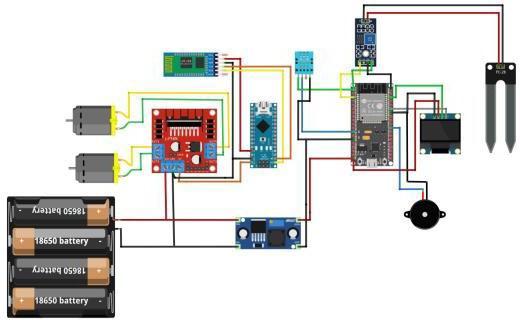
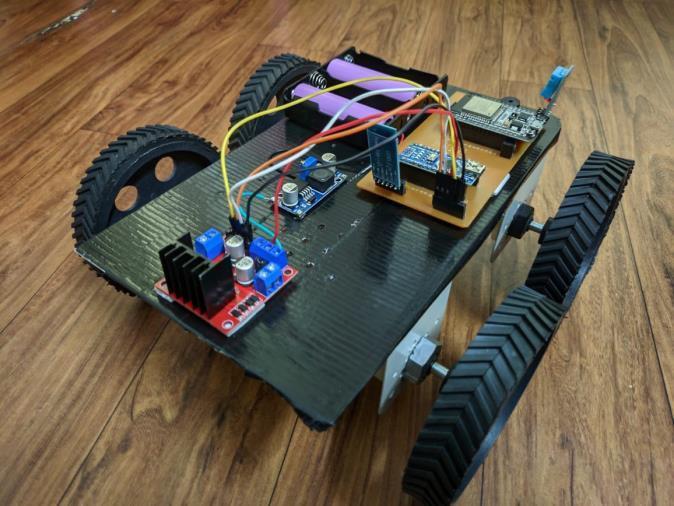
Theblockdiagramoftheproposedsystemisshowninthe figure1.1whichshowshoweachcomponentinthesystem is connected and how they are related to each other. The hardwarecomponentsareconnectedtoeachotheronthe basis of this diagram. This system makes use of two microcontrollers Arduino Nano and ESP32 microcontroller.ThecontrollingunitmanagedbyArduino nano controls the movements and the sensing unit managed by ESP32 collects all the necessary data which accurately has to be measured before sending it over the cloud for further analysis. An inbuilt Wi-Fi feature in ESP32 helps to send the data sensed through the sensors inrealtimetotheIoTplatformThingspeak whereallthe history of the perceived data is stored. A customized
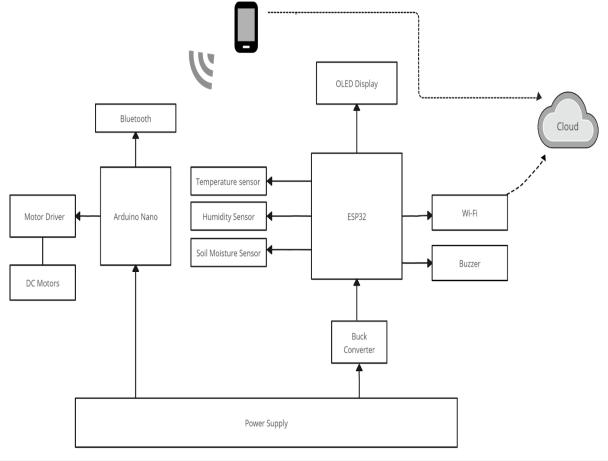
application built to control this system enables to control the movements of robotic car and receive data from the sensorusedi.e.,Temperature,Humidity&Soilmoisture.[5]
The hardware components of the proposed system consistofthecomponentslistedbelow:
ESP32:-
The ESP32 microcontroller is a versatile and powerfulmodulethatcanbeusedasaWi-Fimodulefor IoTapplications.Inthispaper,weproposeasystemthat utilizes the ESP32 to sense the temperature, humidity,
andmoisturelevelsfromattachedsensorsandsendthis data over the cloud through the internet in real-time. TheESP32 isanideal choice for this application due to its built-in Wi-Fi capabilities and powerful processing capabilities. It features a dual-core processor that can runupto240MHz,alongwith 520 KB of SRAM and up to16MBofflashmemory.TheESP32alsosupportsWiFi 802.11 b/g/n, making it compatible with a wide range of Wi-Fi networks. To sense the temperature, humidity, and moisture levels, we will attach a DHT11 sensor and a moisture sensor module to the ESP32. These sensors will provide accurate readings of the environmental conditions and allow us to monitor the conditions in real-time. The ESP32 will then use the built-inWi-Fitosendthisdatatothecloud,whereitcan be accessed and analyzed in real-time. This will be accomplished using cloud-based IoT platforms such as Thing speak Iot Cloud. By utilizing the powerful processing capabilities and built-in Wi-Fi of the ESP32, we can sense the temperature, humidity, and moisture levels and send this data to the cloud in real- time, allowing for efficient monitoring and analysis of environmentalconditions.[6][7]
a controller, such as a smartphone application. The controller sends commands to the Arduino Nano, which translates them into motor movements and sends them to the motor driver. The motor driver then controls the speedanddirectionoftheDCmotor,allowingforprecise control of the robotic car's movements. This system allows for wireless control of the robotic car's movements,makingitanidealchoiceforremotecontrol applications. The proposed system has the capability to move forward, backward, left, right, and stop on command. The use of a DC motor and motor driver ensures precise control of the robot's movements, allowing for efficient andaccuratecontroloftherobot.
TemperatureSensor:-
The DHT11 is a low-cost digital temperature and humidity sensor module that is commonly used in various applications such as home automation, weather stations, and agricultural monitoring. The module is small and easy to use, making it an ideal choice for applications where space is limited. It has a built-in thermistor and a capacitive humidity sensor, which provideaccurateandreliabletemperatureandhumidity readings.TheDHT11iscompatiblewitha widerangeof microcontrollers,anditssimplecommunicationprotocol makesiteasytointegrateintoprojects[6]
The Arduino Nano is a compact and affordable microcontroller board that can be used to control the motorsofarobotcar.Inthispaper,wepresentasystem where the Arduino Nano is used to control the motors wheels of a robot car wirelessly in real-time. The Arduino Nano is programmed to receive commands wirelessly via Bluetooth, which is connected to the Arduino Nano. These commands are sent from a smartphone application to control the robot car's movement. The Arduino Nano then translates these commands into motor movements and controls the speedanddirectionofthe wheelsusinga motordriver. This system allows for real-time wireless control of the robot car's movement, making it an ideal choice for applications that require remote control of a robot car. The Arduino Nano's compact size and affordability makeitanattractiveoptionforroboticsprojects.
DC motors are commonly used in robotics and other applications that require precise control of motor movement.
[6]Inthispaper,wepresentasystemwhereaDCmotor is used to control the movements of a robotic car via
Bluetooth, using a motor driver L298N.The DC motor is connected to the motor driver, which provides the necessary power and control signals to the motor. The motor driver is then connected to an Arduino Nano, whichreceivescommandswirelesslyviaBluetoothfrom
Lithium-ionrechargeablebatteries:-
In this paper, we propose a system that utilizes four rechargeable lithium-ion batteries to power two 10rpm motorsandtheentirecircuit.Lithium-ionbatteriesarea popular choice for portable devices due to their high energy density and long cycle life. The system includes two10rpmmotorsthatareusedtodrivearoboticcar,as well as a range of other electronic components. The rechargeable lithium-ion batteries provide sufficient power to operate the motors and the entire circuit, ensuring that the system can operate for extended periods without the need for frequent recharging. The lithium-ion batteries are rated at 3.7 volts, which is sufficient to power the motors and other electronic components. The batteries are also rechargeable, which means they can be recharged using a suitable charging circuit. The use of rechargeable lithium-ion batteries in this system provides a reliable and efficient power sourceforthemotorsandotherelectroniccomponents.
Soilmoisturesensor:-
Thesoilmoisturesensorisadeviceusedtomeasurethe moisture content of soil. It is commonly used in agricultural and gardening applications to ensure that plants receive the right amount of water. The sensor consistsoftwoprobesthatareinsertedintothesoil,and itworksbymeasuringtheresistanceofthesoilbetween the probes. The higher the moisture content of the soil,
the lower the resistance, and vice versa. The soil moisture sensor is a simple and effective tool that can help to prevent over-watering or under-watering of plants,whichcanleadtopoorgrowthandyield.Itiseasy to use and can provide accurate measurements of soil moisture,makingitanessentialtoolforanygardeneror farmer.
BuckConverter:-
In this paper, we propose the use of a Buck converter to providea stableDC supply totheESP32 microcontroller. A Buck converter is a type of DC-DC converter that is commonly used in electronic devices to provide a stable voltage supply. It works by converting a higher voltage input to a lower voltage output, while maintaining a constant power output. The ESP32 microcontroller requires a stable DC supply to function correctly, and a Buckconverterisanidealchoiceforthisapplication.The Buckconvertercanprovideastableoutputvoltagethatis independent of variations in the input voltage, making it an ideal choice for applications that require a stable DC supply. The Buck converter also offers high efficiency, whichmeansthatitcan convert the input voltage to the desired output voltage with minimal power loss. This makes it an ideal choice for battery-powered applications,wherepowerefficiencyiscritical.Overall,the useofaBuckconvertertoprovideastable DC supply to the ESP32 microcontroller ensuresreliableandefficient operationofthesystem,makingitanessentialcomponent oftheoveralldesign.
BluetoothHC05:-
The Bluetooth HC05 module is a small, low-cost device that enables wireless communication between the robotic car and a mobile application. It is commonly used in a range of applications, including home automation and robotics, where wireless communication is required. In this paper, we propose the use of the Bluetooth HC05 module to enable the roboticcartobecontrolledviaamobileapplication.The Bluetooth HC05 module can be easily integrated with the microcontroller, allowing the user to control the robotic car through a mobile application. The mobile applicationsendssignalstotheBluetoothHC05module, which are then transmitted to the microcontroller to control the movement of the robotic car. This enables the user to control the robotic car from a distance, makingitaconvenientanduser-friendlysolution.[2][6]
soil. When the moisture sensormoduledetectsthatthe soil is too dry, it sends a signal to the microcontroller, whichinturnactivatesthebuzzer.Thebuzzerproduces a sound that is audible to the user, alerting them that the soil needs to be watered. This simple but effective solutionallowstheusertomonitorthemoisturecontent ofthesoilwithouthavingtoconstantlycheckthesensor readings. The buzzer provides a convenient and easyto-usealertsystem,ensuringthattheplantsreceivethe rightamountofwatertogrowandthrive.
OLEDdisplay:-
TheOLED displayisa small,low-powerdisplaymodule that is used to display the temperature and humidity valuesmeasuredbytheDHT11sensor.Inthispaper,we proposetheuseofanOLEDdisplaytoprovidereal-time temperature and humidity data to the user. The OLED display is easy to read and can be used to display a range of information, including text and graphics. The temperature and humidity values are displayed in a clear and easy-to-read format, allowing the user to monitor the environmental conditions in real-time. The OLEDdisplayisalsolow-power,whichmeansthatitcan
be used in battery-powered applications without significantly affecting the overall power consumption of thesystem.Thismakesitanidealchoiceforapplications wherepowerefficiencyiscritical.
D. Software used
The buzzer is a simple audio device that is used to provideanaudiblealertinresponsetoasignalfromthe moisture sensor module. In this paper, we propose the use of a buzzer to indicate the moisture content in the
The Arduino IDE software platform is used to program microcontrollers Arduino Nano and ESP32 in the proposed system mentioned in this paper. Arduino IDE provides a user-friendly graphical interface and a simplified programming language based on C/C++ to make it easy for developers to write and upload code to their microcontroller boards. The IDE includes a code editor with features such as syntax highlighting, automatic code completion, and error highlighting, making it easy to write, test, anddebug code. It also has a serial monitor for real-timedebugging and data visualization. With a wide range of libraries and examples available, developers can easilyincorporate functionality such as reading sensors, controlling motors, and communicating with other devices into their projects. To program the Arduino Nano and ESP32microcontrollersusingtheIDE,onecanselectthe appropriateboardandportsettings,writethecodeinthe code editor, and upload the code to the board using a USB cable. The Arduino IDE is a popular andversatile platform for programming microcontrollers,making it an ideal choice for both beginners and experienced developersinvariousprojects.
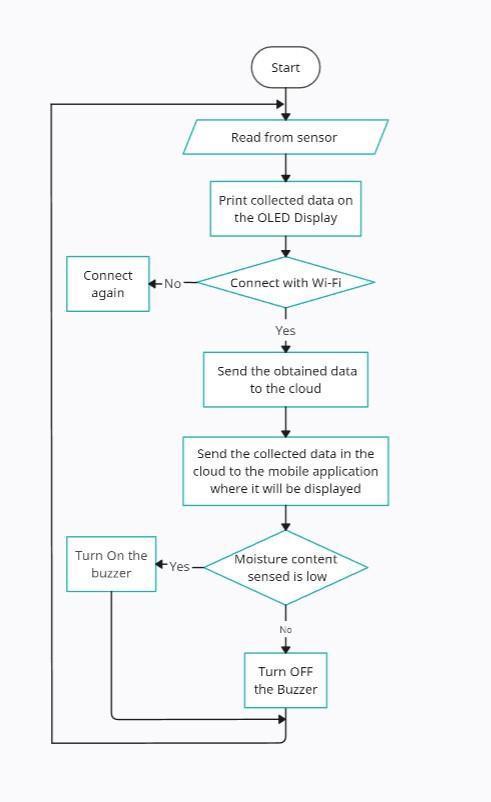
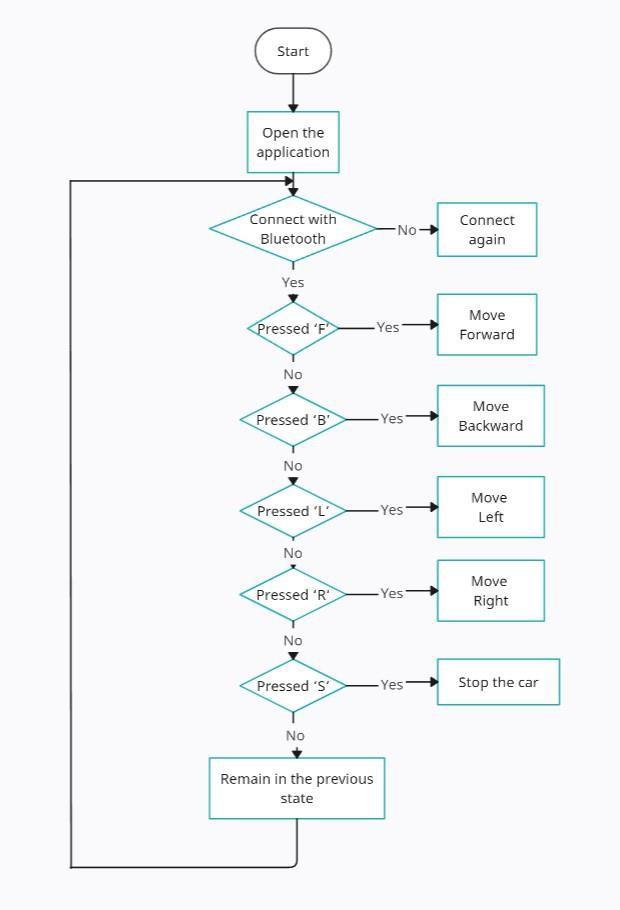
WhenthesystemisturnedON,poweredbyrechargeable Lithium-ionBatteries itpowersArduinonanoandESP32 microcontroller which initiates the controlling and sensing unit of the proposed system.[6][7] So, when this system is powered up the user would be able to connect with the system with the help of mobile application explicitly designed for the purpose through Bluetooth present in the system. User just have to turn ON the Bluetooth connectivity on their mobile device identify the system through its Bluetooth nme under available devices and pair it with device using the correct password.Once the user is connected with Smart IoT system, authorized user willthen have the access to the entire system [8].The user will now get the real-time information and readings of various parameters affecting agricultural yield like
Temperature, Humidity, & Moisture of the soil content.The system proposed in this paper is built in such a way that if the moisture content of the soil measured from the soil moisture sensor is below the determined threshold value an alarm buzzer is triggered and notification for the same is displayed on the app. Also, they will now be able to control the movement of the robotic car on which the system is fixed wirelessly through the mobile app. The mobile application is designed in such a way that it becomes easier for the user to control the robotic movements and at the same time receive real-time agricultural parametersdisplayedwithintheapp.Nowthisdatacanbe utilized further by the farmer to determine the best conditions and environment for increased agricultural productionforeachandeveryportiononthelandusedfor farming which is stored on the cloud Iot platform Thing Speak IoT with all its current and previous historicaldata.
VI. RESULT AND DISCUSSION:
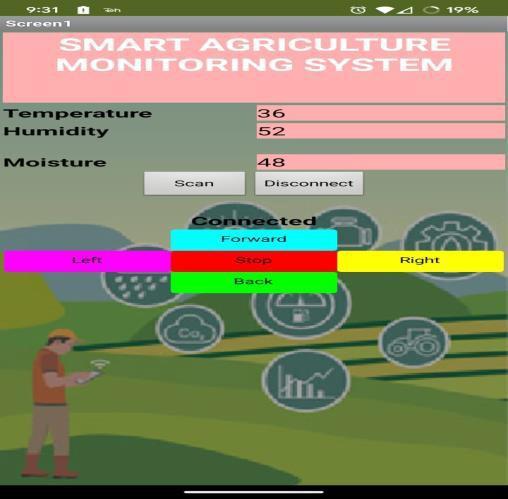
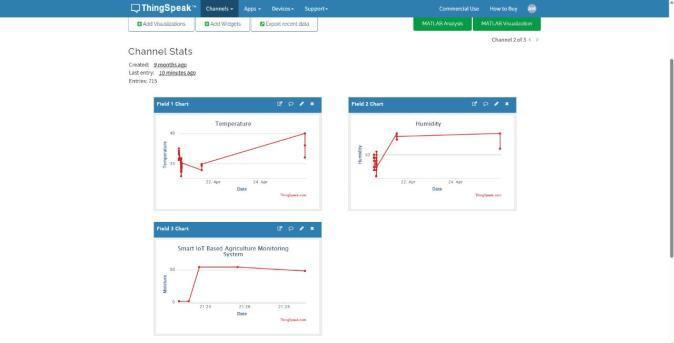
Thesystemsendsthedatathatiscollectedbythesensor totheIoTbasedplatformThingSpeak IoT whereall the previous data and current data is stored. This data is represented in the form of graph for each parameter as seen in the fig. which is further used for data-based analysis. The latest readings displayed on the Thing Speak IoT is then fetched in real time using thing speak API and these values are displayed on the mobile application as shown in the figure. The overall system helps the farmers/users in determining if the current conditions in the agricultural field for different produce is suitable or not without physically being there all the time which reduces labor effort and gives constant accurateresults.
VII. CONCLUSION:
In summary, the proposed system is an innovative solution for addressing the challenges faced by the agriculture sector in India. By providing farmers with
real-time data and control over their crops, the system has the potential to increase crop yields, reduce resource waste, and improve environmental sustainability. Thesystem's simplicity, affordability, and accessibility make it a valuable tool for farmers in rural areas of India,[8] where access to advanced agricultural technologies is often limited. The proposed system representsa significant step towards thedevelopment of smart andsustainable agriculture practices in India, and has the potential to significantly improve the livelihoods offarmersandthe overallhealthoftheagriculturalsector.
REFERENCES
[1] M, Manasa Reddy et al. “IOT based Crop Monitoring system for Smart Farming.” 2021 6th International Conference on Communication and Electronics Systems(ICCES)(2021):562-568.
[2] Boobalan. J, Jacintha. V, J. Nagarajan, K. Thangayogesh and S. Tamilarasu, "An IOT based Agriculture Monitoring System," in International Conference on Communication and Signal Processing, April3-5,2018,India.
[3] Islam, M. S. & Dey, G. K. (2019). Precision Agriculture: Renewable Energy Based Smart Crop Field Monitoring and Management System Using WSN via IoT. In 2019 International Conference on Sustainable Technologies for Industry 4.0 (STI), 2425 December, Dhaka (pp. 1- 6). IEEE. doi: 10.1109/STI47608.2019.9029269.
[4] R. Nageswara Rao and B. Sridhar, "IoT based smart crop-field monitoring and automation irrigation system," in Proceedings of the Second International ConferenceonInventiveSystemsandControl (ICISC 2018), IEEE Xplore Compliant - Part Number:CFP18J06- ART, ISBN:978-1-5386-0807-4; DVD Part Number:CFP18J06DVD, ISBN:978-1-53860806-7.
[5] G. Sushanth and S. Sujatha, "IoT Based Smart AgricultureSystem," 2018International Conference on Advances in Computing, Communications and Informatics(ICACCI),Bangalore,India,2018, pp.1014-1019,doi:10.1109/ICACCI.2018.8554686
[6] Meti, A. G., Rayangoudra, P. N., Biradar, K. S., Kumar, V., Manoj,G.H.,&Murthy,B.T.V.(2022).IoTandSolar EnergyBased Multipurpose Agricultural Robot for Smart Farming. In 2022 IEEE International Conference onData Science and Information System (ICDSIS) (pp. 1-6). IEEE. DOI: 10.1109/ICDSIS53466.2022.9753855
[7] Akhund,T.Md.N.U.,Hossain,Md.Rakib,Newaz,N. T., & Kaiser, M. Shamim. (2021). Low-Cost Smartphone- Controlled Remote Sensing IoT Robot. In M. S.Kaiser et al. (Eds.), Information and Communication Technology for Competitive Strategies (ICTCS 2020), Lecture Notes in Networks and Systems 190. Springer Nature Singapore PteLtd.
[8] Prema, P. (2019). Smart Agriculture Monitoring System using IoT. International Journal of Pure &AppliedBioscience.