AN ANDROID APPLICATION FOR CAMPUS INFORMATION SYSTEM
Abstract - Mobile technology is one of the vast technologies spread between people. The main motivation behind mobile technology is to connect people with each other. Mobile technology has introduced new environments among students and teachers that can be used to improve today’s learning system. Taking into consideration this promising setting, a study was undertaken to realize the impact of such an environment, made possible by the android platform, on the learning processamongstudents.
The system is an internet-based application that can be accessed throughout the institution or a specified department. This system may be used for monitoring attendance for the college. Students as wellas stafflogging in may also access or can search any of the information regarding college. Attendance of the staff and students as well as marks of the students will be updated by the staff. Thissystem is being developed for an engineering college to maintain and facilitate easy access to information. For this, the users must be registered with the system after which they can access as well as modify data as per the permissionsgiventothem.
Key Words: Mobile Technology, Android Platform, Firebase, Arduino, Smart Campus.
1.INTRODUCTION
The system was created with the purpose of offering servicesincollegesandinstitutes.Theuserinterface will replace the current paper records and the systemwill offer an extensive student information system. Using android devices and a secure internet interface,college staff uploads attendance, results, and notifications. Before any record alteration really happens, all data is carefullyexaminedandverifiedontheserver.Thesystem is designed withastudentuserinterfacesothat students can access advice from their seniors. The college administrator's firebase server,whichisusedtostoreall data securely, is used. With the help of the system, accessing student records takes less time and paper effort.
Forthis endeavour,thecollegehadpreviouslydepended mainlyonpaperrecords,whichhadtheirowndrawbacks. Thissystemoffersastraightforwarduserinterfaceforthe

upkeep of student data. It can be used by colleges or educationalinstitutionstoeasilymaintainstudentrecords. Evenreturningstudents,guests,andteachershavetrouble findingbuildings,amenities,andservicesonavastcampus with many buildings, making it difficult to move between them.Thankfully,thissoftwarecomeswithapotentsearch engine and maps that work on any device, giving precise campusnavigation.Inadditiontosearchingforandfinding rooms, buildings, amenities, and everything in between, staff and students can alsoacquire detailed instructions to their desired location.Students can view a better plan for theirstudythankstotheonlinecampusinformationsystem. It aids in themanagement of strategic and well-managed information collages for the university and other institutions. For students and employees (both technical and non-technical), the system administratorcreateslogin IDsandpasswordssotheycan upload and retrieve certain data from the database. Any institutions, colleges, or businesses can use this system as an information managementsystem.
1.1 Problem Statement
Providing comprehensive information about the college campus is the issue. wherein college employees and students can access the information and become acquaintedwiththecampusofthecollege.
1.2 Objective
Themajorgoalsofthisprojectaretosimplifyinformation andbenefitthebigcampus. Theprimary goal increating the app was to combine many functions for students, instructors,andotherstaffmembersofaschool.
2. Literature Survey
There are various existing applications for the management of campus activities. Every application has its characteristics, disadvantages, and advantages.These applications(apps)aremadebytakingintoconsideration the needs of a particular institute. Theseapps provide a singlepurposeonly,andwenecessitatedifferent apps for diverse institutional activities. Android Based Campus Solutions help in the accomplishment of almost all institutionalactivitiesusingmobilephones.[1]
Nethajietal.describedtheproposedworkoftheAndroid BasedCampusSolutionapp.Bhattacharyaetal.described the idea and implementation of the MOBILE-CAMPUS application.UsingthissystemAdministratorcreateslogin id and password for students and staff (Technical and Non-technical) for uploading and downloading some information from the database. The online campus information system enables the students to get a better layoutofeducationplanning.Thissystemcanbeusedasa information management system for any institutes , collegesorany
othercompanies.[2]
Ghandi et al. presented the various approaches, guidelines, and standards followed while developing an application also listed in the "Mobile application development –a practical approach." Xhafa et al. described and analyzed the learning methods using mobile phones from both learning and technological perspectives. Li et al. introduced the client terminal's design.[3]
Chouetal.describedtheessentialityandneedformobile gadgets technology in our daily life. Malhotra et al. described construction and design of a device obstacle detection. Cardei defined the advancement oftechnology inmobileandsensors field.Oneresearcherdescribed the "Smart Campus" application that providing on-campus registration.[4]
Followingstatesthesurveytable:
3. SOFTWARE/HARDWARE REQUIREMENTS
3.1 FIREBASE
Developers can create iOS, Android, and Web apps using the Google-sponsored application development platform knownasFirebase. Toolsareavailable from Firebase for monitoring analytics, reporting and resolvingapperrors, aswellasdevelopingmarketingandproductexperiments. ManyservicesareprovidedbyFirebase,including:
• Analytics
• Authentication
• CloudMessaging
• Realtimedatabase
• Performance
• Testlab
3.2 ANDROID
Google created the Android mobile operating system, which is based on the Linux kernel and is primarily intended for touchscreen mobile devices like smartphonesandtablets.Theprocessthroughwhichnew applications are developed for the Android operating system is known as Android software development. The Android software development kit is integrated with AndroidStudioandistypicallyusedtocreateapplications intheJavaprogramminglanguage.
3.3 ARDUINO IDE
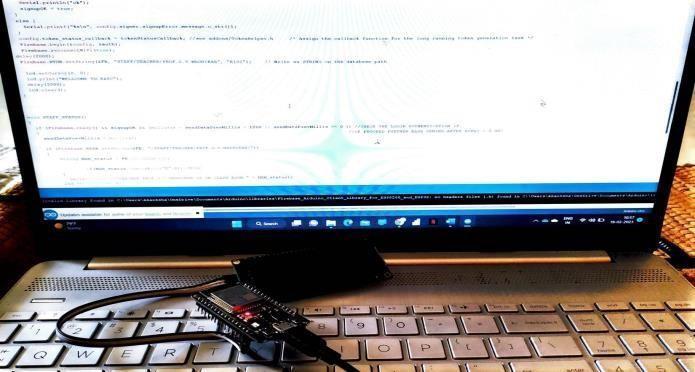
The Arduino software (IDE), developed by arduino.cc,is an integrated development environment that is open source and used to programme the Arduino boards. Permit programming and uploading to Arduino boards. Also, it included numerous libraries and a number of miniature project examples. The C/C++ programming language and many operatingsystems (Windows, Linux, Mac OS X) are supported bythe Arduino software (IDE). Beginners and more experienced users can both easily utilise the Arduino software. It is used to create interactive prototypes and get started with robotics and electronicsprogramming.
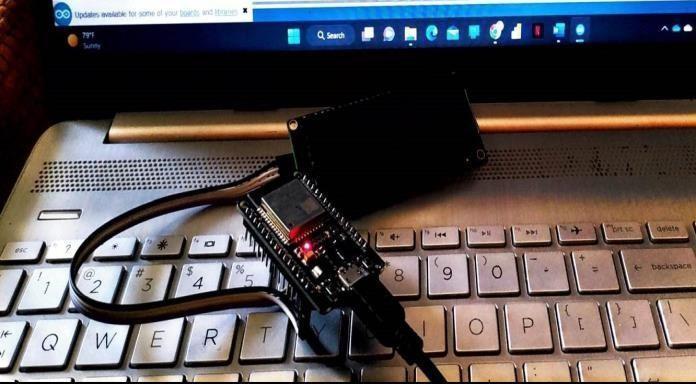
3.4 WIFI ESP8266
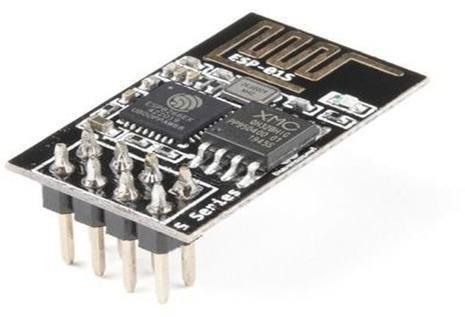
A self-contained SOC called the WIFI Module, which includes an integrated TCP/IP protocol stack, can grant any microcontroller access to your WiFi network. It has the ability to offload all WiFi networking tasks to another application processor or host an application. The module is a very affordable message board with a sizable, constantly expanding community. With its GPIOs, this module may be coupled with sensors and other application-specific devices with a minimum of upfront development and runtime loading because to its robust onboard processing and storage capabilities. Because of its high level of on-chip integration, it only requires a small amount of external circuitry, and even the front-end module is made to take up little space onthe PCB. In addition to supporting APSD for VoIP applications and Bluetooth co-existence interfaces,the module has an internal self-calibrated RF thatenables it to function inall operating environmentswithoutthe needforexternalRFcomponents.
3.5 LCD DISPLAY
LCD (Liquid Crystal Display) is a type of flat panel display which uses liquid crystals in its primary form of operation. LEDs have a large and varying set of use cases for consumers and businesses, as they can be commonly found in smartphones, televisions, computer monitors and instrument panels. LCDs were a big leap in terms of the technology they replaced, which include light-emitting diode (LED)and gasplasma displays. LCDs allowed displays to be much thinner than cathode ray tube (CRT) technology.LCDsconsumemuchlesspowerthanLEDand gasdisplay displays because they work on the principle of blocking light rather than emitting it. Where an LED emits light, the liquid crystals in an LCDproducesanimageusingabacklight.
4. BLOCK DIAGRAM/FLOW CHART
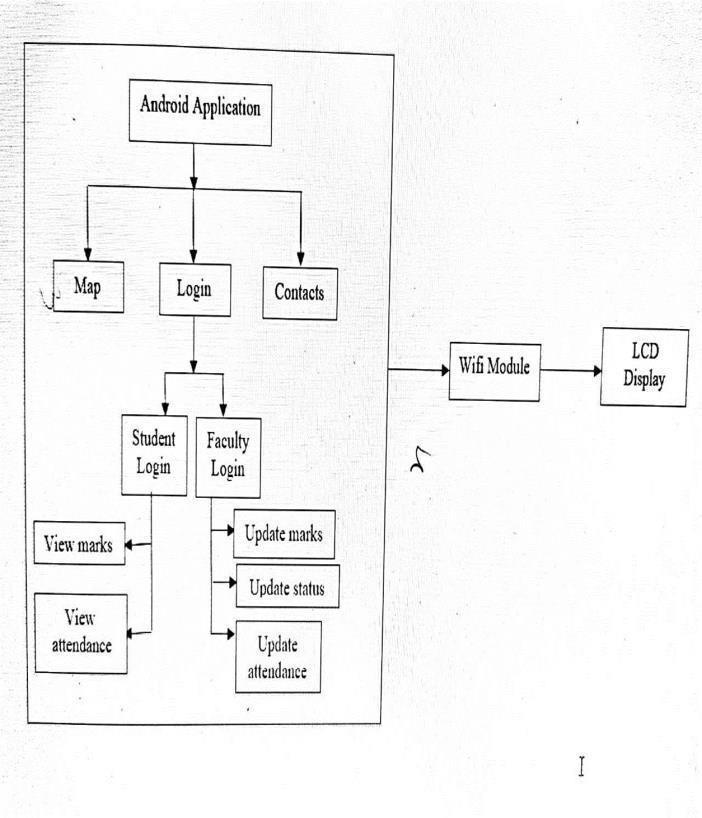
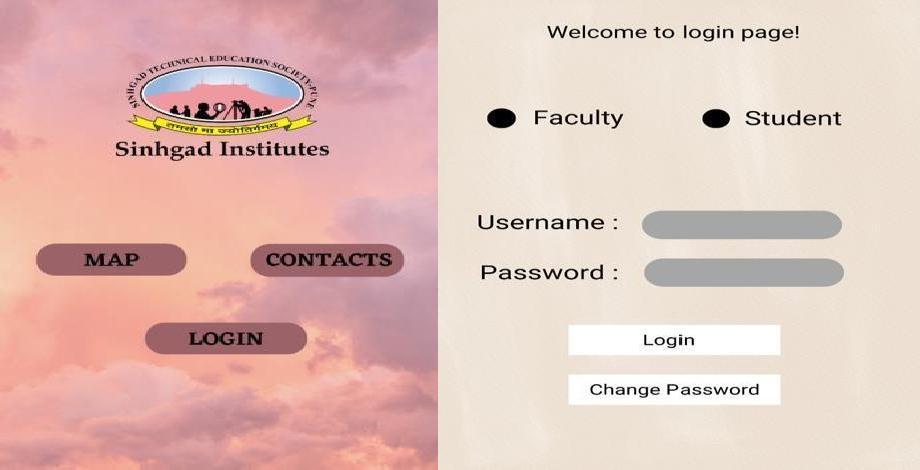
Thehomepageofthisapplicationhasamap,alogin,and contacts. Student login information and teacher login information are also available to students and employees. The status, attendance, and grades of studentscanallbesimplyupdatedbystaff.Studentscan alsoviewtheirgradesandattendance.
5. RESULT
6. CONCLUSION
Theprimarygoalincreatingtheappwastocombinemany functions for students, instructors, and other staff members of a school. It is advantageous for students to reviewthestaffinformation.Whethertheyare occupied or attending a lecture, staff can readily update their job status. Locating the campus is helpful for parents, guardians,andnewcomers.
7. FUTURE SCOPE
•Because the proposed application is practical, userfriendly, and simple to use, it can be used in a variety of contexts.
• Additional features canincrease the demand from users and apps. Reusability is also possible because of the application'sdifferentcharacteristics,andallofitsmodules offerflexibilityandsimplicityofuse.
• Students can comment on the college, the staff, or anotherstudent.
• Can view various system functions with help by selectingthehelpoption.
REFERENCES
[1] Nethaji,T.S.,andSuganthalakshmiR.,(2019),“ Muti
UtilityMobileApplication.”Pacifier24(1):1-3.
[2] Bhattacharya, Sagnik, and M. B. Panbu.(2013) "Design and development of mobile campus, an Android based mobile application for university campus tour guide.”.International Journal of Innovative Technology and Exploring Engineering, 3:25-29. and Technologies(CISTI),1-6..
Prof. Ganesh V. Madhikar Assistant Professor,Dept. ofElectronics and Telecommunication Engineering,Sinhgad CollegeofEngineering, Maharashtra,India

[3] Ghandi,Li.,CatarinaS.,Martínez,D.and Gualotuña T. (2017) , “.Mobile application development process: A practical experience.” 12th Iberian ConferenceonInformationSystems
[4] Chou & Malhotra, Described the essentiality and need for mobile gadgets technology in our daily life:1-6[4]
[5] https://www.researchgate.net
[6] https://www.mappedin.com
[7] https://components101.com/
[8] https://youtu.be/8BGJ9zr2JJU
[9] https://youtu.be/zL33InAvmds
BIOGRAPHIES
Akanksha Sanjay Jadhav Student, Dept.ofElectronicsand Telecommunication Engineering,Sinhgad CollegeofEngineering, Maharashtra,India.
Kalyani Dilip Girsawale Student, Dept.ofElectronicsand Telecommunication Engineering,Sinhgad CollegeofEngineering, Maharashtra,India.


Sakshi Ashwin Panchawatkar Student, Dept.ofElectronicsand Telecommunication Engineering,Sinhgad CollegeofEngineering, Maharashtra,India.