AUTOMATED SOLAR WIRELESS CHARGING FOR ELECTRIC VEHICLE
1Pratik R. Fusate,2
Ayushi S. Gumgaonkar,5Tanvi S.
3
Prashik S. Sadanshiv, Bijagare,6Dr. A. M. Mendhe
1-5B.E. Students, 6Assistant Professor
4
Priyanshu D. Lengure,Department of Electrical Engineering, Priyadarshini J. L. College of Engineering, Nagpur RTM Nagpur University, Nagpur, Maharashtra, India ***
Abstract - Wireless charging of electric vehicles is an emerging technology that has the potential to revolutionize the way we charge our vehicles. This technology eliminates the need for cords and plugs and allows for convenient and efficient charging. In this paper, we will discuss the concept of wireless charging, its history, working principles, circuits, features, construction and future prospects. Electric vehicles have now hit the road worldwide and are slowly growing in numbers. Apart from environmental benefits electric vehicles have also proven helpful in reducing cost of travel by replacing fuel by electricity which is way cheaper.
Key Words: ElectricVehicle,AutomaticWirelessPowerTransfer,SolarPowerSystem,DynamicChargingSystem,Battery ManagementSystem(BMS),AutomatedSolarWirelessChargingforElectricVehicle
1. INTRODUCTION
Electricvehicleshavebecomemoreprevalentovertheyearsduetothegrowingconcernoverclimatechangeand air pollution. One of the main challenges facing electric vehicles is charging. Charging electric vehicles can be a hassle, requiringtheuseofcordsandplugs.Wirelesschargingofelectricvehiclesprovidesanalternativetotraditionalcharging methods.Theideaofwirelesschargingdatesbacktothe19thcenturywhenNikolaTeslafirst proposed the concept of wireless power transfer. Since then, many researchers have been working ondevelopingwirelesschargingtechnology forelectricvehicles.In2010,thefirstwirelesschargingstationforelectricvehicleswasdemonstratedinBerlin,Germany.
1.1 CONSTRUCTIONAL ASPECTS

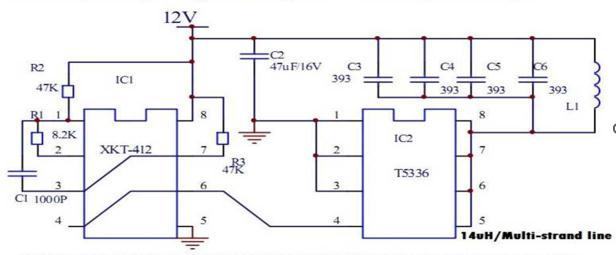
IntransmittercircuitweareusingtheICcircuit412whichispowerbysupplymoduleinreferencewitht5336inthe belowfigure2.1.Wegroundtheterminal5ofIC412and1,2,3withrespecttocapacitorof47Microfaradandproviding12 VoltinputtothecircuittoIC412withthehelpof47kresistortopinno.1andpinno.8similarlythis12valsogiventopinno.7 byaddingresistanceof47kpinno.7andpinno.3orpinno.3andpinno.1ofIC412areshortcircuitedinbetweenpinno.1 and3weplaceonecapacitorof1000ufpinno.2isconnectwith8.2kandresistortopinno.1nowpinno.4andpinno.6are alsoshortandthisoutputsendittoIC5336atpinno.4.12vinputisalsofedtoIC5336withthehelpof4capacitorof393ufto pinno.8,7,6,5becauseithasshortednow,weplacethetransmittercoilL1inparalleltothosefourcapacitors.
1.2 Transmitter Circuit
2.2 Receiving Circuit
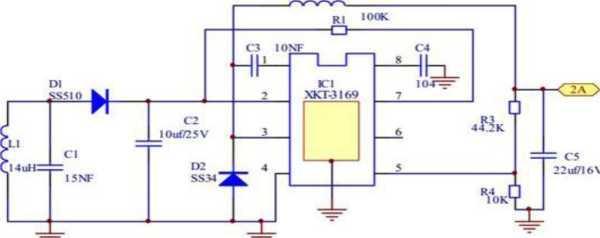
Inreceivingcircuitasshowninfigure2.2,wegroundtheterminal4andpinno.8w.r.tcapacitorof104pf.anodeofdiodeSS34is connectedtogroundandanodeofthediodeisinserieswithinductorcoilto44.2kand10kresistorandgrounditpinno.5,3and pinno.1isalsoconnectedtothislinkbefore10kresistorandpinno.1withcapacitor10nfpinno.2andpinno.7areshorted with100kresistancesimilarlywecreateaparallelnetworkofreceivingcoilandcapacitorof15nfwithdiodeSS510isinseries formatandagainthecathodeofdiodeisconnectedtocapacitor10ufthiswholenetworkfurtherlinkwithpinno.2ofICcircuit 3169
2.3 WORKING PRINCIPLE
Theworkingprincipleofwirelesschargingisbasedontheprincipleofelectromagneticinduction.Whenaelectric currentflowsthroughaconductor,itgeneratesamagneticfieldaroundit.Ifanotherconductorisplacedinthismagnetic field,anelectriccurrentisinducedinthesecondconductor.Inwirelesscharging,thechargingpad(whichisconnectedto anelectricalsource)generatesanelectromagneticfield,whichinducesacurrentinthereceivercoiloftheelectricvehicle. ThiscurrentisthenconvertedtoDCpowerandusedtochargethebatteryofthevehicle
2.4 Construction overview of Relay logic with Respect to PV cell and Transmitting Coil
Hereweused3relaywhichisperformingswitchingactionssothatwecandirectthepowersupplytotransmittingcoil fromPVcellandBatterypackoralsotochargethebatterypackfromPVenergythoserelayscomeintothescenario andplayavitalrole.
Everyrelaymodulehas6terminalsinwhich3terminalsweusedandconnectedforpowersupplyandassignalwe showninpreviousconstructionnowremainingthreeareNO(normallyopen),NC(normallyclose)C(common).we ConnectsolarpaneltotheCofR1(Relay1)andNCofR1connectedwithtransmittingmodule.Batterypackgets connectedtoCofR2(Relay2)andtransmittingcoilontotheNO.
Butnowtheproblemiswhenweswitchtochargethecarfrombatterypackthattimeduethereversevoltage,weface thecontinuousswitchingbetweenR1andR2toovercomethisproblemweinserttheR3inbetweenthoseR1AndR2 CofR3(Relay3)connectedtoNOofR1andNoofR3ConnectedtoCofR2.
2.5 How the System is Driven?
• Tounderstandthisindeeplymannerwemustneedtogothroughblockdiagram.
• WhenthereissufficientamountofsolarenergyvoltagesensorsensethevalueofvoltageIfitisgreaterthanorequals to10vorsimultaneouslyIR sensoralsosense thatthereisEV forcharging(IR=1). Thosecollected data givento ArduinoandArduinoiscodeinsuchawaythatwhenIR==1&&Vin>10(CHG-ONPV)(Relay1,LOW),(Relay2,LOW), (Relay3,LOW)
• WhenthereislackofsolarenergyvoltagesensorsensethevalueofvoltageIfitislessthano,10vorsimultaneouslyIR sensoralsosensethatthereisEVforcharging(IR=1).ThosecollecteddatagiventoArduinoandArduinoiscodein suchawaythatwhenIR==1&&Vin<10(CHG-ONBV)(Relay1,HIGH);(Relay2,HIGH),(Relay3,LOW).
• Thelastoneiswhenthereissufficientamountofsolarenergyandnocarontothestationvoltagesensorsensethe valueofvoltageIfitisgreaterthan10vorsimultaneouslyIRsensoralsosensethatthereisnoEVforcharging(IR=0). ThosecollecteddatagiventoArduinoandArduinoiscodeinsuchawaythatwhenIR==0&&Vin>10(BAT-CHG) (Relay1,HIGH);(Relay2,LOW),(Relay3,HIGH).
2.6 SCHEMATIC OF AUTOMATED WIRELESS CHARGING
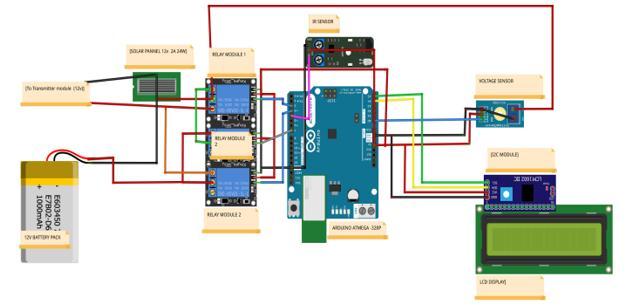
4.1 Construction Overview of Circuit Diagram
HereweusedArduino(atmega328p)asamicrocontrollerboardwhodrivesalltherelaylogicaccordingtotheconditions andparameterreceivedbytheIRandVoltageSensorandwegetthesupplyvoltageatthetransmittingcoilswhichtransferthe DCpowertotheReceivercoilwhichisinstalledinCar.
Wegive5vdctoallthesensorsandrelaymoduleandgroundalltheterminalswithARDUINOgroundpinandtodrive.The Arduinoweusedisof5vdcAdapter.S(signal)pinofvoltagesensorconnecttoA0pinofArduinoandweconnectIRsensorto D4pingofArduino.Nowthes(signal)pinofrelay1connectedtod2,relay2tod3andrelayd3tod7.AssembleI2Cmoduleonto thetopofLCDdisplayw.r.t1to16pins.Thereare4pinsofconnectSupplypinwith5vandgroundtogroundSCltoA5andSDA toA4ofArduino.
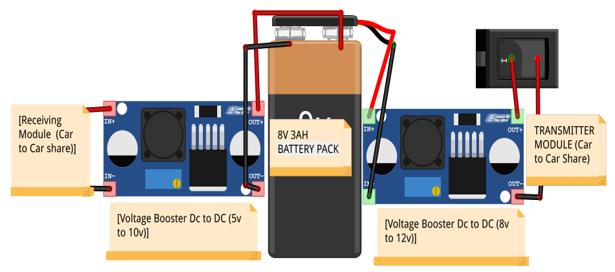
4.2 Concept of Car-to-Car Power Sharing
Thereareover10millionELECTRICVEHICLESusersintheworldandasweseentowardsthefuturethisfiguregoing towrapallthemarket.Wehaveallbecomehugelydependentonthisamazingobjectandthefeelingofitrunningoutofbattery isalltoofamiliarthat.Thesedeviceslast,atbest,aboutonefulldayonachargeandmustspendthebetterpartoftheevening tetheredtoawall. Orinanyemergencysituationlikeyoustuckonhighwaywith0%chargingthenyounoneedtoworryabout itbecauseofcar-to-cartransfer. UnlessyouareconstantlycarryingyourchargerwithyouitisdifficulttokeepyourEVfrom dyingoverthecourseofabusyday.ButwhatifwecouldchargeourVEHICLEconvenientlywithouthavingtofindaplugand carryingachargerwithusatalltimes?Withtheproliferationofelectriccarsonevitalpieceoftechnology,firstdevelopedabout acenturyago,issaidtosignificantlyimprovethewaywekeepourdevicespowered.
Here we used two Buck Boost Converter Module (DC to DC) which amplify the dc signal which we further used the charged the battery of the car and share the power to the receiver’s car. The receiver side booster converter boosted 5v receiveddcvoltageupto10vbecauseourbatterypackis8vandtochargethisweneed10vdcandwhiletransferringthis powertoanothervehicleagainweamplifythe8vto12vtoachievegoodrangeoftransmission.
V. RESULT
Iteliminatestheneedformanualcharging.Instead,thevehiclecansimplyparkoverawirelesschargingpad,andthe chargingprocesswillbeginautomatically.solar-poweredchargingstationsareenvironmentallyfriendly,astheyuserenewable energysources.Additionally,thewirelesschargingprocesseliminatestheneedforunsightlychargingcables,makingthe charging process more aesthetically pleasing. Overall, the development of automated solar wireless charging for electric vehicles has the potential to revolutionize the way we charge our cars, making it more convenient and environmentally friendly.However,moreresearchanddevelopmentaregoingonforimprovementofthisproject.
VI. CONCLUSION
Wirelesschargingofelectricvehiclesisapromisingtechnologythathasthepotentialtorevolutionizethewaywe chargeourvehicles.Althoughitisstillinitsearlystages,thetechnologyisimprovingrapidly,anditisexpectedtobecomemore efficientandcost-effectiveinthefuture.Withthegrowingconcernoverclimatechangeandairpollution,wirelesschargingof electricvehiclescouldplayasignificantroleinreducinggreenhousegasemissionsandimprovingairquality.
Autonomouswirelesschargingofelectricalvehicleisarevolutionarytechnologythathasthepotentialtorevolutionize thewayelectricvehiclesarecharged.Itoffersanumberofbenefits,includingimprovedconvenienceandefficiency,aswellas eliminatingtheriskofelectricshockorfirehazards.
Thetechnologyisexpectedtobecomemoreefficient,reliable,andcost-effectiveinthefuture,aswellasbecoming morewidelyavailable.Additionally,itisexpectedtobecomemoreuser-friendly,withthepotentialtointegratewithother smarttechnologies.
VII. FUTURE PROSPECT
WirelessChargingofelectricvehicleshasabrightfuture,withmanycompaniesinvestinginthetechnology.Asthe technologyimproves,itisexpectedtobecomemoreefficientandcost-effective.Theintegrationofwirelesschargingstations intotheroadinfrastructurecouldalsoleadtoincreasedadoptionofelectricvehicles.Atafundamentallevel,electriccars comparativelyofferaloweroperatingcostcomparedtoconventionalinternalcombustionengines.Onaverage,electricvehicles are75-80%cheaperfromfuelandmaintenanceperspective,whichisanimportantfactorformanyconsumerswhohavehigh usage. This reality holds true across factors because it’s materially cheaper to charge a battery compared to refueling a conventionalliquidfueltank
REFERENCES
[1].PradyumnaYambar“DynamicWirelessChargingofElectricVehicle”InternationalJournalforResearchinAppliedscience andEngineeringTechnology(IJRASET),volume6IssueIII,March2018.
[2].GrantCovicandJohnBoys“WirelessChargingofElectricVehicles”,ieee.org/newsletter/march-2018/wirelesscharging-forelectric-vehicles.
[3]. Asst. Prof. Swapna Manurkar, Harshada Satre, Bhagyashree Kolekar, Pradnya Patil, Samidha Bailmare, “WIRELESS CHARGINGOFELECTRICVEHICLE”,InternationalResearchJournalofEngineeringTechnology,Vol.7,Issue03,March2020.
[4]. Shital R Khutwad, Shruthi gaur “Wireless Charging System for Electric Vehicle” International conference on signal processing,communication,powerandembeddedsystem(scopes)-2016.
[5]. "Automated Solar Powered Wireless Charging System for Electric Vehicles" by M. Saravanan, S. Saravanan, and K. Ravichandran,inInternationalJournalofAppliedEngineeringResearch,2018
[6]. Design and Implementation of an Automated Solar-Powered Wireless Charging Station for Electric Vehicles" by S. S. BabatundeandE.A.Omidiora,inIEEETransactionsonIndustrialElectronics,2019.
[7].AutomatedSolar-PoweredWirelessChargingSystemforElectricVehiclesinSmartCities"byC.Li,X.Zhang,andW.Wu,in IEEEAccess,2021.
[8].AutomatedSolarWirelessChargingSystemforAutonomousMobileRobots"byS.SureshKumarandS.M.Kamalakkannan, inJournalofRobotics,2021
[9]. Wireless Charging System Using Solar Panels for Smartphones" by S. H. Park, J. H. Shin, and Y. S. Kim, in Journal of InformationDisplay,2021.
BIOGRAPHIES
Dr. A. M. Mendhe born in 1973 has receive the B.E. degree in Electrical Engineering in 1996, M.E. degree in Electrical Power System from SSGM college of Engineering, Shegaon, India, Ph.D. in ElectricalEngineeringfromSSSUTMS,Sehore,India.


His research interests include Power System. Currently, he is working as Associate. Prof. in Electrical Engineering Department at Priyadarshini J.L. College of Engineering, Nagpur, India. He is a LifeMemberoftheIndianSocietyforTechnicalEducationandInstituteofEngineers,India.
Pratik Ravindra Fusate was born in Nagpur, Maharashtra, India, in 1997.Currently pursuing B.E in ElectricalEngineeringatPriyadarshiniJLCollegeOfEngineering.Nagpur
Ayushi Suresh Gumgaonkar wasborninNagpur,Maharashtra,India,in2001.CurrentlypursuingB.Ein ElectricalEngineeringatPriyadarshiniJ.LCollegeOfEngineering.Nagpur.
Prashik Sunil Sadanshiv was born in Nagpur, Maharashtra, India, in 1998.Currently pursuing B.E in ElectricalEngineeringatPriyadarshiniJLCollegeOfEngineering.Nagpur
Tanvi Shyam Bijagare was born in Nagpur, Maharashtra, India, in 2002.Currently pursuing B.E in ElectricalEngineeringatPriyadarshiniJLCollegeOfEngineering.Nagpur


Priyanshu Dattatray Lengure wasborninNagpur,Maharashtra,India,in2001CurrentlypursuingBEin ElectricalEngineeringatPriyadarshiniJLCollegeOfEngineering.Nagpur