Quantum Implementation of RSA Crypto-algorithm using IBM-QISKIT
Pallavi Verma1 , Dr. Palla Penchalaiah 21Student, VIII Semester, B.Tech(ECE), VIT University, Vellore, Tamil Nadu, India (E-mail: pallavi.verma2019@vitstudent.ac.in)
2Associate Professor, Dept. of Micro & Nano Electronics, VIT University, Vellore, Tamil Nadu, India

Abstract - Quantumcomputershavethepotentialtobreak classical RSA encryption, which could lead to the loss of sensitive information, financial data, and other confidential information. To address this issue, a new generation of cryptography called quantum cryptography has emerged. Quantum cryptography exploits the principles of quantum mechanics for encryption & decryption, making it impossible for hackers to break. However, the implementation of quantum cryptography is still in its early stages. The motivation behind this project is to explore the feasibility of using quantum computing to enhance the security of traditional cryptographic techniques. The project aims to implement the RSA encryption algorithm on a quantum computer such as IBM-QISKIT platform. This will evince the potentialofquantumcomputinginthefieldofcryptography. Specifically, the aim is to investigate and compare the efficiency, accuracy, and security of potential different methodsforquantumimplementationofRSA:(1)Montgomery multiplication, (2) Chinese remainder theorem, (3) Shor’s Algorithm.
Key Words: Quantum Computing, IBM-QISKIT, RSA, Chinese Remainder Theorem, Montgomery Multiplication, Shor’s Algorithm
1. INTRODUCTION
Quantum computing is a game-changing technology that promises to revolutionize the world of computing as we know it. Traditional computers work with binary digits, knownasbits,whichcanbeeither0or1.However,quantum computersuse quantumbits,orqubits, whichcanexist in multiple states simultaneously. This property of qubits allowsquantumcomputerstoperformcertaincalculations exponentiallyfasterthanclassicalcomputers,makingthem ideal for solving complex problems in fields such as cryptography,drugdiscovery,andartificialintelligence.The RSA algorithm is a widely used and trusted encryption method that relies on the difficulty of factoring large composite numbers. However, the security of RSA can be compromisedbyquantumcomputers,whichcanefficiently factorsuchnumbersusingShor'salgorithm. Tocounterthis, therehasbeengrowinginterestinimplementingRSAusing quantum computing techniques, which can provide an additionallayerofsecurityagainstquantumattacks.
Inthiscontext,thequantumimplementationofRSAusing Qiskit(IBM) has emerged as a promising approach. By leveraging the power of quantum mechanics, Qiskit can provide efficient solutions for the complex mathematical operationsrequiredbyRSA.Thisquantumimplementation ofRSAusingQiskithasthepotentialtoenhancethesecurity ofdatatransmissionandstorage,andpavethewayforthe developmentofnext-generationcryptography.[1]
1.1 What is a QUBIT?
Inquantumcomputing,aqubitorquantumbitisabasicunit ofquantuminformation thequantumversionoftheclassic binarybitphysicallyrealizedwithatwo-statedevice.Aqubit isatwo-state(ortwo-level)quantum-mechanicalsystem,one ofthesimplestquantumsystemsdisplayingthepeculiarityof quantum mechanics. Examples include the spin of the electroninwhichthetwolevelscanbetakenasspinupand spindown;orthepolarizationofasinglephotoninwhichthe twostatescanbetakentobetheverticalpolarizationandthe horizontalpolarization.[2]
Inaclassicalsystem,abitwouldhavetobeinonestateorthe other.However,quantummechanicsallowsthequbittobein a coherent superposition of both states simultaneously, a property that is fundamental to quantum mechanics and quantumcomputing.Inadditiontosuperposition,qubitscan alsoexhibitaphenomenoncalledentanglement.Thismeans thatthestateofonequbitisdirectlyrelatedtothestateof anotherqubit,eveniftheyareseparatedbylargedistances.
1.2 The BLOCH Sphere
TheBlochsphereislikeamapofallthepossiblestatesthata single qubit can be in. Imagine a sphere, like a beach ball, whereeachpointonthesurfacerepresentsadifferentstate ofthequbit.Thenorthpoleofthesphererepresentsaqubit that is definitely in the state "0", and the south pole representsaqubitthatisdefinitelyinthestate"1".Allother pointsonthesphererepresentasuperpositionofthe"0"and "1"states.TheBlochsphereisimportantbecauseithelpsus tovisualizeandunderstandhowqubitswork.Bylookingat theBlochsphere,wecanseehowdifferentquantumgates (liketheX,Y,andZgates)affectthestateofaqubit.Wecan alsoseehowmeasurementscollapsethestateofaqubitto either"0"or"1".[3]
2. The Quantum Phenomena
One of the most well-known quantum phenomena is superposition,whichmeansthataquantumobject,suchasan atomorphoton,canexistinmultiplestatesorlocationsatthe sametime.Thisisdifferentfromclassicalobjects,whichexist inasinglestateorlocationatanygiventime.(Thismeans thatanatomcanbeintwodifferentstatesatthesametime.)
Another quantum phenomenon is entanglement, which occurs when two quantum objects become connected in a waythattheirpropertiesarecorrelated,evenwhentheyare far apart from each other. This means that measuring the property of one object will instantaneously affect the propertyoftheotherobject,eveniftheyarelightyearsapart. (Atomscanalsobecome"entangled"witheachother.This means that what happens to one atom can affect what happenstoanotheratom,nomatterhowfaraparttheyare.)
Another phenomenon is quantum tunneling, which is the ability of a quantum object to pass through a potential barrier,evenifitdoesnothaveenoughenergytoovercome thebarrieraccordingtoclassicalphysics.(Whenatomsare in superposition, they can sometimes do things that seem impossible.Forexample,theycanpassthroughsolidobjects, likewalls,withoutbreakingthem.Thisiscalled"tunnelling")
Quantummechanicsalsoinvolves,whichisdescribedbythe Heisenberguncertaintyprinciple.Thisprinciplestatesthat themore preciselythe positionofa particle isknown,the lesspreciselyitsmomentumcanbeknown,andviceversa. (Itisimpossibletosimultaneouslyknowtheexactposition andthemomentumoftheparticle.)[4]
3. The RSA Algorithm
RSA(Rivest-Shamir-Adleman)isapublic-keycryptosystem usedforsecuredatatransmissionovertheinternet.Itisone ofthemostwidelyusedencryptionalgorithms,andisusedto encryptsensitiveinformationsuchascreditcardnumbers andpasswords.TheRSAalgorithmusestwoprimenumbers togenerateapublicandprivatekeypair.Thesecurityofthe algorithmreliesonthedifficultyoffactoringlargenumbers intotheirprimefactors.PublicKeyencryptionalgorithmis alsocalledtheAsymmetricalgorithm.Asymmetricalgorithms are those algorithms in which sender and receiver use differentkeysforencryptionanddecryption.Eachsenderis assignedapairofkeys:PublicKey&PrivateKey.ThePublic key is used for encryption, and the Private Key is used for decryption. Decryption cannot be done using a public key. The two keys are linked, but the private key cannot be derivedfromthepublickey.Thepublickeyiswellknown, buttheprivatekeyissecretanditisknownonlytotheuser who owns the key. It means that everybody can send a messagetotheuserusinguser'spublickey.Butonlytheuser candecryptthemessageusinghisprivatekey
Choosetwoprimenumberspandq.Thesearekeptsecret andareusedtogeneratethepublicandprivatekeypairs.
Compute n = p * q. This is the modulus and is part of the public key. Euler's totient function phi(n) = (p-1)*(q-1). Chooseanintegeresuchthat1<e<phi(n)andgcd(e,phi(n)) =1.Thisisthepublickey.Computedsuchthatd*e=1mod phi(n). This is the private key. To encrypt a message, the senderconvertsthemessageintoa numbermlessthann, andraisesittothepowerofemodn.Todecryptthemessage, thereceiverraisestheencryptedmessagetothepowerofd modn.[5]
4. The IBM-QISKIT
IBMQiskitisapowerfulopen-sourcesoftwaredevelopment kitforbuildingquantumcomputingapplications.Itisoneof the most popular and widely used platforms for creating, simulating,andexecutingquantumprograms. WithQiskit, users can write quantum algorithms and execute them on realquantumdevicesprovidedbyIBMoronsimulatorsthat emulate the behavior of quantum systems. Qiskit also includesavarietyofpowerfultoolsforvisualizingquantum circuitsandanalyzingtheresultsofquantumcomputations. Whetheryouareaseasonedquantumcomputingexpertor just starting out, Qiskit provides a robust set of tools and resourcestohelpyouexploretheexcitingworldofquantum computing.Qiskitconsistsoffourmaincomponents:Terra, Aer,Ignis,andAqua.[6]
6. Implementation of Quantum RSA methods
Modular exponentiation: The most straightforward way to implementRSAisbyusingmodularexponentiation.Thekey generationalgorithmgeneratestwolargeprimenumbers,p andq,andcalculatestheirproduct,N=p*q.Itthenchoosesa numberesuchthat1<e<(p-1)(q-1)andgcd(e,(p-1)(q-1))= 1.Thepublickeyis(N,e),andtheprivatekeyisd,wheredis themodularinverseofemodulo(p-1)*(q-1).Toencrypta message, m, the sender calculates c = m^e mod N, and to decryptit,thereceivercalculatesm=c^dmodN.
Chineseremaindertheorem: AnotherwaytoimplementRSAis by using the Chinese remainder theorem. This method is faster than modular exponentiation, especially when the numbers involved are very large. The key generation algorithmisthesameasinthepreviousmethod.Toencrypta message,m,thesenderfirstcalculatesm1=mmodpandm2 =mmodq.Thesenderthencalculatesc1=m1^emodpand c2 = m2^e mod q. The sender then uses the Chinese remaindertheoremtocalculatecsuchthatc≡c1(modp) and c ≡ c2 (mod q). To decrypt the message, the receiver calculates d1 = d mod (p-1) and d2 = d mod (q-1). The receiver then calculates m1 = c^d1 mod p and m2 = c^d2 mod q. The receiver then uses the Chinese remainder theoremtocalculatemsuchthatm≡m1(modp)andm≡ m2(modq).
Montgomery multiplication: Montgomerymultiplicationisa technique used to speed up modular multiplication. It is based on the observation that if we use the Montgomery reductionalgorithmtoreducetheresultofamultiplication, thentheresultisalreadyinMontgomeryform,andwecan skip the final step of the algorithm. This saves time and reducesthenumberofmodularreductionsthatneedtobe performed. This method is used in hardware implementationsofRSA,asitisfasterthanothermethods.
5. The IBM-QISKIT Code
5.1 Chinese Remainder Theorem
Let'sconsiderasystemoftwolinearcongruences:
x≡amodpx≡bmodq,wherepandqaredistinctprime numbers.TheCRTtellsusthatthereisauniquesolutionforx modulopq,whichcanbeobtainedusingthefollowingsteps:


1.ComputetheproductN=pq.
2.Findthemodularinversesyandzofpandq,respectively, such that y≡ 1 mod pandz ≡ 1 mod q. This can be done usingtheextendedEuclideanalgorithm.
3.Computethevaluesuandv,whereu≡aymodpandv≡ bxmodq.
4.Thesolutionforxisgivenbyx≡(uqz+vpy)modN.
Ingeneral,theCRTcanbeextendedtosolvesystemsoflinear congruenceswithanynumberofequations,providedthatthe moduli are pairwise coprime (i.e., they have no common factorsotherthan1).[7]
Result:
Theinputintegersare[2,3,4,5]
Thecorrespondingconstantsare[3,5,7,11]
Themoduliare[5,7,9,11]
Thesolutionsare:
x=12640mod3465
5.2 Montgomery Multiplication
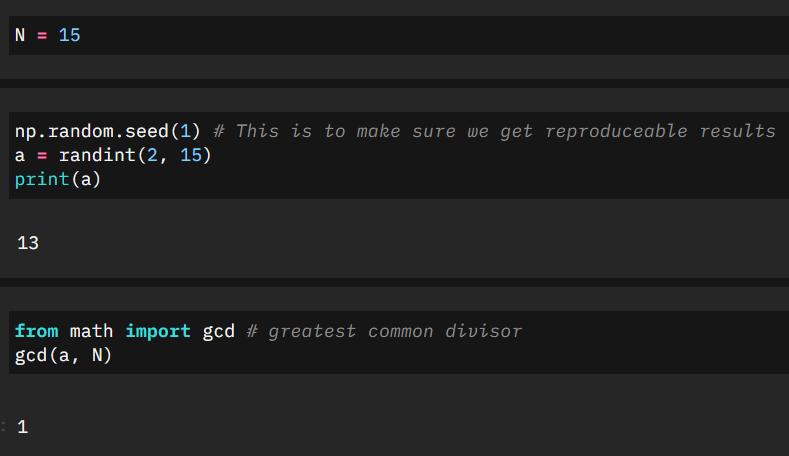
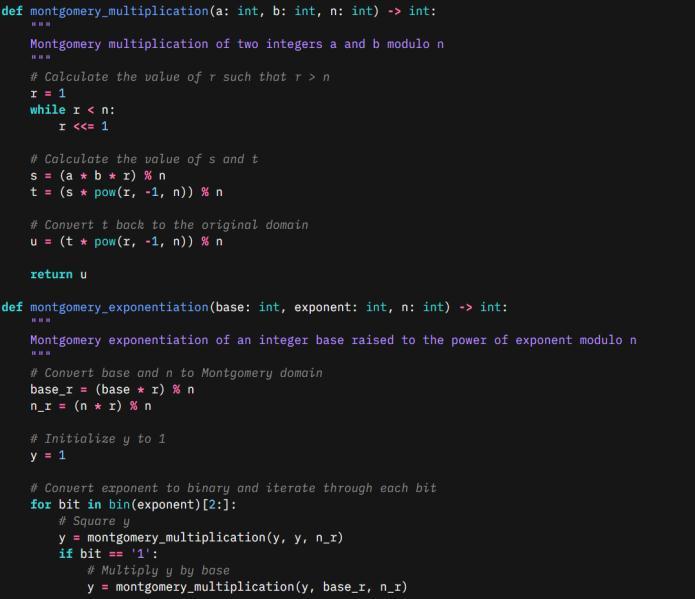
Generate two large prime numbers, p and q, and calculate theirproductN=pq.ThisisthemodulusforRSAencryption. Choose an integer e such that 1 < e < (p-1)(q-1) and e is coprimewith(p-1)(q-1).Thisisthepublickey.Calculatethe modularinversedofemodulo(p-1)(q-1).Thisistheprivate key.ChoosearandommessagemthatislessthanN.Convert the message m to its Montgomery representation, which involvesmultiplyingitbyacertainfactorandthenreducingit modulo N. Encrypt the Montgomery representation of the messagemusingthepublickeye,whichinvolvesraisingitto thepowereandreducingtheresultmoduloN.Decryptthe encryptedMontgomeryrepresentationofthemessageusing theprivatekeyd,whichinvolvesraisingittothepowerdand reducing the result modulo N. Convert the decrypted Montgomery representation of the message back to its originalrepresentation.[8]
Result:
ThefirstlineoftheoutputshowstheresultofMontgomery multiplicationof123456and654321modulo1000000007. Theresultis128054480.
The second line of the output shows the result of Montgomery exponentiation of 123456 to the power of 123456789modulo1000000007.Theresultis406267049.
5.3 Shor’s Algorithm
Inquantumcomputing,aqubitorquantumbitisabasicunit ofquantuminformation thequantumversionoftheclassic binarybitphysicallyrealizedwithatwo-statedevice.Aqubit isatwo-state(ortwo-level)quantum-mechanicalsystem,one ofthesimplestquantumsystemsdisplayingthepeculiarityof quantum mechanics. Examples include the spin of the


electroninwhichthetwolevelscanbetakenasspinupand spindown;orthepolarizationofasinglephotoninwhichthe twostatescanbetakentobetheverticalpolarizationandthe horizontalpolarization.[9][10][11]
Result:
ATTEMPT1:
RegisterReading:11000000
CorrespondingPhase:0.75
Result:r=4
GuessedFactors:3and5
***Non-trivialfactorfound:{guess}***
***Non-trivialfactorfound:{guess}***
6. CONCLUSIONS
Thecryptographyfieldisextensivelyresearcheduponinthis project. The potential of classical and quantum computer and their phenomena was compared and observed. The observationleadstothebeliefthatquantumcryptographyis much powerful than the traditional cryptography. This is possible due to the fact of various potential quantum phenomenonsuchsuperposition,entanglement,tunneling etc.
The IBM Quantum Dashboard was accessed in order to achievethedesiredresultsintheproject.Theprojectwas initializedwiththestudyofbasicquantumgatesandthen the same was coded in the IBM-QISKIT shell (refer to the attached images). The histogram plots clearly explain the presenceofsuperpositioninsomecaseandentanglement suchastheHadamardgateimplementation&alsotheother phenomena. The result might have some noise due the quantumserversbuteffectsaretotheminimum.
The work was successful in demystifying and introducing readerstoclassicalandquantumcryptographyaswellasthe fundamental concepts behind encryption. The significant pertinent studies in the various branches of classical and quantumcryptographywereexamined.
The goal of the project is to inspire to learn more about quantumresearchandtoserveasasolidstartingpointfor those just entering the subject of quantum cryptography. Moreover,whilecompletingtheproject,itwasobservedthat quantumcryptographyforsureisalevelbetterthatclassical cryptography; but the amount of development needed in order to realize it in the practical world is still underdeveloped.Beitthesoftwareorthehardwareperspective bothneedstheirownshareofdevelopmentandprogress.
REFERENCES
[1] Aumasson,Jean-Philippe(2017).Theimpactofquantum computing on cryptography. Computer Fraud & Security, 2017(6), 8–11. doi:10.1016/S13613723(17)30051-9.
[2] Mavroeidis,V.,Vishi,K.,Zych,M.D.,&Jøsang,A.(2018). The impact of quantum computing on present cryptography.arXivpreprintarXiv:1804.00200.
[3] Everitt, H. O. (Ed.). (2005). Experimental aspects of quantumcomputing.SpringerScience+BusinessMedia.
[4] V. Padamvathi, B. V. Vardhan and A. V. N. Krishna, "QuantumCryptographyandQuantumKeyDistribution Protocols: A Survey," 2016 IEEE 6th International Conference on Advanced Computing (IACC), Bhimavaram, India, 2016, pp. 556-562, doi: 10.1109/IACC.2016.109.
[5] I.B. Djordjevic. “Conventional Cryptography Fundamentals.” In: Physical-Layer Security and QuantumKeyDistribution.Springer,Cham.2019,pp6591.
[6] IBMQuantum,https://learn.qiskit.org/course.
[7] Salifu, Abdul-Mumin. (2018). Rivest Shamir Adleman Encryption Scheme Based on the Chinese Remainder Theorem. Advances in Networks. 6. 40. 10.11648/j.net.20180601.14
[8] Jang,K.,Song,G.J.,Kim,H.,Kwon,H.,Lee,W.K.,Hu,Z.,& Seo,H.(2021).Binaryfieldmontgomerymultiplication onquantumcomputers.CryptologyePrintArchive.
[9] Chouhan,N.,Saini,H.K.,&Jain,S.C.(2017,February).A novel technique to modify the SHOR'S algorithm Scaling the encryption scheme. In 2017 Second International Conference on Electrical, Computer and CommunicationTechnologies(ICECCT)(pp.1-4).
[10] Experimental demonstration of Shor’s algorithm with quantumentanglementB.P.Lanyon,T.J.Weinhold,N.K. Langford,M.Barbieri,D.F.V.James∗,A.Gilchrist,andA. G. White Centre for Quantum Computer Technology Department of Physics University of Queensland, BrisbaneQLD4072,Australia ∗DepartmentofPhysics CenterforQuantumInformationandControlUniversity ofToronto,TorontoONM5S1A7,Canada.
[11] Gerjuoy, E. (2005). Shor’s factoring algorithm and moderncryptography.Anillustrationofthecapabilities inherent in quantum computers. American journal of physics,73(6),521-540.