Land Registration System Using Blockchain Technology
Aakash Shrestha1 , John Saud , Niraj Kumar Rauniyar , Sindhu k41,2,3EIGHT SEMESTER, DEPT. OF CSE, SAMBHRAM INSTITUTE OF TECHNOLOGY, BENGALURU-560097
4ASST PROFESSOR, DEPT. OF CSE, SAMBHRAM INSTITUTE OF TECHNOLOGY, BENGALURU-560097, INDIA ***

Abstract – Land registration is a critical process that involves the legal recording of land ownership, rights, and transactions. The current land registration systems in many countries often face challenges suchas corruption, inefficiency, and lack of transparency. Land Registration is a use case which involves lot of middlemen and central authorities inthe process which then puts trust in the system. Keeping traces of who owns which part of land is challenging when there are hundreds or thousands of land records to maintain. Using Blockchain will remove the middlemen in the system and also will reduce corruption and increase speed of the process. Land Registration is a simple decentralized application which is build using the Ethereum Blockchain principals. We can use this registration procedure as an substitute to bypass the existing system flaws. Here the user who owns the land registers his land details and also enters market value of the land by providing all the necessary proofs. A government authority who traditionally looks intolandregistry is assigned as a land inspector can do the registration process. Lands coming under a particular village can be registered to the system only through the inspector who is assigned to that village. The smart contract used here is written in such a way that the owner has to transfer his property completely to the buyer and no transaction of the land can be partial. Even we allow a government authority is involved in registration process, the entire process is transparent and the transaction happens only between the two clients.
Key Words: Blockchain, Ethereum, Smart Contracts, Ganache, Metamask, Ganache, Truffle.
1. INTRODUCTION
A blockchain is a continuously expandable list (chain)ofrecords(blocks)thatareconnectedviaencrypted dataexchange.Eachblocktypicallycontainsareferenceto thepreviousblock,atimestamp,andtransactiondata.Oneof the most popular blockchain applications is the cryptocurrencyBitcoin.Duetothefactthatthetransactiondataon all applications (clients) are visible for everyone and traceablestored,thissystemisconsideredtamper-proofand transparent.
With the use of blockchain, it is possible to run a continuouslyexpandablelistofbookingsdecentralizedand the respective proper state must be documented because many participants are involved in the bookkeeping. This concept is referred to as Distributed Ledger technology (decentralizedbookingtechnology).Whatshouldbebooked
and documented with it, is irrelevant. Crucially, later transactions build on previous transactions and confirm them as correct by demonstrating knowledge of past transactions. Bookings do not necessarily have to be propertytransfers,butitcanalsobeaformalconfirmation oftheexistenceofallnecessarydocumentsbythenotaryso that a notarized land purchase agreement can be made. Thus,individualprocessingstepsoftheprocessoftransfer of ownership could be speeded up and made more transparent,sothatthepartiesinvolvedcanatanytimehave anoverviewofthestatusofproceedings.
2. LITERATURE SURVEY
BlockchainforLandAdministration"byTarekZein andRohanBennett(2018):Thispaperexplorestheuseof blockchaintechnologyinlandadministration,includingland registration.Itdiscussesthebenefitsandchallengesofusing blockchainforlandregistrationandprovidesacasestudyof ablockchain-basedlandregistryinSweden.
"AComparativeAnalysisofLandRegistrationUsing Blockchain Technology" by Ismaila Temitayo Sanusi et al. (2019): This study compares the use of blockchain technology for land registration in Nigeria and Ghana. It analyzesthebenefitsandchallengesofusingblockchainfor land registration and evaluates the feasibility of implementing blockchain-based land registries in these countries.
"Blockchain-BasedLandAdministration:AReview ofApplicationsandPotentials"byJuliusOladeleOgunyemi etal.(2021):Thispaperprovidesacomprehensivereviewof blockchain-based land administration systems, including land registration, around the world. It evaluates the strengthsandlimitationsofthesesystemsandidentifiesthe keychallengesandopportunitiesforfurtherresearchinthis field.
AnalyzingvarioustestcasesArturoCastellanosand Raquel Benbunan-Fich: proposed digitization of land records.Theyexperiencedthattheinternalprocessplaysa feasible role in Blockchain digitization of land records. Digitizinglandrecordwillreducethetimedelaycausedin traditional process and speed up the process. A survey in Georgia and it has been found tha t the rate of fraud is reducedafterimplementationofBlockchaininlandrecords.
AmodelproposedbyRishavChatterjee wecanonly considerRegistrationDocumentandKhasranumber(aplot or survey number given to a particular piece of land in villages).Chaincodeisthelogicbehindtheentiresystem. Chain code was used to ensure that the land record are genuine. The Chain code used in Khasra Blockchain does alterationintheKhasra,butitistiedwiththeregistration blockchainalso.Anysuchbindingneedsavalidregistration.
3. PROBLEM STATEMENT
Land registration is a crucial process for establishing and maintaining property rights, and it is a complexprocessthatofteninvolvesmultipleintermediaries, paper-baseddocumentation,andhightransactioncosts.The current land registration system is vulnerable to fraud, corruption,andinefficiency,whichcanleadtodisputesover property ownership, impede economic development, and deprivevulnerablegroupsoftheirpropertyrights.
Therefore, there is a need for a more secure, transparent,andefficientlandregistrationsystemthatcan prevent fraud, reduce disputes, and promote sustainable landmanagement.Blockchaintechnologyhasthepotential to address these challenges by providing a decentralized, tamper-proof,andtransparentsystemforlandregistration.
Buildingtrustandcommunityacceptanceiscrucialforthe adoption and sustainability of a blockchain-based land registrationsystem.
In summary, the problem statement for land registration using blockchain technology is how to design andimplementasystemthatcanovercomethelimitations and challenges of the existing land registration system, providesecurepropertyrights,ensurecompliancewithlegal andregulatoryframeworks,andbuildtrustandcommunity acceptance. This requires addressing technical, legal, and socialchallengesanddevelopingasustainable,scalable,and interoperable system that can be adopted by different countriesandcommunities.
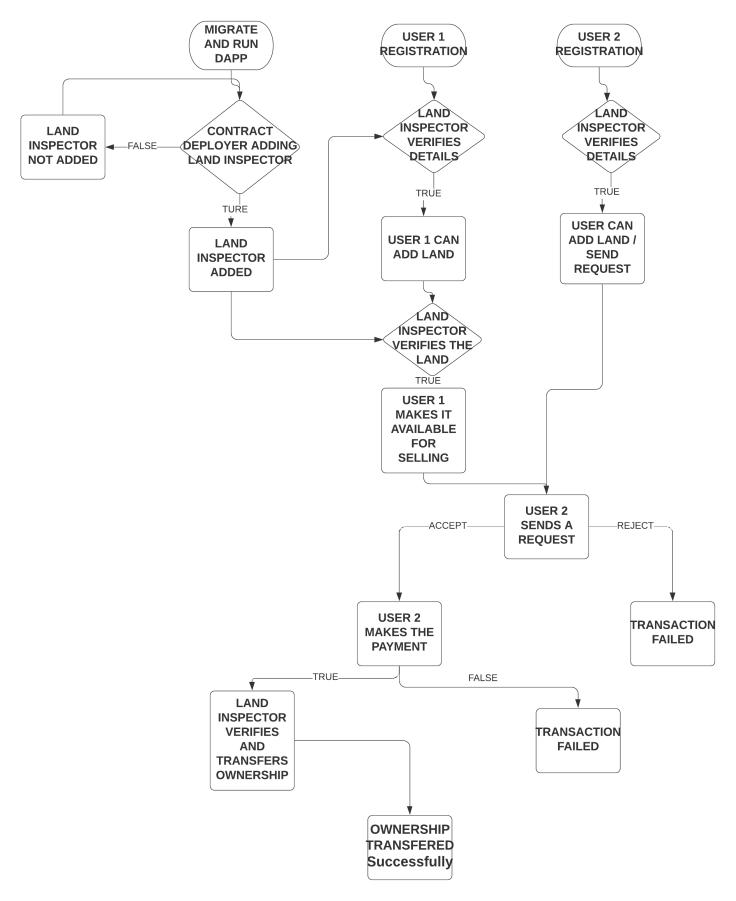
4. FLOW DIAGRAM
4.1 PROJECT FLOW
Userlogsinbyenteringhisprivatekeyorconnectinghis metamaskwallet.
Ifuserisloggedinforfirsttime,thentheyhavetoenter allhisdetailsanduploadtheiridentitydocument.
Forstoringdocuments,wehaveusedIPFSbasedonFile Coin.
After successful login, user can now move to his dashboard.
Asofnow,theuserisnotyetverifiedandonlytheland inspectorcanverifyhim.
For this, the contract owner will first add the land inspector.
Afterlandinspectorisadded,hecanlogintohisaccount.
Land inspector can view the registered users. He can viewthedocumentsandverifytheusers.
Nowtheusersareverified.
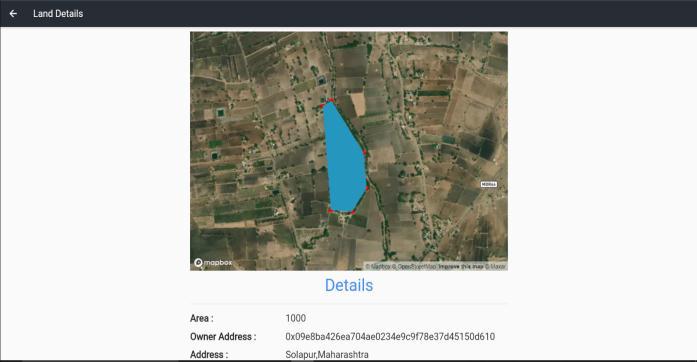
Users can now add their lands. They can add all the detailsofland,landdocumentandusercanalsodraw theirlandonmapaswecanseebelowimage.
added land inspectors. The land inspector’s dashboard consists ofthefunctionality toverifyuser,verifylandand transfer ownership. If we login as the user, we have the optionsofaddinglands,landdetails,seeingalllands,sending andreceivinglandrequests.WehaveusedtruffleIDEtoset uptheDAPP.
Afterlandadding,onlytheLandinspectorcanverifyit.
Afterlandhasbeenverifiedbythelandinspector,user i.e.,ownerofthatlandcanmakeitonsell.
Onceitisonsale,allotheruserscanseeallthelandsin the land Gallery option. Here they can see all land details,areaonthemapandcansendrequesttobuythe land.
Owner of land can see all received requests and can rejectoraccepttherequest.
Afterthelandowneracceptstherequest,userwhohas senttherequestcanmakepaymentfromhisaccountto buytheland.
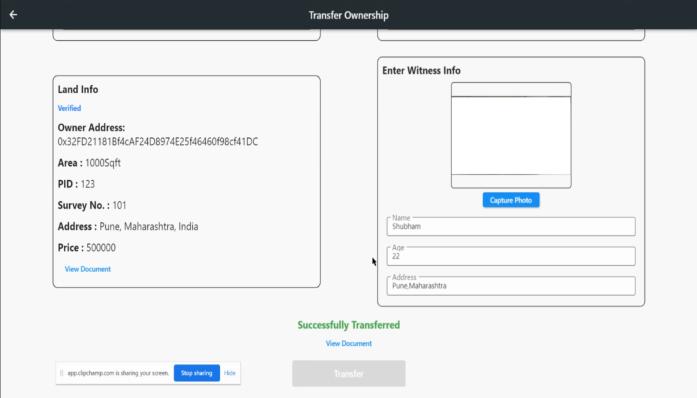
Finally, the land inspector can see all the payments doneandwillverifythepaymentandthentransferthe ownership. While transferring land, land seller, buyer andonewitnesshastobepresent.Landinspectorwill capture their photo, will take information from the witnessandthentransfertheland.
Aftertransferringland,appwillcreatedigitallysigned documentanditwillbeautomaticallyuploadedtothe database
Thensellercanseetheboughtlandinmylandoption.
4.2 IMPLEMENTATION
Flutter - We have made frontend of our project using Flutter.FlutterisopensourceandcreatedbyGoogle.Itisa cross platform SDK. Using single codebase we can create applicationforAndroid,IOSandWebapplication.Currently with newer version of Flutter we can also create apps for Windows, Linux and Mac os. On the front screen, one can login as a user, land inspector, or contract owner. The contract owner can add a land inspector and see all the
Smart Contract -Blockchainistobitcoin,whattheinternet istoemail.Abigelectronicsystem,ontopofwhichyoucan buildapplications.Currencyisjustone.Bitcoinsupportsan optional and special feature called scripts for conditional transfer of values. Ethereum blockchain extended the scriptingfeatureintoafullblowncodeexecutionframework called smart contract. A smart contract provided the very powerful capability of code execution for embedding business logic on the blockchain. With addition of code executioncomesseriousconsiderationaboutpublicaccess totheblockchainhence,theclassificationofpublic,private andpermissionedblockchainbasedonaccesslimits.Inthis project we have implemented a smart contract as the backendwhichconsistsofallthetermsandconditionsfora smoothandsecuretransferofpropertyregistration.
Truffle -Truffleisaworld-classdevelopmentenvironment, testingframeworkandassetpipelineforblockchainsusing theEthereumVirtualMachine(EVM),aimingtomakelifeas a developer easier. Truffle is widely considered the most popular tool for blockchain application development with over1.5millionlifetimedownloads.
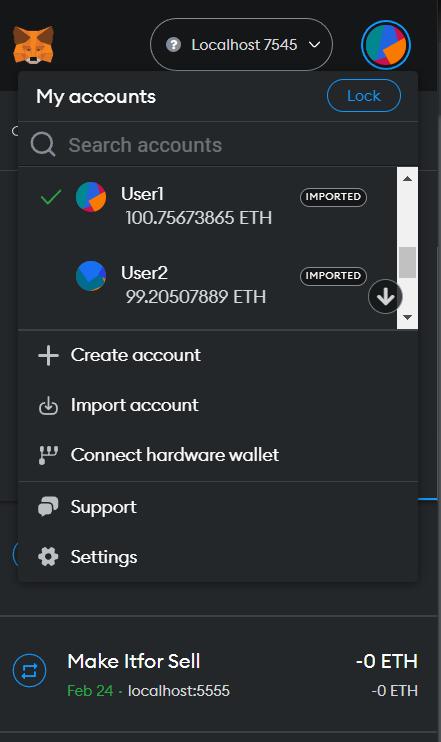
Metamask -MetaMaskisasoftwarecryptocurrencywallet used to interact with the Ethereum blockchain. It allows users to access their Ethereum wallet through a browser extensionormobileapp,whichcanthenbeusedtointeract withdecentralizedapplications.
Web3.js - Web3.jstalkstoTheEthereumBlockchainwith JSON RPC, which stands for "Remote Procedure Call" protocol.Ethereumisapeer-to-peernetworkofnodesthat stores a copy of all the data and code on the blockchain. Web3.js allows us to make requests to an individual Ethereum node with JSON RPC in order to read and write datatothenetwork.It'skindoflikeusingjQuerywithaJSON APItoreadandwritedatawithawebserver
5. DEVELOPMENT AND TESTING
Truffle -Truffleisaonestopidefortestinganddeveloping decentralized applications like our project. It is very commontowriteandcompileSoliditycodemanuallywhich isfineforsmallprojects.However,asourprojectisgrowing bigger and bigger, it is good to have an automatic way of smart contracts development. In addition, testing Solidity codeiscrucialtoavoidanyproblematicsituationcausedbya buginthesmartcontract.Therearedifferentframeworks availablefortakingcareofthedevelopmentprocess.Truffle isoneofthemandisoftenregardedastheEthereumSwiss Knifeframeworkasitisadevelopmentenvironment,testing
frameworkandassetpipelineforEthereum.Wehaveused truffleforourprojectfordeploymentandtesting.
6. RESULTS AND DISCUSSION
Login Page – Onthefrontscreen,onecanloginasauser, landinspector,orcontractowner.Thecontractownercan addalandinspectorandseealltheaddedlandinspectors. Thelandinspector’sdashboardconsistsofthefunctionality toverifyuser,verifylandandtransferownership.Ifwelogin astheuser,wehavetheoptionsofaddinglands,landdetails, seeingalllands,sendingandreceivinglandrequests.
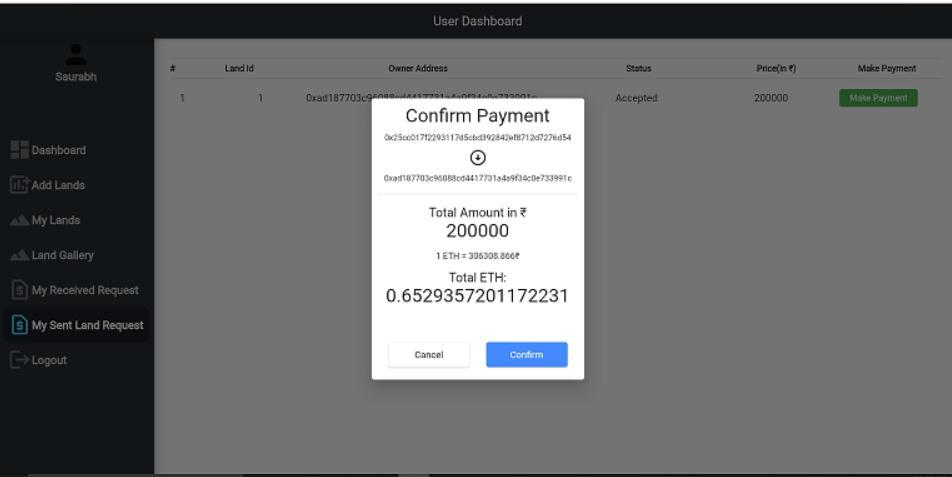
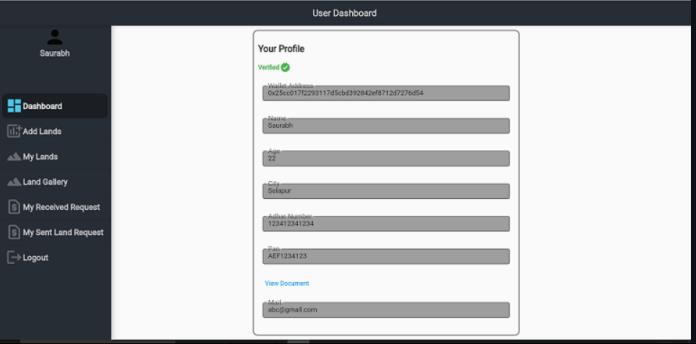
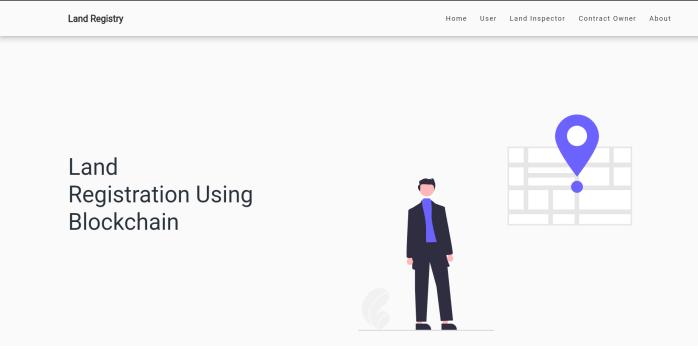
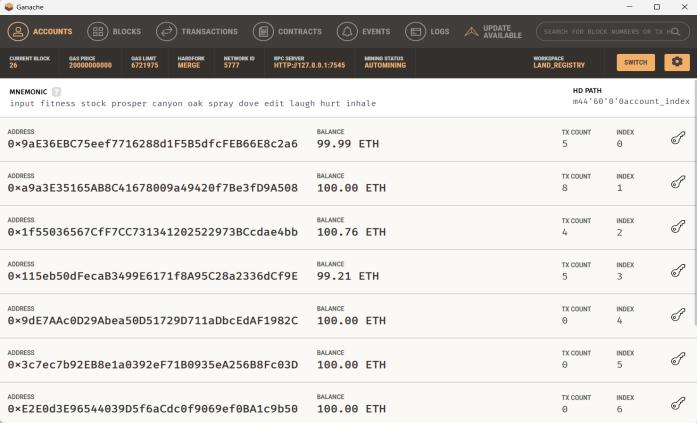
Ganache - Ganache is an Ethereum simulator that makes developingEthereumapplicationsfaster,easier,andsafer.It includesallpopularRPCfunctionsandfeatures(likeevents) and can be run deterministically to make development a breeze. We have used ganache for testing to create blockchain locally. On this we deploy our smart contract, carry out transactions. We can carry out as many transactionsaswewantfortestingpurposes.
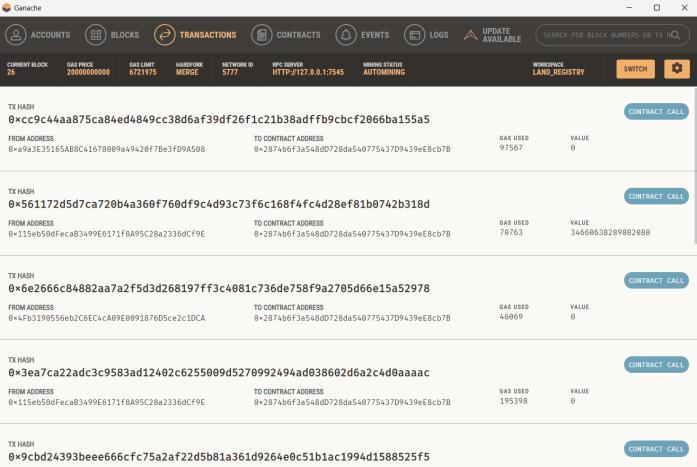
Working –Firstuseraddshislanddetailswhichareverified bythelandinspector.Tobuyorsellland,usermustsenda request to land inspector. After the request has been 26 accepted by land inspector the users can make the transactions. The transaction is verified by the land inspector.Afterthetransactionisverified,theownershipis transferred.
7. FUTURE SCOPE
Blockchainisasocialrevolutionandismakingits waythroughallimportantareasespeciallywheresecurityis aconcern.Itisasocialrevolutionandwehavetotakeour best efforts to harness this technology to the best of our ability. There is good scope for improving the current solution for cloud storage. The application serves basic functionalities but can be extended to provide some advancedfeatures.
Hosting the DAPP on a cloud platform-Whendeployedin real-time the number of users on the application would increasesotoscaleourapplicationwewillhostitonacloud platformsuchasAWS
Collaboration with government agencies-Thefinalstage of our project is to reach out to government and test our DAPP with their collaboration to collect real world inputs andseehowourprojectstandsinthereal-time.
8. CONCLUSIONS
Theconventionalpropertyregistrationsystemhas severalflawsthatdemandedfocusofresearcherstoaddress thesameissues.Amongmanyissues,tamperingofrecord, misuseofpropertyandunethicalpracticesconcerningpoor financemanagement,thatleadtraditionalpropertysystem an area for research. This study provides a solution for controlling transparency and provides a trusted property registrationsystemovertheBlockchain.Theinfrastructure offers many features to the stakeholders related to the buyingandsellingofproperty.Thetransparency,integrityof the record, and trust factor is ensured via a tamper-proof ledger.
REFERENCES
[1].ALEXANDRU OPRUNENCO AND CHAMI AKMEEMANA. USING BLOCKCHAIN TO MAKE LAND REGISTRY MORE RELIABLE IN INDIA, AVAILABLE: https://www.undp.org/blog/using-blockchain-make-landregistry-more-reliable-india
[2]. GOVT OF INDIA SITE FOR BLOCKCHAIN IN LAND RECORDS:https://blockchain.gov.in/landrecords.html
[3]DESIREEDANIELANDCHINWELFEJIKASPERANZA.THE ROLE OF BLOCKCHAIN IN DOCUMENTING LAND USERS' RIGHTS,AVAILABLE: https://www.frontiersin.org/articles/10.3389/fbloc.2020.0 0019/full
[4]. RESTORING TRUST IN PUBLIC LAND REGISTRIES, GEORGIA AVIALABLE: https://www.newamerica.org/digital-impact-governanceinitiative/digital-impact-and-governance initiativeprojects/digi-blogs/project-capsule-georgia-land-titlingsystem/
Deployment
on mainnet or a private Ethereum
networkCurrentlytheblockchainnetworkisdeployedontheropsten testnetwhichusesETHfromfaucetswhichhasnorealvalue andthereforenomarketfortesnetETH.Sogoingfurtherwe woulddeployitonaMainnetoraprivateethereumnetwork dependinguponourrequirementssothatitgetsconnected withrealworld.
[5].I. KARAMITSOS, M. PAPADAKI, AND N. B. AL BARGHUTHI, “DESIGN OF THE BLOCKCHAIN SMART CONTRACT:AUSECASEFORREALESTATE,”JOURNALOF INFORMATION SECURITY, VOL. 9, NO. 03, P. 177, 2018.AVAILABLE:
https://www.scirp.org/pdf/jis_2018062815280747.pdf
[6].SOLIDITY PROGRAMMING DOCUMENTATION, AVAILABLE:https://docs.soliditylang.org/en/v0.8.11/
[7]ETHEREUM BLOCKCHAIN DEVELOPER’S DOCUMENTATION:
https://ethereum.org/en/developers/docs
BIOGRAPHIES
Aakash Shrestha is pursuing BE. CSE in Sambhram Institute of Technology,Bangalore.Workedas a leader in final year project on blockchainbasedlandregistration.


John Saud is pursuing BE CSE in SambhramInstituteofTechnology, Bangalore Worked in final year project on blockchain based land registration

NirajKumarRauniyarispursuing BE. CSE in Sambhram Institute of Technology,Bangalore.Workedin final year project on blockchain basedlandregistration.
Mrs.SindhuK,AssistantProfessor, Department ofComputerScience &Engineering,SambhramInstitute of Technology, Bangalore She guidedthroughthiswholeproject