International Research Journal of Engineering and Technology (IRJET) e-ISSN:2395-0056

Volume: 10 Issue: 04 | Apr 2023 www.irjet.net p-ISSN:2395-0072
International Research Journal of Engineering and Technology (IRJET) e-ISSN:2395-0056
Volume: 10 Issue: 04 | Apr 2023 www.irjet.net p-ISSN:2395-0072
1 Post Graduate Student, Department of Civil Engineering, Pillai HOC College of Engineering and Technology, Rasayani, Tq. Khalapur, Dist. Raigad, State- Maharashtra, India.
2 Head of Department & Asso. Professor, Department of Civil Engineering, Pillai HOC College of Engineering and Technology, Rasayani, Tq. Khalapur, Dist. Raigad, State- Maharashtra, India.
3 Associate Professor, Department of Civil Engineering, Pillai HOC College of Engineering and Technology, Rasayani, Tq. Khalapur, Dist. Raigad, State- Maharashtra, India. ***
Abstract:
Toaccomplishprojectgoalsintermsoftime,money,quality,anddegree,ithasbeendeterminedthatmanagingrisksisan essentialmanagementprocedureforfoundationdevelopmentprojects.Usingathoroughanalysisofagreementstates,this researchrecognises dangers and dividesthem into eight categories. It isseenina personal way. The project'sobjectives are believed to be most affected by risk analysis, social and political opposition, plan revisions, and work suspension. Several suggestions for reducing development project hazards, or mitigation techniques, have been found through this research.Thecontractagreementsareusedasa tooltomanagerisk,andtheclient, contractors,andfinancial backersor institutions that are sponsoring the project must outline any risks to the executive's plan during the project's lifespan. From the attainability stage onward, it is anticipated that clients, contractors, project workers, and governmental organisationswillworktogethertoresolveprojectedhazardsinduecourse.
Keywords -ProjectRisk;Riskmanagement;Riskdistribution;Infrastructureprojects;Contractdocument.
Introduction:
Risk in the Infrastructure development business is undeniable in view of the complicated powerful climate in which developmentworkmustbeperformed.Asdevelopmentexercisesareunsureinnature,consequently,studiescertifythat development is a significantly risk slanted industry. This exploration centers around the risk included particularly in building and framework projects as it is an enormous piece of development industry. For the fruitful accomplishment of undertakinggoalsandtargets,riskoughttobeoverseeninasuccessfulway
Risk has numerous definitions and some are examined here. As indicated by project the executives establishment risk is characterized as "an unsure occasion whose results can adversely affect project targets". Essentially it tends to be characterized as chances of something awful occurring. Risk is characterized as chances of something happening that mightinfluencetheundertakingobjectivesortargetsinanegativemanner.
Initial phase in overseeing risk is recognizing risk without it we can't continue further. In this way, chance ought to be distinguished completely as it is vital to recognize every single risk included. The motivation behind risk ID isn't to get exact and correct expectations for risk occasions. Its motivation is to perceive every one of the potential risks with high effect. Hence, it gives an understanding to what risks are available or can be looked in future before it really happens. Subsequently, having sufficient opportunity to get ready for these risks. As risk and vulnerabilities continues to change hencedistinguishingproofofchanceisaniterativeinteractionwithnewriskarisingduringthelifecycleofaventure.Prior tooverseeingriskfactors,distinguishingthemisimportant.
When risk present is distinguished now the following significant step is to evaluate those chance elements as certain variables can be more basic than others. Examination of risk is the second step of the board interaction. The motivation behind this step is to totally evaluate the risk factor and to focus on them as examined before. This step assumes a significant part as risk alleviation measures are chosen in view of this step. Examination of risk can be comprehensively ordered into two classes for example quantitative and subjective risk investigation according to ISO 31000: 2009. Both
International Research Journal of Engineering and Technology (IRJET) e-ISSN:2395-0056
Volume: 10 Issue: 04 | Apr 2023 www.irjet.net p-ISSN:2395-0072
quantitativeand7subjective risk examinationprocedurescenteraroundfindingthe risk factorspresentindevelopment projects. Subjective risk examination comprises of organized and factual information and quantitative risk examination comprisesofinformationin typeofimpressions,assessments,agendas,andsoforth.Subjectiveprocedureestimatesrisk asfarasitscriticalitywhichgivesbetterthoughtofchancecomponent.Byandlargeutilizedtechniqueforrisk appraisal compriseoflikelihoodand seriousness ofchance element.Inthis,the risk factorsare examined in view ofthe likelihood and seriousness of the risk. As the general effect of chance will rely upon the likelihood for example how frequently it happens and seriousness for example its effect based on project goals in conditions of cost, time, and quality. Dissecting risklikethispursueschoicemakingprocessmoreexactwithgenuinecircumstanceslookednearby.Themotivationbehind risk the board is to survey the result of occasions on the off chance that undertaking didn't continue as per arranged timetableandcutofftimes.Itgivesanessentialthoughtthataspecificoccasionitdidn'tcontinueasexpectedcaninfluence this much. Factors recognized are focused on in light of their effect on project targets. Table 2 shows various techniques ordinarilyutilizedforinvestigationofchanceelements.
Quantitative methods
Qualitative methods
MonteCarloSimulation AssessmentofProbability&ImpactsofIdentifiedrisk.
SensitivityAnalysis
DecisionTreeAnalysis
Checklists
ProbabilityandimpactMatrix
Relativeimportanceindex
Probability and Impact Assessment of Risk:
Likelihoodofchanceischaracterizedasrecurrenceofthatoccasiontohappen,andseriousnessofriskischaracterizedas effect of risk once the occasion has happened. Generally speaking, augmentation of this for example likelihood and seriousness give the worth of effect of chance which expresses the criticality of the risk. Recurrence of chance can be determinedbyutilizingconditionnumber1andseriousnessofriskutilizingequationnumber2.
1. Frequency index F.I =∑������∗��×100 ……………..(1)
Where,
a=weightassignedbyrespondent
n=responsesprobability
N=totalnumberofparticipants
A=maximumweight
(Source: Ibrahim Mahamid , Nabil Dmaidi., (2013) CONSULTANTS’ VIEW TOWARD THE FACTORS AFFECTING TIMEOVERRUNINPUBLICCONSTRUCTIONPROJECTS)
2. Severity index S.I =∑������∗��×100 ……………..(2)
Where,
a=weightassignedbyrespondent
n=responsesprobability
N=totalnumberofparticipants
A=maximumweight
Volume: 10 Issue: 04 | Apr 2023
Methodology:
2395-0072
Construction projects consists of internal and external risks which can be further divided into various categories.Classifyingintocategoriesisimportantbecausetheseprojectscontainsvariousuncertaintiesandrisks. Toavoidtheseriskslawsandregulationsshouldbefollowed.Unfortunately,wecan’tavoidtheserisksbutwecan manage them to decrease their impact. By categorization of risk, we can optimize our risk management process andthusavoidinglosses.
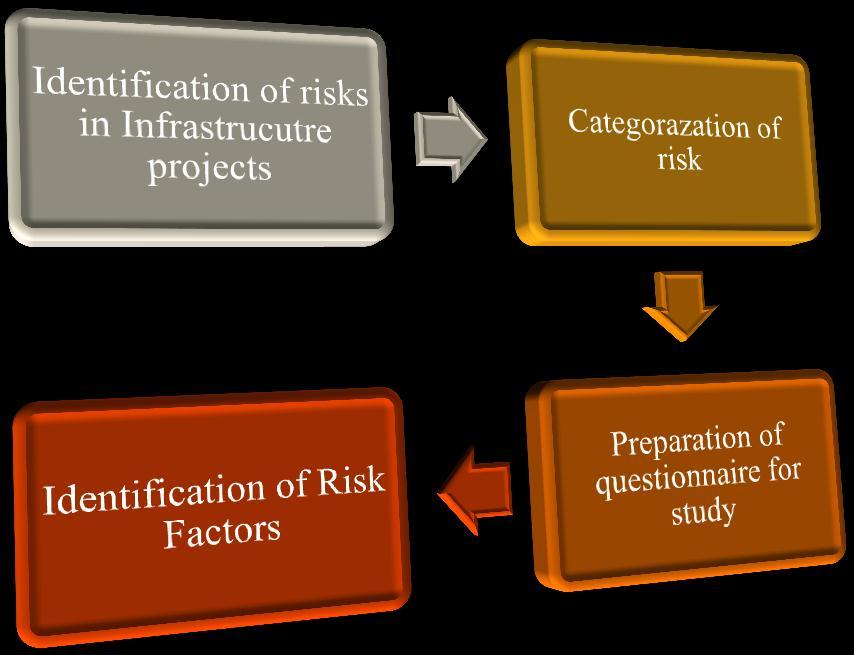
Manyresearchersclassifyriskindifferentcategoriesbasedonvariousparametersandassumptions.Risk categorizationalsodependsuponorganizationsastheyclassifyriskaccordingtotheirsuitability.Inthisresearch riskcategorizationisdonebyin-depthstudyofriskcategoriesandcombiningvariouscategorieswherenecessary. A try is done to cover all the possible risks under these categories. Various risk categories were joined like technical andconstruction risk categorieswere joined toformone category.Similarly,contractual andlegal was joined to form one category. Resource and site-related category were joined to form one category. Economic categoryandfinancecategorywere joined to formone category. Safetyand health category werejoined toform onecategory.
Atotalofeightriskcategorywererecognized.
These are those risks which emerge because of fumble of occasions/assets by the supervisory crew. In this abilities, experience of supervisory group assumes a significant part. They need to take quick and precise choices for improved results.Anypostponementsorstopsindirectioncanbringaboutcolossalmisfortunes.
RF1 Poorcoordinationorcommunicationamongvariousparties
RF2 Poormanagementskills
RF3 Lackofexperienceoftheprojectteam
RF4 Personalconflictsbetweendifferentclientsinvolved
RF5 Poorsitemanagementandsupervision
RF6 Shortageofskillfulmanagersandprofessional’s
RF7 Improperprojectplanningandbudgeting
RF8 Changeoftopmanagement
RF9 Inadequatequalityplanningandqualityassurance
RF10 Lackofclarityoverrolesandresponsibilities
RF11 Governmentrestrictionsonforeigncompanies
2. Technical and Construction Risk:
Specialized risks and development risk are likewise vital in project achievement. In specialized risk angles like details, innovation, plan, and designing are there. In development takes a chance with perspectives like expense/time overwhelms, quality, development strategies are there. For effective fruition of venture, these viewpoints ought to be overseenideal.
3.
Takesachancewithlikeaccessibilityofmaterial,work,andgearareassetrisk.Thenagain,site-relatedchancesarethose whichareconnectedwithsitelikeunexpectedundergroundcircumstances,accessibilityoffundamentalthingsonlocation likepower,availabilityofsite,andsoon.
Authoritative and legitimate risks are those which are connected with questions in agreement archives, claims, and differentissuesconnectedwithoverallsetoflaws.Itcanemergeatanystageduringdevelopmentprocess.Thiscanbring aboutsignificantdeferralsandcostincrementasinsomecaseschoicesfromcourtarepostponedforlongtime.
This risk classification is connected with risk emerging because of expansion in charges, expansion, changing unfamiliar trade, presentingnewfinancial strategies,andsoforth these risks straightforwardlyinfluencesthemonetarylimitofthe undertakingasthesethingsarenotconsideredwhile arrangingofspendingplan.Thus,these risksshouldbearrangedat the beginning of the undertaking. In some cases project needs to endure a ton as far as culmination time because of financingissues.Somonetaryandmonetaryrisksoughttobeconcentratedcautiouslyandunequivocally. Sr.
1 RF41 Unpredictedchangesininterestrates
2 RF42 Paymentdelays
3 RF43 Failuretomeetrevenuetargets
4 RF44 Unpredictedchangesininflationrates
5 RF45 Inaccurateassessmentofmarketdemand
6 RF46 Project-fundingproblems
7 RF47 Fluctuationinexchangerateofcurrency
International Research Journal of Engineering and Technology
Volume: 10 Issue: 04 | Apr 2023 www.irjet.net
Socio-political risks emerge becauseofsocial andpolitical natureofthearea inwhichventureisto be taken.Social risks are those which are connected with strict contrasts, various societies, and so on political risks are those which emerges becauseofprogressofgovernment,strategies,regulations,andguidelines.Nowandagainnewcodesorrulesareforcedin duringprogressingproject.
1 RF48 Unfavourablesocialenvironment
2 RF49 Politicalinstabilityofthegovernment
3 RF50 Compensationandlandacquisitionproblems
4 RF51 Publicoppositiontotheproject
5 RF52 Differentreligiousandculturalbeliefs
6 RF53 Lawsandpoliciesrevisinginbetweenofproject
7 RF54 Labourdisputesandstrikes
8 RF55 Improperprojectfeasibilitystudy
9 RF56 Outbreakofhostilities(riots,revolutions&terrorism)
Ecological risks are those which emerges because of progress in nature like avalanches, quakes, ceaseless precipitation, and so forth. These risks by and large stay inconspicuous till it happens in view of obscure nearby circumstances like climate.Naturalriskscancostcolossaldeficiencyofcashandtimeintheeventthatnotarrangedasexpected.
1 RF57 Pollution related to construction activities (dust, harmful gases,etc.)
2 RF58 Strictenvironmentalrulesandregulations
3 RF59 Changesinenvironmentalstandards
4 RF60 Legalproceedingsduetowrongdisposalofwaste
5 RF61 Badweather(snow,excessrain)
6 RF62 Naturaldisasters(floods,landslides,etc.)
7 RF63
Improperassessmentofprojectimpactsonenvironment
Wellbeingandrisksarethoseriskswhichareconnectedwithwellbeingandsecurityofindividualsengagedwithproject. These incorporate different wellbeing guidelines, planning for mishaps and wounds happening nearby, and so on. More modestdestinationsandlittledevelopmentorganizationsalargeportionofthetimesdisregardwellbeingandsecurityof individuals engaged with development exercises. Thus, government needs to make a few severe strategies in regards to wellbeing and risks alongside shock checks. Anybody found not observing wellbeing and security guidelines and guidelinesoughttobefinedwiththegoalthateverybodyinfuturefollowstheseguidelines.
8
The basic inspiration driving overview is to amass information from respondents. It contains destined plan of factors of chance recognized by documentation overviews, past experience of undertaking people, and context oriented examinationsofpre-executedprojects.Pilotstudywasdoneonsurveytoinvestigateitsclearnessandstraightforwardness of sorting out questions as a matter of fact. Risk factors those were seen as not associated with study plan or those componentswhichwerefoundreiteratedwaskilledorchanged.
Frequency Analysis and Ranking:
WheninformationassortmentisfinishedfrompollstudyfollowingstageistoexamineitLikelihoodofriskischaracterized asitscapacitytorehashinaspecifictimeframe.Inpoll,overviewlikelihoodwasevaluatedonthree-pointLikertscale.One implies low likelihood, two means moderate likelihood and three connotes high likelihood. The gathered information is examinedforlikelihoodofchanceutilizingrelativesignificancefileandisreferredtoasrecurrencerecordasdisplayedin Table. The computation comprise of three sections first segment shows the chronic number of risk code and the risk factor,secondsectioncompriseoftherecurrenceonsizeofthreeandlastsegmentdemonstratetherecurrenceestimation utilizing relative significance record with rank for recurrence. In this the positioning of risk factors is done in light of recurrencerecordasdisplayedinTable
International Research Journal of Engineering and Technology (IRJET) e-ISSN:2395-0056
International Research Journal of Engineering and Technology (IRJET) e-ISSN:2395-0056
Volume: 10 Issue: 04 | Apr 2023 www.irjet.net p-ISSN:2395-0072
Severity Analysis and Ranking:
When recurrence list is determined subsequent stage is to compute seriousness utilizing relative significance file. Seriousness determined utilizing relative significance record is known as seriousness file (S.I). Seriousness is the proportion of chance figure terms of how extreme a risk can be whenever it has happened. In poll, seriousness was decided on five-point Likert scale. One shows extremely low seriousness, two demonstrate low seriousness, three demonstrate moderate seriousness, four demonstrate high seriousness and five show exceptionally high seriousness. EstimationsforseriousnessofchanceisshowninTable4.2.
International Research Journal of Engineering and Technology (IRJET) e-ISSN:2395-0056
Volume: 10 Issue: 04 | Apr 2023 www.irjet.net
When information assortment is finished from poll overview following stage is to examine risk capability of the variables recognized. Risk potential is determined by augmentation of recurrence record and seriousness list as talked aboutin researchtechnique.Recurrenceofa risk factor ischaracterizedasitscapacitytorehashina specific timeframe. Seriousness of a risk factor is characterized as how extreme a risk variable can be whenever it has happened. Risk potentialforvariousclassesaredeterminedinadditionalconversation.Characterizingriskfactorsasbasic,moderate,low and positioning of risk variables will be finished based on risk effect and standardization of risk influence esteem. For computation of risk influence, ascertaining risk potential is significant first. As knowing recurrence, seriousness and chance capability of a risk assumes a significant part in administration of the risk calculate present task. Top three risk factorsineveryclassificationisexaminedinconversationofvariousclassificationsandforother riskfactorspresentina class,thecomputationscanbetrackdownincomparingtables.
Inmanagementcategoryatotalof11factorswerethereandtopthreeriskfactorsinthiscategoryarediscussed further. ‘Shortage of skillful managers and professional’s’ was found to have maximum value of risk potential with (FI = 2.22, SI = 3.82 and RP = 8.47). It is seen that lack of required skills can be observed in locally available managers and professionals. Sometimes for quality and complicated work skilled professionals are necessary. To meet these criteria sometimes management, have to recruit people from other areas who are skilled in the work. This is time-consuming as well as costly process. For other management risk factors calculations of FI, SI and RP are shown in Table 4.3 and comparisonofRPofmanagementriskisshowninFigure4.1.
Nextriskcategoryistechnical&constructionrelatedwith11riskfactorspresentinitandtopthreeriskfactorsin thiscategoryarediscussedfurther.AllfactorsinthiscategoryareshowninTable4.4withfrequencyindex,severityindex and risk potential. In this category the most significant risk factor was ‘Unclear and incomplete detailing in design drawingsandspecifications’with(FI=2.08,SI=3.59andRP=7.46).Itisoftenseenthatprojectsaredelayedduetolate approvalsbyvariousdepartments.ComparisonofRPoftechnical&constructioncategoryisshowninFigure4.2.
Third risk category considered in this research is resource & site-related category. Top three risk factors with highest RP in this category are discussed here. This category involved factors related to site and resources. ‘Shortage of skillful workers locally’ was found to be a major factor with (FI = 2.27, SI = 3.44 and RP = 7.80). All other factors in this categoryareshowninTable4.5alongwithcalculationsforFI,SIandRP.CalculationforRPisshowninFigure4.3.
Fourth category used in this research is contractual and legal risks. This category deals with factors related to contracts and legal problems. This category consists of seven risk factors. Top three risk factors in this category are discussedfurther.Majorfactoridentifiedinthiscategorywas‘Hugecompetitionatthetenderingstage’with(FI= 2.35,SI =3.35andRP=7.85).Itisgenerallyseenthatcontractdisputesandclaimstakeyearstomakeitsfinaldecisionresulting hugelosstoproject.CalculationofFI,SIandRPforcontractualandlegalriskssshowninTable4.6andcomparisonofRI forcontractualandlegalrisksisshowninFigurenumber4.4.
Fifth category considered in this research is economic and financial risk. In this category a total of seven risk factors are there and it deals with factors related to economics and finance. This factor is also important in deciding projects success or failure in building and infrastructure projects. Top risk factor for this category namely- ‘payment delays’ is the most significant risk factor identified in this category with (FI = 2.21, SI = 4.05 and RP = 8.93). Most of the times payments are delayed for the required work resulting in delays and cost overruns. All factors in this category are discussed in Table 4.7 along with FI, SI and RP. Comparison of RP of economic and financial risk category is shown in Figure4.5.
SixthCategoryusedinthisresearchissocio-politicalrisk.ATotaloftenriskfactorsarethereinthiscategory.This categorydealswiththesocialandpoliticalriskspresentinbuildingandinfrastructureprojects.Topmostfactoridentified in this category was ‘Compensation and land acquisition problems’ with (FI = 2.15,SI = 3.35 and RP = 7.21). Most of the timescontractorsarenotpreparedfornewpoliciesandregulations.Lawsandpoliciessometimesalsochangewithchange ingovernment.Inworstcaseevensomeprojectshavetoshutdownbecauseofnotabletofollownewregulations.Other factorsofthiscategorywithFI,SIandRParediscussedinTable4.8andcomparisonofRPofsocio-politicalriskcategoryis showninFigure4.6.
Volume: 10 Issue: 04 | Apr 2023 www.irjet.net
Environmental risk istheseventh categoryusedinthis study.Thiscategoryconsistedofsevenrisk factors. This categorymainlydealswithproblemsrelatedwithenvironmentandeffectsofprojectonenvironment.Mostsignificantrisk recognizedinthiscategorywas‘badweatherconditions’with(FI=1.96,SI=3.91andRP=7.66).Thisfactorcanresultin hugelossesifnotrecognizedatrighttimeasmostlyitdependsonlocalconditionsofthearea.Sometimescontinuousbad weather can result in huge cost and time overruns. Second most significant risk factor identified in this category was ‘naturaldisasters’with(FI=1.82,SI=4.02andRP=7.33).Naturaldisastersresultinhugelossesintermsofcostaswell astimeanditcanbemanagedbymitigationmeasureslikeinsurance,etc.Wecannotplanfornaturaldisastersbuthaving knowledgeregardingitwillsurelyhelpinminimizinglosses.Thirdmajorriskfactorrecognizedwas‘strictenvironmental rules and regulations’ with (FI = 2.09, SI = 3.07 and RP = 6.41). Due to strict rules some companies might face problems because of their attitude of not following any regulations. Other factors in this category are discussed in Table 4.9 along withFI,SIandRP.ComparisonofRPofenvironmentalriskcategoryisshowninFigure4.7.
Last category used for this study is related to health and safety. In this category a total of six risk factors were there. Very less attention is given towards health and safety of employees working in most of the projects especially projectsonsmallscales.ForfactorsofthiscategoryFI,SIandRPisshowninTable4.10.ComparisonofRPofhealthand safetyriskcategoryisdoneinFigure4.8.
Subsequent to examining recurrence, seriousness and chance potential next we need to compute risk influence valuesutilizingconditionnumber6asportrayedinresearchsystem.InviewoftheupsidesofRIstandardizedvalueswas determinedandfactorswerepositioned. Riskrecognizedinthisexaminationwasgroupedintothreelevelstobespecific basic,moderateandlow.Theselevelswerechoseninviewofthestandardizedqualities.Basicriskfactorsarethosehaving standardizationesteemmorethan0.50,moderate risk factorsarethosehavingstandardizationvaluesfrom0.25to0.50, okay factors are those having esteem under 0.25. Risk factors recognized in building and framework projects with positioningandlevelofcriticalityaretalkedaboutinTable4.11.
International Research Journal of Engineering and Technology (IRJET) e-ISSN:2395-0056
Volume: 10 Issue: 04 | Apr 2023 www.irjet.net p-ISSN:2395-0072
Thirty-six critical risk factors were identified in building and infrastructure projects. Top ten critical risk factors identifiedwerenamely-Paymentdelayswith(RI=2.99),Shortageofskillfulmanagersandprofessional’swith(RI=2.91), Delaysinthesitepossessionwith(RI=2.90),Hugecompetitionatthetenderingstagewith(RI=2.80),Shortageofskillful workers locally with (RI = 2.79), Low labour productivity with (RI = 2.79), Contractual disputes and claims with (RI = 2.77),Improperprojectplanningandbudgetingwith(RI=2.77),Shortageordelayindeliveryofexpectedmaterialswith (RI=2.75),Failuretomeetrevenuetargetswith(RI=2.74).
Highestvalueof(RI=2.99)wasobservedandminimumvalueof(RI=2.02)wasobserved.Forcriticalriskfactors RIrangedfrom (2.99 to2.53),for moderate risk factorsRIranged from(2.49to 2.26)andforlow risk factors RIranged from(2.24to2.02).Comparisonofnumberoffactorsincritical,moderateandlowrisklevelareshowninTable4.12.
Formanagingrisk ina compellingwaythisstudyproposesa risk reliefmodel.Thismodel comprisesofsevensignificant boundaries. This model will doubtlessly assist with projecting directors, risk chiefs, engineers, supervisory group who needstomanageriskandvulnerabilitiesonlocationduringdevelopmentphasesoftheventure.
FirstboundaryisIDofrisk factorspresentinbuildingandfoundationproject.Itassumesasignificantpartinoverseeing risk as without realizing which chance and vulnerabilities are available, we can't oversee it. Along these lines, distinguishing proof of risk ought to be would completely keeping all angles in care. Past examinations, explores, experiencedworkerscanhelpinriskrecognizableproof.
Second significant boundary is appraising of distinguished risk. This implies while managing risk it ought to be evident that the way in which basic risk can be regarding cost, time, quality, efficiency, and so forth. As certain risks need quick consideration when contrasted with other. In different terms a few risks are more basic when contrasted with others. Along these lines, risk can be evaluated by their capacity to influence project goals. Chance can be appraised as low, moderate,andhigh.
Third boundary in risk relief model is order of risk. Risk order likewise assumes a significant part to figure out which groupengagedwithundertakingoughttodealwithaspecific risk.Thisorderofriskexplainswhatsegmentneedstodeal withaspecificriskmodel:supervisorycrew,specializedgroup,financegroup,andsoforth.
International Research Journal of Engineering and Technology
Volume: 10 Issue: 04 | Apr 2023 www.irjet.net
2395-0072
Fourthboundaryischaracterizingphaseofriskatwhichitwillhappen.Aspecificriskcanhappeninsinglestageaswellas innumerous stages.Inthisway,tooverseeitappropriatelythereisneedtoknowitscapacityinvariousstages. Riskcan arise at any stage so a constant check has to be there. Different phases of a task can be named possibility, obtainment, development,activity,andmove.
Fifthboundaryinriskalleviationmodelisriskportion.Alargeportionofthetimeswhilemanagingchances,partiesdon't geta senseofownership withrisk presentand frequentlystatecapableothersfortheboardof that risk.To managethis chancedesignationoughttobethereasitwillcharacterizepartiesliablefortheexecutivesofriskpresentinprojects.Fora specificriskliabilitymightliewithproprietor,projectworker,expertoritverywellmaybesharedbyvariousgatherings. Portionoughttobedoneappropriatelyasitwillhelpinviableadministrationofchance.
6th boundary of alleviation model is risk reaction. Answering risk implies how we intend to manage it to such an extent that its adverse consequences can be limited. Answering risk can be chosen by concerned specialists of organizations. Reactiontoriskcanberefreshedinthemiddlebetweenofventurecontingentuponneedtoadjustit.
Seventhboundaryischeckingandcomments.Inthis,aconsistentcheckingandcontrolisthereonthe riskfactorsaswell asonthemoderationmethodologies.It'scritical tocheckwhetherourreliefsystemsdealingwithlimitingtheimpactsof theriskorwewanttoalterit.Atlast,commentsarecomposedintheeventthatanyrequired.
A ton of building and framework projects needs to confront risk and vulnerabilities during development period bringingaboutgiganticmisfortuneswithregardstocost,time,quality,efficiency,andsoforth.Thisexaminationexpectsto makemindfulness with respect to risk with the executivesstructure in developmentindustry.The primarytarget ofthis studywastodistinguishriskfactors,rankthemaspertheircriticality,andrecommendreliefmeasurestolimittheimpacts ofchancepresentinbuildingandframeworkprojects.
At first, 71 risk factors were recognized through top to bottom investigation of writing connected with risk present in building and framework projects. These 71 risk factors were ordered into eight significant classes. A Risk profile was arranged comprising of these variables and information was gathered through survey overview. Seriousness list and recurrence record was determined utilizing RII (Relative Importance Index) Method. Most extreme worth of SI (Severity Index) was viewed as 4.08 and least worth of SI was viewed as 2.60. Top five elements for seriousness were specifically Flare-up of threats (riots, insurgencies and psychological oppression), Installment delays, Absence of involvement of the undertaking group, Deficiency of capable directors and expert's and Private matters between various clients included. GreatestworthofFIwasviewedas2.44andleastincentiveforFIwasviewedas1.31.Topfivevariablesforlikelihoodwas to be specific Low work efficiency, colossal contest at the offering stage, Postpones in the site ownership, Ill-advised projectarrangingandplanningandDeficiencyoftalentedspecialistslocally.
After that RP and RI was determined for every one of the elements. Risk potential worth ran between 8.47 to 4.07. Risk influence esteem ran between 2.91 to 2.02. Standardized values for various risk factors was tracked down based on RI. Factors having standardized esteem more prominent than 0.50 are considered as basic risk factors. 36 risk factors were viewedasbasicinbuildingandfoundationprojects.ToptenbasicriskfactorsfoundwereinparticularInstallmentdelays, Installmentdelays,Defersinthesiteownership,Immenserivalryattheofferingstage,Lackoftalentedspecialistslocally, Lowworkefficiency,Legallybindingdebatesandcases,Ill-advisedprojectarrangingandplanning,Deficiencyorpostpone in conveyance of anticipated that materials and Disappointment should meet income targets. Factor investigation was performed on the basic risk factors recognized. Risk alleviation measures was additionally proposed in this exploration whicharetalkedaboutfurther.
1. Adeleke, A.Q., Bahaudin, A.Y. and Kamaruddeen, A.M., (2016). “Preliminary analysis on organizational factors influencing effective construction risk management: A case study of Nigerian construction companies”. Sains Humanika,8(2).
2. Al-Bahar,J.F.andCrandall,K.C.,(1990).“Systematicriskmanagementapproachforconstructionprojects”.Journal ofconstructionengineeringandmanagement,116(3),pp.533-546.
International Research Journal of Engineering and Technology (IRJET) e-ISSN:2395-0056
Volume: 10 Issue: 04 | Apr 2023 www.irjet.net p-ISSN:2395-0072
3. Aleshin, A., (2001). “Risk management of international projects in Russia”. International Journal of Project Management,19(4),pp.207-222.
4. Chaitali S. Pawar, Suman S. Jain & Jalinder R. Patil (2015) “Risk Management in Infrastructure Projects in India”. InternationalJournalofInnovativeResearchinAdvancedEngineering(IJIRAE),pp.172-176.
5. Choudhry, R.M. and Iqbal, K., (2013) “Identification of risk management system in construction industry in Pakistan”.JournalofManagementinEngineering,29(1),pp.42-49.
6. Dandage, R., Mantha, S.S. and Rane, S.B., (2018) “Ranking the risk categories in international projects using the TOPSISmethod”.Internationaljournalofmanagingprojectsinbusiness.
7. Hwang,B.G.,Zhao,X.andToh,L.P.,(2014).“RiskmanagementinsmallconstructionprojectsinSingapore:Status, barriersandimpact”.Internationaljournalofprojectmanagement,32(1),pp.116-124.
8. Jackson, S., (2002), September. “Project cost overruns and risk management”. In Proceedings of Association of Researchers in Construction Management 18th Annual ARCOM Conference, Newcastle, Northumber University, UK(pp.2-4).
9. KTLiew,WWLow,KSWongandSYWong,Review:Riskassessmentofinfrastructureprojectsonprojectcost, IOPConf.Series:MaterialsScienceandEngineering495(2019)012088
10. Kamalendra Kumar Tripathi1 and Kumar Neeraj Jha (2017) “Determining Success Factors for a Construction Organization:AStructuralEquationModelingApproach”.
11. LailaM.Khodeir,MohamedNabawy(2019)"Identifyingkeyrisksininfrastructureprojects–CasestudyofCairo FestivalCityprojectinEgypt”,AnShamsEngineeringJournals,pp.613-621.
12. LidijaRihar, TenaŽužek, TomažBerlec and JanezKušar (2019) “Standard Risk Management Model for InfrastructureProjects”.Risk ManagementinConstructionProjects,Intechopen,pp.1-16
13. Monzer, N., Fayek, A.R., Lourenzutti, R. and Siraj, N.B., (2019). “Aggregation-Based Framework for Construction Risk Assessment with Heterogeneous Groups of Experts”. Journal of Construction Engineering and Management, 145(3),p.04019003.
14. M. M. Ghazal & A. Hamid, “Application of Knowledge discovery in database (KDD) techniques in cost overrun of construction projects,” Int. Journal Const. Management., vol. 0, no. 0, pp. 1-15,2020, doi: 10.1080/15623599.2020.1738205.
15. Mohamed Abdel-Monem, Abdel-Rahman El-Mohr, Karim El-Dash, Cost Overrun Gap Analysis in Construction Projects:State-of-The-Art,EngineeringResearchJournal(ERJ)Vol.51,No.3July2022,pp.76-97.
16. Mohammad Waffy Fazil, *, Chia Kuang Lee1 and Puteri Fadzline Muhamad Tamyez1, “Cost estimation Performance in the Construction projects: A Systematic Reviewand Future Directions,” International Journal of Industrial Management (IJIM), ISSN: 2289-9286 e-ISSN: 0127-564X VOL. 11, ISSUE 1, 217 – 234 DOI: https://doi.org/10.15282/ijim.11.1.2021.6131
17. S.Shoar,T.W.Yiu,S.Payan,andM.Parchamijalal,“Modelingcostoverruninbuildingconstructionprojectsusing the interpretive structural modeling approach: a developing country perspective,” Eng. Constr. Archit. Manag., 2022,doi:10.1108/ECAM-08-2021-0732
18. ShubhamSharma,"RiskIdentificationandManagementInBuildingAndInfrastructureProjects"
19. Siraj,N.B.andFayek,A.R.,(2019)“Risk IdentificationandCommonRisksinConstruction:LiteratureReviewand ContentAnalysis”.JournalofConstructionEngineeringandManagement,145(9),p.03119004
20. Turskis, Z., Gajzler, M. and Dziadosz, A., (2012). “Reliability, risk management, and contingency of construction processesandprojects”.JournalofCivilEngineeringandManagement,18(2),pp.290-298.
International Research Journal of Engineering and Technology (IRJET) e-ISSN:2395-0056
Volume: 10 Issue: 04 | Apr 2023
www.irjet.net
p-ISSN:2395-0072
21. Ugwu,M.C.,Osunsanmi, T.O. andAigbavboa,C.O.,(2019) “EvaluationofRisk ManagementPracticein theNigeria ConstructionIndustry”.ModularandOffsiteConstruction(MOC)SummitProceedings,pp.373-380.
22. Viswanathan, S.K., Tripathi, K.K. and Jha, K.N., (2020) “Influence of risk mitigation measures on international construction project success criteria–a survey of Indian experiences”. Construction Management and Economics, 38(3),pp.207-222.
23. Willumsen, P., Oehmen, J., Stingl, V. and Geraldi, J., (2019) “Value creation through project risk management”. InternationalJournalofProjectManagement,37(5),pp.731-749.