"Integration of Planning, Analysis, Design, Estimation and Scheduling of a Multispeciality Hospital By Building Information Modelling (BIM) "
M. Jaisheelan1, N. Mohamed Ijaz2, P. Chadhurya1,2,3Final year B.Tech Civil Engineering, Department of Civil Engineering, Periyar Maniammai Institute of Science and Technology, (Deemed to be University), Vallam, Thanjavur, Tamilnadu, India
4Associate Professor and 5Assistant Professor(SG), Department of Civil Engineering, Periyar Maniammai Institute of Science and Technology, (Deemed to be University), Vallam, Thanjavur, Tamilnadu, India. ***
Abstract - This study aims to assess the application of Building Information Modeling (BIM) in the design and construction of a multispeciality hospital project. The project was executed using a combination of software technologies including AutoCAD, Revit, STAAD.Pro, RCDC, and MS Project. The study demonstrates the integration of various design and construction processes into a unified digital model, leading to improved collaboration among project stakeholders and more accurate project planning and analysis phases. Utilization of Revit and other BIM tools enabled creation of an interactive and immersive 3D model of the hospital, resulting in enhanced communication and decision-making. Implementation of RCDC and MS Project facilitated accurate estimation of quantities and scheduling of construction activities, reducing time and cost overrun risk. This project highlights the benefits of BIM technology implementation in the design and construction of multispeciality hospitals, contributing to overall project efficiency and productivity. The findings of this study serve as a valuable reference for building professionals considering BIM technology integration in their projects.
Key Words: AutoCAD, Revit, STAAD.Pro, RCDC, and MS Project.
1. INTRODUCTION
BuildingInformationModeling(BIM)isa powerful digital toolthathasrevolutionizedtheconstructionindustry.BIM enables the integration of planning, analysis, design, estimation,andschedulingprocessesintoa unifieddigital model, resulting in improved collaboration and communication among stakeholders. In this study, we exploretheapplicationofBIMtechnologyinthedesignand construction of a multispeciality hospital project. This project utilized a combination of software technologies, includingAutoCAD,Revit,STAAD.Pro,RCDC,andMSProject, toenableaccurateprojectplanningandanalysis.
1.1 Problem Statement:
Healthcare facilities are critical for providing medical servicestothecommunity,butthedesignandconstructionof such facilities often face challenges related to accuracy, collaboration,andefficiency.
Thesechallengescanleadtodelays,errors,andincreased costs,whichcanultimatelyaffectthequalityofcareprovided topatients
1.2 Solution:
TheuseofBuildingInformationModeling(BIM)and other software technologies such as AutoCAD, Revit, STAAD.Pro,RCDC,andMSProject,enabledus tointegrate theplanning,analysis,design,estimation,andschedulingof the project into a unified digital model. This approach resulted in improved collaboration among project stakeholders,moreaccurateprojectplanningandanalysis phases, and ultimately, the timely delivery of the project withinbudget.
The adoption of BIM and other software technologiescanimprovetheconstructionprocessinmany ways,includingreducingerrors,increasingefficiency,and savingtimeandcosts.Byshowcasingthisproject,wehopeto inspire other professionals in the field to adopt similar approaches and contribute to the advancement of the constructionindustry
1.3 Objectives
The primary objective of this study is to assess the applicationofBIMtechnologyinthedesignandconstruction ofamultispecialityhospital.Weaimtodemonstratehowthe useofBIMtoolscanenableaccurateplanning,analysis,and estimation of quantities and scheduling of construction activities.
2. LITERATURE REVIEW
V.J.SaranandS.S.PimplikarexaminedBIMtechnologyhas thepotentialtorevolutionizethehealthcareinfrastructure planningprocess,includingdesign,construction,andfacilities management.TheauthorshypothesizethatBIMcanfacilitate accurateplanning,analysis,andestimationofquantitiesand scheduling of construction activities, leading to improved collaborationamongprojectstakeholdersandmoreefficient projectmanagement,aswellasreducingtheriskoftimeand

costoverrunsthroughaccurateestimationofquantitiesand schedulingofconstructionactivities.
S. Alomari and M. Al-Qawasmi., in his study, observed the implementation of BIM technology in hospital design and construction can bring significant benefits, including improved project efficiency and productivity, better collaboration among project stakeholders, and enhanced decision-making. The authors also aim to explore the challengesandlimitationsofBIMtechnologyinthiscontext, andprovideinsightsonhowtoovercomethem
SankarF.Alarconetal.,dealswithBIMadoptioninhealthcare construction can result in improved project management, design quality,and costandtime performance. Thearticle also suggests that there are several challenges to BIM implementation in healthcare, such as stakeholder engagement,datamanagement,andstandardization,which needtobeaddressedtoachievesuccessfulBIMadoption
A.Srikanthetalinhisstudies,mainpurposeofourdesignis satisfyingthemedicalrequirementsofpeople.Inthisdesign we concerned about the plan, analysis and design of Multispeciality institutional structure. The plan of the institutionalstructureisdonebyusingAUTOCADDsoftware. TheanalysisofstructureswasdonebyusingE-tabsaswellas IS 456 (2000). The design of RCC element is grounded on limitstatesystemasperIS456(2000).
3. DATA COLLECTION
1) Compendium of Norms for Designing of Hospitals & MedicalInstitutions–CPWD
a)LandArea
MinimumLandarearequirementareasfollows:
Upto100beds=0.25to0.5hectare
Upto101to200beds=0.5hectaresto1hectare
500bedsandabove=6.5hectare(4.5hectareforhospital and2hectaresforresidential)
b)SizeofhospitalaspernumberofBeds
GeneralHospital–80to85sq.Mperbedtocalculatetotal plintharea
TeachingHospital-100to110sq.Mperbedtocalculate totalplinth
c)ICUbeds=5to10%oftotalbeds
d) Floor space for each ICU bed = 25 to 30 sq. m (this includessupport4services)
e)FloorspaceforPediatricICUbeds=10to12sq.mper bed
f)FloorspaceforHighDependencyUnit(HDU)=20to24 sq.mperbed
g)FloorspaceHospitalbeds(General)=15to18sq.m perbed
h)Bedsspace=7sq.mperbed
i)Minimumdistancebetweencentersoftwobeds=2.5m (minimum)
j)Clearanceatfootendofeachbed=1.2m(minimum)
2)TamilNaduCombinedDevelopmentandBuildingRules
a)Theheightofroominastructureotherthandomestic residencyshouldnotbelowerthan3.00mhanded,inthecase ofair-conditionedapartmentsitshallnotbelowerthan2.5 m.
b) The height of restroom or potty shall be not lower than2.20m.
c) Any structure having further than four bottoms including basement or sunken bottoms, shall have at least twostaircases,oneofwhichmaybeanexternalstairway
d)Theminimalrangeofstairshallbenotlowerthan1.20 m
e)Theminimalrangeoftreadshallbe30cm.
f)Theheightofplatformshallnotexceed15cm.
g)Theheightofrailshallbenotlowerthan90cm
h) Therangeoffireescapestaircaseshall benotlower than75cm.
i)Therangeoffireescapestairtreadshallbenotlower than15cm.
j) The height of the fire escape stair platform shall not exceed19cm.
k)Theheightofrailofafireescapestaircaseshallnotbe lowerthan100cms
l)MinimumCarpetAreainm2
Nursingarea19–25m2
Intensivetherapy30–50m2
Surgicalarea130–160m2
X-ray60–70m2
Recoveryarea25–30m2
Patientroomminimum10m2forsinglebedand16m2 fordoublebed
Doctor’sstation16–20m2
Eyetreatmentminimum25m2
EarNoseandThroat(ENT)25–30m2
4. METHODLOGY
Themethodologyusedinthisstudyinvolvedtheintegration ofvarioussoftwaretechnologies,includingAutoCAD,Revit, STAAD.Pro, RCDC, and MS Project, in the design and constructionofamultispecialityhospitalproject.Thestudy employed a unified digital model, allowing for improved collaborationamongprojectstakeholdersandmoreaccurate projectplanningandanalysisphases.TheutilizationofRevit andotherBIMtoolsfacilitatedthecreationofaninteractive and immersive 3D model of the hospital, resulting in enhanced communication and decision-making. ImplementationofRCDCandMSProjectenabledtheaccurate estimation of quantities and scheduling of construction activities,reducingtimeandcostoverrunrisk.Overall,the study highlights the benefits of BIM technology implementation in the design and construction of multispeciality hospitals, contributing to overall project efficiency and productivity. The findings of this study can serve as a valuable reference for building professionals consideringBIMtechnologyintegrationintheirprojects.
4.1 Software techniques
AutoCAD:AutoCADisasoftwareusedforcreating2Dand 3Ddesignsanddrafting.Inthisproject,AutoCADwasused forcreatinginitialdesigndrawings.
Revit: Revit is a software used for creating Building Information Models (BIM). It was used in this project to createaninteractiveandimmersive3Dmodelofthehospital, allowingforenhancedcommunicationanddecision-making., itwasusedtofacilitateaccurateestimationofquantitiesof constructionmaterials.
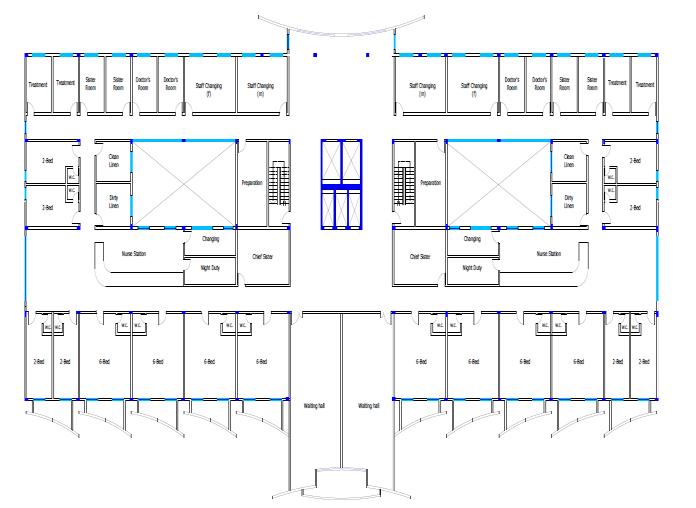
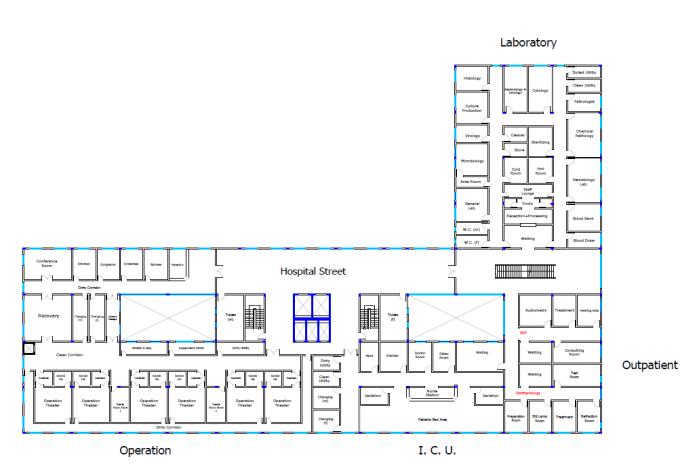
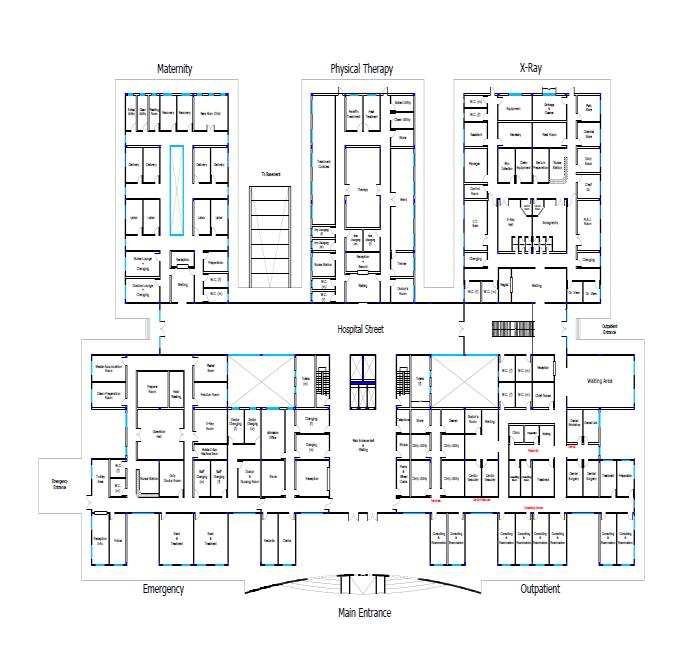
STAAD.Pro:STAAD.Proisasoftwareusedforstructural analysis and design. It was utilized in this project for analyzing and designing the structural components of the hospital.
RCDC: RCDC is a software used for the design and detailingofreinforcedconcretestructures.Inthisproject,it was used to facilitate accurate estimation of quantities of constructionmaterialsforthereinforcedconcretestructures.
MS Project: MS Project is a software used for project management.Itwasusedinthisprojectforschedulingand tracking construction activities, reducing time and cost overrunrisk.
4.2 PLANNING
5.1 Load case details Dead load
Deadloadconsistsoftheself-weightofthecolumn,beam, slabandwall Slab
Buildingdimensionacrosswinddirection(b)=65.00m
Heightofthebuildingaboveground(h)=16.5m
a/b=1.78
h/b=0.25
Wind Load in X-Direction
Cf=1.15
WindSpeed,Vz=Vbxk1xk2xk3xk4=45.7639m/s
WindPressure,Pz=0.6Vz2=1.257(KN/m2)
Wind Load in Z-Direction
Cf=1.30
WindSpeed,Vz=Vbxk1xk2xk3xk4=45.7639m/s
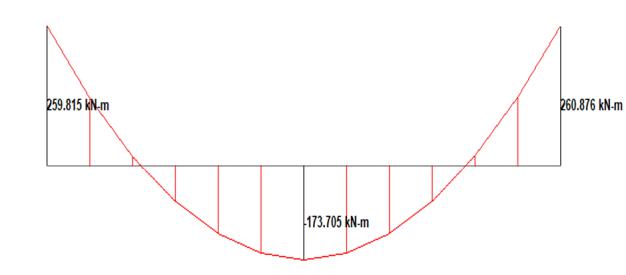
WindPressure,Pz=0.6Vz2=1.257(KN/m2)
Combination Load Cases
1*(deadload)+0.8*(liveload)+0.8*(windloadindirection)
+0.8*(windloadinzdirection)
Analysis beam no. 1921
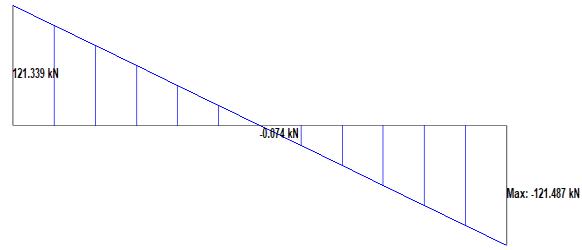
TheBendingMoment,ShearForceandDeflectioninthe BeamNo.1921ofsubstituteframemaybecomputedby STAAD.Pro
Bending Moment Along Z-Axis
Liveloadwasdeterminedbyusingcodefordesignloads(IS 875:2000Part2)forvarioustypesandpurposesofroom
Wind Load
Windloadwasdeterminedbyusingcodefordesign loads(IS875:2000Part2)forvariousheightofthe building
Vb=47m/s,K1=1.07,K3=1,K4=1,Kd=0.9,Ka=0.9, Kc=0.9 and TerrainCategory=3
Buildingdimensionalongwinddirection(a)=116.00m
Shear Force Along Y-Axis
Deflection Along Y-Axis
Fig -6
6. STRUCTURAL DESIGN
Table -2: Specification
Element Specification
Gradeofconcrete M15andM25 Gradeofsteel Fe500DandFe550D
175mm(thick)
300mmx300mm
mmx600mm
mmx750mm
ImposedLoad=1.000KN/sqm
LiveLoad=3.000KN/sqm
SlabThickness=175.000mm
EffectiveDepthAlongLX,Deffx=150.000mm
EffectiveDepthAlongLY,Deffy=140.000mm
Self-Weight=4.375KN/sqm
TotalLoad,TL=8.375KN/sqm
Span=2-Way
PanelType=InteriorPanel
6.1 Design of Slab
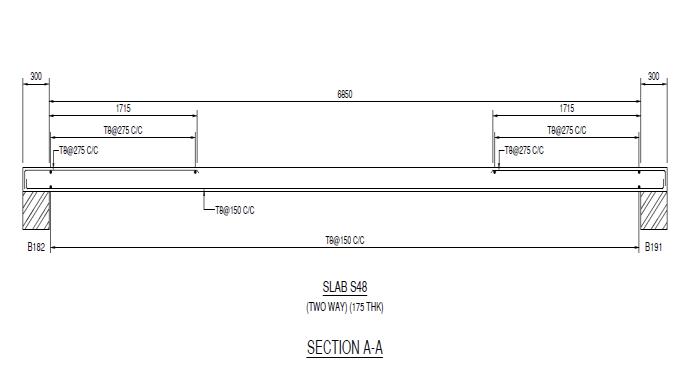
Generaldata
SlabNo.:S48
Level=3.3m
DesignCode=IS456
GradeofConcrete=M25
GradeofSteel=Fe500
ClearCover=20.000mm
LongSpan,Ly=7.300m
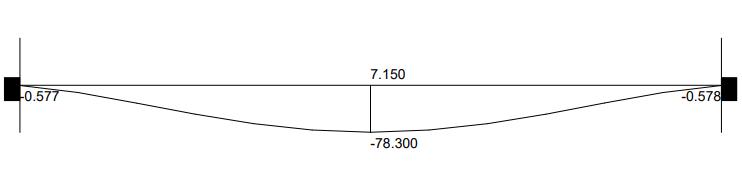
ShortSpan,Lx=7.150m
Designdata
Bottom@lx 8@125
Bottom@ly 8@125
Top@lx(Cont) 8@130
Top@lx(End)
Top@ly(Cont) 8@125
Top@ly(End)
Dist.Steel 8@275
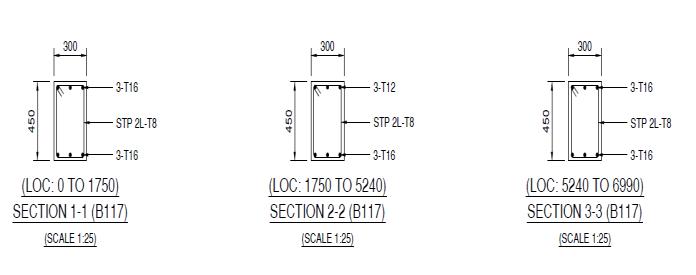
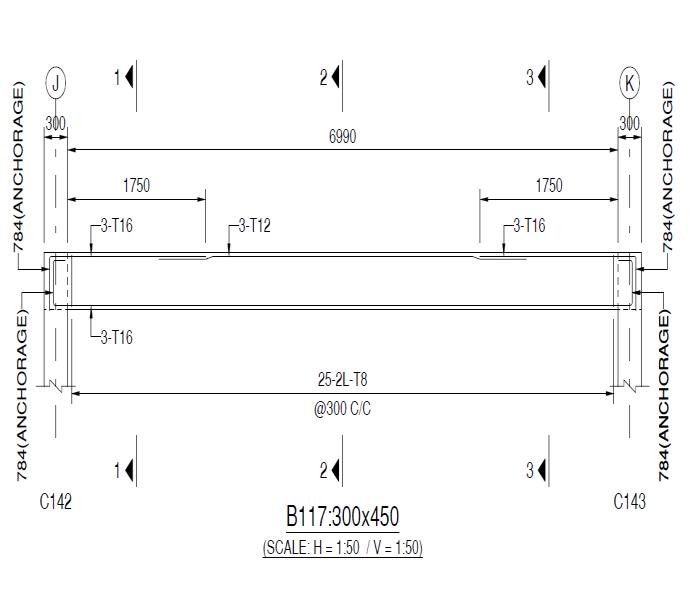
6.2 Design of Beam
BeamNo:B117
BeamLength:7290mm
Breadth(B):300mm
Depth(D):450mm
EffectiveDepth(d):395mm
GradeofConcrete(Fck):M25
GradeofSteel:Fe500
ClearCover(Cmin):25mm
Es:2x10^5N/sqmm
MaximumSpacingCriteria
Basic
Spc1=0.75d=296mm
Spc2=300mm
SFRDesign
BeamWidth=300mm
BeamDepth=450mm
WebDepth=450<=750mm
SideFaceReinforcementNotRequired.
NoofFloors=1
NoofColumnsinGroup=1
ColumnType:Unbraced
Minimumeccentricitycheck:OneAxisataTime
CodedefinedD/Bratio:4
D/BRatio:2<=4Hence,DesignasColumn
6.3 Design of Column
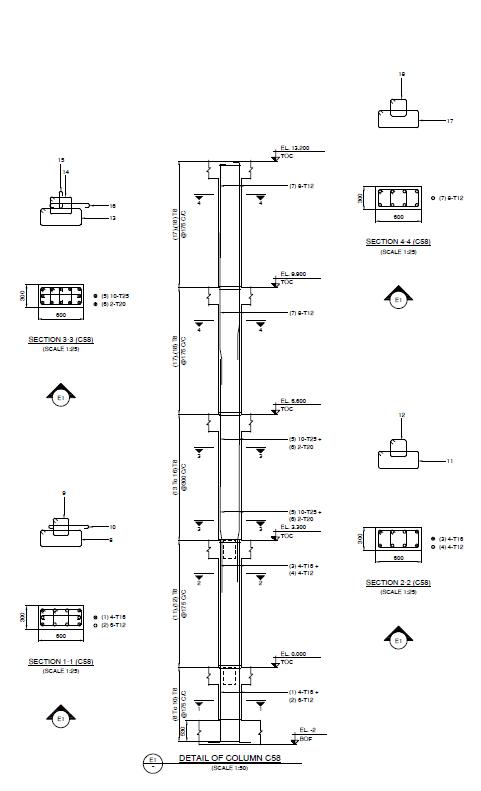
GeneralData
ColumnNo.:C58
Level:0mto3.3m
DesignCode=IS456
GradeofConcrete=M25
GradeofSteel=Fe550
ColumnB=300mm
ColumnD=600mm
LiveLoadReduction=30%
ClearFloorHeight@B=2850mm
ClearFloorHeight@D=2850mm
6.4 Design of Shear wall
GeneralData
WallNo.:C83
Level:0mto3.3m
GradeofConcrete=M25
GradeofSteel=Fe550
WallB=200mm
WallD=3600mm
ClearCover=40mm
ClearFloorHeight@B=3000mm
ClearFloorHeight@D=3000mm
NoOfFloors=1
NoOfWallsInGroup=1
WallType:Unbraced
Minimumeccentricitycheck:OneAxisataTime
CodedefinedD/Bratio:4
D/BRatio:18>=4
Hence,DesignasWall
LoadData
AnalysisReferenceNo.=2645
CriticalAnalysisLoadCombination:5
LoadCombination=[1]:(load1:deadload)+0.8(load2:live load) +0.8 (load 3: wind load in x direction) +0.8 (load 4: windloadinzdirection)
CriticalLocation=BottomJoint
Pu=254.57kN
NormalLinks
Diameterofmainhorizontalsteel=8mm
Thus,Spacing=200mm
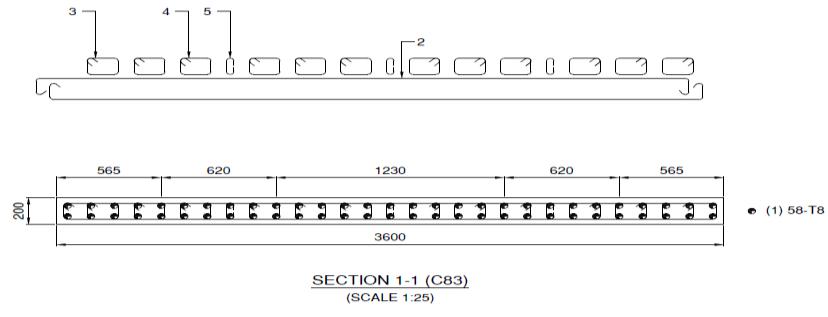
Spacingofhorizontalreinforcementisminimumoffollowing
D/5=720mm
3xB=600mm
Maximum=450mm
Spacingconsidered=200mm
6.5 Design of Footing
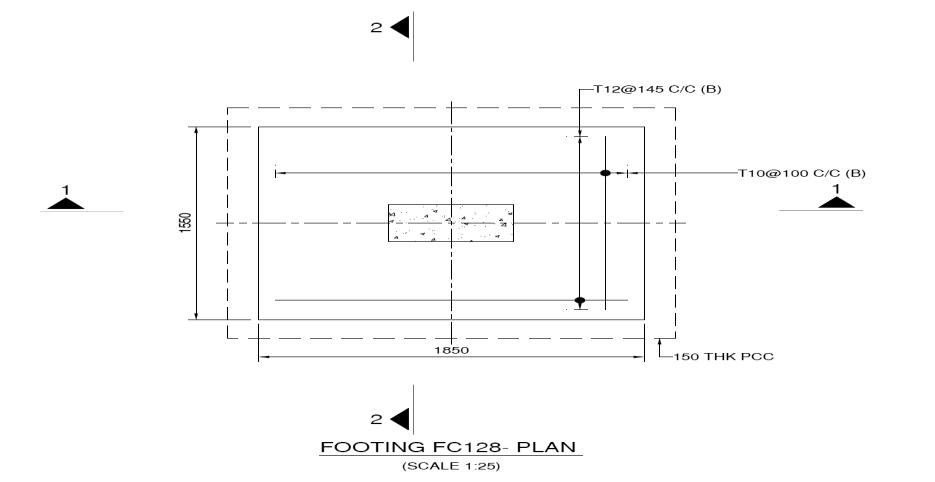
GeneralData
DesignCodes:IS456
FootingNo:FC128
ColumnNo:C128(600mmx300mm)
ConcreteGrade:M25 SteelGrade:Fe550
ClearCover:50mm
Df:1.5m Dw:3m
DensityofSoil=18kN/cum
SoilBearingCapacity=900kN/sqm
PermissibleSBCIncreaseforEQ=25%
PermissibleSBCIncreaseforWind=25%
Designcrosssectionby:Averagepressure
FootingType:Pad
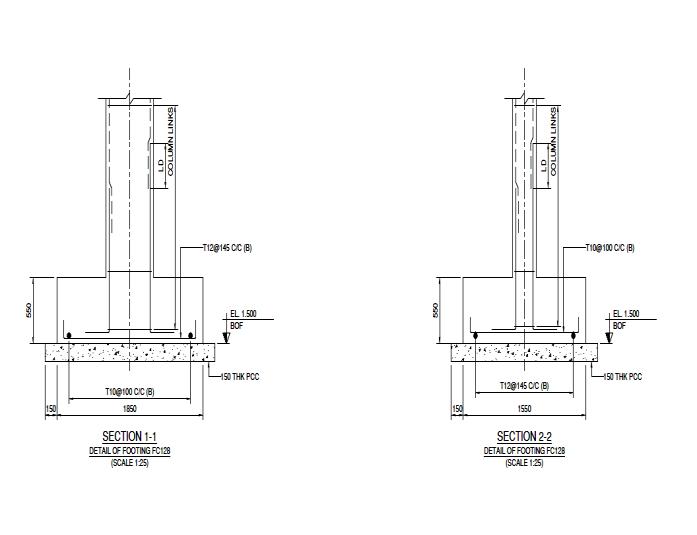
FootingSize(LxBxD):1850mmX1550mmX550mm
EffectiveSelfWeight=39.43KN
OffsetAlongL(Loff)=625mm
OffsetAlongB(Boff)=625mm
DesignData
FootingNo:FC128
ConcreteGrade:M25
SteelGrade:Fe550
ClearCover:50mm
ColumnNo:C128(600mmx300mm)
Footingsize(LxBxD):1850X1550X550(mm)
Bottom@L:T12@145
Bottom@B:T10@100
7. ESTIMATION
Estimation is an importantaspect ofconstruction,as it involves the process of determining the cost and time required to complete a construction project. Accurate estimation helps in budgeting, scheduling, and resource allocation,whicharecrucialforthesuccessfulcompletionofa project.Civilengineersuseavarietyoftechniquesandtools toestimatethecostofmaterials,labor,equipment,andother resourcesrequiredfora project.Thisinvolvesconsidering variousfactorssuchasdesignspecifications,siteconditions, and local market rates. The goal of estimation in civil engineeringistoprovidearealisticestimateofthecostand durationofaproject,whileensuringthatallnecessaryfactors areconsidered.
7.1 Quantity Estimation
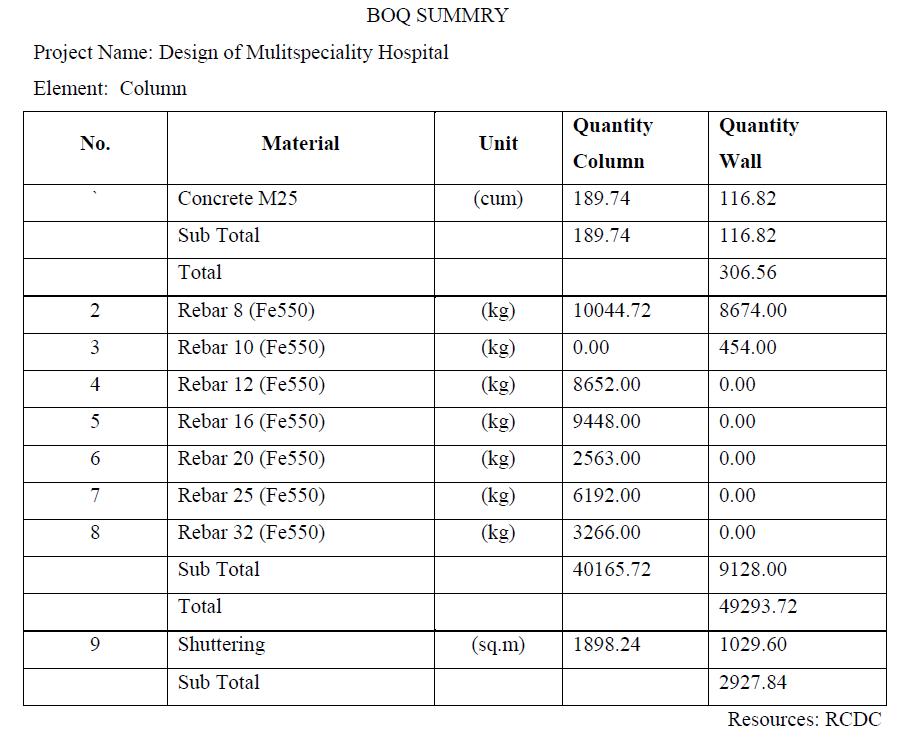
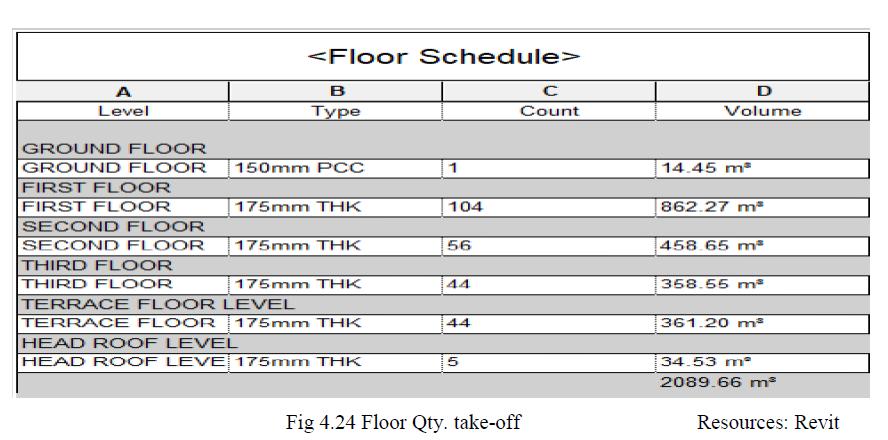
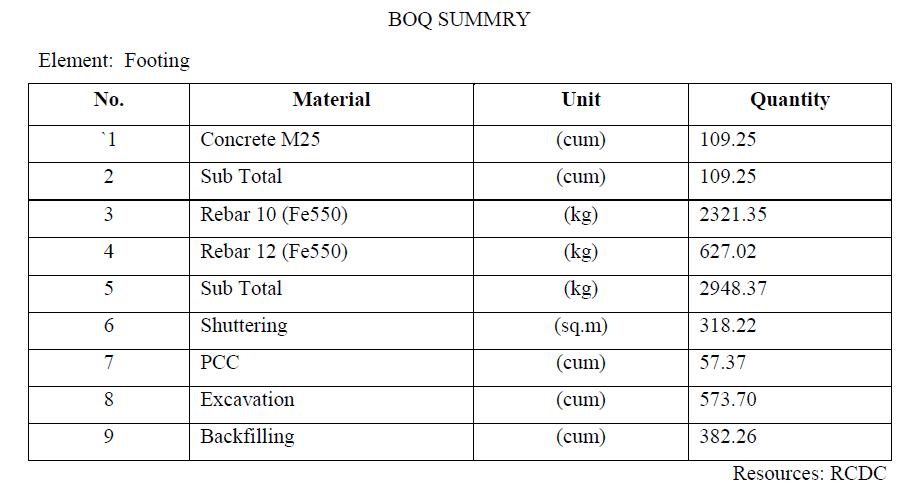
Construction projects require accurate and efficient quantity takeoff in order to ensure that the project stays within budget and is completed on time. With the advancementoftechnology,theuseofspecializedsoftware has become an indispensable tool for construction professionals. In this report, we present the results of a quantitytakeoffperformedusingRevitandRCDCsoftware, two of the most widely used tools in the construction industry.
Table -3 SiteSummaryofEstimation
NameofWork:CivilworksforProposedDevelopmentof MultispecialityHospitalatThanjavur
results of a scheduling performed using Microsoft (MS) Project,oneofthemostwidelyusedtoolsintheconstruction industry.
Table -4 Schedulingofwork
8. SCHEDULING
Scheduling is an essential aspect of construction projectmanagement,andplaysacriticalroleinensuringthe successfulcompletionofconstructionprojects.Byproviding a clear and concise overview of the project timeline, scheduling helps to coordinate and control the various activitiesandtasksinvolvedinaconstructionproject,and providesaframeworkforriskmanagement,costcontrol,and quality control and resources allocation. we present the
9. IDENTIFICATION AND RECTIFICATION OF ERRORS
Duringtheplanningstage,wediscoveredthatthe initiallayoutofthehospitalhadinadequatespaceforcertain departments, which would have resulted in operational issuesinthefuture.UsingBIMsoftwarelikeRevit,wewere abletomodifythelayoutandadjustthespacestomeetthe required specifications. We also found errors in the structural design during the analysis phase, which we rectifiedusingsoftwarelikeSTAADProandRCDC.Theuse of these software tools allowed us to detect errors in the structural design, such as weak points in the building structure,andmakenecessarycorrectionstoensurethatthe building was structurally sound. Overall, the use of BIM technology helped us detect and rectify errors at various stagesoftheproject,whichcontributedtothesuccessofthe projectandreducedthelikelihoodoffutureissues
10. RESULT AND DISCUSSION
TheintegrationofvarioussoftwaresuchasAutoCAD,Revit, STAAD Pro, RCDC, and MS Project in the design of a
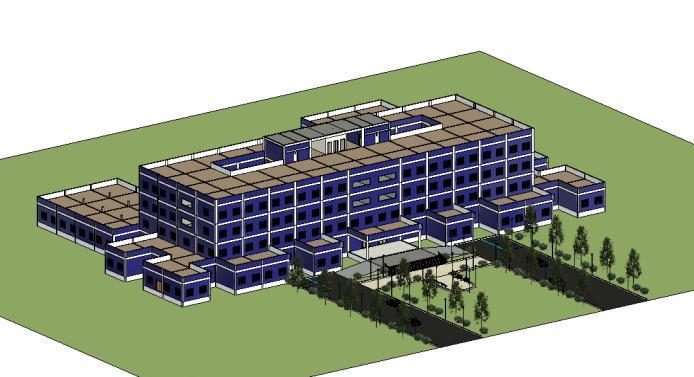
multispecialityhospitalusingBIMtechnologyhasprovento behighlybeneficialforcivilengineers.Thismethodallows for accurate planning, analysis, design, estimation, and scheduling of construction activities, resulting in a more efficient and cost-effective project. The collaboration of differentsoftwareensuresthattheprojectisdesignedand executed seamlessly, with no room for errors or discrepancies.BIMtechnologyenablesreal-timeupdatesand changestobemade,whichiscrucialinconstructionprojects wheretimeandaccuracyareofutmostimportance.Overall, theintegrationofvarioussoftwareusingBIMtechnologyhas provedtobeanindispensabletoolforcivilengineersinthe design and construction of large-scale projects such as multispeciality hospitals The integration of planning, analysis, design, estimation, and scheduling through BIM technology can save a lot of time and effort. The use of software like AutoCAD, Revit, STAAD Pro, RCDC, and MS Project can simplify the design process and provide a platform for collaboration and communication between differentteamsinvolvedintheproject.WiththehelpofBIM technology,itiseasiertodetecterrorsandinconsistenciesin the design, which can be rectified before the construction process begins, saving time and money. The ability to visualize the project in 3D models allows for better communicationwithclients,stakeholders,andcontractors, reducingthelikelihoodofmisunderstandingsandmistakes.
budget,andtotherequiredqualitystandards.Theyalsohelp to reduce the risk of human error, improve the overall qualityofthedesign,andfacilitatetheintegrationofvarious design aspects such as cost estimating, scheduling, and resourceallocation.
It is therefore advisable for civil engineers to continually updatetheirknowledgeandskillsinthisareatostayatthe forefrontoftheirfield
ACKNOWLEDGEMENT
Werenderoursincerethanksandrespectfulgratitudetoour Supervisor Dr.V.A.Shanmugavelu, M.E., Ph.D., Associate Professor, Department of Civil Engineering for providing valuableguidance.
We wouldlike toextend ourspecial thankstoall thestaff members of the Department of Civil Engineering and Technicians who are always available when we need technicalassistance
wedeeplythank ourparentsandfamilymemberfortheir unconditionaltrustandtimelyencouragementthroughout ourstudy.
REFERENCES
[1] CompendiumofNormsforDesigningofGovernmentof India Ministry of Housing & Urban Affairs - Central Public Works Department - Hospitals & Medical Institutions-2015
[2] CodeofPracticeisanIndianStandardcodeofpractice for general structural use of plain and reinforced concrete.IS-456-2000.
[3] The structural practice handbook SP:16-1980 Design AidsforReinforcedConcretetoIS:456-1978
11. CONCLUSIONS
In conclusion, the use of software techniques in civil engineering design projects is increasingly becoming essentialintoday'srapidlyevolvingtechnologicallandscape. Software such as STAAD Pro, RCDC, and Revit offer numerous benefits to civil engineers, including improved accuracy,efficiency,andconsistencyindesignandanalysis. These tools also allow engineers to perform complex calculations and simulations, visualize the behavior of structures under different loading conditions, and collaboratemoreeffectivelywithotherstakeholders.
Furthermore, software techniques provide a more streamlinedandeffectiveapproachtoprojectmanagement, helpingtoensurethatprojectsarecompletedontime,within
[4] Code of Practice for Design Loads (Other Than Earthquake)ForBuildingsandStructuresIS-875-1987.
[5] NationalBuildingCode2005–2015
[6] NeufertArchitects'DataFourthEdition-2014
[7] Dr.Ramachandra,LimitStateDesignofReinforced
[8] Concrete'.
[9] B.C.Punmia,AshokKumarJain,ArunKumar
[10] Jain,R.C.C.Design',LakshmiPublisher,NewDelhi.
[11] N.Krishna raju, Ramaamurtham & N.N.Narayanan, DesignofR.C.Cstructures.
[12] P.C.Varghese,LimitStateDesignofReinforcedConcrete.
[13] F. Alarcon, et al. “BIM in healthcare construction”, journalAutomationinConstructionin2018,volume85, pages96-109
[14] S.AlomariandM.Al-Qawasmi,“BIMinHospitalDesign andConstruction”,JournalofHealthcareEngineering.
[15] V. J. Saran and S. S. Pimplikar “BIM for Healthcare Infrastructure Planning”, International Journal of Engineering&ResearchTechnology,Volume10,Issue 10,Oct2021.
[16] MVK Satish and K. Bhavana, “Production base design and analysis of a new Hospital building subjected to impactloadusingStaadPro”,AIJREAS.