SEISMIC RESILIENCE PERFORMANCE OF CORRUGATED STEEL SLIT SHEAR WALLS
1Student,Dept.of civil Engineering, Universal Engineering College, Vallivattom, Kerala, India

2Assistant Professor, Dept. of Civil Engineering, Universal Engineering College, Vallivattom, Kerala, India ***
Abstract -The aim of the study is to understand the factors that contribute to the hysteresis behavior of corrugated steel slit shear walls. The study designed several models to investigate the effect of design parameters, including effective corrugation angles, slit number, angle of corrugation, and steel property. The design procedure focused on ensuring that the shear walls exhibit plastic deformations before yielding to increase energy dissipation. The study found that the placement angle, height, number of slits, and spacing of the corrugation significantly influence the seismic performance of the steel corrugated plate shear walls. The analysis revealed that the seismic performance of the shear wall was best when the corrugation was placed at an angle of 90◦ Additionally, the study investigated the effectiveness of splitted slits and found that a combination of full slit and splitted slit improved the performance of the best model. Finally, the study compared the hysteresis behaviors of models with and without slits to understand the impact of slits on the behavior of the shear wall. Overall, the study provides insights into the design parameters that can improve the seismic performance of corrugated steel slit shear walls and highlights the importance of considering hysteresis behavior in the design process.
Key Words: corrugated steel plate shear walls, slits, ANSYS, hysteresis behaviour, FEMA
1. INTRODUCTION
Steel Plate Shear Wall (SPSW) systems have become increasingly important in recent years as a lateral force-resisting system in buildings. They are used in many different countries and building types due to their ability to withstand earthquakes and other lateral forces. Energy dissipation technologies have been developed to mitigate damage in structures during seismic events. These technologies use materials such as steel plates, steel bars, and steel strips to dissipateenergyatspecificlocationsinthestructure.Thesteelslitshearwall(SSSW)isatypeofmetallicdamperthathas been investigated due to its higher energy dissipation, better ductility, and ease of installation and repair.A steel plate shearwalliscomposedofa steel infill plate,surroundingboundary beams,andboundarycolumns.Additionalhorizontal or vertical stiffeners may be required for stiffened steel shear walls. Corrugated Steel slit Shear Walls (CSPSWs) have become more popular as an efficient lateral force-resisting device due to their improved hysteresis behavior, buckling stability, and higher out-of-plane stiffness compared to flat plates. Shear walls made of Steel Corrugated Plate (SCP) are commonly used in real-world engineering and have high elastic starting stiffness, stable hysteresis properties, and good seismicperformance.Theangle,height,andspacingofcorrugationshaveasignificantimpactontheseismicperformance of shear walls. Overall, Steel Plate Shear Wall systems and their variants are important components of seismic-resistant buildingdesignandconstruction.
2. LOADING PROTOCOL
Cyclicloadingprocedurewereadoptedasdisplacementcontrolledincrementalcycleloadingscheme.Thendriftratiosare 0.5%, 1.0%, 1.5%, 2.0%, 2.5%, 3.0%, 3.5%, 4.0%, 4.5%, 5.0%, and 6.0% are imposed to the specimens in sequence.displacementprovidedinthetableisappliedincyclicloadingasperFEMA.
3. ANALYZED SPECIMEN
According to the different angles between the corrugation of steel shear wall under the conditions of 30◦ , 60◦ , and 90◦ were designed0◦ were not analyses because the horizontal corrugation is not appropriate for the slits.The steel columnofthesteelframeofthecorrugatedsteelslitshearwall adoptedarectangularboxsectionThesectionsizeofthe rectangularsteelcolumnwas500×400×20mm,anditsheightwas4.5m.TheH-shapedsteelbeamhadasectionsizeof 500×300×20×15mm,anditsspanwas6m.
Thethicknessofthecorrugatedsteelshearwalls was15mm.Theyieldstrengthofthe framecolumn,framebeam,and shearwallwas380MPa.Perpendicularimpactloadwasappliedatthelaterallyattopofcolumnofframeand2supports areprovidedattopandbottom,CSSSWshaveplasticdeformations(i.e.energyconsumption)beforethestructuregetsinto yielding.
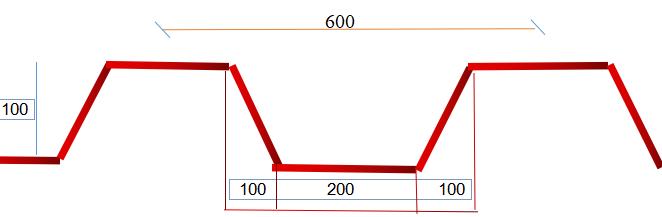
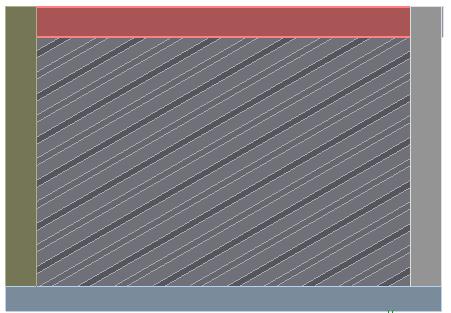
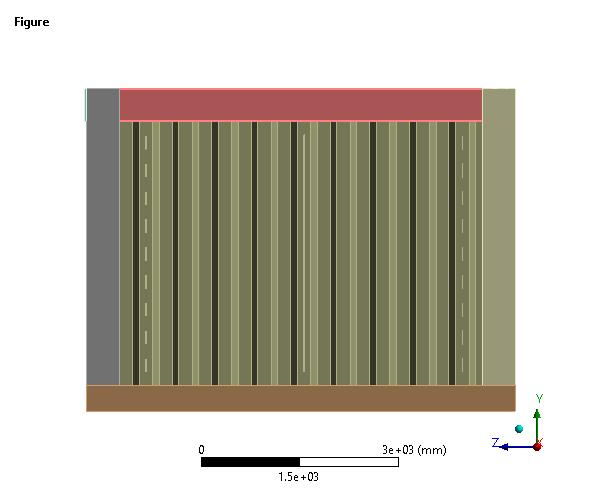
Theabovefigureshows threeangleofcorrugationofsteelslitshearwalls(30º,60º,90º).0ºisnotanalyzedbecauseitis not appropriate for slit due to the horizontal corrugation, Here analysis proves that 90º is more effective. So the model designedwith90ºcorrugationangle.
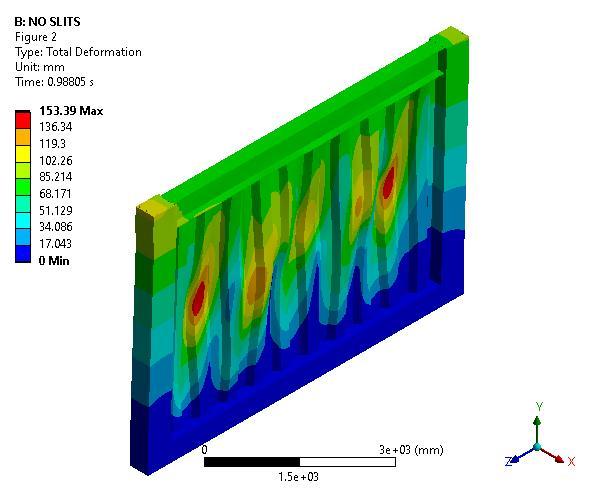
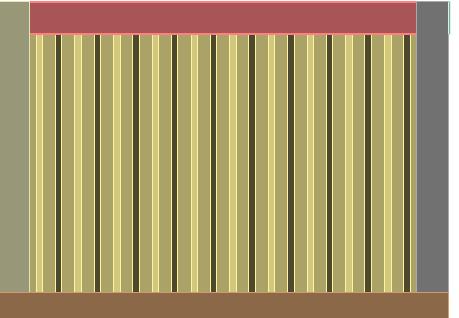

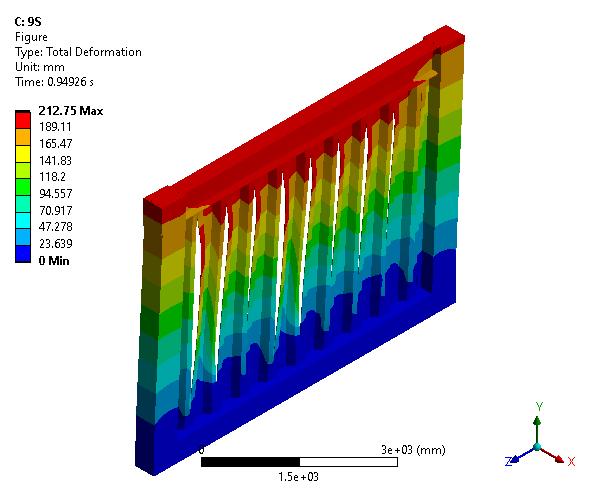
Theabovefiguresshowsthetotaldeformationdiagramsofwallwithoutslitandwallwithninenumbersofslits.Themodelwithoutslit have the maximum deformation atthe center partof walland the modelwith nine numbersof slithave maximum deformation at the top endofslitofbeamthenitreducesuptobottom.in thisobjectivepart10modelsareanalyzed(modelwith1-9numbersofslitand modelwithoutslit).Andalsodifferentmodelsof3to7numbersslitmodelswereanalyzed.
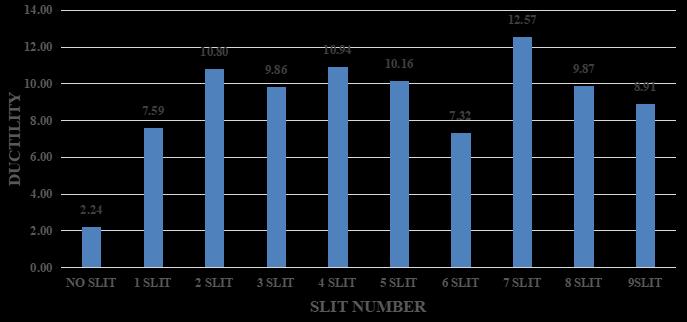
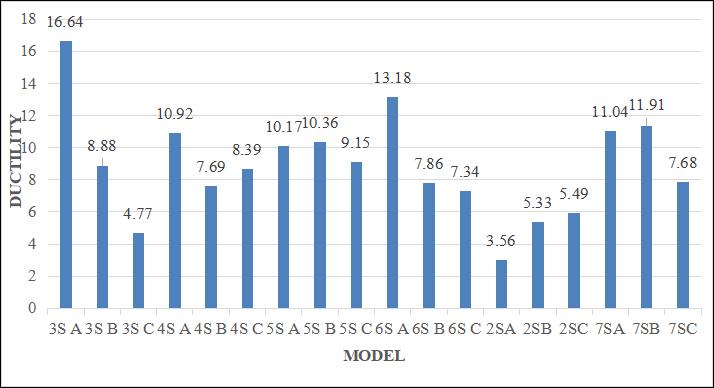
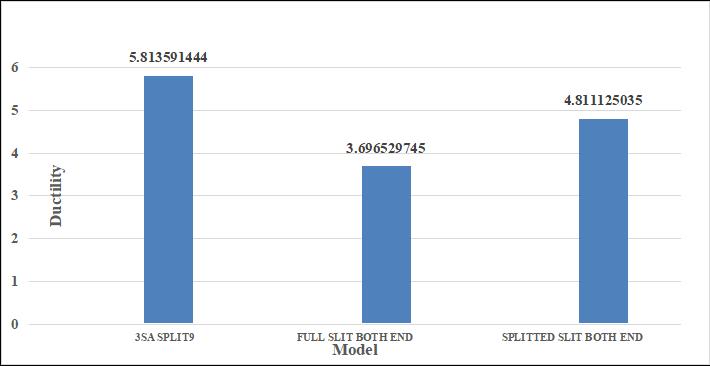
The load-deflection curves can be used to design and optimize structures such as beam columns and bridges. Engineers canusethecurvetodeterminemaximumloadastructurecanwithstandbeforeitfails,andadjustthedesignaccordingly. The graph given above shows the load vs displacement graph .after that different models of same number of slits are analyzed.Theductilitybarchartsofallmodelsaregivenbelow.
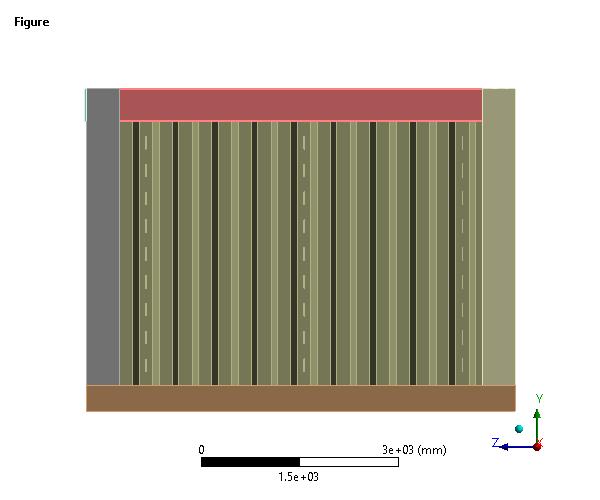
Find out the effective model from above models and changed it into three different models. All slits are splitted and Combinationoffullslitandsplittedslit(fullslitandbothendsandsplittedslitatbothends).afullslitissplittedintonine numbersofslits.
Carry cyclic analysis of wall to find energy absorption capacity capacity of corrugated steel slit shear wall .Here three modelsareselectedforcomparison.ThefirstoneisWallwithoutslit.Itisselectedbecausetheenergyabsorptioncapacity ofwallwithoutslitisneedtoknowthevariationinthevalues.Thenmoreeffectivemodelwithslitandmodelwithsplitted slitisselectedtofindenergyabsorptioncapacity.
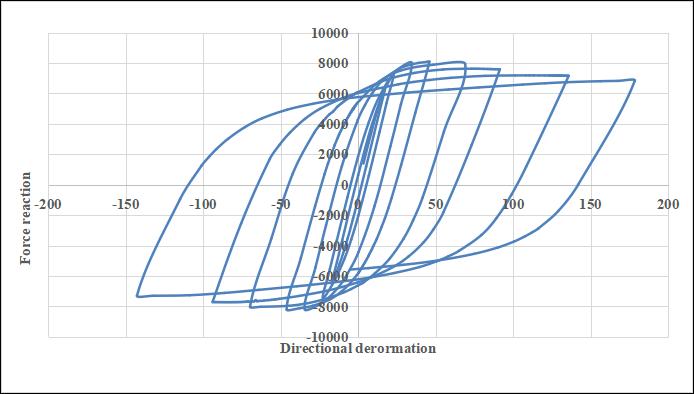
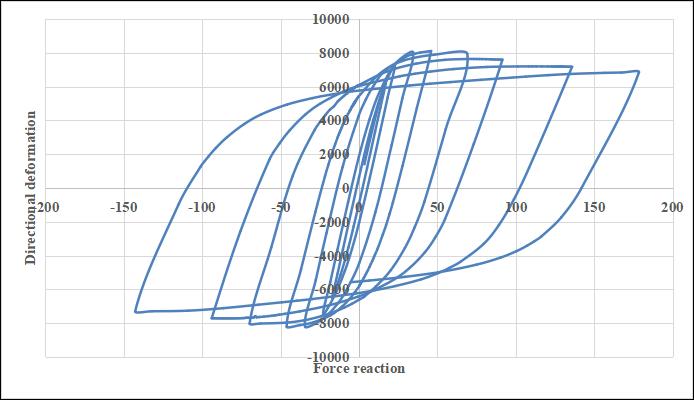
The energy absorption capacity is the energy consumption capacity of members under repeated loads.it can reflect non linearmechanicalperformanceofthemembersorstructures. Therefore,energyabsorptioncapacitycanbeanimportant index to measure the seismic performance of members. Therefore, under a certain strength guarantee ,if the component has good energy absorption capacity ,it can absorb a large part of seismic energy in the earthquake. Here energy absorptioncapacityisobtainedfromtheareaofloopbyusingoriginsoftware.
4. CONCLUSIONS
1. Fromtheanalysisofdifferentmodelsofcorrugatedsteelslitshearwalls,itisobservedthatnumberofslitsisnotonly amainfactorthatdeterminetheductility, ductilityaswellasenergyabsorptioncapacityvarieswithspacebetween slitsandlengthofslit
2. Corrugation inclination anglesof 30◦, 60◦, and 90◦ indicatesthat theseismic performance of the shear wall isthe bestwhenthecorrugationinclinationangleis 90◦.
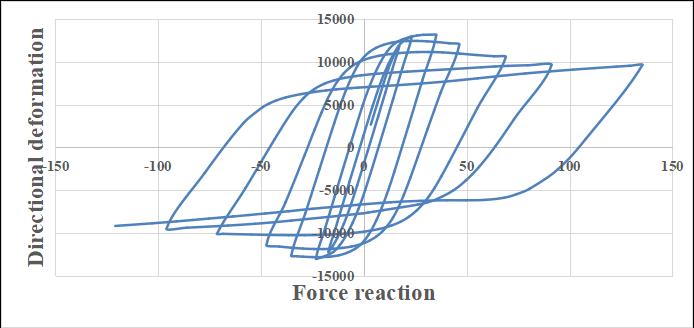
3. Modelwithoutslithavelessenergyabsorptioncapacityaswellasductility
4. From the analysis 3sa model (3 slit model with max space) have maximum ductility and 3sa split 9 have maximum energyabsorptioncapacity
ACKNOWLEDGEMENT
I wish to thank the Management, Principal and Head of Civil Engineering Department of Universal Engineering College, Thrissur,AffiliatedbyallIndiaCouncilforTechnicalEducationNewDelhiandAPJAbdhulKalamTechnologicalUniversity fortheirsupport. Thispaperisbasedonthe work carriedoutby me (Aiswarya P. T.),aspartofmy PGcourse, underthe guidance of Gouri S. Kumar(Assistant Professor, Civil Department, Universal Engineering College, Thrissur, Kerala).I expressmygratitudetowardsherforvaluableguidance.
REFERENCES
[1] Haifeng Bu, Liusheng He, Huanjun Jiang (2022) “Study on steel slit shear walls with different characteristics of hysteresisbehavior”
[2] Liang Zheng, Wen Wang, Hongwei Ge, Hong Guo, Ying Gao, Yunshan Han (2022)“Seismic performance of steel corrugatedplatestructuralwallswithdifferentcorrugationinclinations”
[3]Ji-ZhiZhao,Mu-XuanTao,Zhen-HaoWu,Liang-DongZhuang(2022) “Experimentalandnumericalstudyonbentshear paneldampermadeofBLY160steel
[4]LászlóGergelyVigh,AbbieB. Lie, GregoryG. Deierlein,EduardoMiranda, Steven Tipping (2014) “Component model calibrationforcyclicbehaviorofacorrugatedshearwall”
[5]Fereshteh Emami, Massood Mofid, Abolhassan Vafai ( 2013) “Experimental study on cyclic behavior of trapezoidal corrugatedsteelshearwalls”
[6]LászlóGergelyVigh,GregoryG.Deierlein,EduardoMiranda,AbbieB.Liel,StevenTipping(2013)“Seismicperformance assessmentofsteelcorrugatedshearwallsystemusingnon-linearanalysis”
[7]Jeffrey W.Bermana, Oguz C. Celika,b, Michel Brunea (2004) “Comparing hysteresis behavior of light-gauge steel plate shearwallsandbracedframes”
[8] FEMA 461, Interim Testing Protocols for Determining the Seismic Performance Characteristics of Structural and NonstructuralComponents,FederalEmergencyManagementAgency,WashingtonDC,2007.