Using AI to Recommend Pesticides for Effective Management of Multiple Plant Diseases
Shreyanshi Patel1, Rahul Borkar2 , Adarsh Kumar3 , Kunal Raj4 , Aashish Sahu51Professor, Priyadarshani College of Engineering, Nagpur, Maharastra

2Under Graduate Student, Priyadarshani College of Engineering, Nagpur, Maharastra
Abstract
Trees, Plants and Crops are one of the principal sources of food for humans as well as other animals. They are crucial for our continuance. Similar to us they are also living organisms. Once in a while we get afflicted by diverse diseases. Like us, plants are also affected by various types of illness. Plants that are infected by disease have results on their health which have severe consequences like less food production. Most plant ailments are contagious which spread rapidly all over the whole crop. Prior prevention and ceasing of disease is a necessity step to stop further harm and proper crop production. Usually, farmers or professionals keep a close eye on the plants in order to discover and identify diseases. However, this procedure is frequently time-consuming, costly, and imprecise. We need to ameliorate and quicken the process of disease perception and its diagnosis. The main aim of this research paper is to demonstrate a Disease Recognition System that is supported by providing solutions with Fertilizer Recommendation to make plant disease spotting easier and briskly. In this research paper we are providing methodology to make use of Computer Vision with a Machine Learning Model (Convolution Neural Network) to make an effective system for plant disease detection. CNN is a form of artificial neural network that is specifically intended to process pixel input and it is used in image recognition. Overall, we are intended to provide a method using machine learning to detect the disease present in plants on a colossal scale.
Keywords - Convolutionla Neural Network (CNN), Colossal,ComputerVision,Disease.
Introduction
Every day, agriculture produces an average of 23.7 million tonsoffood,provideslivelihoodsfor2.5billionpeople,and it is also the largest source of income and jobs for poor, rural households. In developing countries, agriculture accountsfor29%ofGDPand65%ofjobs.Thedifferentpet animal breeds, birds and insects also directly or indirectly depend upon agricultural food for their aliment.. In addition,biodiversitydirectlysupportsagriculturesystems
by helping to ensure soil fertility, pollination and pest control. For these reasons, agricultureis key for producing foodforagrowingworldpopulation[5]
Howdoplantdiseasesimpactfoodsecurity?Plantdiseases are a major impediment to the production and quality of important food stuff. Pests and diseases pose a threat to foodsecurity
Because they can damage crops, thus reducing the availability and access to food, increasing the cost of food. Inaddition,plantdiseasecandevastatenaturalecosystems, compounding environmental problems caused by habitat loss andpoorlandmanagement.Themostdirecteconomic impact of a trans boundary pest or disease is the loss or reducedefficiencyofagriculturalproduction-whetheritbe of crops or animals - which reduces farm income. The severity of the economic effect will depend on the specific circumstances[5].
Independent of the prevention approach, identifying a disease correctly when it first appears is a crucial step for efficient disease management. Majority farmers based on their experience and knowledge try to identify plant disease and try to prevent it by applying pesticides or fertilizers on the farm. But this is not an accurate method and the wrong prevention approach might of course damage the crops. Disease identification and solution has been supported by agricultural extension organizations or otherinstitutions,suchaslocalplantclinics.Butthecost of the process is high and most clinic labs are located in the citywhichmakesitdifficultforfarmers.
A system capable of performing such tasks can play an important role in avoiding the excessive use of pesticides and chemicals, reducing both the damage caused to the environment and to the associated use of pesticides and chemicals.Thegrowingtechnologyinmachinelearningand availabilityofbigdataanalysismethodshasthepotentialto spur even more research and development in smart farming. Besides promoting higher yield crops in a more sustainable manner, it also aims to contribute to event forecasting, detection of diseases, and management of farms.
This research paper demonstrates the methodology to implement server based and mobile based approach for diseaseidentificationandfertilizersuggestionemployedfor disease commercial use. Several factors of these technologies being high resolution cameras, high performance processing and extensive built in accessories are the added advantages resulting in automatic disease recognition. Modern approaches such as machine learning and deep learning algorithms have been employed to increase the recognition rate and the accuracy of the results.
The literature review presented in this paper also aims to provide guidance on the development of such ML-based tools,inordertoprovidefarmerswithdata-drivendecision making assistance systems. In this way, farmers can be assisted with lowering the need for pesticide application andtheharmthatcomeswithit,whilealsopreservingand enhancing crop quality and yield. This contributes to the continued availability of food to meet global population demands while doing less damage to the planet. The application of ML-based techniques has promoted the emergence of projects that have enriched the development andtheevolutionofsmartfarming.Withthisinmind,this article also contributes to the progression, development, andsuccessofsuchprojects.[1][2][3][4].
Literature Review
Plant Disease Detection Using Cnn by Nishant Shelar1 , SurajShinde2,ShubhamSawant3,ShreyashDhumal4,and Kausar Fakir 5.1,2,3,4, Department of Electronics and Telecommunication, Ramrao Adik Institute of Technology, Navi Mumbai, India. [ITM Web of Conferences 44, 03049 (2022)] [ICACC-2022]. The research paper demonstrates a Disease Recognition Model that is supported by leaf image classification. To detect plant diseases, we are utilizing image processing with a Convolution neural network (CNN). A convolutional neural network (CNN) is a form of artificial neural network that is specifically intended to processpixelinputandisusedinimagerecognition.[1]
Machine Learning for Detection and Prediction of Crop
Diseases and Pests: A Comprehensive Survey by Tiago Domingues 1, Tomás Brandão 2 and João C. Ferreira 3, Instituto Universitário de Lisboa (ISCTE-IUL), [ISTAR-IUL, 1649-026]Lisboa,Portugal2InovInescInovação,Instituto de Novas Tecnologias, 1000-029 Lisbon, Portugal [Correspondence:tards@iscte-iul.pt]
Thissurveyaimstocontributetothedevelopmentofsmart farming and precision agriculture by promoting the development of techniques that will allow farmers to decrease the use of pesticides and chemicals while
preserving and improving their crop quality and production.[2]
Convolutional Neural Networks for the Automatic IdentificationofPlantDiseasesbyJustineBoulent1,Samuel Foucher 2, Jérôme Théau 3 and Pierre-Luc St-Charles 4, Department of Applied Geomatics, Université de Sherbrooke, Sherbrooke, QC, Canada. [REVIEW article : Front. Plant Sci., 23 July 2019]. This survey allows us to identifythemajorissuesandshortcomingsofworksinthis research area. We also provide guidelines to improve the use of CNNs in operational contexts as well as some directionsforfutureresearch.[3]
Crop: Plant Disease Identification Using Mobile by ManikantaMunnangi[Oct18,2019][4]
Food production & availability - Essential prerequisites for sustainable food security M.S. Swaminathan1 and R.V. Bhavani 2, Indian J Med Res. 2013 Sep; 138(3): 383–391.[PMCID: PMC3818607] [PMID: 24135188]. This paper deals with different aspects of ensuring high productivity and production without associated ecological harm for ensuring adequate food availability. By mainstreaming ecological considerations in technology development and dissemination,wecanenteraneraofevergreenrevolution and sustainable food and nutrition security. Public policy supportiscrucialforenablingthis.[5]
Artificial Intelligence in Agriculture: An Emerging Era of Research Paras M. Khandelwal and Himanshu Chauhan Department of Information Technology, Kavikulguru Institute of Technology and Science, Ramtek 441106, Maharashtra, India. The current paper throws a vision of how the diverse sectors of agriculture can be fuelled using AI. It also investigates AI-powered ideas for the future and thechallengesanticipatedinfuture.[6]
Implementation
1.Dataset Acquisition
WhatTypesofDatasetsUsed?
Therearethreetypesofdatasetsareused:
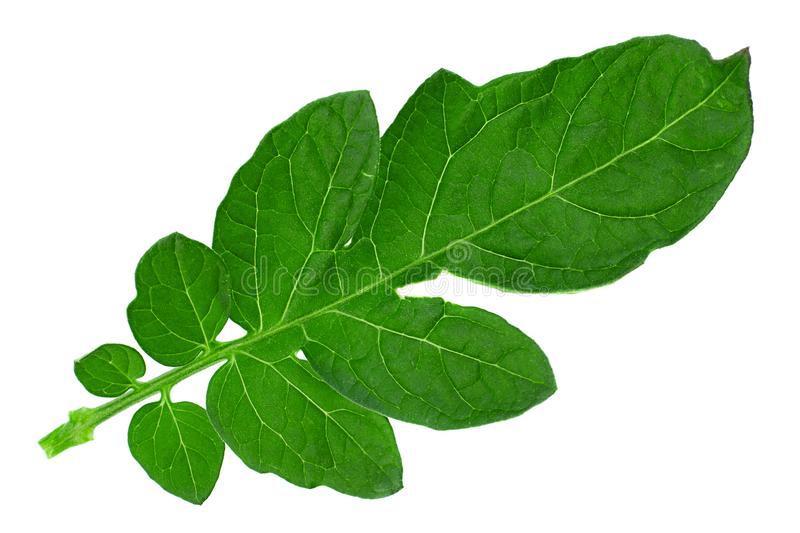
1. Dataset of leaf images taken in a plain background with controlled pixel quality which makes dataset trainingeasier.
Ex.[ShowOnefromDatasetofYourProject]
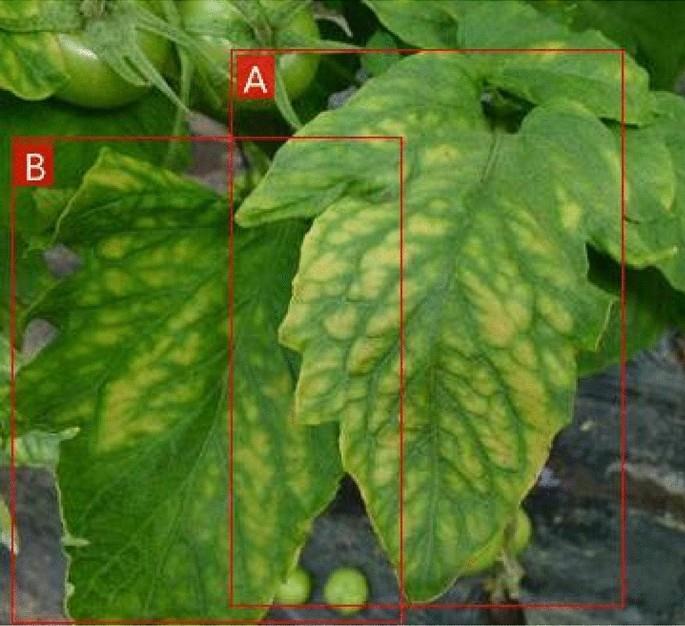
2. Second dataset of leaf images contains a complex background but the object of interest means the leafbodyisclearandrecognizable.It'sabithardto makeamodel.
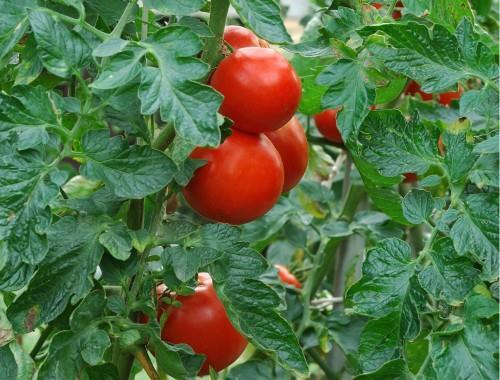
3. Third type of dataset of leaves contains more complex backgrounds which also contain other plant parts like steam, flower, etc. This type of dataset is best suited for making operational models.(Farmersandnormaluseprospective)
background
For our project proper operational implementation we wanted all above three types of leaf dataset. We used an open source dataset for our project called Plant village which contains approx 70% images taken in controlled mannerandothersinuncontrolledmanner.
There are multiple plant datasets available on this dataset repository. We picked and downloaded according to our use.
2.Noise Reduction
Different sorts of filters, such as Gaussian and median filters, are used to limit noise to gain smoother images. These filters have an impact of blurring and disposing of non applicable small print of an image, at the fee of doubtlessly dropping applicable textures or edges. Erosion and dilation are two morphological photo operations that can be utilized for binary or gray-scaled images. Erosion gets rid of islands and tiny items, leaving solely large objects. In different words, it shrinks the foreground objects. On the other hand, dilation will increase the visibility of objects and fill in tiny gaps, including pixels to the boundaries of objects in an image. These operations decrease small print and beautify areas of interest. These strategies are helpful, for instance, for pest detection in opposition to an impartial background, such as photographsoftrapswithcapturedinsects.
Images are normally saved in the RGB format, which is an additive coloration mannequin of red, green, and blue components. Due to the excessive correlation between theseshadecomponents,itistypicallynownotappropriate tooperatecolorationsegmentationintheRGBshadespace.
Therefore it is necessary to undergo in idea that there are others coloration areas such as HSV or L*a*b*. In HSV the shade aspects are: hue (pure color), saturation (shade or quantityofgray),andprice(brightness).IntheL*a*b*color space, L* is the luminance (brightness), a* is the fee alongside the red-green axis, and b* is the price alongside the blue-yellow axis. In these coloration spaces, the brightness of a shade is decoupled from its chromaticity, permittingthephotosto be processedwithspecial lighting fixtures stipulations [69]. This is full-size in the context of agriculturalpicturesreceivedinthefields,consideringthey can have been shot beneath a number of light occasions or at one-of-a-kind instances of the day. Histogram equalization is an approach for adjusting contrast. In low distinctionimages,thevary ofdepthvaluesissmaller than in excessive distinction images. Equalization of the Agriculture 2022, 12, 1350 9 of 23 histogram spreads out thedepthrangesforthedurationofvaluesinawiderrange. Contrast enhancement is now not immediately utilized in theRGBshadespace,duetothefactitappliestobrightness values. Thus, photos have to be transformed both to grayscale or to a coloration area that carries a brightness component,suchastheHSVorL*a*b*colorspaces.
frequent properties. The homes of these regions, such as colorationandbrightness,rangeconsiderablyincontrastto their surroundings. This method can be used, for instance, torealizeandbecomeawareofspotsinleafimages.
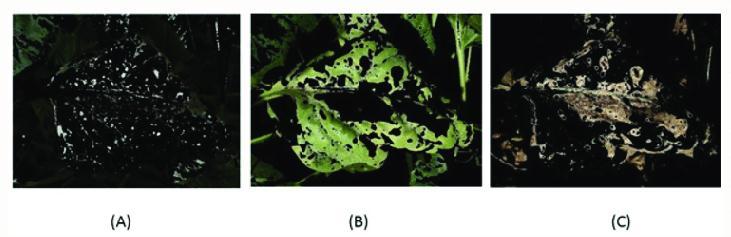
Thek-meansclusteringalgorithmisafamousunsupervised ML algorithm that can be used for photograph segmentation. Pixels are grouped into clusters which have pixels with similar shade and brightness values. This methodishelpful,forinstance,todiscoverbrokenareason leaves.Thistechniqueisusedtopreciselyoutlinethephoto areas corresponding to the plant leaf components affected through disease. Intensity thresholding is a simple and simplified strategy for picture segmentation. According to the pixel value, that pixel is categorized into a team (e.g., wholesomeordiseased).Whentheusageofthistechnique, photos are often transformed to gray-scale first and then thresholdedtheusageofagraydepthvalue.
3.Image Processing
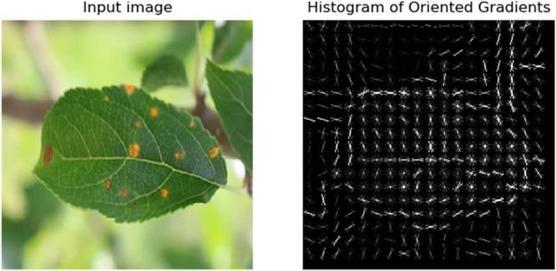
Imagesegmentationisthetechniqueofgroupingpixelsinto areas of interest. In the context of crop sickness identification, these areas of hobby can be, for instance, diseased areas on the plant leaves, for assessing the severity of the contamination through the quantity of the contaminated area, or for history removal, when you consider that the elimination of the history permits highlighting of the areas of pastime for similarly analysis. Histogram of oriented gradient is a laptop imaginative and prescient approach for getting areas of pixels that share
4.Feature Extraction
Feature extraction is a frequent step in the pre-processing of pix for shallow ML models. Common picture function extractionalgorithmsencompass:
1) HistogramoforientedGradient(HoG),
2) SpeededUpRobustFeatures(SURF)
3) ScaleInvariantFeatureTransform(SIFT)
Different characteristic extractors achieve special aspects that can be greater or much less appropriate for the particulartroubleathand.
SIFTfindsscaleandrotationinvariantneighborhoodpoints via the entire image, acquiring a set of picture places referred to as the image’skey-points. SURF is conceptually comparable to SIFT, with the gain of being a good deal
faster, which can be relevant for the implementation of real-timeapplications.
HoG focuses on the shape and structure of the photograph objects, by using detecting edges on pictures oriented according to unique directions. The distribution of gradients in accordance to these instructions are used as features. The histogram of oriented gradients (HOG) is an elementdescriptorutilizedasapartofPCvisionandimage processing for the sake of object detection. Here we are makingutilizationofthreecomponentdescriptors:
inexperienced and blue bands, and between NIR and inexperienced bands), band ratios and dimension discount the usage of predominant aspect analysis. The authors additionally investigate which kind of statistics achieves niceoverallperformanceonthemodels.
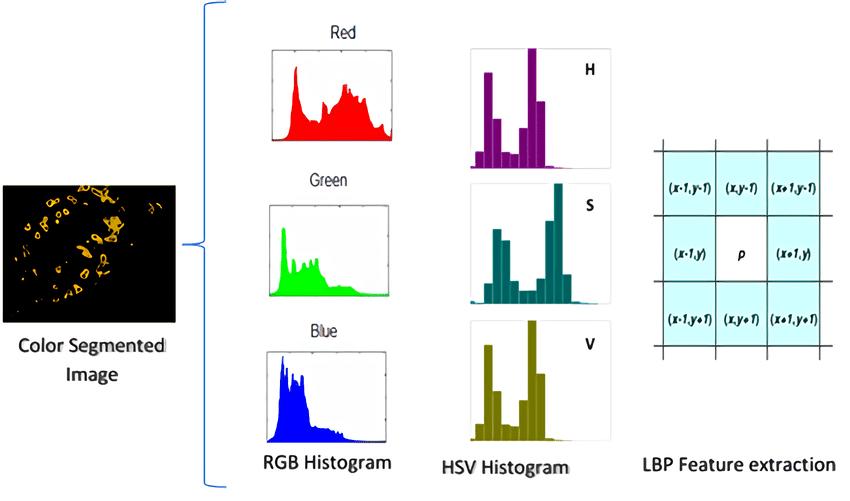
Hu moments are basically used to extract the shape of the leaves. Haralick texture is used to get the texture of the leaves and color Histogram is used to represent the distributionofthecolorsinanimage.
Random forests are, as a whole, a learning method for classification, regression and other tasks that operate by constructing a forest of the decision trees during the training time. Unlike decision trees, Random forest overcomesthedisadvantageofover-fittingoftheirtraining datasetandithandlesbothnumericandcategoricaldata.
Thedistributionofphotoshadesisrepresentedwiththeaid of a shade histogram. Since most ailments have signs and symptoms that influence the color of the leaves, the histogram can additionally be used for distinguishing between healthful and unhealthy flora . Some pc imaginative and prescient algorithms for function extractiondemandthatsnapshotsaretransformedtograyscale,suchasHaralicktextureorsidedetectionalgorithms, etc. Haralick texture elements are computed from a Grey Level Co-occurrence Matrix (GLCM), a matrix that counts the co-occurrence of neighboring gray-levels in the image. The GLCM acts as a counter for each mixture of gray-level pairs in the image. Diseased and wholesome leaves have one of a kind textures in that a diseased leaf has an extra irregular floor and a healthful leaf has a smoother one. These facets permit differentiation of a wholesome leaf from a diseased one. Local Binary Pattern (LBP) is every other method used for photograph texture aspects extractionsturdytoeditionsonlightingfixturesconditions. Multi-spectral photograph data-sets can be exploited to create new facts and enhance the overall performance of models.For example, originally,therehave beenNIR snap shots of the fields and from these statistics the authors created new snapshots from spectral variations (between
5. Data Preprocessing
Before sending photos to the convolution neural communitymodel,twopre-processingstepsarefrequently necessary.First,thepics oughttousuallyberesizedtosuit the dimension of the inner layer of the CNN. Secondly, the pics need to be normalized to assist the mannequin to converge extra rapidly as properly as to higher generalize onunseendata. Eveniftheuseofcolorationpictureshelps the identification process, as the overall performance decreases solely barely at some point of the grayscale transformation,thishighlightsthatthecommunitydepends on the whole on different aspects to become aware of diseases. . In fact, history administration is one of the difficult factors in the implementation of computerized techniques for figuring out phytosanitary troubles in imagery. With traditional picture processing methods, leaf segmentation is a preliminary step to the evaluation .Since it is the energy of the CNNs to manipulate complicated backgrounds,historicalpastsuppressionisunnecessary.
6.Model Training
HowthePROPOSEDSYSTEMisImplemented?
We are building a neural network model for image classification. This model will be deployed on the android application for live detection of plant leaf disease through an android phone’s camera. The recognition and classificationproceduresaredepictedinFig.1Fig.1.Block DiagramOfProposedSystem.
(1) The first step is to collect data. We are using the PlantVillageDataset,whichiswidelyavailable.Thisdataset wasreleasedbycrowdAI.
(2) Pre-processing and Augmentation of the collected dataset is done using pre-processing and Image-data generatorAPIbyKeras.
(3) Building CNN(Convolutional Neural Network) Model (Vgg-19 architecture) for classification of various plant diseases.
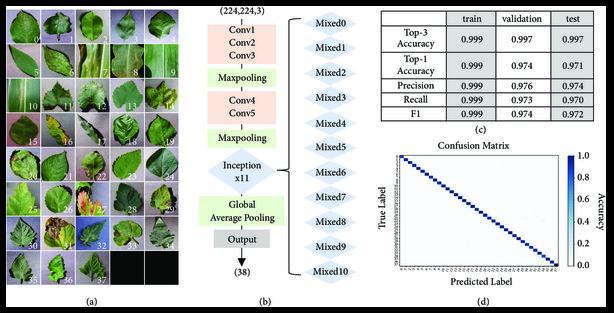
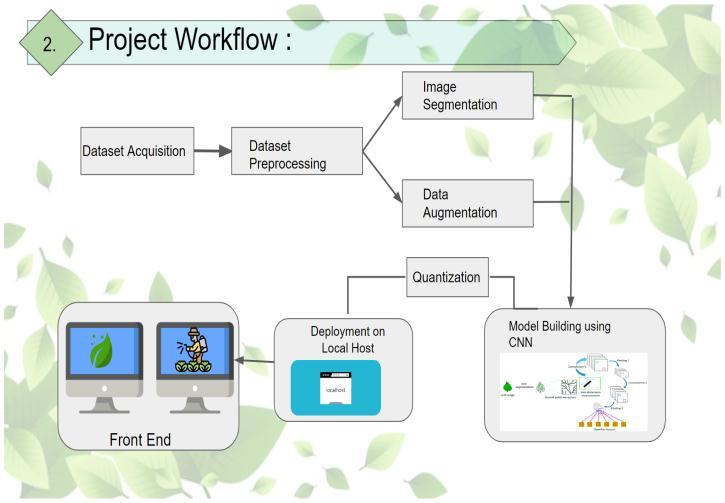
(4) Developed model will be deployed on the Android Application with help of TensorFlow lite. 4. CONVOLUTIONAL NEURAL NETWORK ARCHITECTURE (VGG-19)Fig..CNNArchitecture
A Convolutional Neural Network has three layers: a convolutional layer, a pooling layer, and a fully connected layer.Fig2showsalllayerstogether.
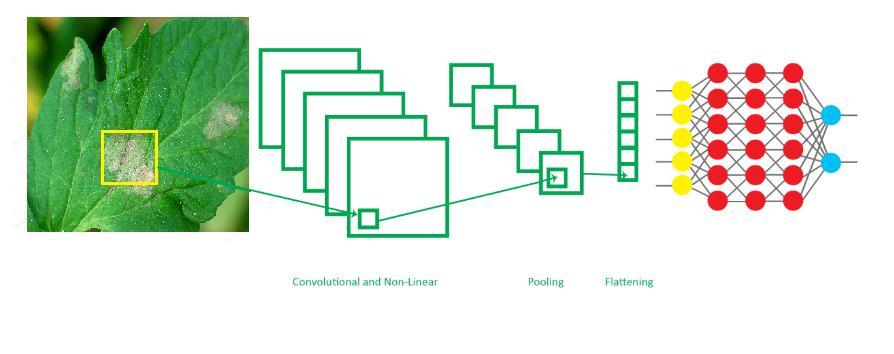
1)Convolution Layer Convolutional layer: produces an activation map by scanning the pictures several pixels at a time using a filter. Fig 3 shows the internal working of the convolutionlayer.Fig.3.ConvolutionLayer
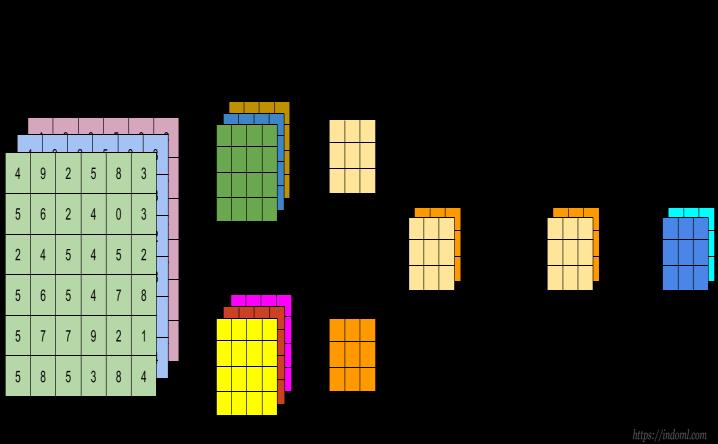
2)Pooling Layer Pooling layer: reduces the amount of data createdby theconvolutional layersothatit isstored more efficiently. Fig shows the internal working of the pooling layerFig..PoolingLayer.
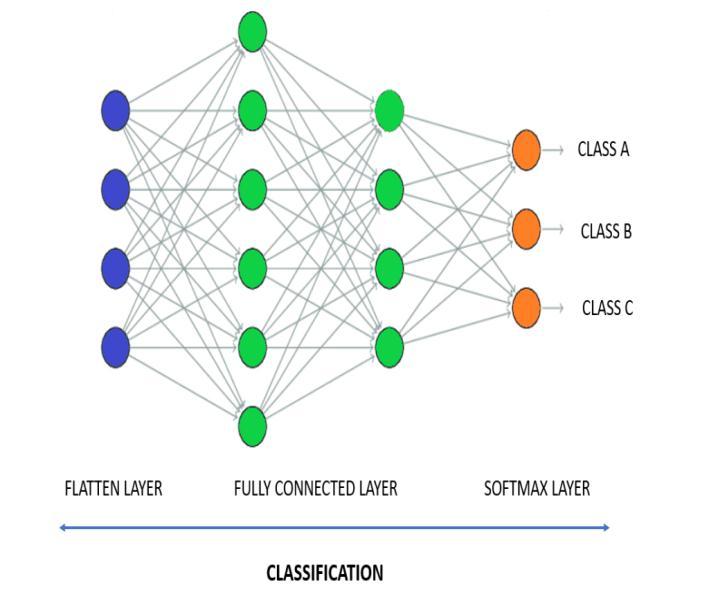
4)4.1:FullyConnectedLayerFullyconnectedinputlayer–The preceding layers' output is "flattened" and turned into asinglevectorwhichisusedasaninputforthenextstage.
4.2 : The first fully connected layer – adds weights to the inputs from the feature analysis to anticipate the proper label.
4.3 : Fully connected output layer – offers the probability foreachlabelintheend.Fig showstheinternalworkingof a fully connected layer is a sophisticated CNN with pretrained layers and a thorough grasp of how an image is definedintermsofform,color,andstructure.CNNisadeep neuralnetworkthathasbeentrainedonmillionsofphotos withchallengingclassificationproblems.
Providing Solution Approach
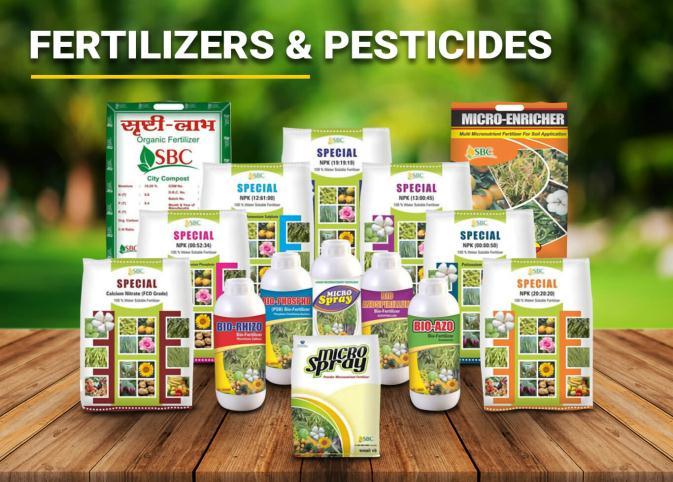
Successful detection of disease is the first step of the process. More important part is to provide and implement prevention methodology to stop further harm to the crop. Thiscanbedonebyusingproperfertilizersandpesticides.
Collaborative filtering methods
Collaborative methods for recommender systems are methods that are based solely on the past interactions recordedbetweenusersanditemsinordertoproducenew recommendations.
Content based methods
Content based methods suffer far less from the cold start problemthancollaborativeapproaches:newusersoritems can be described by their characteristics (content) and so relevantsuggestionscanbedoneforthesenewentities.
To reduce complexity and make providing solutions easy we can develop our own page for each disease which will also contain videos and other website links to get proper andfurtherimplementationmethodology.
Fig. 10: FullyConnectedLayer
Steps :
1. ImportLibraries.
2. Loadtrainandtestdataintoseparatevariables.
3. Function to Get count of images in train and test data.
4. Viewnumberofimagesineach.
5. Pre-processingourrawdataintousableformat.
6. Generating augmented data from train and test directories.
7. DiseasesNames/classes.
8. BuildingCNNmodel
9. Visualizationofimagesaftereverylayer.
10. StartTrainingCNNwithParameters.
11. SavingModelweights.
12. Predictions
13. FertilizerSuggestion
11: Fertilizerandpesticidesuggestion
Result
A?%accuracyratewasachievedusingearlystoppingwhile Training the model on ? epochs. Figure ? depicts the visualizationoftrainingandvalidationaccuracy.Theresult of detecting and recognizing a plant is shown in Figure ? . On the left, a healthy plant leaf, and on the right, a sick infected plant. The result of detecting and recognizing a potatoplantisshowninFigure?.Ontheleft,ahealthyplant leaf,andontheright,asickinfectedplant.
Conclusion
We are profitable in developing ailment classification methods used for plant leaf ailment detection. A deep gettingtoknowmannequinthatcanbeusedforautomated detectionandclassificationofplantleafillnessesiscreated. More than 5 species on which the proposed mannequin is tested. 38 instructions of vegetation had been taken for identificationvia thiswork. Throughthis, wehave beenin a position to do image-processing tasks. We have been additionally capable to create the convolution neural community mannequin which is a superior convolution mannequin and instruct the mannequin with the facts for prediction. The prediction achieved by means of our mannequin is nearly correct. We have effectively deployed thesefashionsonthestructureofawebsite.
Future Use
Moreuseandtrainingofthemodelwithacomplexdataset will improve the accuracy of prediction. This will provide an efficient solution to the farmers. Also improved and more researched fertilizer suggestions will provide more beneficiary to the end user. Moreover if this project also gets support of hardware pathology components that will addtremendousnewimplementationandusefulnessinthe project.
Finally, it is well worth noting that the method introduced right here is no longer meant to substitute present options forailmentdiagnosis,howeveralternativelytocomplement them. Laboratory assessments are in the end continually extradependablethandiagnosesprimarilybasedonvisible signs and symptoms alone, and typically early-stage prognosis by visible inspection by myself is challenging. Nevertheless, given the expectation of extra than 5 Billion smartphones in the world with the aid of 2030 of which nearly a Billion in Africa we do trust that the strategy represents a potential extra approach to assist forestall yield loss. What's more, in the future, photo information fromasmartphonemayadditionallybesupplementedwith area and time records for extra upgrades in accuracy. Last but notleast,it would be prudentto holdin your mind the lovely tempo at which cell science has developed in the previous few years, and will proceed to do so. With ever enhancing variety and exception of sensors on mobiles devices, we reflect on the possibility that distinctly correct diagnoseswiththeaidofthesmartphonearesolelyaquery oftime.
References
[1]https://www.itmconferences.org/articles/itmconf/abs/2022/04/itmconf_ic acc2022_03049/itmconf_icacc2022_03049.html
[2]Agriculture|AnOpenAccessJournalfromMDPI
[3]Frontiers | Convolutional Neural Networks for the Automatic Identification of Plant Diseases (frontiersin.org)
[4]https://towardsdatascience.com/crop-plant-diseaseidentification-using-mobile-app-aef821d1a9bc
[5]https://www.ncbi.nlm.nih.gov/pmc/articles/PMC38186 07/
[6](PDF)ArtificialIntelligenceinAgriculture:AnEmerging EraofResearch(researchgate.net)