1
International Research Journal of Engineering and Technology (IRJET) e-ISSN:2395-0056

Volume: 10 Issue: 04 | Apr 2023 www.irjet.net
1
International Research Journal of Engineering and Technology (IRJET) e-ISSN:2395-0056
Volume: 10 Issue: 04 | Apr 2023 www.irjet.net
Abstract - The world will generate 2.59 billion tonnes of waste every year by 2030. Within this waste, organic waste is emerging as a significant contributor to climate change as the world’s demand for food rises. Landfills are a common management technique but cause groundwater pollution, disturb ecosystems and cause health problems in surrounding residential colonies. Apart from other common and safe ways to manage raw organic waste including composting,biofuelsetc.,GarageEnzymeorEcoEnzyme is a viable option. It is made from the fermentation of raw organic waste with water and organic sugar. It has applications ranging from wastewater treatment to soil treatment and disinfection. This theoretical study surveys the materials, methods and properties of eco enzyme solution. It then goes on to review various applications of eco enzyme solution. Further, the limitations are discussed along with the future scope of this solution in solving ecologicalproblemsoftheworld.
Key Words: Garbage Enzyme, Eco Enzyme, Solid Waste Management, Wastewater Treatment, Environmental Engineering
Organic waste management is becoming one of the major challengesinthepostindustrialera.Globalfoodwasteand loss is responsible for 8% of GHG emissions annually [1]. About60%ofallfoodwastedaroundtheworldismadeof fresh fruit and vegetable waste which is generated through production, processing, eating, cooking, peeling andcuttingactivitiesbyFMCGcompanies,restaurantsand households. About 80% of this waste can be reused since ithasfibercontent,moistureandothernutrients.[2]
Itendsupinlandfillswhicharehazardousforresidencies and also produce toxic leachate which can degrade groundwater. The organic waste in these sites is acted upon by bacteria which produces a gas 25 times more potentthancarbondioxide:methane.Therefore,alternate methodsarebeingresearched.
Garbage enzyme is an organic solution produced by the fermentationoffreshkitchenwaste,organicsugar(brown sugar, jaggery, molasses etc.) and water. It has the potentialtosolvetheenvironmentalchallengesofthe21st centuryinacost-effectivemanner.
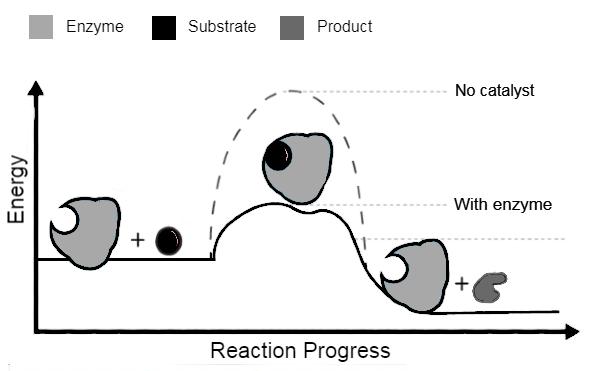
Protein molecules in the bodies of living beings that catalyze chemical reaction are known as Enzymes. They act as biological catalysts and catalyze only specific molecules(substrates).Theyprovidetherightorientation andsurfaceareaforthereactants,thusreducingactivation energy. They themselves remain unreacted during the reaction. Enzymes are used in many industries including foods, beverages, detergents, textiles, leather, chemicals, biomedical etc. Theamylasesarea group of enzymesthat hydrolyze starch molecules to generate smaller polymers composed of glucose units. They are already well known to enhance the treatment of starch containing food wastewaters. Proteases are known to solubilize proteins in waste streams resulting in residue solids used for animalfodder(forcattleandfishes).Lipasehasbeenused forpreventionoffat blockageorfilmingin wastesystems before discharging wastewater into the sewage system. Slaughterhouse wastewater, which is rich in fats, has also beentreatedwithlipasegroupofenzymes.
MicrobialFermentationprocessiscommoninbiochemical engineeringtoproduceenzymesonalargerscale.
Scale-up is required which is achieved by fermenters of differentvolumes.
Fermentation is the metabolic process of breakdown of complexsugarintosimplerones.
Along with photosynthesis and aerobic respiration, fermentationisawayofextractingenergyfrommolecules. During fermentation, due to a lack of complex digestive systems, microbes pre-digest the potential food source such as organic and inorganic materials outside their cell boundaries first. To achieve this pre-digestion, microbes excrete enzymes through their outer membrane with its supportive cell wall into the environment. [3] Microbes canbemadetoproducelargequantitiesofenzymesunder suitable growth conditions. They can be cultivated by usinginexpensivemediaandproductioncantakeplacein ashortperiodoftime.
Raw organic waste is a well-known non edible source of lipids, amino acids, carbohydrates, and phosphates. Biomass contains 30–50% of cellulose, 20–40% of hemicellulose and 10–15% lignin. Cellulose is the main assembly of lignocellulosic biomass which is a glucose polymer. Duringfermentationof waste, afterglucoseand other simpler sugars are produced, the process continues till ethanol is produced by the action of yeast called Saccharomyces Cerevisiae. Further, ethanol is oxidized intoaceticacidbytheAcetobacterAcetigroupofbacteria [4]. The end result is a multipurpose solution which can work as a cleaner, insecticide, pesticide and organic fertilizer. It can be used for pre-treating wastewater and preventingdrainblockagesaswell.
Organic Sugar (brown sugar, jaggery, molasses etc.), raw organic materials (Fruit and vegetable peels, petals, fresh leaves etc.) and water are mixed together in the ratio of 1:3:10toprepareGarbageEnzyme.
Extra sugars are provided externally because as the microbial colonies grow, they need more energy to digest complex food sources. Organic sugars are preferred over refined sugars because of high mineral content which servesasfoodformicrobialfermentation.Useofmolasses may be better compared to other sugar sources. This is because molasses sugar is the unwanted substance from sugar production that contains microorganisms. Due to the presence of these microorganisms, the organic matter infruitwastesisfurtherandfasterdecayed.[5]
Themixingprocessisdoneinanair-tightplasticcontainer whichisabletoexpand.Duringthefirstmonth,gassesare released during the fermentation process. Pressure built up in the container is released daily or in two days to avoidrupturingforthefirstmonth.
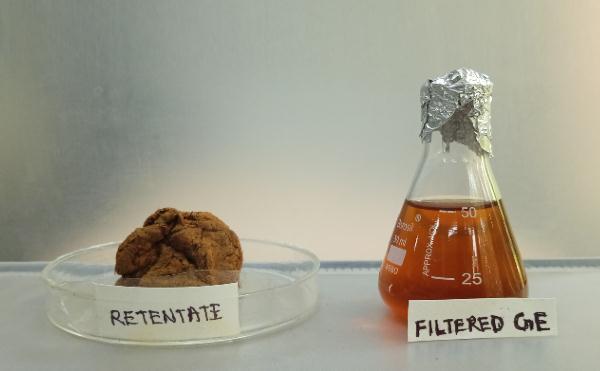
The container is left undisturbed in a cool, dry and wellventilated place. It is left to ferment for 3 months to produce GE solution. The fermentation yields a brownish
liquid, which is separated from the solids. The solution is filteredafter3monthstoobtaintherequiredsolution.[3]
ThecolorofGEisdarkbrownbutthetypeofrawmaterial used could be responsible for change in color and odor. Use of more vegetable peels makes it smell pungent comparedtofruitpeels,whichleaveafragrantsmell.
Chemical analysis indicates 0.15 ml/ml of alcohol content and 4.8 g/ml acetic acid on an average along with the presence of majorly Amylases, Lipases and Proteases groups of enzymes. Depending on the type of peels used, other enzymes in small quantities may be found (Papain enzymefrompapayapeeletc.).[6]
Biological analysis of GE indicated probable presence of bacteria and yeasts like Pseudomonas, Yersinia, A. niger, Trichoderma viride, Saccharomyces cerevisiae and Rhizopusstolonifera.Itispossiblethatafewotherspecies couldhavediedinanextremelyacidicenvironment.[6]
The quantitative aspect of parameters changes with time, type of organic waste and type of natural sugar used for fermentation.
80% or more wastewater returns to the environment without adequate treatment. Wastewater treatment methods mainly include physicochemical and biological methods. Physicochemical methods like chemical oxidation, distillation, membrane-based separation techniques, and adsorption work, but they are expensive and cause further pollution and damage. Biological methods are eco-friendly and remove most pollutants in wastewater. These methods use plants, microbes and enzymesfortreatingwastewater.[8]
Thedifferentphysicochemicaltreatmentslikeflocculation, chemical precipitation, coagulation, floatation, and membrane separation offer benefits like flexibility to changetemperature,thesimplicityofcontrol andactivity, and speed. They also have disadvantages, such as their operational expenses due to high energy utilization, the utilized chemical compounds, and costs for sludge removal. Therefore, Enzymatic processes can be a viable optionforpretreatmentofwastewater.
Enzymes act by dissociating the molecules to simpler forms and microbes utilize these intermediates in their metabolism, which results in complete degradation of substances. Microbes grow faster due to increase in availability of intermediates and therefore produce more enzymes which in turn degrade the substrate. This becomesacyclicprocess.
Extracellular polymeric substances bind microorganisms together and help in adhesion of biofilms to surfaces. Hydrolytic enzymes present in GE destroy the physical integrityofextracellularpolymericsubstancesorEPSthat leadstoweakeningofthewasteflock andsolidsettlingin wastewaterstreatedwithGE.
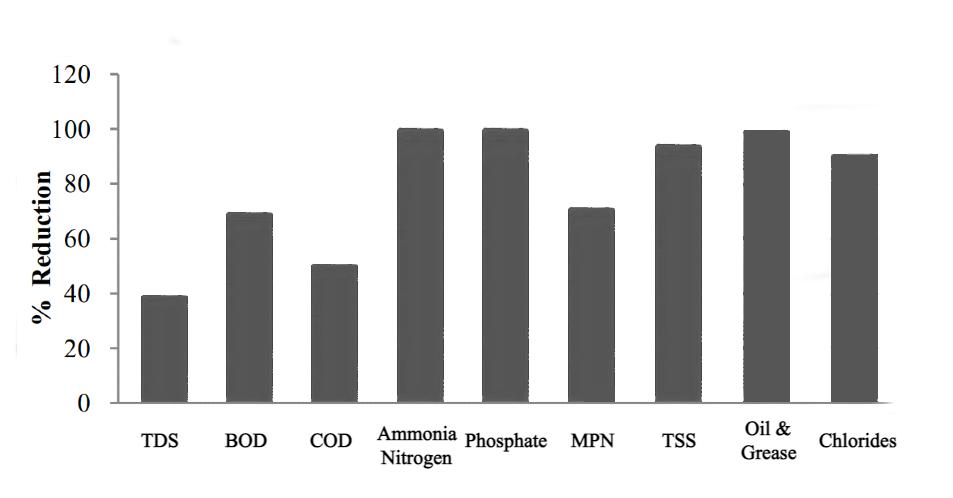
Chart -1:Commonpollutantsandtheirremovalfrom wastewaterusing10%GE(Dataplottedusing[3][9])
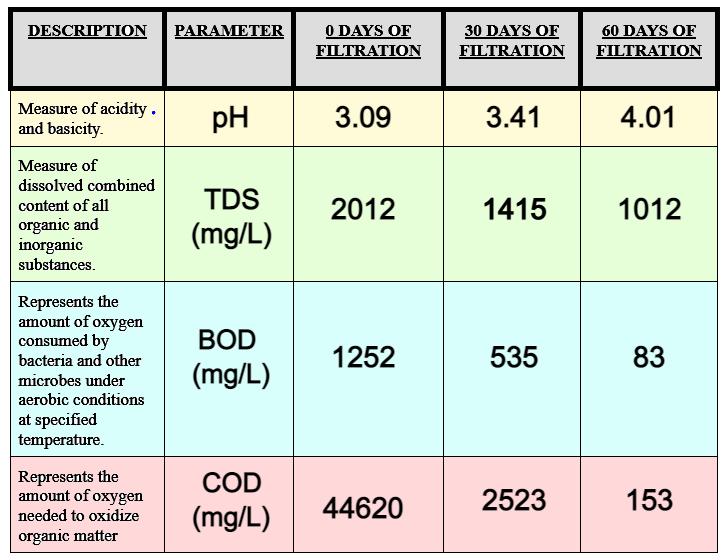
Garbage Enzyme has been successfully used to treat Greywater, Sewage Wastewater, Dairy Wastewater and Landfill Leachate. Treatment time for wastewater treated with GE varies from study to study and depends on how effective the GE solution is. Wastewater treatment time can be decreased if finely crushed organic waste is used for the preparation of enzyme solution, leading to better fermentation. Treatment time was found to be 5 days when enzyme is used 60 days after filtration as it takes time for the parametersin GEtostabilize.[3][7] Forother studies, the minimum treatment time was observed to be 25-27daysfromavailableliterature.
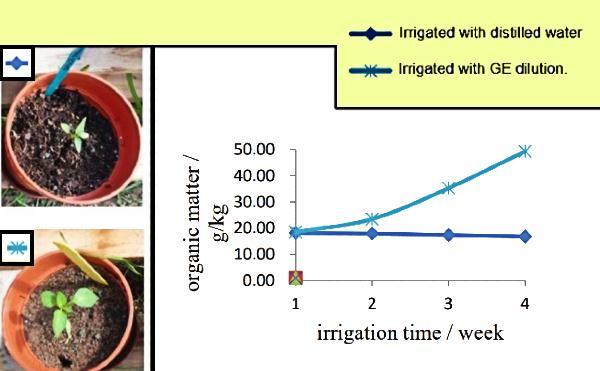
Eco-enzyme can be used as a natural fertilizer and biopesticide because the ingredient to make it is kitchen waste which is an organic material. The insecticide property is likely due to the pungent smell of acetic acid. The composition of GE also makes it suitable for agriculture. Brown sugar or molasses is a carbohydrate source which breaks into carbon, oxygen, and hydrogen whenitdecomposes.Theseserveasnutrientsforthesoil. Protein from vegetables decomposes to give nitrogen whichalsofertilizesthesoil.[10].
The results of a study show that the tendency of the best concentrationtoinfluencethegrowthoflettucecropis10 cc / L. Giving eco garbage enzyme solution gives a real increase in stem circumference, root growth, and dry weightofplants.[13]
SimilarResultshavebeenobservedforaloeveraandchili plants.[11]
Eco enzyme also displays cleaning properties. Acetic acid present in it is a good descaling agent that removes limescale.Removalofstainsandoilblotscanbeattributed totheactivityoflipaseenzyme.
The antimicrobial potential of garbage enzyme for four microorganisms was measured by the zone of inhibition aroundthediscplacedontheinoculatedagarplate.When comparedwithcontrolstandards,thebacterialandfungal zone of inhibition for 15% garbage enzyme solution was higherthanreferences.
Disinfectant potential of garbage enzyme was compared withphenol.Theresultindicatedthatthegarbageenzyme can be diluted four times as much as phenol, till attaining equivalent killing power for the test organism as that of phenol.[5]
Another real-life study showed that the concentration of eco enzyme at 50% and above exhibited significant antibacterialactivityagainstEnterococcusfaecalis.
Enterococcusfaecalisisoneofthemostcommonbacterial species. These bacteria also live in the mouth and reproductive tract of humans. They are resistant to hot, salty,oracidicenvironments.[14]
These studies show that Eco Enzyme is a powerful disinfectant. Along with the role of enzymes in breaking microbial flocks as mentioned above, acetic acid also contributes to the antimicrobial properties of Garbage Enzyme. Acetic acid crosses bacterial cell membranes because of the pH gradient, leading to the disruption of cellularmetabolicactivitiesofbacteria.
Ecoenzymeisamultipurposeliquidwhichcostsabout3-4 times less when compared to commercial cleaning agents and can be made at a fraction of the cost of industrial fertilizersandinsecticides.Ithasthepotentialtosolvethe problems of solid waste management and therefore climatechange.Itis,initself,completelybiofriendly.
On the other hand, studies show that metal ions such as Ca2+, Na+ and K+ was overall not affected in terms of reductionoftheionsthemselves.Thiscouldpotentiallybe duetothenaturalpropertiesofenzymesthatdonotreact withthemetaltoformasecondaryproduct.Thisrestricts theusageofecoenzymes.[15]
Thereare plentyof studies on batchscaleproductionand utilizationofgarbageenzymesbutastableandcontinuous method of production on an industrial scale is still to be seen. There is a need to determine the exact molecular mechanism of GE so that similar and more effective solutions can be developed using solid waste. Also, additives need to be discovered which reduce the fermentationperiod.Thesefactorswhencombinedhinder entrepreneurialactivities.
The real success of eco enzyme lies in its ability to empower the cottage industries. Other than technical challenges, eco enzyme still faces major challenges. There is still a lack of awareness and therefore very little demand and production. Waste segregation into organic and non-organic waste is only seen in the metropolitan households of developing countries. Fruit juice vendors and small eatery operators see no incentive in selling organicwastetocommercialfacilities.Utilizationofwaste to resources for commercial activity is still not exempt fromtaxesinmanycountries.
The municipal corporations in developing countries can actively participate in the collection and segregation of organic waste as well as in the production and selling of GEtofarmersandhouseholdsataneconomicalprice.
[1] M. Crippa, E. Solazzo, D. Guizzardi, F. MonfortiFerrario, F. Tubiello and A. Leip, "Food systems are responsible for a third of global anthropogenic GHG emissions", Nature Food, vol. 2, no. 3, pp. 198-209, 2021.Available:10.1038/s43016-021-00225-9.
[2] A. Nandan, B. P. Yadav, S. Baksi, and D. Bose, “Recent Scenario of Solid Waste Management in India,” World Sci News, vol. 66, pp. 56–74, 2017,Available: www.worldscientificnews.com
[3] Fazna Nazim and V.Meera, “Treatment of Synthetic Greywater Using 5% and 10% Garbage Enzyme
Solution Bonfring,” Dec. 2013, doi: 10.9756/BIJIEMS.4733.
[4] M.M. Khandaker, U.A. Abdullahi,M.D.Abdulrahman, N. A. Badaluddin, and K. S. Mohd, “Bio-Ethanol Production from Fruit and Vegetable Waste by Using <em>Saccharomyces cerevisiae</em>,” Bioethanol Technologies, Nov. 2020, doi: 10.5772/INTECHOPEN.94358.
[5] C. Arun and P. Sivashanmugam, “Investigation of biocatalytic potential of garbage enzyme and its influenceonstabilizationofindustrialwasteactivated sludge,”ProcessSafetyandEnvironmentalProtection, vol. 94, no. C, pp. 471–478, Mar. 2015, doi: 10.1016/J.PSEP.2014.10.008.
[6] S. Sarabhai, A. Arya, and C. Arti Arya, “Garbage enzyme: A study on compositional analysis of kitchen waste ferments,” ~ 1193 ~ The Pharma Innovation Journal,vol.8,no.4,pp.1193–1197,2019, Available: www.thepharmajournal.com
[7] A.Kumar, H. K. Sadhya,Dr. E.Ahmad,and S. Dulawat, “Application of Bio-Enzyme in Wastewater (Greywater) Treatment,” MATTER: International Journal of Science and Technology, vol. 4, no. 2, pp. 12–26,Jul.2020,doi:10.20319/MIJST.2018.42.1226.
[8] S. Feng et al., "Roles and applications of enzymes for resistant pollutants removal in wastewater treatment", Bioresource Technology, vol. 335, p. 125278, 2021. Available: 10.1016/j.biortech.2021.125278.
[9] A.Joseph,J.Joji,N.Prince,R.Rajendran,D.Nainamalai and D. M, "Domestic Wastewater Treatment Using Garbage Enzyme", SSRN Electronic Journal, 2020. Available:10.2139/ssrn.3793057.
[10] L.W.Arifin,A.Syambarkah,H.S.Purbasari,R.Ria,and V. A. Puspita, “Asian Journal of Food and AgroIndustry Introduction of eco-enzyme to support organic farming in Indonesia,” As. J. Food Ag-Ind, pp. 356
359,2009,[Online].Available:www.ajofai.info
[11] M. Hemalatha and P. Visantini, "Potential use of ecoenzymeforthetreatmentofmetalbasedeffluent",IOP ConferenceSeries: MaterialsScienceandEngineering, vol. 716, no. 1, p. 012016, 2020. Available: 10.1088/1757-899x/716/1/012016.
[12] Yujie Tong and Bingguang Liu, “Test research of different material made garbage enzyme’s effect to soil total nitrogen and organic matter,” IOP Conf Ser Earth Environ Sci, pp. 1–6, 2020, doi: 10.1088/17551315/510/4/042015.
[13] I. M. S. Ni Wayan Yuliandewi, “Utilization of Organic Garbage as ‘Eco Garbage Enzyme’ for Lettuce Plant Growth (Lactuca Sativa L.),” International Journal of Science and Research (IJSR), vol. 7, no. 2, pp. 1521–1525, Feb. 2018, [Online]. Available: https://www.ijsr.net/archive/v7i2/ART2018367.pdf
[14] H. A. K. Mavani et al., “Antimicrobial Efficacy of Fruit Peels Eco-Enzyme against Enterococcus Faecalis: An InVitroStudy,”IntJEnvironResPublicHealth,vol.17, no. 14, pp. 1–12, Jul. 2020, doi: 10.3390/IJERPH17145107.
[15] L. C. Wen, R. L. Z. Ling, and S.-S. Teo, “Effective Microorganisms in Producing Eco-Enzyme from Food Waste for Wastewater Treatment,” Applied Microbiology: Theory & Technology , pp. 28–36, May 2021,doi:10.37256/AMTT.212021726.