Renewable Energy Driven Optimized Microgrid System: A Case Study with Hybrid Solar PV- Battery Storage- Thermal Storage
 Sachin Bhimrao Takale1 , Dr. Sandeep Joshi2 ,
1Student, Dept. of Mechanical Engineering, Pillai College of Engineering, Maharashtra, India
2Professor, Dept. of Mechanical Engineering, Pillai College of Engineering, Maharashtra, India
Abstract - A renewable energy driven microgrid system can be designed by integrating with optimally sized renewable energy source such as Solar PV with Battery EnergyStorageSystem(BESS)andThermalEnergyStorage System (TESS). Microgrids integrate Renewable energy source with the other energy mix intelligently. They seamlessly balance the variable output of renewable energy with traditional generation assets. In doing so, the microgrid overcomes the downside of solar energy as they only generate power when the sun shines without any human intervention. In this research study the attempt is made to carry out design engineering of Hybrid Microgrid System to meet Thermal and Electrical demands of the building in optimized and cost-effective way. The design philosophy, Greenhouse gas emission reduction and operating cost savings are demonstrated as the outcome of thisstudy.
Key Words: Microgrid, Hybrid Microgrid, Battery Energy Storage, Thermal Energy Storage, Solar PV and Energy Efficiency.
1. INTRODUCTION
DistributedenergygenerationthroughMicrogridrefersto a variety of technologies that generate electricity at or nearwhereitisused(enduseareas),suchassolarpanels and combined heat and power. When connected to the electric utility’s lower voltage distribution lines, distributed generation from Microgrid can help support delivery of clean, reliable power to additional customers and reduce electricity losses along transmission and distributionlines.
Microgrid provides better power transmission efficiency, power quality, reliability, and security for end users with reduced operating cost. While doing this it also helps to minimize carbon footprint and greenhouse gas emissions bymaximizingcleanlocalenergygeneration.
To work, micro-grids must include three essential components:
1. Locally produced energy: to ensure they can operate independently in the event they are disconnected(photovoltaicpanels,windturbines,
cogeneration, heat pumps, biomass plants, hydroelectric turbines, etc.) and an additional back-upsupplyofenergy(powergenerators).
2. A storage system: batteries, a supply of water for pumped-storage hydroelectricity and, in the future, super-capacitors and a chemical based latent-heatstoragesystem.
3. A smart management system: to ensure the continuous balance between electricity generationanddemand.
A microgrid connects to the grid at a point of common coupling that maintains voltage at the same level as the maingridunlessthereissomesortofproblemonthegrid or other reason to disconnect. A switch can separate the microgrid from the main grid automatically or manually, anditthenfunctionsasanisland.
2. LITERATURE REVIEW
Ali Saleh Aziz et al. [1] have done the research on Feasibility analysis of grid-connected and islanded operation of a solar PV microgrid system: A case study of Iraq. They used simulation tool as HOMER software for theirstudy.Theyconcludedthatimplementingthissortof project can provide clean, economical, and continuous electricityproductionincountrieswithdailyblackouts.
S Devassy, B Singhn et al. [2] have done the research on Performance Analysis of Solar PV Array and Battery Integrated Unified Power Quality Conditioner for Microgrid Systems. It was experimentational study on existing system. They concluded that their research outcome addresses the issue of the integrating power quality improvement along with the generation of clean energy.
Furat Dawood et al. [3] havedonetheresearchonStandAlone Microgrid with 100% Renewable Energy: A Case Study with Hybrid Solar PV-Battery-Hydrogen. They used Homer Pro Software for their research. They concluded that that the proposed hybrid energy systems have significant potentialities in electrifying remote communities with low energy generation costs, as well as
a contribution to the reduction of their carbon footprint and to ameliorating the energy crisis to achieve a sustainablefuture.
Andrew Bilich et al. [4] have done the research on Life CycleAssessmentofSolarPhotovoltaicMicrogridSystems inOff-GridCommunities.Itwastheorybasedanalysisand studied Solar PV & BESS based Microgrid system. They concluded that there is significant potential for PV microgrids to be feasible, adaptable, long-term energy access solutions, with health and environmental advantagescomparedtotraditionalelectrificationoptions.
Mashood Nasir et al. [5] havedonetheresearchonSolar PV-BasedScalableDCMicrogridforRuralElectrificationin Developing Regions. It was theory-based analysis and studied Solar PV DC Microgrid system. They concluded that proposed highly distributed off-grid solar photovoltaic dc microgrid architecture suitable for rural electrificationindevelopingcountriesanditissuperiorin comparison with existing architectures because of its generation and storage scalability, higher distribution efficiencyandlocalizedcontrol.
Jakir Hossain et al. [6] have done the research on Modelling and Simulation of Solar Plant and Storage System - A Step to Microgrid Technology. It was Simulation basedanalysisbyusingMatlab/Simulink and studied Solar PV & BESS based Microgrid system. They concluded for both the cases of islanded mode and gridtied mode operation, the performance of the microgrid systems along with the storage unit have been analyzed for the different parameters. All the simulation results have been demonstrated on the virtual platform such as Matlab/Simulink.
3. MICROGRID DESIGN – CASE STUDY
To evaluate the feasibility of proposed Microgrid and present optimized design engineering methodology, a campusofPillaiCollege ofEngineering,New Panvel (Navi Mumbai) has been taken as a case study. The facility consists various energy guzzlers in the form of HVAC system, lighting, Appliances like computers, Printers & workshop equipment’s and 75 kWp DC Rooftop Solar PV (SPV). Load profile of the campus is generated from load sheetdetailsandoneyearelectricitybillsdata
To develop this Microgrid with the objective of reaching towards Net Zero Energy (NZE) consuming building, emphasisisfirstlygivenonsignificantreductionofenergy consumption, predominantly in HVAC system approx. by 50%asHVACloadformsalmost50%oftotalfacilityload.
Proposed replacement of existing Air-cooled Split ACs of total capacity of 200TR with poor specific power consumption 1.35 kW/TR by water cooled central chilled
watersystemwithThermalEnergyStorageSystem(TESS) with the objective of better specific power consumption, 0.70kW/TRyearlyaveragechillerplantefficiency.
After reduction of energy use, emphasis is given towards switching to renewableenergyto meet balance electricity demand with storage. This approach has resulted in significantly reduction in capital investment for SPV & Battery Energy Storage System (BESS) due to their size reduction and thus makes this concept economically sustainable
TheenergyvectorforproposedMicrogridsystemconsists ofsuitablysizedSPV,BESSandTESS.
LoadafterHVACSystemOptimisation
With energy efficiency measures 150,000 kWh consumption reduced which results in facility’s total balancecumulative yearly loadof770,000kWh. Thepeak loaddroppedto250kWfromearlier300kW.
Shift of HVAC Night Load to Day Time by using TESS
To make highest use of generated Solar PV energy during daytime, HVAC night load shift is proposed to daytime by using TESS. TESS shall be charged during daytime and discharged during nighttime to meet night cooling load. With this strategy the size of BESS will be significantly reduced as it will not include HVAC load which forms majorloadoftotalenergydemand.Totalnighttimecooling load is 169 TR and corresponding power consumption shallbe208kW
Histogram showing typical nighttime cooling load is depicted below. This load profile shall be used for TESS systemsizing.
Nighttime cooling through TESS & Day time charging operationisshowninabovegraph.
TESS Charging time: 1.00 pm to 4.00 pm and TESS Dischargingtime:6.00pmto6.00am.
PeakNighttimehourlycoolingload:13TR
OperationTimeorCoolingdemand:13Hrs
Watercooledscrewbrinechillercapacity:50TR(1W)
TotalStorageCapacityofTESS:225TRH
TotalPlateHeatExchangerCapacityRequired:50TR
PrimarysideBrineIn/outTemp:-2/-5.5DegC
SecondarysidechilledwaterIn/outTemp:12/7DegC
Shift of Night Load to Day Time by using BESS
To meet the night load by using renewable energy it is proposed to use Battery Energy Storage System. BESS shall becharged during daytime byusing SPV system and discharged during nighttime to meet night load excluding coolingloadwhichshallbecateredbyusingTESS.
PeakNighttimehourlyelectricalload:163kW
BESSDischargeHoursperday:15Hrs
BESSChargeHoursperday:9Hrs
BESSUsefulEnergyStoragecapacity:715kWh
BESSInverterCapacity:200kW
BESSCyclesofOperation:1cycle/day
Application:LoadShifting
TypeofBESS:LithiumPhosphate
BESSsystemoutputvoltage:415VAC
Use of SPV and BESS to meet the total electrical load the of facility.
The optimized size of SPV system shall cater total electrical demand of the facility with BESS and TESS. Yearly average hourly existing (current) load profile, load profile after energy efficiency measures, BESS and TESS charging discharging profile, and coincidental solar generation is depicted in below table. This data forms the basis of high-level performance of proposed Micro-grid system.
With the installation of 500 kWp, the total available energywouldbe743,000kWhannually.
At most of times, the solar power will be utilized to cater tothefacilityload,however,intheanalysissomecurtailed power (excess energy) was indicated in the analysis. As per the analysis, the total excess solar energy (unused energy) is around 61,600 kWh which is 8.2% of the total solar energy generated. With respect to effective PV utilization the renewable energy share would be 90 % of the total plant load including curtailment losses from proposedMicrogridSystem
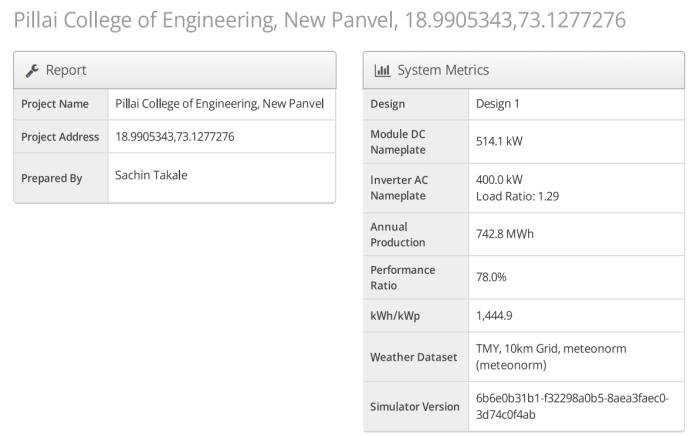
Solar PV System Sizing through Helioscope Simulation
possibleasfromdesignedsolarPVsystem.Theforecasted performanceratioofsolarPVsystemasdepictedfromthis simulationis78%
4. FEASIBILITY ANALYSIS
Commercial feasibility analysis of proposed Microgrid system is done by comparing cost required for new installation of microgrid system versus current operating cost of existing conventional system. Existing system means the total power demand to meet facility load is drawnfromgridandDGoperationincaseofGridfailure.
Simulation of selected results for Base case Vs ProposedMicrogridScenarios
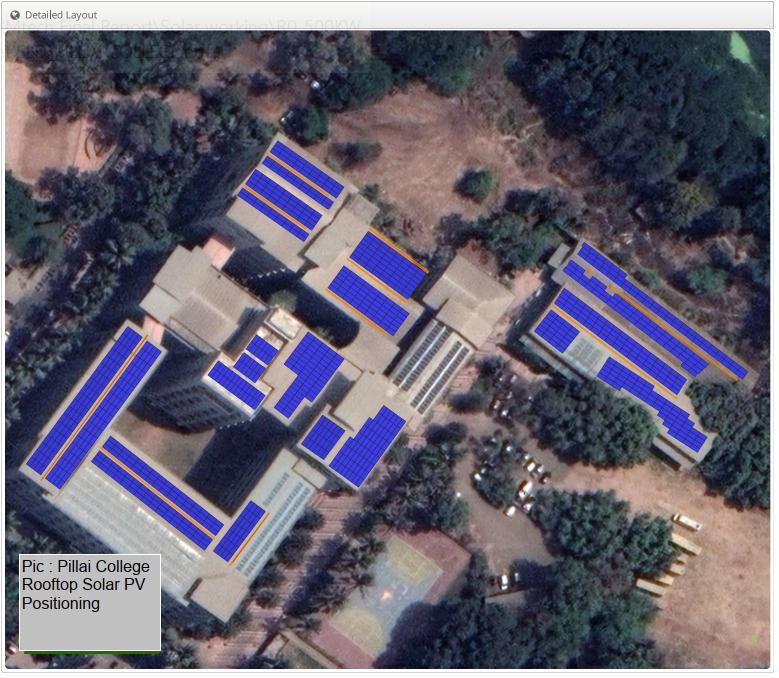
The proposed new solar PV modules of total 500 kWp capacityareshowninbluecolor.
ThetotalrequireddesignsolarPVcapacityis514kWpDC. The cumulative maximum AC output from string inverter is 400 kW. The yearly solar generation of 742.8 MWh is
5. CONCLUSIONS
The evaluation of proposed Micro-grid system demonstrated that the hybrid BESS-TESS based Renewable Energy system is a favorable and innovative approach for designing towards Net Zero Energy consuming, renewable energy-based Microgrid systems especially for facilities located in Metropolitan regions with high electricity tariff rate and for those establishments who have set aggressive decarbonization goals. The simulation results of this proposed system discoveredthatithastheveryminimumcarbonemissions alongwiththeprojectlifetimeof15years.
Additionally, it is significantly cost-effective solution comparedto100%Batteryenergystorage-basedsolution. The promising simple payback period of 5.0 years makes this system a highly prospective and cost-effective option for the transition towards 100% renewable energy based Microgridsystems.
6. FUTURE SCOPE
Furthermore,evaluationisrequiredforoptimalutilization of excess or shortfall in solar PV output considering seasonal changes at micro level to develop 100% renewabledrivenMicrogridwithminimumenergylosses.
Refined control logics for seamless operation of proposed solarPVandhybridstoragesystem.
REFERENCES
[1] Ali Saleh Aziz et al. Feasibility analysis of gridconnected and islanded operation of a solar PV microgrid system:AcasestudyofIraq;2020
[2] S Devassy, B Singh, Performance Analysis of Solar PV Array and Battery Integrated Unified Power Quality ConditionerforMicrogridSystems;2020
[3]FuratDawood etal.Stand-AloneMicrogridwith100% Renewable Energy: A Case Study with Hybrid Solar PVBattery-Hydrogen;2020
[4] Andrew Bilich et al Life Cycle Assessment of Solar Photovoltaic Microgrid Systems in Off-Grid Communities; 2017
[5] Mashood Nasir et al., Solar PV-Based Scalable DC Microgrid for Rural Electrification in Developing Regions; 2017
[6] Jakir Hossain et al. Modelling and Simulation of Solar PlantandStorageSystem:ASteptoMicrogridTechnology; 2017