Endangered Species Conservation
Rishita Shekapure, Shreya Sawant, Shrutika Kadam, Sakshi Chaudhari Prof. S.N Chaudhari Computer Engineering Department, Datta Meghe College of Engineering, Navi Mumbai ,Maharashtra , India.Abstract - In recent years, the biodiversity of the planet has been disappearing at an unprecedented rate. Several species are close to going extinct, thus it's important to protect the populations that still exist. It is possible to consistently observe animals in their natural settings and determine the effect of temperature in animal conservation. The use of automatic hidden cameras for wildlife monitoring has increased dramatically in the modern world due to its efficiency and dependability in capturing data on animals in large volumes, more effectively, and without operator interference. Yet, it can be time-consuming and exhausting to manually analyze and extract information from such enormous datasets obtained by camera traps. challenging procedure. For ecologists and biologists who want to watch wildlife in its native habitat, and make conclusions about the future state of animals. This presents a substantial obstacle. We have reviewed all recent works on deep learning-based animal detection and identification in the field. By examining numerous publications, authors have discovereda method of compiling all the data on all the endangered species and how temperature affects them, and then making predictions to determine the count of animals with changein temperature over future years.
Keywords: Automatic hidden cameras , Natural settings, Temperature,Futurecount.
1.INTRODUCTION
As our planet continues to face the challenges of climate change, habitat loss, and human activity, many animal species are struggling to survive. Endangered species are those that are at risk of extinction, and their conservation is a critical priority for scientists, policymakers, and conservationistsaround the world. Machine learning is a powerfultoolthatcanhelpusbetterunderstandthethreats facing endangered species and develop effective strategies for their protection. By analyzing large datasets of species populations, habitat characteristics, and environmental variables, machine learning algorithms can identify patterns and relationships that may not be apparent to humananalysts.
However, monitoring and protecting endangeredspecies canbea dauntingtask,especiallyforspecies thatare rare, elusive, or inhabit remote areas. Traditional methods of monitoring, such as field surveys, can be time-consuming, expensive,andmaynotprovideaccurateorreal-timedata.
In recent years, there has been a growing interest in using machine learning algorithms to monitor and protect endangered species. Machine learning is a subfield of artificial intelligence that allows computers to learn from data and make predictions or decisions without being explicitlyprogrammed.
Machinelearningalgorithmscanhelpovercomesomeofthe challenges of monitoring endangered species. Machine learningalgorithmscananalyzelargeamountsofdatafrom various sources, including satellite imagery, acoustic recordings,andcamera traps, toidentify,track andmonitor endangered species. Machine learning algorithmscan also be trained to recognize patterns and anomalies in data, which can be useful for detecting changes in species populationsorhabitats.
Also the importance of Temperature change in Animal disappearance cannot be ignored. By building this project we are also emphasizing the effect of temperature change on animal counts in the future years. Using the CNN approach we are also providing the much needed User interfaceforrecognitionandclassificationoftheseanimals.
In this analysis of endangered species using machine learning,we will explore thepotential of thistechnologyto improve our understanding of these species and their habitats.Wewill lookat casestudies ofsuccessful machine learning applications, examine the challenges and limitations of this approach, and discuss future directions for research and conservation efforts.
Ultimately, we hope to demonstrate how machine learning can be a valuable tool in the fight to protect endangered speciesandpreservebiodiversityforfuturegenerations.
2. LITERATURE SURVEY
Michela Pacifici et al.[1] proposed a paper where summarization of different currencies used for assessing species’climatechangevulnerabilityisdone.Theydescribe three main approaches used to derive these currencies (correlative, mechanistic and trait- based), and their associated data requirements, spatial and temporal scales of application and modelling methods. Identified strengths and weaknesses of the approaches and highlight the sources of uncertainty inherent in each method that limit projection reliability. Also provided guidance for conservation practitioners in selecting the most

appropriate approach(es) for their planning needs and highlightpriorityareasforfurtherassessments
Tanishka Badhe et al.[2] proposed a paper in which different research papers were studied and a comparison tablewasmadetostudytheaccuracyofvarioustechniques usingdiffdatasets.CNN ,YOLOSSDwerethemainfocused group of algorithms. These algorithms can be used for animal identification and localization and further these animals can be classified as endangered or not. After the survey,itisconcludedthatVGGNETwasthebestalgorithm foranimalclassificationBycombingSSD andYOLOwecan useitaccuratelyforobjectdetection.Thesealgorithmscan be combined to be used for analysis and classifying the endangered species. Albin Benny et al.[3] introduced a blockchain-based electronic voting system that utilizes smart contracts to enable secure and cost- efficient elections while guaranteeing voters privacy. This project explores the potential of blockchain technology and its usefulness in the e-voting scheme. The blockchain will be publiclyverifiableanddistributedinawaythatnoonewill beabletocorruptit.
Gabriel Spadon et al. [3] proposed a system where they presented a methodology to detect andrecognize animal species observed in wild conditions. They used deep convolutional neural networks trained to distinguish between eight differentanimal species. The training of the network was based on images extracted from the IMAGENet dataset. For testing, they constructed a dataset with regularRGB images andimagestaken with a thermal camera. By combining regular RGB images and thermal images,wesurpassedtheresultsofthemethodFastRCNN, which had limitations in detecting the regions of a given image in which animals were present. In our approach, they selected regions from the thermal images using the segmentation algorithm SLIC;then, weused the regionsof interest, as indicated by their thermal signatures, to identify the corresponding regions as seen in the RGB images. These regions were input to a neural network capable of tracing theprobabilityoffinding agivenspecies in each region of interest. they directly compared thier method to the Fast R-CNN method over metrics precision (PR), recall (RE), f-measure (FM), and average precision (AP).TheirmethodoutperformedtheFastR-CNNresultsin all the tests concerning the recognition of the animal species. As future works, they expect to increase the numberofanimalspeciesandimprovethesuccessinlargescale animal recognition by usingcamera-trap images. In addition, they intend to compare with different methods, includingFaster-RCNNandYolo2.
John Alfredetal.[4]Developedawebapplicationtorecord cameradataandassigntimestamps.Thesetupconsistedof a Raspberry Pi 3B+ and a Raspberry Pi camera module powered by a solar power bank. The model can label the categoriesandsurroundingboxesonanimage.Itthenuses
a CNN to calculate each region’s attributes. It predicts its categoriesandboundingboxes byusingthecharacteristics of each defined region. It detects the endangered species using YOLOv5model using the dataset provided as input to themodel
Hung Nguyen et al. [5] proposed a framework to build automated animal recognition in the wild, aiming at an automatedwildlifemonitoringsystem.Inparticular,weuse a single-labeled dataset from Wildlife Spotter project, done by citizen scientists, and the state-of-the- art deep convolutional neural network architectures, to train a computational system capable of filtering animal images and identifying species automatically. Our experimental results achieved an accuracy at 96.6% for the task of detecting images containing animal, and 90.4% for identifyingthethreemostcommonspeciesamongthesetof images of wild animals taken in South- central Victoria, Australia, demonstrating the feasibility of building fully automated wildlife observation. This, in turn, can therefore speed up research findings, construct more efficient citizen sciencebased monitoring systems and subsequent management decisions, having the potential to make significantimpactstotheworldofecologyandtrapcamera imagesanalysis.
SazidaB.Islametal.[6]Thispaperproposesanautomated wildlife monitoring system by image classification using computer vision algorithms and machine learning techniques. The goal is to train and validate a Convolutional Neural Network (CNN)that will be able to detectSnakes, Lizards andToads/Frogsfromcameratrap images. The initial experiment implies building a flexible CNN architecture with labeled images accumulated from standard benchmark datasets of different citizen science projects. After accessing satisfactory accuracy, new camera-trapimagerydata(collected fromBastropCounty, Texas)willbeimplementedtothemodeltodetectspecies. The performance will be evaluated based on the accuracy of prediction within their classification. The suggested hardware and software framework will offer an efficient monitoring system, speed up wildlife investigation analysis,andformulateresourcemanagementdecisions.
Ritwik Dilip Kulkarni et al.[7] formed end to end pipeline is constructed that begins from searching and downloading news articles about species listed in Appendix I of the Convention on International Trade in EndangeredSpeciesofWildFaunaandFlora(CITES)along with news articles from specific Twitter handles and proceeds with implementing natural language processing and machine learning methods to filter and retain only relevant articles. A crucial aspect here is the automatic annotation of training data, which can be challenging in many machine learning applications. A Named Entity Recognition model is then used to extract additional relevantinformationforeacharticle.
Ana Cristina Mosebo Fernandes et al.[8] The aim of this study was to locate areas of habitat for an exemplary species, i.e., sage-grouse, based on current climate conditions and pinpoint areas of future habitat based on climateprojections.Thelocationsofwildlifewerecollected from Volunteered Geographic Information (VGI) observations in addition to normal temperature and precipitation, vegetation cover and other ecosystemrelated data. Four machine learning algorithms were then used to locate the current sites of wildlife habitats and predict suitable future sites where wildlife would likely relocateto,dependentontheeffectsofclimatechangeand basedonatimeframeofscientificallybackedtemperatureincreaseestimates.
3. REQUIREMENTANALYSIS
3.1 Recommended Operating System
● Window7
● Linux:Ubuntu16.04-17.10
3.2 Hardware more
● Processor: Minimum 1 GHz; Recommended2GHzor
● Ethernetconnection(LAN)ORawireless adapter(Wi-Fi)
● HardDrive:Minimum32GB; Recommended64GBormore
● Memory(RAM):Minimum1GB; Recommended4GBorabove
3.3 Software
● Python
● VisualStudio
● Flask
● Html
● CSS
4. METHODOLOGY
4.1 Research design
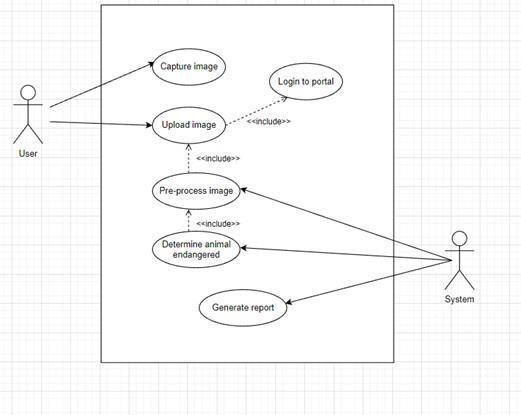
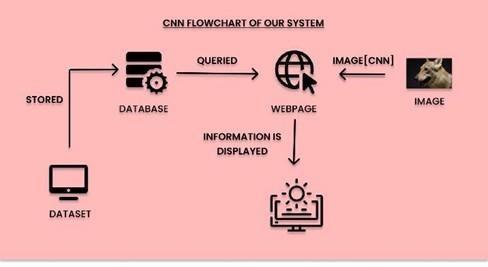
The main goal of this article is to create a system where we can predict the vulnerability of the Endangered species. We basically propose a model which can predict the future temperatures as well as give us the Animal countaccordingtothetemperature.Thesystemalsouses the CNN approach using which the pictures of the Endangered animals are recognized and information of thatanimaliswelldisplayed.
4.2 Proposed Model
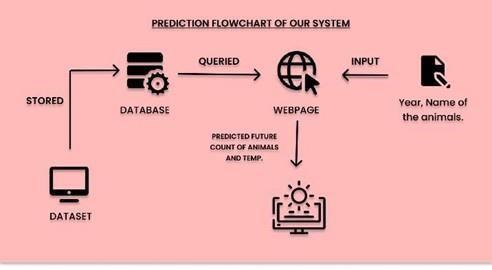
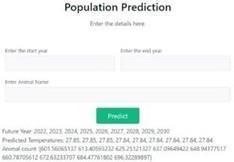
So, our system basically has an interface where you can get the Endangered animal information displayed for which the CNN model is used and it also has a functionality where using the starting year ,ending year andtheanimalnamethefuturecountofanimalaccording tothetemperaturecanbepredicted.
4.3 Interface ( web page)
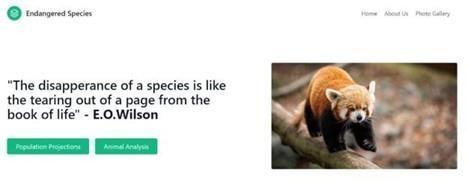
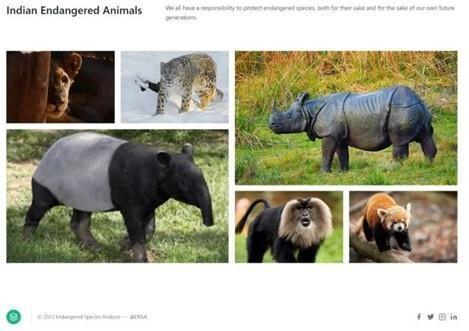
The user will first encounter the home page. On the home page, there will be a home , about us and a photo gallery section. We will have two buttons .One will be where you can gather information about the Endangered species in India. The second button will help you to gain moreinsightsontheendangeredanimalbymakingfuture predictions about the count of the animal in the coming yearsdependingonthefuturetemperature.
4.4 The CNN Approach
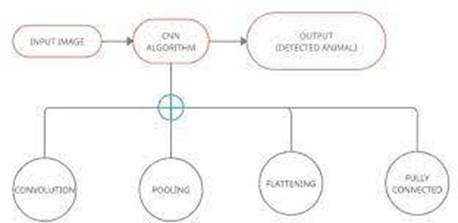
A convolutional neural network (CNN or convnet) is a subset of machine learning. It is one of the various types of artificial neural networks which are used for different applications and data types. A CNN is a kind of network architecture for deep learning algorithms and is specifically used for image recognition and tasks that involvetheprocessingofpixeldata.
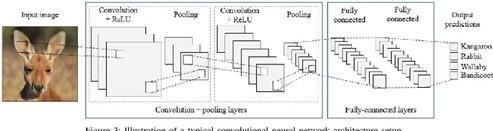
A deep learning CNN consists of three layers: a convolutional layer, a pooling layer and a fullyconnected (FC)layer.Theconvolutionallayeristhe firstlayerwhile theFClayeristhelast.
From the convolutional layer to the FC layer, the complexity of the CNN increases. It is this increasing complexity that allows the CNN to successively identify larger portions and more complex features ofan image untilitfinallyidentifiestheobjectinitsentirety.
Convolutional layer:
The majority of computations happen in theconvolutional layer,whichisthecore building block ofa CNN.Asecond convolutional layer can follow the initial convolutional layer.Theprocessofconvolutioninvolvesakernelorfilter inside this layer moving across the receptive fields of the image,checkingifafeatureispresentintheimage.
Overmultipleiterations,thekernelsweepsovertheentire image. After each iteration a dot product is calculated between the input pixels and the filter. Thefinal output from the series of dots is known as a feature map or convolved feature. Ultimately, the image is convertedinto numerical values in this layer,which allows the CNN to interprettheimageandextractrelevantpatternsfromit.
Pooling layer:
Liketheconvolutionallayer,thepoolinglayeralsosweeps a kernel or filter across the input image. But unlike the convolutionallayer,thepoolinglayerreducesthenumber of parameters in the input and also results in some information loss. On the positive side, this layer reduces complexityandimprovestheefficiencyoftheCNN.
Fullyconnected layer.
The FC layer is where image classification happens inthe CNN based on the features extracted in the previous layers. Here, fully connected means that all the inputs or nodes from one layer are connected to every activation unitornodeofthenextlayer.
AllthelayersintheCNNarenotfullyconnectedbecauseit would result in an unnecessarily dense network. It also wouldincreaselossesandaffectthe output quality, and it wouldbecomputationallyexpensive
How
our CNN works?
A CNN can have multiple layers, each of which learns to detect the different features of an input image. A filter or kernel is applied to each image to produceanoutputthatgetsprogressivelybetterandmore detailed after each layer. In the lower layers, the filters canstartassimplefeatures.
Ateachsuccessivelayer,thefiltersincreaseincomplexity tocheckandidentifyfeaturesthatuniquelyrepresentthe input object. Thus, the outputof each convolved image thepartiallyrecognizedimageaftereachlayer becomes the input for the next layer. In the last layer, which is an FC layer, the CNN recognizes the image or the object it represents
With convolution, the input image goes through a set of thesefilters.Aseachfilteractivates certainfeaturesfrom theimage,itdoesitsworkandpassesonitsoutputtothe filter in the next layer. Each layer learns to identify different features and the operations end up being repeated for dozens, hundreds or even thousands of layers.Finally,allthe imagedataprogressingthroughthe CNN'smultiple layersallowtheCNNtoidentifytheentire object.
In our system, when you input the picture of the Endangered animal it is able to recognize which animal it isanddisplaystheinformationrelatedtothatanimal.The information displayed may include the scientific name, Theirhabitatetc.
4.5 Animal Count Prediction:
The second feature that we are providing Endangered animalcountprediction.
Basically the idea lies in the fact that temperature change affects the habitat of the animal. As the habitats of the animals are affected the count of the animals gets in turn affected. Thus, our model will be able to show you the approximate Endangered animal count wrt. to the temperatureinthatrangeofyear.
Theinputsrequiredwillbe: Thestartingyear
·
· TheEndangeredanimalname
4.6 User Interface
User interface is needed to ensure that the user can interact with the system. User is done using languages like HTML, CSS and flask as a framework. Itwill be useful toprovideusersbetterinteractionwiththesystem.
5. ANALYSIS OF ALGORITHM
5.1 CNN Model
Aconvolutionalneuralnetwork(CNNorconvnet)isasubset of machine learning. It is one of the various types of artificial neural networks which are used for different applications and data types. A CNN is a kind of network architecturefordeeplearningalgorithmsandisspecifically used for image recognition and tasks that involve the processingofpixeldata.
5.2 Use Case Diagram
6. RESULT AND
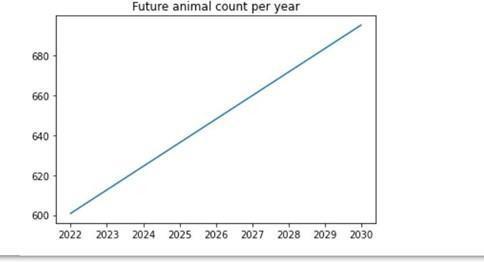
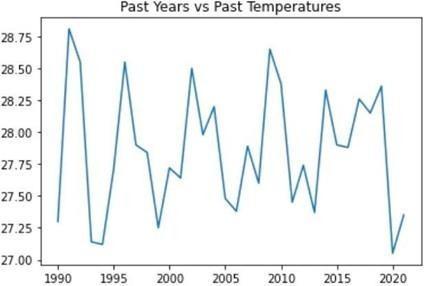
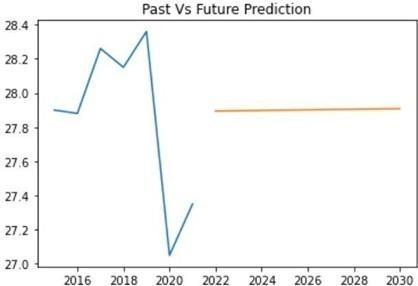
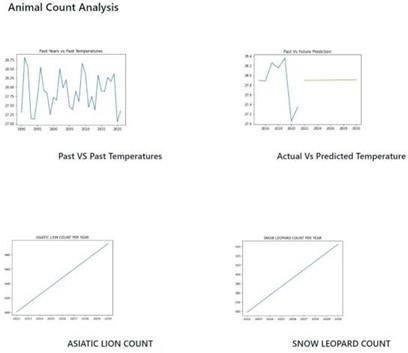
This is past and future prediction where the fluctuations in the temperatures are represented in the form of a graph. plottedin theformofagraph.



7. CONCLUSION
So our project basically predicts the future count of animals based on the future temperature and provides relevant information about the Endangered animals based on just their images. Our project is basically very useful for the environmentalistswhowishtosaveourendangeredanimals. By knowing how the animals might be affected by this temperaturechangeandwhat is theideal temperaturetobe maintained , thus they can tunnel their efforts in the right direction. This project also can be very useful to spread awarenessamongpeopleas theygettoknowa goodamount of information about the endangered animals and hence can alsobemotivatedtosavethem.
8. FUTURE SCOPE
So, our project is basically very useful for the environmentalistswhowishtosaveourendangeredanimals. By knowing how the animals might be affected by this temperaturechangeandwhatisthe ideal temperaturetobe maintained , thus they can tunnel their efforts in the right direction. This project also can be very useful to spread awarenessamongpeopleastheygettoknowagoodamount of information about the endangered animals and hencecan alsobemotivatedtosavethem.Infuture,alertscanbeissued ifthecount ofanimals is likely tohave asignificant decrease inthecomingyears.Insteadoftemperatureotherfactorslike precipitation, humidity etc can also be added which may impacttheanimal’ssurvival.
REFERENCES
[1] Pacifici, M., Foden, W. B., Visconti, P., Watson, J. E.M., Butchart, S. H. M., Kovacs, K. M., Rondinini, C.(2015).Assessingspeciesvulnerabilitytoclimatechange. NatureClimateChange.
[2]Tanishka Badhe, Bhagyashree Waghmare,Janhavi Borde, Prof. Anagha Chaudhari -Study of Deep Learning Algorithms to Identify and Detect Endangered Species of Animals-(January2022)
[3] Gabriel Spadon; Jose F Rodrigues; Wesley Nunes Gonçalves; Bruno Brandoli Machado- Recognition of Endangered Pantanal Animal Species using Deep Learning Method Dr.A.P.J Abdul Kalam Technical University,OnlineVotingSystem(2018IJCCN).
[4] John Alfred J. Casta˜neda,Angelo L. De Castro,Michael Aaron G,Hezerul Abdul KarimDevelopment of a Detection System for Endangered Mammals in Negros Island,Philippines Using YOLOv5n (June2022)
[5] Hung Nguyen, Sarah J. Maclagan, Tu Dinh Nguyen, Thin Nguyen, Paul Flemons, Kylie Andrews, Euan G. Ritchie, and Dinh Phung - Animal Recognition
and Identification with Deep Convolutional NeuralNetworks for Automated Wildlife Monitoring, DeakinUniversity,Geelong,Australia,2017.
[6] Sazida B. Islam, Damian Valles- Identification of Wild Species in Texas from Camera-trap Imagesusing Deep Neural Network for Conservation Monitoring,CCWC,2020
[7] RitwikDilipKulkarni,EnricoDiMinin-Automated retrieval of information on threatened species from onlinesourcesusingmachinelearning(March2021).
[8] Guillera-Arroita,et al. (2018) A decision support system with conservation planning with machine learningmodels.
© 2023, IRJET | Impact Factor value: 8.226 | ISO 9001:2008 Certified